The GTM engineer boom: Inside the fastest-growing job in B2B sales


The job market in the age of artificial intelligence is ever-changing, and new titles are popping up practically every day. One in particular has seen astronomical growth.
A GTM engineer was unheard of just five years ago, yet today it’s one of the most searched-for postings in business-to-business sales. LinkedIn postings for GTM engineer roles show thousands of open spots. Straddling the responsibilities of a sales rep, revenue operations analyst, and systems engineer, this job requires someone who can wear many hats, but perhaps that’s what’s so enticing.
Its rise is indicative of another trend. The increase in AI technology doesn’t necessarily eliminate humans; it helps create additional technical roles. Apollo examined data from LinkedIn, Bloomberry, and general job data to outline what this job entails and why it’s growing at an unprecedented rate.
A hiring signal, with caveats
The sudden explosion of go-to-market engineering roles can seem jarring, but only because the role didn’t exist a couple of years ago. Thousands of postings nationally certainly indicate meaningful demand, but it’s not enough to make it a common household job.
Since the role is so new, there isn’t a widely accepted definition for postings. Each organization takes its own approach to role responsibilities. Therefore, the growth curve should be taken as indicative of a direction rather than a precise measurement.
Definition: A revenue-system builder
Look at recent job postings for GTM engineer roles from leading firms like Blackboard, LeanData, Leap Group, and Uncapped, and you may come away with more questions than answers. When you strip away company-specific language, a GTM engineer is hired to design and build systems that move a prospect from a random lead to a qualified conversation. They build the system that leads scoring, routing rules, and automations that keep an entire tech stack together.
GTM engineers are builders. Traditional sales or marketing operations maintain what already exists, but a GTM engineer is expected to design something new to enhance operations. It could be a new workflow, a new data pipeline, or just a new way of qualifying prospects.
Daily work: From signal to action
With mandates that can differ from company to company, defining what daily work looks like for a GTM engineer is a challenge. Generally speaking, though, the day-to-day work centers on one single loop: Grab a signal, add some context, score it, and then trigger the right outbound or internal action. A GTM engineer’s role is to build the loop itself.
The RevOps overlap
RevOps is one of the roles that most often gets mixed up with GTM engineering. The responsibilities are similar, but the actual skill and technology emphasis differ. A Bloomberry analysis compared over 1,000 GTM engineering jobs against RevOps roles:
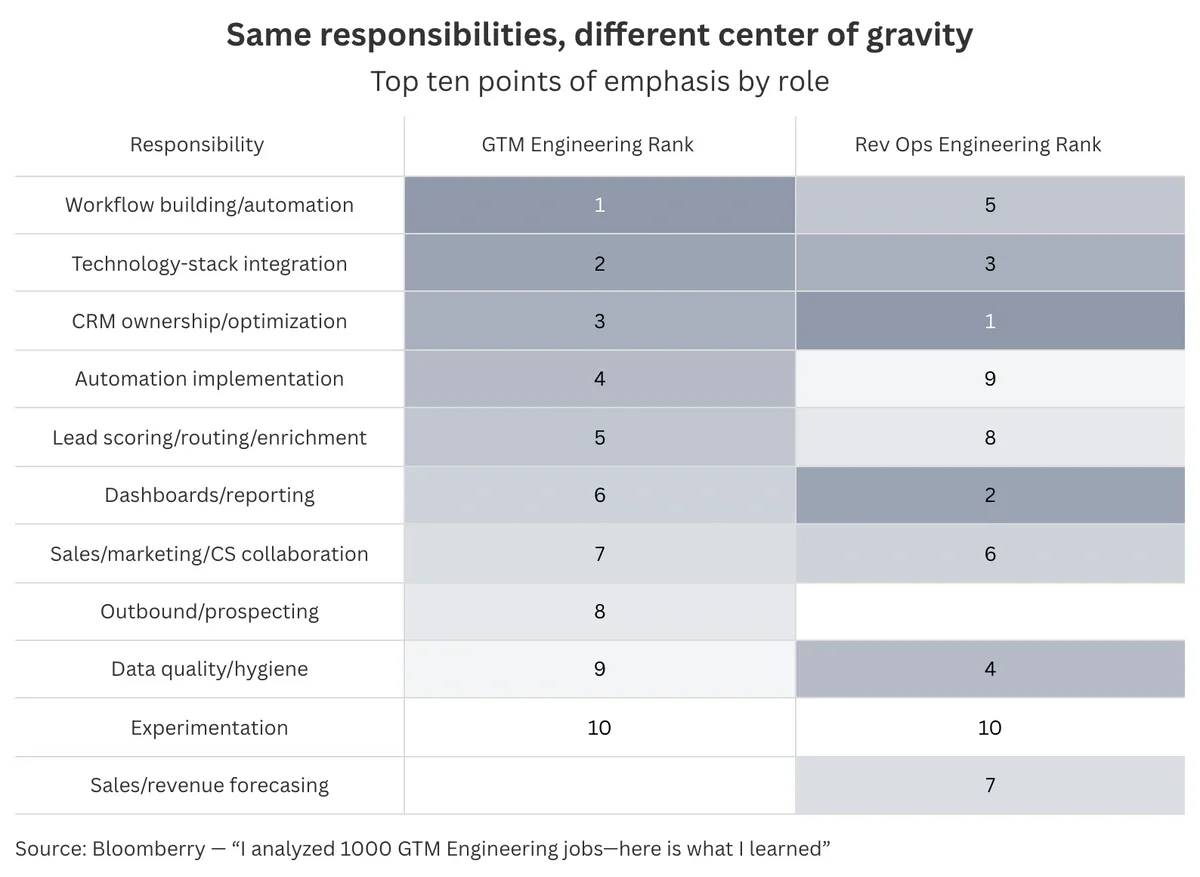
Nine of the 10 most common responsibilities in a GTM engineering role also show up in a RevOps posting. The main difference comes in their ranking emphasis.
GTM engineer roles typically lead with workflow building and automation, whereas RevOps roles have CRM ownership at the top. RevOps roles are also more likely to list sales and revenue forecasting as named responsibilities, while GTM engineering positions focus more on outbound and prospecting duties. The jobs are certainly within the same family, but they have different centers of gravity.
Why AI led to the creation of the role
The sudden rise in GTM engineering roles isn’t a coincidence. Postings really took off around 2023, roughly the same time general-purpose AI assistants and workflow-automation tooling grew rapidly enough that a single person could do the work of a larger team.
Apollo’s own 2026 AI in Sales & Go-to-Market survey noted that AI adoption on revenue teams had reached 97%, but only 17% of those teams described their AI setup as fully operational. That gap between adopting AI and running it well is where a GTM engineer comes in.
Compensation: The technical premium
The tasks of a GTM engineer are complex and often have large organizational impacts. Their pay reflects that. Based on U.S. Bureau of Labor Statistics data, individuals in this profession earn a median pay of nearly $125,000. Compensation aggregators, like GTME Pulse, note that senior individuals with over five years of experience can make in the range of $200,000-$250,000 on average, meaning the career ladder offers serious growth.
The human builds the machinery
The role of a GTM engineer isn’t to sign off on what AI produces. It’s to design the system that qualifies and routes thousands of prospects instantaneously, and then monitor and troubleshoot it on an ongoing basis. The title may change, but the underlying job will likely continue to appear in job postings, compensation data, and AI integration into companies for the foreseeable future.
Share this post
Start using Apollo today
Start your free trial with Apollo today—then use these resources to guide you through every step of the process.

Start using Apollo today
Start your free trial with Apollo today—then use these resources to guide you through every step of the process.
or
By signing up, I agree to Apollo's Terms of Service and Privacy Policy.
Continue Learning
Explore these handpicked resources to deepen your understanding of AI-powered GTM
9 Sales Tasks AI Agents Now Handle, and 4 Humans Still Own
AI agents are cutting prospect research time by 34% and email drafting by 36%. See the 9 sales tasks shifting to AI in 2026, and the 4 that stay human.
The Toggle Tax: What 1,200 Daily App Switches Are Quietly Costing Sales Teams
Sales reps spend only 40% of their week actually selling. See what the toggle tax costs the other 60%, and how to close the gap.
Agentic GTM, Explained: What Changes When Sales Agents Run the Workflow
83% of AI-using sales teams report revenue growth (Salesforce). See what separates autonomous sales agents from AI features, and what changes by 2028.