What's an AI SDR and How Does It Differ from a Traditional Sales Development Representative?
An AI SDR is software that autonomously executes the prospecting, outreach, and meeting-booking workflows traditionally performed by a human Sales Development Representative. Rather than assisting a rep, an AI SDR operates end-to-end with minimal human intervention. As the category matures in 2026, platforms like Apollo's AI Sales Assistant now handle everything from account research and list building to multi-channel sequence execution and follow-up, using plain-language instructions from the rep.
The difference is not just automation. It is a fundamental shift in where work happens and who decides next-best action. Gartner projects 40% of enterprise applications will include task-specific AI agents by end of 2026, up from under 5% in 2025, making AI SDR capabilities a mainstream expectation rather than a competitive edge.

Research Less, Close More With Apollo
Tired of burning hours on manual lead research instead of selling? Apollo surfaces verified contacts instantly so your team spends time closing, not digging. Nearly 100K paying customers already made the switch.
Start Free with Apollo →Key Takeaways
- AI SDRs handle prospecting, outreach, follow-up, and meeting scheduling with minimal human intervention, unlike traditional SDRs who do each step manually.
- The real difference is autonomy: AI SDRs decide next-best actions; traditional SDRs require human judgment at every step.
- The SDR role is unbundling, not disappearing. Humans focus on ICP strategy, objection handling, and high-context conversations while AI handles volume and workflow execution.
- Signal quality determines AI SDR performance. The differentiator is real-time intent data and enrichment, not just email generation.
- Governance and human-in-the-loop controls are now required, not optional, as agents take actions rather than draft suggestions.
What Is an AI SDR and What Does It Actually Do?
An AI SDR is an autonomous software agent that handles the full top-of-funnel sales workflow without a human executing each step. According to Salesforce, these intelligent systems handle tasks such as prospecting, lead qualification, personalized outreach across multiple channels, follow-up sequences, and meeting scheduling with minimal human intervention.
This is distinct from a writing assistant or a sequence template tool.
An AI SDR researches accounts, determines which prospects match your ICP, generates personalized messages grounded in real signals (funding rounds, job changes, tech stack), executes multi-touch sequences, and hands off only qualified, intent-showing leads to AEs.
Struggling to scale prospecting without adding headcount? See how Apollo's AI sales automation executes your outbound workflows end-to-end.
How Does an AI SDR Differ from a Traditional SDR?
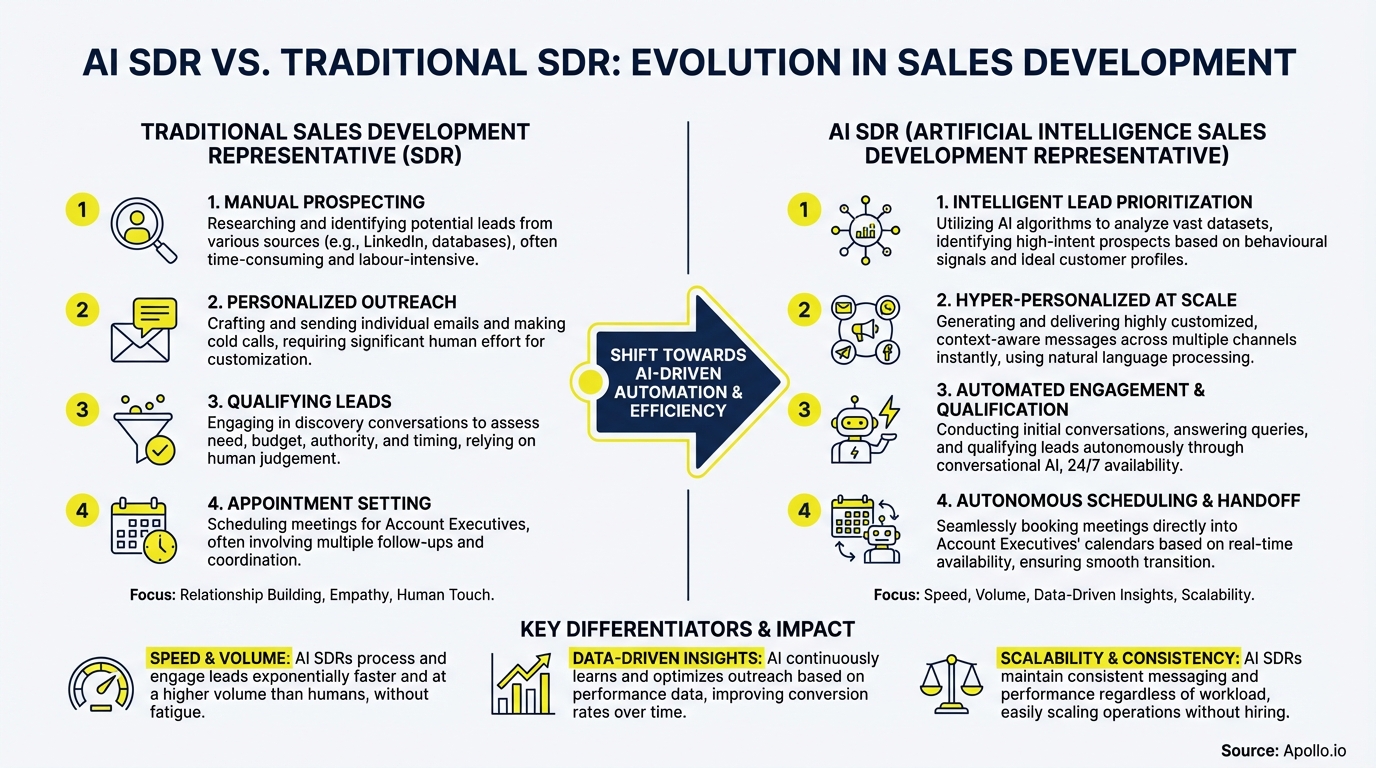
The core difference is autonomy and throughput. A traditional sales development motion requires a human to research each account, write each message, log each activity, and decide each next step. An AI SDR executes that entire chain based on rules, signals, and ICP criteria you define once.
| Dimension | Traditional SDR | AI SDR |
|---|---|---|
| Prospecting | Manual list building, CRM searches | Automated ICP matching from signal triggers |
| Outreach volume | Limited by working hours | Scales continuously without fatigue |
| Personalization | Research-dependent, inconsistent | Signal-grounded, consistent at scale |
| Follow-up | Manually tracked and triggered | Automated based on engagement data |
| Handoff to AE | Rep judgment on readiness | Intent-based escalation rules |
| Objection handling | Real-time, nuanced | Limited to scripted or templated responses |
| Relationship depth | High-context, adaptive | Low-context for complex or strategic accounts |
As Verse.ai notes, AI SDRs excel at high-volume, repetitive, and data-driven tasks, freeing human SDRs to focus on more complex, relationship-building, and strategic aspects of sales. This is the unbundling happening across B2B GTM teams in 2026.

How Do SDRs and BDRs Benefit from AI SDR Tools?
SDRs and BDRs benefit most when AI handles research and first-touch volume so they can focus on conversations that require human judgment. The biggest time sink for traditional SDRs has been communication work: Gong's State of Sales Engagement research found reps spent an average of 12.1 hours per week writing emails in 2024, a burden AI SDR tooling directly eliminates.
For SDRs using Apollo, the Outbound Copilot automatically finds ICP-matching prospects, adds them to sequences, and sets cadence, all without manual clicks. Erik Fernando Nieto, BDR at JumpCloud, puts it directly: "Apollo's AI Assistant filters and cleans prospect data for me, so I can find the right people faster and run better searches. It saves me about an hour per prospecting session."
RevOps leaders also benefit. AI SDR workflows create consistent, auditable outbound activity that feeds clean pipeline data into CRM, reducing the signal noise that makes sales analytics unreliable when reps log inconsistently.
Turn Weak Funnels Into Pipeline Gold
Tired of watching marketing leads stall before they ever reach your pipeline? Apollo surfaces verified, in-market buyers so your team qualifies faster and forecasts with confidence. Nearly 100K paying customers stopped guessing and started closing.
Schedule a Demo →What Is the AI SDR Maturity Model?
AI SDR adoption follows a three-stage maturity progression: assistive, co-pilot, and agentic. Understanding which stage your team occupies determines which capabilities to activate and what governance to put in place.
- Stage 1 — Assistive: AI drafts emails and suggests prospects. Reps approve every action. Best for teams new to AI tooling. Low risk, limited throughput gain.
- Stage 2 — Co-pilot: AI builds sequences, enriches contacts, and executes follow-up. Reps review outputs in batch and set guardrails. Significant throughput improvement with moderate oversight.
- Stage 3 — Agentic: AI researches accounts, selects prospects, runs multi-channel sequences, and escalates only intent-showing leads to AEs. Human oversight is exception-based, not step-by-step. This is where Microsoft's Dynamics 365 Sales Qualification Agent and similar tools now operate.
Most B2B GTM teams in 2026 are at Stage 2, moving toward Stage 3. The transition requires defined ICP criteria, clean enrichment data, and explicit escalation rules before removing human approval from the loop. Learn how sales automation can be implemented responsibly at each stage.
Why Does Signal Quality Determine AI SDR Performance?
An AI SDR's output is only as relevant as the signals it acts on. Generic LLM-generated outreach fails because it is not grounded in real account context. The differentiator in 2026 is buying-signal infrastructure: funding rounds, hiring patterns, tech-stack changes, and intent data that indicate when a prospect is actually in-market.
Apollo's AI Research combines Apollo's 230M+ contact database with real-time web intelligence to surface account-specific signals before outreach.
The AI Content Center then grounds every message in your value proposition, ICP pain points, and product differentiators, not generic templates.
This is why Apollo users leveraging AI-powered messaging saw a 35% increase in bookings in a published Anthropic case study.
Spending hours researching accounts before every outreach? Search Apollo's 230M+ contacts with 65+ filters and let AI Research do the account work for you.
What Governance Do AI SDRs Require?
As AI SDRs move from drafting text to taking actions, governance becomes a real operational requirement. Teams must define approval thresholds, audit trails, and escalation rules before deploying agentic workflows at scale. Martal.ca confirms that even the most capable AI SDR systems handling prospecting, lead qualification, personalized outreach, follow-up sequences, and meeting scheduling require a human governance layer to maintain quality and brand safety.
Practical governance checklist for AI SDR deployment:
- Define ICP criteria and disqualification rules in writing before activating automation
- Set maximum send volume per day with deliverability buffers
- Require human approval for outreach to named accounts or executive contacts
- Build escalation triggers: any reply, any negative sentiment, any legal or competitive mention routes to a human
- Audit sequence performance weekly against qualified meetings booked, not emails sent
- Review AI-generated messaging quarterly against brand and compliance standards
For enterprise GTM teams, Apollo's Organization tier includes advanced routing, admin controls, and workflow governance that support agentic deployment with appropriate oversight. Learn more in the Apollo AI Overview.

How Do You Get Started with an AI SDR Workflow in 2026?
Getting started with an AI SDR workflow requires four inputs: a defined ICP, clean enrichment data, grounded messaging context, and a human escalation path. Teams that skip any of these inputs generate high volume with low relevance, which accelerates pipeline decay rather than growth.
Apollo's AI Sales Assistant is built to support the full workflow from a single interface. Matt Tumbiolo, Enterprise BDR at Smartling, describes the practical outcome: "Apollo's AI Assistant makes building targeted prospecting lists effortless. I can give it very specific prompts, and it stays within those parameters to deliver accurate, high-quality results."
Start with the AI Assistant to sell smarter, configure the AI Content Center with your value proposition and ICP pain points, activate the Outbound Copilot for automated prospect enrollment, and set AI-powered scores to prioritize which accounts get human attention first. This consolidates what traditionally required separate prospecting, enrichment, engagement, and analytics tools into one workspace. As Cyera noted after adopting Apollo, "Having everything in one system was a game changer."
The AI SDR debate in 2026 is settled on one point: teams that combine human strategy with AI execution outperform those running either in isolation. Schedule a Demo to see how Apollo's end-to-end GTM platform helps your SDRs, BDRs, and revenue leaders run an AI-augmented outbound motion that converts.
Prove Pipeline ROI With Apollo
ROI pressure killing your tool budget? Apollo delivers measurable pipeline impact so you can walk into any budget review with confidence. Leadium 3x'd their annual revenue — your numbers could be next.
Start Free with Apollo →Don't miss these
Sales
Inbound vs Outbound Marketing: Which Strategy Wins?
Sales
What Is a Sales Funnel? The Non-Linear Revenue Framework for 2026
Sales
What Is a Go-to-Market Strategy? The 2026 GTM Playbook
See Apollo in action
We'd love to show how Apollo can help you sell better.
By submitting this form, you will receive information, tips, and promotions from Apollo. To learn more, see our Privacy Statement.
4.7/5 based on 9,690 reviews
