
Most SaaS deals are decided before a demo ever gets booked. By the time a CTO fills out a form, they've usually already picked a frontrunner.
That means lead generation for SaaS companies isn't really about catching buyers at the bottom of the funnel anymore. It's about showing up with relevance long before they raise their hand, and having the right list ready when they do.
This guide shows you who to target, how to reach CTOs and CIOs specifically, how to build technographic lists, and how to run the entire motion with Apollo's B2B lead generation tools.

Apollo Ends Manual Contact Hunting For Good
Still burning hours manually researching accounts and piecing together contact details before every outreach? Apollo builds verified prospect lists instantly from 240M+ contacts at 98% accuracy. Reps spend less time digging, more time selling.
Start Free with Apollo →Key Takeaways
- SaaS buyers often pick a preferred vendor before they talk to sales, so your content and lists need to work pre-shortlist, not just at demo request.
- Build your first target list around CTOs and CIOs, with VP-level buyers as secondary contacts on the buying committee.
- Technographic filters let you find accounts already running a competitor's stack, which is one of the strongest signals in SaaS selling.
- Inbound trial signups need instant routing to the right AE, not a manual queue that cools the lead down.
- A connected data, intelligence, and execution workflow beats stitching together five separate point tools.
Who Should SaaS Companies Target For Lead Generation?
SaaS companies should build their core list around CTOs, CIOs, and VP-level buyers at SaaS, fintech, and mid-market companies. These are the people who own the technical evaluation and who sit closest to the budget for tools like yours.
Our data shows SaaS sellers search for CTOs more than any other technical title, with CIOs close behind, and lean on technographic filters to find accounts already running a competitor's stack. That's worth acting on directly: if you know who your competitor's customers are, you already know who's most likely to switch.
Across IT services and software more broadly, owners, CEOs, and founders get searched for more than any technical title, with CTOs and CIOs close behind, which tells you the economic buyer often gets the first touch instead of IT. For a SaaS company selling into mid-market or enterprise accounts, that means your list shouldn't be CTO-only.
It should pair the technical buyer with an economic buyer on the same account.
Build this list first: CTOs and CIOs at companies on a named competitor's tech stack, paired with a VP or director in the department that owns the budget, filtered to your ICP company size and industry. Apollo's B2B database covers 240M+ people and 30M+ companies with 65+ filters, so you can build that exact list in minutes instead of guessing from a spreadsheet.
How Do SaaS Companies Sell To CTOs?
Selling to CTOs starts with showing you understand their stack, not just their title. CTOs evaluate tools on technical fit, integration effort, and security posture before they ever care about your pricing page.
Skip generic outreach. Lead with something specific: a technical integration point, a migration path off their current tool, or a security/compliance detail that matters to engineering leaders.
Here's a simple sequence that works for CTO outreach:
| Step | Channel | Message Angle |
|---|---|---|
| 1 | Reference their current tech stack and a specific integration or migration point | |
| 2 | Social touch | Share a technical resource (architecture doc, API reference, benchmark) relevant to their stack |
| 3 | Call | Short, direct ask for a technical scoping conversation, not a sales demo |
| 4 | Loop in the economic buyer (VP/director) with a business case angle |
CTOs also want proof that other technical teams trust the product. Keep a short list of technical case studies and integration guides ready to send the moment a CTO replies, since that's often the deciding factor in whether they stay engaged.
How Do SaaS Companies Build Technographic Lists?
Technographic lists are lists of companies filtered by the specific software or tools they currently run. For SaaS sellers, this is one of the highest-signal ways to prioritize outreach, because a company already paying for a competing tool has already proven budget and intent in your category.
Here's how to build one:
1. Identify two or three competitor tools (or adjacent tools) that signal your ICP uses software like yours.
2. Filter Apollo's database by technology used, then layer on company size, industry, and location to match your ICP.
3. Pull the CTO and the relevant department head from each matched account, since the department head is often the day-to-day user and internal champion.
4. Add a "currently on [competitor]" variable to your messaging so outreach feels specific instead of generic.
5. Route the highest-fit accounts (smaller team, clear budget signal, recent hiring in the relevant department) to a priority sequence first.
This is also where Apollo's intelligence layer helps, since it scores accounts by fit and signal strength so your team works the list in the right order instead of top to bottom alphabetically.

How Can SaaS Companies Generate Leads Without A Big Budget?
Not every SaaS company has a demand gen budget on day one. These channels build pipeline without heavy ad spend.
Partner and integration marketing: Co-market with platforms you integrate with. Their customers are often already in your ICP, and a joint webinar or listing in their app marketplace costs nothing but time.
Communities and forums: Technical buyers research in developer communities, Slack groups, and forums before they ever talk to sales. Answer real questions there instead of pitching, and let your expertise do the selling.
Content built for the technical evaluation stage: Comparison pages, integration guides, and security/compliance docs get read by CTOs doing due diligence, often before they show up in your CRM at all.
Research from professional networks found that SaaS buyers are more influenced by personalization and relevance to their industry than by generic product promotion, which is exactly why vertical-specific content outperforms broad messaging for technical buyers.
Customer referrals and case studies: Ask happy customers for warm intros to similar companies. A CTO trusts a peer's recommendation more than any ad.
Pick one channel this week and commit to it for a full quarter before judging results.
How Do SaaS Companies Earn Trust And Shorten The Sales Cycle?
Reach Prospects Before They Go Cold
Still guessing which leads are actually ready to buy? Apollo flags in-market prospects with real intent signals, so reps stop chasing dead ends. Built-In saw a 10% win rate lift using Apollo's scoring.
Start Free with Apollo →Technical buyers expect proof before they'll take a meeting. That proof usually means a security overview, an architecture diagram, a sandbox or trial environment, and references from similar-sized companies.
Common objections at this stage include integration complexity, data migration risk, and procurement/security review timelines. Address all three upfront in your outreach and on your site, rather than waiting for a prospect to ask.
Watch for timing triggers that signal a buying window is opening:
| Trigger | What To Do |
|---|---|
| New VP Engineering or CTO hire | Reach out within the first 90 days, when new leaders are reevaluating tools |
| Recent funding round | Prioritize these accounts for outreach since new budget often follows |
| Headcount growth in engineering or RevOps | Flag as a signal the team is scaling past their current tools |
| Contract renewal window with a competitor | Time outreach 60-90 days before their likely renewal date |
A clear ROI case matters more than ever in this stage of the cycle. Have a simple cost/time comparison ready before the first call, not after the prospect asks for one.
How Does Apollo Help SaaS Companies Generate Leads?
If you're a B2B SaaS company, you're likely dealing with three specific problems: finding accounts on a competitor's stack, getting the CTO and the economic buyer in the same sequence, and routing inbound trial signups before they go cold. Apollo solves all three from one workspace.
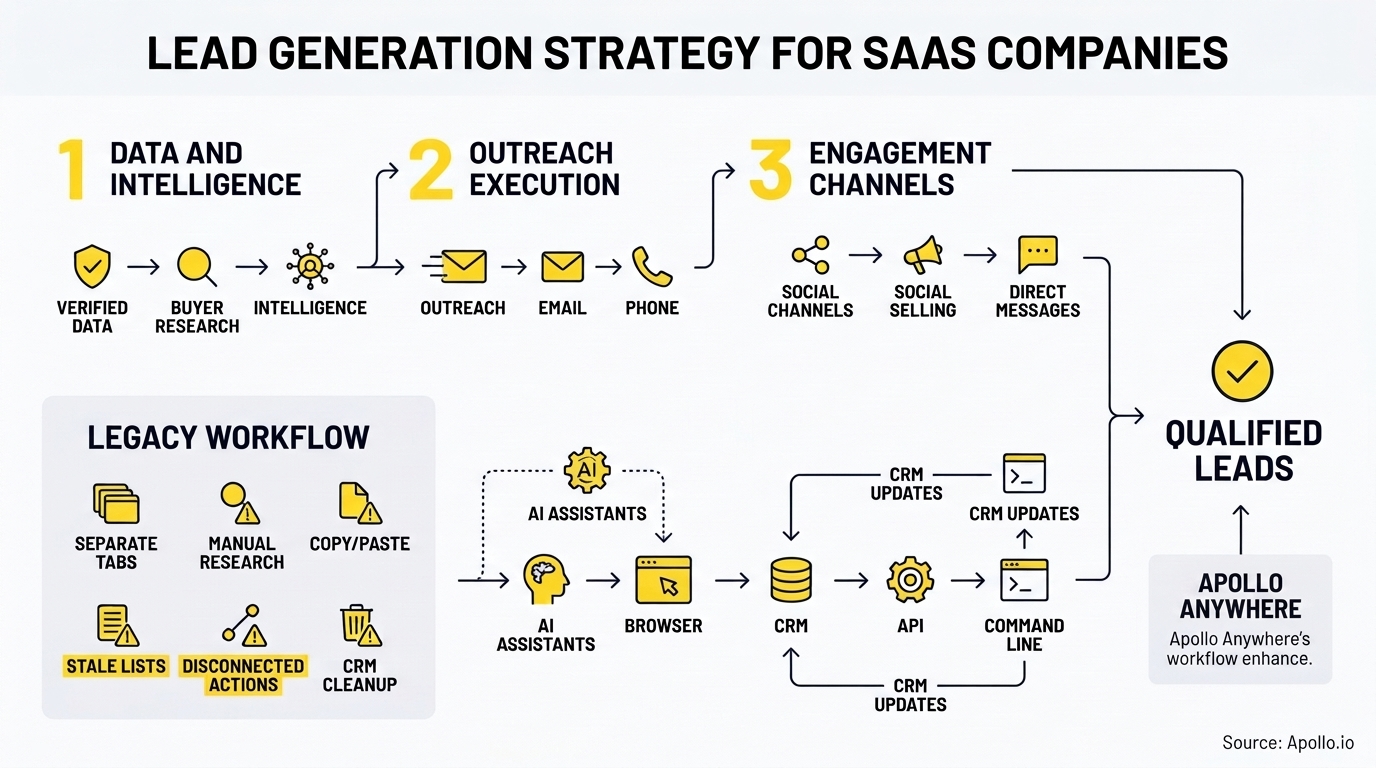
Here's the prototypical workflow. A SaaS team starts by filtering Apollo's database for companies running a named competitor's technology, then pulls both the CTO and the relevant department head into a single list.
From there, Apollo's intelligence layer scores those accounts by fit, so reps know which to work first.
The team builds and launches a multi-step sequence across email, phone, and social using Apollo's sales engagement tools, with messaging that references the account's current stack. Reps can do this research step right inside their browser with Apollo's Chrome extension, pulling verified contact details while reading a prospect's site or reviewing a corporate-style profile, without switching tabs.
On the inbound side, trial signups get automatically routed to the right AE using Apollo's Inbound capabilities, so a CTO who signs up for a trial at 9pm doesn't wait three days for a follow-up. And because Apollo meets teams where they already work, a rep can also pull account research or build a list from inside Apollo MCP, Apollo's Model Context Protocol, directly in ChatGPT or Claude, instead of opening another tab. Spending hours stitching together a prospecting tool, a sequencing tool, and a separate enrichment tool? Search Apollo's database with 65+ filters and build your first technographic list free.
Throughout the process, Apollo Profile keeps one unified record per contact and company, so CRM data stays current without manual cleanup. Collin Stewart of Census put it simply: "We cut our costs in half."
How Do You Sell To Executives At SaaS Companies?
If you're selling into the SaaS industry itself rather than running SaaS lead gen for your own company, your targets are the same CTOs, CIOs, and VP-level buyers covered above. Use Apollo's industry filter to narrow to "Software" or "SaaS," layer on company size for mid-market or enterprise, and filter by seniority to pull decision-makers instead of individual contributors.
Add a technographic filter for the specific tools your product integrates with or replaces, since that narrows your list to accounts with a clear reason to care. Tired of manually qualifying every signup before handing it to sales? Build a qualified pipeline view inside Apollo instead of managing it in a spreadsheet.

Frequently Asked Questions
How Do SaaS Companies Qualify Leads Before Passing Them To Sales?
Score leads on fit (title, company size, industry, tech stack) and intent (trial activity, content engagement, pricing page visits) before routing to an AE. Set a minimum threshold on both so reps spend time on accounts that are ready, not just ones that filled out a form.
How Should SaaS Companies Measure Lead Generation ROI?
Track pipeline generated and closed-won revenue per channel, not just cost per lead or form fills. Tie every lead back to its source in your CRM so you can see which channels produce real opportunities, not just volume.
How Do SaaS Buying Committees Affect Lead Generation?
Buying committees at mid-market and enterprise SaaS companies typically include a technical evaluator (CTO/CIO), an economic buyer (VP/director), and often an end-user champion. Build your list and content to reach all three, not just the first person who filled out a form.
Can SaaS Companies Generate Leads Without A Sales Team?
Yes, through self-service trials, in-product upgrade prompts, and content that lets technical buyers self-qualify before talking to anyone. Route high-intent self-service signups to a rep only once they show clear buying signals, like inviting teammates or hitting usage limits.
SaaS lead generation now runs on relevance before the demo, not persuasion during it. The teams that win build the right list early, reach CTOs and economic buyers together, and keep every inbound signal moving instead of sitting in a queue. Start a Trial with Apollo and build your first technographic list today.
Prove Pipeline Impact Before Leadership Asks
Stuck justifying spend before you even finish the trial? Apollo shows measurable pipeline lift fast, so budget approval stops being a guessing game. Leadium grew revenue 3x after automating outreach with Apollo.
Start Your Free Trial →Don't miss these
Sales
Inbound vs Outbound Marketing: Which Strategy Wins?
Sales
What Is a Sales Funnel? The Non-Linear Revenue Framework for 2026
Sales
What Is a Go-to-Market Strategy? The 2026 GTM Playbook
See Apollo in action
We'd love to show how Apollo can help you sell better.
By submitting this form, you will receive information, tips, and promotions from Apollo. To learn more, see our Privacy Statement.
4.7/5 based on 9,690 reviews
