
How Sales Intelligence Platforms Collect and Verify Contact Data
Your reps are bouncing emails, dialing dead numbers, and wasting hours on contacts that left their jobs months ago. The root cause is almost always the same: stale, unverified contact data. Understanding how sales intelligence platforms collect and verify contact data helps GTM teams make smarter buying decisions and stop paying for data they can't use.

Build Pipeline With Verified Data
Tired of burning hours on manual research only to hit dead ends? Apollo surfaces accurate contacts instantly so your team spends time selling, not searching. Join 600K+ companies building predictable pipeline.
Start Free with Apollo →Key Takeaways
- Sales intelligence platforms pull contact data from dozens of sources simultaneously, then normalize and deduplicate records before surfacing them to users.
- Verification is a lifecycle, not a one-time check: collection, normalization, identity resolution, anomaly detection, and re-verification triggers all play a role.
- CRM data quality is a significant and costly problem for most B2B organizations, making continuous verification essential rather than optional.
- Multi-source "waterfall" verification is replacing single-database lookups as the standard for high-accuracy contact records in 2026.
- SDRs, RevOps leaders, and AEs all benefit differently from verified data: fewer bounces, cleaner routing, and better pre-call intelligence.
How Do Sales Intelligence Platforms Collect Contact Data?
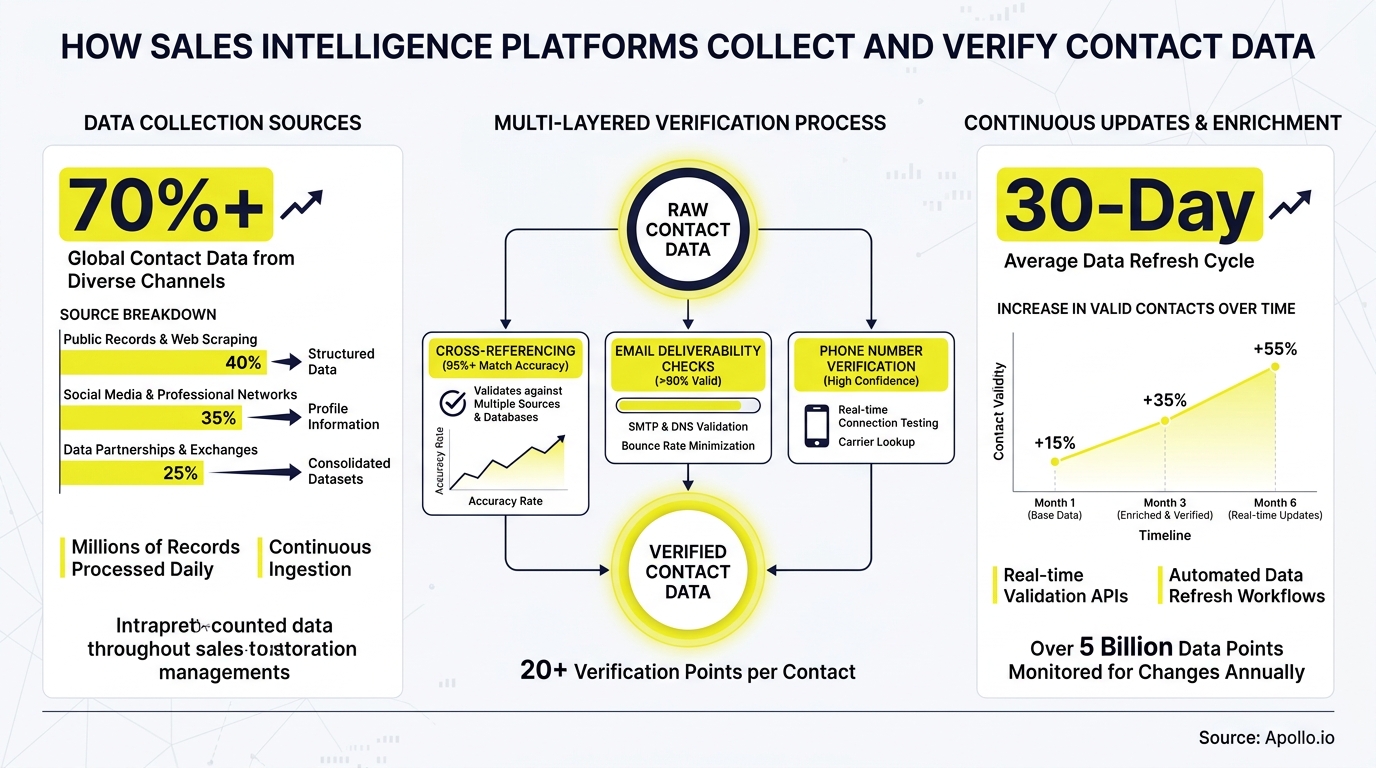
Sales intelligence platforms aggregate business contact information from a wide range of external sources simultaneously. According to MarketsandMarkets, platforms gather data from CRM systems, social media, market reports, company websites, news feeds, public filings, and other industry databases. No single source provides complete coverage, which is why multi-source aggregation is the foundation of every major platform.
Common collection channels include:
- Public web and business directories: Company websites, press releases, and professional profile pages
- Public filings and regulatory databases: SEC filings, company registrations, and government records
- First-party signals: User-contributed updates, partner integrations, and opt-in data sharing
- Browser extensions: Capturing business contact details as users browse professional profiles across the web
- Intent data signals: Behavioral data indicating active research or buying interest (learn more about how intent data is collected)
What Is the Contact Data Verification Lifecycle?
Verification is a multi-stage lifecycle, not a single check at the point of collection. The five core stages are:
| Stage | What Happens | Why It Matters |
|---|---|---|
| 1. Normalization | Standardize formats (phone, email, job title syntax) | Enables consistent matching and deduplication |
| 2. Identity Resolution | Match records across sources to a single canonical profile | Eliminates duplicates and conflicting data points |
| 3. Email Verification | Syntax checks, domain validation, mailbox ping tests | Reduces bounce rates and protects sender reputation |
| 4. Phone Validation | Line-type checks, carrier lookup, DNC screening | Confirms dialability and channel appropriateness |
| 5. Re-Verification Triggers | Job-change detection, periodic refresh, anomaly flagging | Keeps records current as people change roles or companies |
Data from Landbase shows approximately 70% of CRM data is outdated, incomplete, or inaccurate. That figure explains why platforms that rely on periodic batch refreshes consistently underperform those with continuous re-verification architectures.
Struggling with stale records slowing your pipeline? Enrich your CRM with Apollo's 230M+ verified business contacts and stop chasing contacts who moved on months ago.

How Do Platforms Use AI to Verify Data at Scale?
AI-powered verification has become the industry standard for handling the volume and velocity of B2B contact changes. Leading platforms combine machine learning models with selective human review to flag anomalies that automated checks miss. As noted by SuperAGI, some vendors use a triple-verification process combining human research, artificial intelligence, and crowdsourced updates to maintain data accuracy.
Key AI-driven verification methods include:
- Anomaly detection: Flagging records where job title, company, or email pattern deviates from expected norms
- Job-change signals: Monitoring professional profile updates to trigger re-verification when a contact moves roles
- Multi-source triangulation: Cross-referencing the same contact across multiple data providers and returning the most recently confirmed datapoint
- Waterfall enrichment: Querying a ranked sequence of sources until a verified result is found, rather than relying on a single database
This shift toward continuous enrichment strategies reflects the reality that no single source stays current across all industries and geographies.
Turn Funnel Guesswork Into Closed Deals
Tired of watching quality leads stall before they ever reach your pipeline? Apollo surfaces in-market buyers with precision targeting so your team stops chasing dead ends. Over 600K companies forecast with confidence.
Start Free with Apollo →How Do SDRs and RevOps Teams Benefit from Verified Contact Data?
SDRs benefit most directly: verified emails mean fewer bounces, verified phone numbers mean fewer dead calls, and job-change alerts mean outreach reaches the right person at the right company. For RevOps leaders, verified data means cleaner routing logic, more accurate attribution, and CRM records that don't require constant manual cleanup.
The productivity case is clear. When contact records are unreliable, reps spend time on research and remediation instead of selling. Building a reliable contact data enrichment workflow directly reclaims selling capacity across the team.
For Account Executives managing active deals, verified firmographic data (accurate headcount, funding status, tech stack) sharpens pre-call preparation and reduces time lost on misqualified opportunities. Apollo's sales intelligence and lead database surfaces all of this in one workspace, so AEs aren't toggling between tools to piece together account context.
What Should GTM Teams Look for When Evaluating Data Quality?
Not all verification claims are equal. Use these criteria when assessing a platform's data quality approach:
- Verification methodology transparency: Does the vendor document what types of verification occur (email ping, phone line-type check, human review)?
- Refresh frequency: How often are records re-checked? Job changes happen continuously, not quarterly.
- Waterfall vs. single-source: Multi-source waterfall enrichment consistently outperforms single-database lookups for coverage and recency.
- Verification provenance in the UI: Can RevOps teams see what kind of verification occurred on each record and when?
- Email accuracy benchmarks: Ask for documented deliverability rates. Apollo maintains 97% email accuracy across its 230M+ person database.
- DNC and compliance screening: Verification increasingly includes channel-appropriateness checks, not just data correctness.
Understanding the difference between data enrichment and data cleansing also helps teams decide which workflow gaps to prioritize first.
Need verified contacts without the guesswork? Search Apollo's database with 65+ filters and find decision-makers whose details have been continuously verified.
Why Is Continuous Verification the 2026 Standard?
Point-in-time verification is no longer sufficient. B2B contacts change roles, companies, and email addresses at a pace that makes any static database obsolete within months. The market reflects this urgency: according to Fortune Business Insights, the sales intelligence market is estimated at USD 4.85 billion in 2025 and expected to reach USD 5.37 billion in 2026, with sustained growth driven by demand for higher data quality and real-time verification capabilities.
In 2026, leading platforms are moving toward always-on verification architectures: automated re-enrichment triggered by job-change signals, CRM sync events, or time-based schedules. This replaces the old model of buying a list, importing it once, and hoping it holds for a quarter. For teams building scalable outbound, data sync workflows that keep CRM records current are becoming as important as the initial data source.
How Does Apollo Approach Contact Data Collection and Verification?
Apollo combines a 230M+ person database with continuous enrichment, waterfall verification, and 97% email accuracy to give GTM teams a single, verified source of truth. Instead of stitching together a separate data provider, engagement tool, and enrichment service, Apollo consolidates the full workflow.
As Cyera put it: "Having everything in one system was a game changer."
Apollo's CRM enrichment tool automatically fills gaps and flags outdated records, while the waterfall enrichment engine cross-checks multiple sources to return the most recently verified contact details. RevOps teams get clean data in their CRM without manual intervention. SDRs get verified emails and phone numbers before they dial. And the entire team works from one platform instead of managing three or four subscriptions.

Start With Better Data
Contact data quality is a foundational GTM problem. Platforms that treat verification as a lifecycle rather than a checkbox consistently deliver better deliverability, cleaner pipelines, and higher rep productivity.
The right platform collects broadly, verifies rigorously, and refreshes continuously.
Apollo gives B2B GTM teams verified contact data, built-in enrichment, and multi-channel engagement in one workspace. No extra tools, no patchwork integrations, no guessing whether your data is current. Request a demo and see how Apollo's verification engine keeps your pipeline data accurate and your reps focused on selling.
Prove Pipeline ROI With Apollo
ROI pressure killing your tool budget approval? Apollo delivers measurable pipeline impact from day one — so you walk into every budget review with hard numbers, not guesses. Join 600K+ companies justifying every dollar spent.
Start Free with Apollo →Don't miss these
Sales
Inbound vs Outbound Marketing: Which Strategy Wins?
Sales
What Is a Sales Funnel? The Non-Linear Revenue Framework for 2026
Sales
What Is a Go-to-Market Strategy? The 2026 GTM Playbook
See Apollo in action
We'd love to show how Apollo can help you sell better.
By submitting this form, you will receive information, tips, and promotions from Apollo. To learn more, see our Privacy Statement.
4.7/5 based on 9,690 reviews
