Revenue Efficiency Metrics: A CFO Evaluation Framework


Your board wants to know why revenue is growing but margins are compressing. Your sales leader is asking for more headcount. Your finance model says you should be profitable by now. Something is broken, and you need numbers that actually explain what. Apollo.io outlines what CFOs should understand about revenue efficiency metrics and how to use them to make better investment decisions.
Key Takeaways
- Revenue efficiency metrics translate sales activity into financial accountability, track them at the CFO level, not just in RevOps dashboards.
- The net magic number and cost of customer acquisition are the two metrics most likely to expose whether your go-to-market spending is structurally sound.
- Organizations that build a revenue operations function around shared metrics grow revenue nearly three times faster than those that don't, according to a Forrester-commissioned study cited by Corefactors.
- Before buying any analytics tool, define which efficiency questions you need to answer, technology should surface answers to questions you've already asked, not generate questions you haven't.
- The right evaluation framework separates leading indicators (pipeline coverage, stage velocity) from lagging ones (closed revenue, churn rate) and tracks both.
What problems do CFOs actually face with revenue efficiency metrics?
The core problem isn't a lack of data. It's fragmented data that nobody trusts.
Your customer relationship management system shows one number, your sales engagement tool shows another, and your finance model reconciles neither. You end up in quarterly reviews where half the meeting is spent debating whose spreadsheet is right instead of making decisions.
Here's what that looks like in practice. You're trying to calculate customer acquisition cost, so you pull marketing spend from one system, sales compensation from another, and closed deals from a third.
By the time you've reconciled those three sources, the number is already outdated and still doesn't account for implementation costs or the sales engineer time embedded in every enterprise deal.
The second problem is metric selection. Most companies track what's easy to pull, not what's actually predictive.
Call volume is easy. Pipeline coverage ratio is harder.
Forecast accuracy over rolling quarters is harder still. But call volume tells you almost nothing about whether your go-to-market motion is efficient.
According to Deloitte Digital, B2B organizations with revenue operations in place were 1.4 times more likely to exceed their revenue goals by 10% or more compared to those without it. The difference isn't magic, it's having agreed-upon metrics that everyone from sales to finance uses to make decisions.
Which revenue efficiency metrics actually matter to a CFO?
Four metrics deserve regular CFO attention. Everything else is context for your revenue operations team.
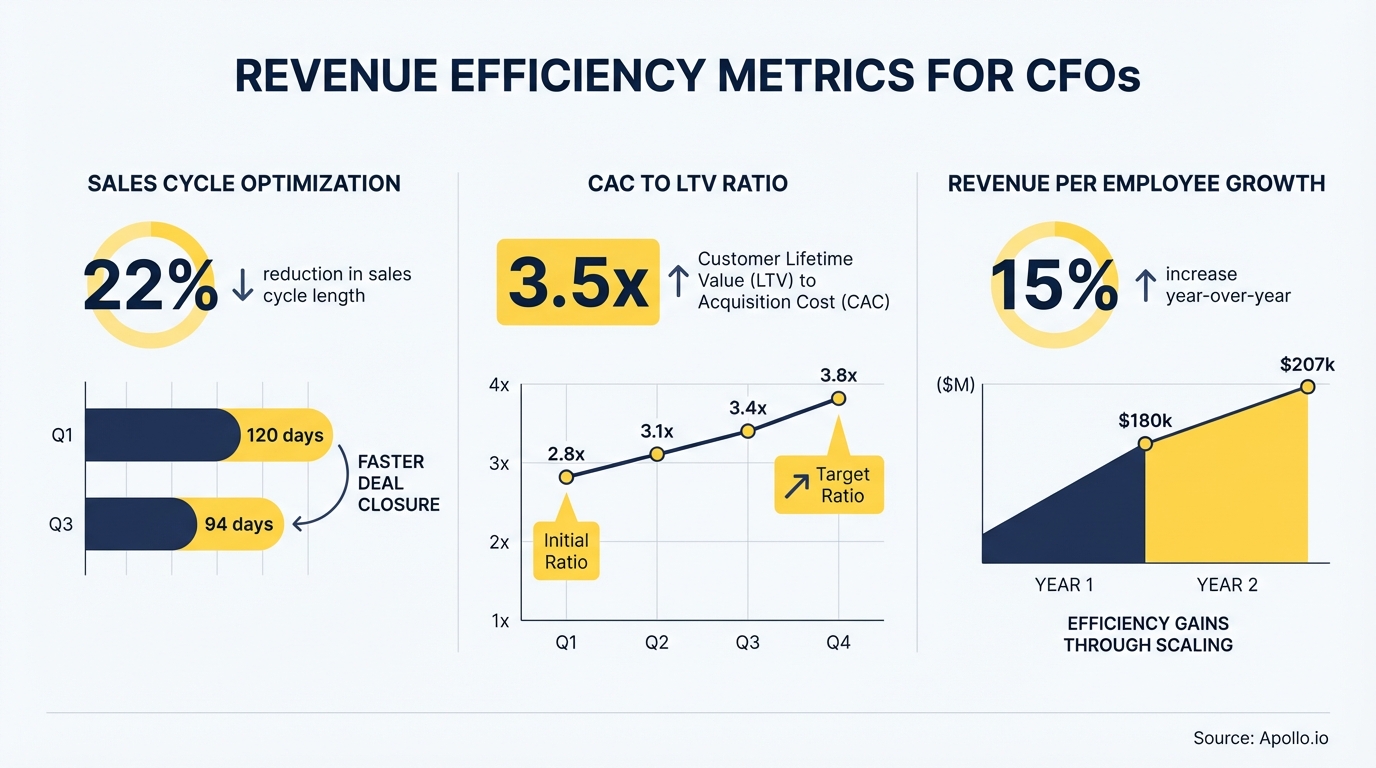
Net Magic Number. This is new annual recurring revenue generated per dollar of sales and marketing spend in the prior quarter. A number above 0.75 suggests your go-to-market motion is efficient. Below 0.5 means you're spending more to acquire revenue than that revenue will justify in the near term. BCG's research on software companies explicitly highlights the net magic number as a core efficiency metric tied directly to company valuation and compensation design.
Customer Acquisition Cost Payback Period. How many months does it take to recover what you spent to acquire a customer?
A payback period under 12 months is healthy for most software businesses. Above 18 months, you're funding growth on credit.
This metric also tells you how sensitive your business is to churn, if customers leave before you've recovered acquisition costs, you have a structural problem, not a sales execution problem.
Pipeline Coverage Ratio and Velocity. Coverage ratio (pipeline value divided by quota) is a leading indicator of whether you'll hit your number.
Velocity (how fast deals move through stages) tells you whether your process is working or whether deals are stalling in discovery, procurement, or legal. If deals stall consistently at the same stage, that's a fixable process problem, but only if you're tracking it.
Forecast Accuracy. The gap between what your team calls and what actually closes is the single most expensive form of inefficiency. Overly optimistic forecasts cause overinvestment in capacity. Overly conservative forecasts cause missed growth opportunities. Teams that track performance metrics at the rep and deal level consistently produce more accurate forecasts than those relying on gut feel from sales leaders.

How do you evaluate revenue efficiency metrics solutions?
Start with the question, not the tool. Before evaluating any platform, write down the three efficiency questions your current setup cannot answer.
If you can't write them down, you're not ready to buy anything.
Once you have your questions, evaluate solutions against these criteria:
Data source integration. Can the platform ingest data from your customer relationship management system, your marketing automation platform, your finance system, and your sales engagement tools without requiring a six-month implementation? Ask vendors for a list of out-of-the-box connectors and get specific about your stack.
Metric definitions. Does the platform let you define metrics your way, or does it impose its own definitions? Customer acquisition cost means different things to different companies. A platform that calculates it their way but can't adapt to yours will generate numbers your finance team won't trust.
Latency. How fresh is the data? A dashboard built on 24-hour-old data may be fine for board reporting. It's useless for a sales leader trying to decide which deals to push this week. Know which decisions you're making and at what frequency before you accept a vendor's data refresh commitments.
Role-specific views. Your head of sales development needs to see sequence conversion rates. Your account executive team needs pipeline velocity by stage. You need payback period and magic number. One dashboard does not serve all three audiences. Solutions that force everyone into the same view end up used by nobody.
Alert logic. Can the platform tell you when something breaks before your quarter is over? Proactive alerts on coverage ratio drops, velocity slowdowns, or unusual churn signals are worth more than any static report.
What does revenue leak look like, and how do you find it?
Revenue leak is the gap between the revenue you should be generating based on your inputs and the revenue you actually close. It shows up as deals that stall without a clear reason, proposals that never get followed up, and churned customers who gave you warning signals you ignored.
Research cited by Clari's 2024 State of Revenue Leak report found that revenue operations leaders report approximately 26% of revenue lost to leakage from pipeline opacity and process gaps. That's a quarter of potential revenue disappearing before it reaches your income statement.
To find your leaks, map every stage in your sales process and calculate the conversion rate between each one. Where does the steepest drop happen?
That's your first leak. Then look at deal age by stage.
Deals that sit in the same stage for more than twice your average stage duration are either stalled or ghost opportunities that inflate your pipeline coverage ratio artificially.
Qualified leads that never get contacted after initial inquiry are another common leak point. Sales cycles in some segments are already long, according to Norwest's 2024 Sales and Marketing Benchmark Report, companies with an annual contract value between $50,000 and $100,000 reported it takes nearly nine months to close a deal. If you're adding friction at the front end through slow follow-up, that timeline gets worse, not better.
How should CFOs structure their revenue efficiency reporting cadence?
Different metrics belong at different review frequencies. Mixing them all into one monthly report means you're either acting too slow on leading indicators or creating noise around lagging ones.
Weekly (operational): Pipeline coverage ratio, deal velocity by stage, forecast call vs. Prior week, and any alert triggers from your analytics system. This belongs to your Chief Revenue Officer and revenue operations team, with CFO visibility on exceptions only.
Monthly (management): Customer acquisition cost payback period, gross revenue retention, net revenue retention, and sales productivity per quota-carrying head. This is where finance and sales leadership should meet with a shared data source.
Quarterly (board-level): Net magic number, Rule of 40 performance (growth rate plus free cash flow margin), lifetime value to customer acquisition cost ratio, and forecast accuracy vs. Actual close rate for the prior quarter. These belong in your board package.
One common mistake: CFOs who only look at quarterly metrics miss the leading indicators that would let them intervene earlier. If your magic number deteriorates in Q1, you won't see it in the income statement until Q3.
The monthly cadence is where you catch problems early enough to fix them.
How do you make the final revenue efficiency metrics investment decision?
Ask these specific questions before signing any contract for an analytics or revenue intelligence platform.
1. Can you show me the metric calculation behind your definitions?
Any vendor who can't show you exactly how they calculate customer acquisition cost, pipeline coverage, or forecast accuracy should not have access to your data. Opaque calculations produce numbers you can't defend in a board meeting.
2. What does implementation actually take?
Get a realistic timeline from a reference customer with a similar tech stack, not from the vendor's implementation guide. Ask the reference how long until they trusted the data enough to make decisions from it.
3. Who owns the platform day-to-day?
If the answer is "your revenue operations team," find out how many people that team has and whether they have capacity. An analytics platform nobody maintains becomes expensive shelf software within six months.
4. What happens to our data if we leave? You need a clear data export path and an understanding of retention policies. This is a compliance and risk question, not just a procurement one.
5. What's the total cost of ownership?
Platform fees are the starting point. Add implementation costs, any required integrations, internal administration time, and training.
Then ask what it costs to add users as your team scales. Platforms that price per seat punish growth in ways that don't show up in the initial contract.
The decision comes down to whether the platform will generate more accurate answers to the efficiency questions you've already defined than your current approach. If you haven't defined those questions yet, that's where to start.
A clear question is worth more than any dashboard.

Share this post
Start using Apollo today
Start your free trial with Apollo today—then use these resources to guide you through every step of the process.

Start using Apollo today
Start your free trial with Apollo today—then use these resources to guide you through every step of the process.
or
By signing up, I agree to Apollo's Terms of Service and Privacy Policy.
Continue Learning
Explore these handpicked resources to deepen your understanding of AI-powered GTM
The GTM engineer boom: Inside the fastest-growing job in B2B sales
GTM engineer postings have surged since 2023. Here’s what’s fueling the fastest-growing role in B2B sales, how it differs from RevOps, and what it pays.
9 Sales Tasks AI Agents Now Handle, and 4 Humans Still Own
AI agents are cutting prospect research time by 34% and email drafting by 36%. See the 9 sales tasks shifting to AI in 2026, and the 4 that stay human.
The Toggle Tax: What 1,200 Daily App Switches Are Quietly Costing Sales Teams
Sales reps spend only 40% of their week actually selling. See what the toggle tax costs the other 60%, and how to close the gap.
Agentic GTM, Explained: What Changes When Sales Agents Run the Workflow
83% of AI-using sales teams report revenue growth (Salesforce). See what separates autonomous sales agents from AI features, and what changes by 2028.