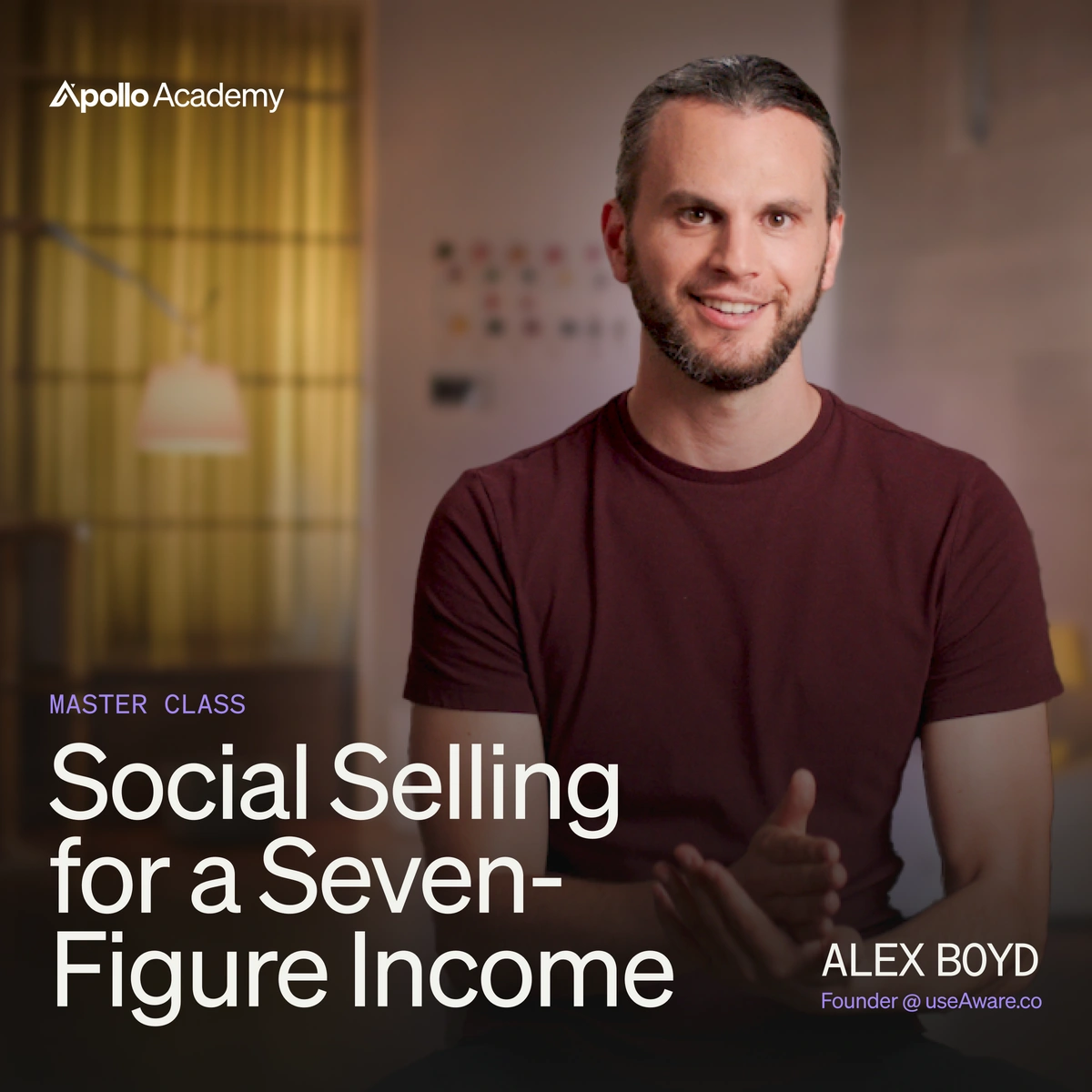
Master Class: Social Selling for a Seven-Figure Income
Every time Alex Boyd hits the little, blue "Post" button on LinkedIn, he makes $13,000.
Today, he boasts a social selling empire, where posting a few times per week generates over 30% of the revenue for his company Aware — totaling over five million dollars.
His social selling formula is a result of diligent trial and error, carefully written stories, and hundreds of closed-won deals.
And today, he's sharing his playbook with you in his 35-minute NEW Master Class course: Social Selling for a Seven-Figure Income — free on Apollo Academy.
What is social selling?
Social selling isn't about spamming your network with sales pitches. It's the art of using social media to find the right prospects, build trusted relationships, and ultimately, achieve your sales goals. Think of it less like a megaphone and more like a conversation at a coffee shop. You're there to listen, share valuable insights, and help people publicly. When you do it right, the sales conversations happen naturally.
Traditional selling vs. social selling: What's changed
Remember the days of endless cold calls and generic email blasts? That's traditional selling—a one-way street where you push your message out and hope something sticks. Social selling flips the script. It's a two-way dialogue. Instead of interrupting prospects, you attract them by sharing valuable content and engaging in relevant conversations. While traditional selling is about the close, social selling is about building the relationship first. The trust you build publicly translates directly to closed deals later.
Why social selling matters for B2B revenue
So, why should you care? Because your buyers are already on social media, doing their own research long before they ever talk to a salesperson. Social selling puts you where they are, allowing you to influence their decision-making process early on. It helps you build a personal brand, establish credibility, and stay top-of-mind. The data doesn't lie. Apollo data reveals that adding just one LinkedIn touchpoint to your automatic emails campaigns increases your chances of booking a meeting by 14%. It's not just about being social; it's about generating real, measurable pipeline.
What's in the course?
Alex cuts through all the overly dramatized, overly complicated "do's and don'ts" of social selling and boils it down to a single truth.
Social selling is about helping people publicly.
"[It's] a way to build relationships online," he says, "A way to showcase your knowledge on specific topics and have open discussions with others about it…because people buy from people they trust."
"LinkedIn is a way to build relationships online...because people buy from people that they trust."
— Alex Boyd, Founder at Aware
LinkedIn is uniquely suited for B2B lead generation but at its core, it's still a social media platform. What you post and how you present yourself affect the likelihood of your prospects responding.
It starts by dedicating the time to create a personal brand that potential buyers reliably get value out of. From there, you need to know how to create memorable conversations that seek to solve — not sell.
In just 35 minutes, the new Social Selling for a Seven-Figure Income Master Class gives you Alex's step-by-step social selling framework across six short segments:
- The three principles of social selling
- The power of commenting
- Posting high-value content
- Navigating inbound conversations
- Starting outbound conversations
- Nailing the meeting request
Watch the full course on Apollo Academy today for free.
And, while you're there, don't forget to check out our other Master Class courses:
- How to Write Cold Emails Anyone Will Respond to with Samantha McKenna
- Building a World-Class Outbound Program with Josh Garrison
The three principles of social selling from Alex's masterclass
To build real, workable pipeline through LinkedIn, every seller needs to understand three key principles from Alex's playbook.
- Demonstrate credibility. Think of LinkedIn as a space to share what you've learned — a journal of sorts. Alex dives into best practices for showcasing your wins, your losses, and your learnings through LinkedIn posts that position you as a relatable and knowledgeable source in the eyes of your potential buyers.
- Highlight customer results. Posting a generic case study to your LinkedIn account without any context (and expecting people to think any better of you for it) won't get you far. "You need to learn to write a real story," Alex says. He gives best practice examples in the course.
- Slow down interactions. Salespeople need to reframe how they think about social selling— it's a long game. You sell more by not pushing the sale. Alex teaches you how to nurture prospects with insightful comments, resurface old conversations, and tastefully transition friendly inquiries into meeting requests.
Social selling platforms: Where to focus your efforts
While social selling can happen on any platform, for B2B, one reigns supreme: LinkedIn. It's the world's largest professional network, making it the go-to place to connect with decision-makers, share industry insights, and build your professional brand. While other platforms like X (formerly Twitter) can be useful for certain industries, your primary focus should be on mastering LinkedIn. It's where your buyers are spending their time, and it's where you'll see the most significant return on your effort.
How to measure your social selling success
How do you know if your efforts are paying off? Forget vanity metrics like likes and shares. Focus on what actually moves the needle. Track the number of meaningful conversations you start in the DMs. Monitor how many of those conversations turn into booked meetings. The ultimate measure of success is pipeline and revenue. Use your CRM to track leads sourced from social activities. When you can directly attribute closed deals to your social selling efforts, you know you've cracked the code.
Start building your social selling system
Social selling isn't a quick hack; it's a long-term strategy that builds on itself. The key is consistency and a genuine desire to help. By sharing your expertise and building real relationships, you create a powerful inbound engine that works for you around the clock. Ready to turn these principles into action? Apollo gives you the tools to find your ideal buyers on LinkedIn, engage them with intelligent outreach, and track your success all in one place. Get Started
Frequently asked questions about social selling
How much does social selling cost?
The primary cost of social selling is your time. While you can invest in paid tools like LinkedIn Sales Navigator or advertising, the core activity of building your brand and engaging with prospects is free. The real investment is the consistent effort required to create content and nurture relationships.
Which social media platform is best for B2B social selling?
For B2B sales, LinkedIn is the undisputed leader. It's designed for professional networking and is where most of your potential buyers and decision-makers are active. While other platforms can supplement your strategy, mastering LinkedIn should be your top priority.
How long does it take to see results from social selling?
Social selling is a marathon, not a sprint. You might see initial engagement within a few weeks, but building a strong personal brand and a consistent flow of inbound leads can take three to six months of consistent effort. The key is patience and persistence.
What's the difference between social selling and social media marketing?
Social media marketing is typically a one-to-many approach, run by the marketing team to build brand awareness for the company. Social selling is a one-to-one or one-to-few approach, run by individual salespeople to build personal trust and generate leads directly.
How do I measure social selling ROI?
Measure what matters: conversations, meetings, and revenue. Track how many DMs lead to a discovery call. Use tracking links or ask prospects how they found you. The ultimate ROI is the value of the deals you close that originated from your social selling activities.
Share this post
Start using Apollo today
Start your free trial with Apollo today—then use these resources to guide you through every step of the process.
Start using Apollo today
Start your free trial with Apollo today—then use these resources to guide you through every step of the process.
or
By signing up, I agree to Apollo's Terms of Service and Privacy Policy.
Continue Learning
Explore these handpicked resources to deepen your understanding of AI-powered GTM
Sales Email Subject Lines that Actually Convert (with Examples!)
Email subject lines are the MVPs of email marketing. Learn how to create and optimize email subject lines that convert.
The 5 Best Sales Sequences We've Ever Seen
Take your outbound to the next level with automated sequences of touchpoints, custom designed to deliver value to prospects at scale. Here are the top 5 sequences you should try today.
What is the Best Time of Day to Call or Email Prospects?
Research says you can drastically increase your conversion rates by simply contacting your prospects at the right time of day. Learn the best times to reach out here.
How to Use Content in Prospecting Emails to Avoid the Cold Shoulder
Tired of being "left on read" by your prospects? Here's how Letterdrop CEO Parthi Loganathan and his team snag their prospects' attention by sharing value-additive content in their cold emails.