
How to Build a Sales Funnel Website That Converts Visitors Into Customers
B2B buyers now complete 70% of their purchasing journey before contacting sales. Your sales funnel website must work harder than ever to guide prospects through this self-serve buying process. A properly designed funnel website transforms anonymous visitors into qualified leads by delivering the right content at each decision stage. According to Gartner, 80% of B2B sales interactions now occur in digital channels, making your website the primary revenue driver.

Scale Teams Without Scaling Chaos With Apollo
Tired of inconsistent processes slowing down your growing team? Apollo standardizes your entire GTM motion with proven playbooks and automation. Join 550K+ companies scaling efficiently.
Start Free with Apollo →Key Takeaways
- A sales funnel website guides prospects from awareness to decision with targeted content at each stage
- B2B buyers consume 3-7 content pieces before contacting sales, requiring strategic content placement
- Digital-first funnels with AI automation and self-serve elements convert 35% more visitors
- Tool consolidation cuts costs and complexity while improving conversion tracking across funnel stages
- RevOps teams need unified data to optimize funnel performance and forecast revenue accurately
What Is a Sales Funnel Website?
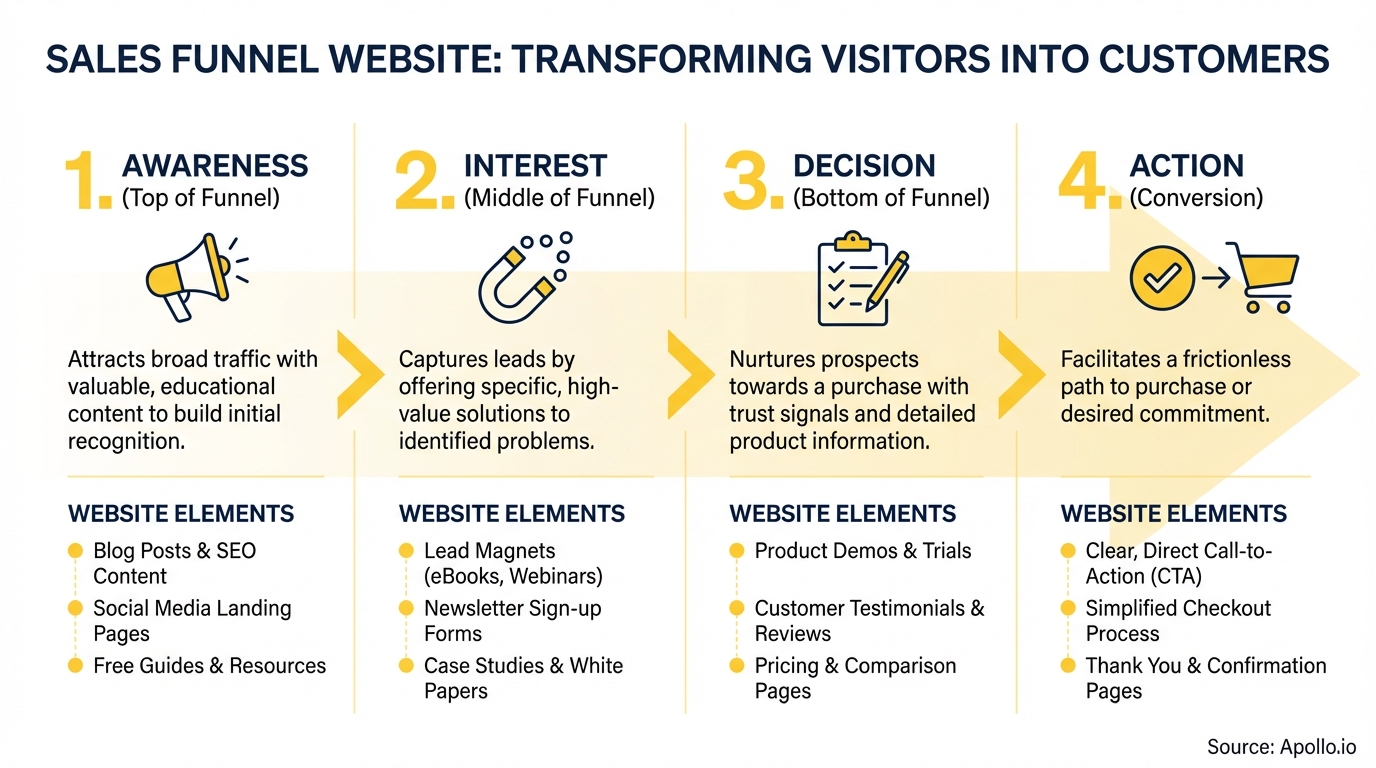
A sales funnel website is a strategically designed digital platform that moves prospects through awareness, consideration, and decision stages with targeted content and conversion paths. Unlike traditional websites that present information randomly, funnel websites map content to buyer intent at each stage.
The website architecture includes landing pages for awareness (blog posts, guides), consideration pages (case studies, comparison charts), and decision pages (demos, trials, pricing). Each stage answers specific questions buyers ask during their research process.
For SDRs and BDRs, this means prospects arrive at sales conversations already educated on solutions, shortening qualification time by 40%.
Modern B2B funnel websites integrate with CRM systems to track visitor behavior, score leads based on engagement, and trigger automated follow-up sequences. Research by Gitnux shows B2B buyers engage with 3-7 content pieces before reaching out, making content mapping critical for conversion.
How Does a Sales Funnel Website Work in 2026?
Sales funnel websites work by matching content types to buyer research behaviors at each funnel stage. The top of funnel (TOFU) captures attention with educational content like blog posts and guides. Middle of funnel (MOFU) nurtures consideration with detailed comparisons and case studies. Bottom of funnel (BOFU) converts with demos, trials, and sales conversations.

Here's how content aligns with buyer intent:
| Funnel Stage | Buyer Intent | Content Types | Conversion Goal |
|---|---|---|---|
| Awareness (TOFU) | Problem identification | Blog posts, guides, videos | Email capture |
| Consideration (MOFU) | Solution research | Case studies, webinars, comparisons | Demo request |
| Decision (BOFU) | Vendor selection | Pricing, trials, ROI calculators | Sales conversation |
AI-powered websites now personalize content based on firmographic data, showing enterprise prospects different messaging than SMB visitors. Struggling to track which content drives pipeline? Apollo's pipeline intelligence connects website engagement to closed deals.
Turn Forecast Guesswork Into Revenue Certainty
Struggling to trust your pipeline data when deals slip through the cracks? Apollo gives you real-time visibility across every stage—from first touch to close. Built-In increased win rates 10% with Apollo's unified platform.
Start Free with Apollo →Why Do Sales Leaders Need Digital-First Funnel Websites?
Sales leaders need digital-first funnel websites because buyers complete most research independently before engaging sales. Forrester Research reports that over half of large B2B transactions ($1M+) will process through digital self-serve channels. Your website must qualify and educate prospects without human intervention.
For RevOps teams, digital funnels provide unified data on buyer behavior, content performance, and conversion bottlenecks. This visibility enables accurate forecasting and resource allocation.
Sales leaders managing distributed teams benefit from consistent messaging across all touchpoints, ensuring prospects receive the same value proposition regardless of entry point.

Key benefits for leadership:
- Predictable pipeline: Track visitor-to-lead conversion rates by source and content type
- Shorter sales cycles: Educated prospects move faster through qualification and decision stages
- Scalable growth: Add leads without proportional headcount increases
- Better forecasting: Historical funnel data improves revenue predictions
How Do SDRs Use Funnel Websites to Book More Meetings?
SDRs use funnel websites to identify high-intent prospects based on content engagement and timing. When a prospect downloads a BOFU asset like a pricing guide or ROI calculator, the website triggers alerts for immediate outreach.
This intent data transforms cold outreach into warm conversations with context.
Modern sales development teams access visitor tracking dashboards showing which pages prospects viewed, how long they engaged, and which content they downloaded. SDRs reference this activity in outreach: "I noticed you downloaded our integration guide—are you evaluating CRM options?"
Tired of generic outreach that gets ignored? Apollo's sales engagement platform personalizes sequences based on website behavior and firmographic data.
Best practices for SDRs:
- Set alerts for BOFU content downloads (pricing, demos, trials)
- Customize outreach messaging based on viewed content topics
- Prioritize accounts with multiple stakeholder visits
- Use email templates that reference specific content engagement
What Are the Essential Components of a High-Converting Funnel Website?
High-converting funnel websites include five essential components: targeted landing pages, progressive profiling forms, content mapping, behavior tracking, and automated nurture sequences. Each component serves a specific role in moving prospects toward conversion.
Targeted Landing Pages: Create dedicated pages for each traffic source and buyer persona. Enterprise prospects land on pages highlighting security and scalability, while SMB visitors see pricing and speed-to-value messaging.
Progressive Profiling: Capture more data with each interaction. First form asks for email and company. Second form adds role and company size. Third form qualifies budget and timeline. This approach maintains high conversion rates while building complete prospect profiles.
Content Mapping: Align content types with buyer journey stages. TOFU content educates on problems. MOFU content demonstrates solutions. BOFU content proves ROI and addresses objections.
Behavior Tracking: Monitor page views, time on site, content downloads, and return visits. This data feeds lead scoring models that prioritize prospects for sales outreach.
Automated Nurture: Trigger email sequences based on content downloads and page visits. Prospects who view pricing pages receive ROI calculators and case studies automatically.
How Can Account Executives Leverage Funnel Data to Close Deals Faster?
Account Executives leverage funnel data to prioritize prospects, personalize pitches, and address objections proactively. When AEs access complete engagement history—every page viewed, content downloaded, and email opened—they enter conversations with full context on buyer needs and concerns.
For example, if a prospect viewed competitive comparison pages and pricing calculators, the AE knows they're in active evaluation mode. The conversation focuses on differentiation and ROI rather than basic education.
This targeted approach shortens sales cycles by 30-40% compared to generic discovery calls.
AEs managing enterprise deals use funnel data to map buying committee engagement. When multiple stakeholders from one account visit the website, AEs identify champions, influencers, and decision-makers based on their content consumption patterns.
Tactical applications:
- Reference specific content in sales pitches to demonstrate relevance
- Identify objections based on competitor comparison page views
- Prioritize accounts with buying committee engagement
- Time follow-up based on recent website activity
Why Tool Consolidation Matters for Funnel Performance
Tool consolidation eliminates data silos and reduces integration complexity that hampers funnel optimization. When RevOps teams manage separate tools for prospecting, engagement, analytics, and CRM, they lose visibility into which activities drive conversions.
Unified platforms provide complete buyer journey visibility from first touch to closed deal.
Census, an Apollo customer, cut costs in half by consolidating their tech stack. Predictable Revenue reduced the complexity of three tools into one.
Cyera found that having everything in one system was a game changer for their go-to-market execution.
Founders and CEOs benefit from consolidated platforms through lower software costs, faster team ramp time, and simplified reporting. Instead of paying for ZoomInfo, Outreach, and separate analytics tools, teams access 224M+ verified contacts, multi-channel engagement, and complete funnel analytics in one workspace.
For B2B sales organizations scaling outbound, tool consolidation means cleaner data, fewer login credentials, and unified workflows that improve adoption rates and reduce training time.
Start Building Your Revenue-Driving Funnel Website
Sales funnel websites are no longer optional for B2B growth. With 67% of buyers preferring self-serve research over sales conversations, your website must qualify, educate, and convert prospects independently.
The most effective funnel websites combine targeted content, behavior tracking, and automated nurture sequences to guide buyers from awareness to decision.
Focus on three priorities: map content to buyer journey stages, implement behavior tracking for lead scoring, and consolidate your tech stack for complete funnel visibility. Sales leaders who invest in digital-first funnel websites see 35% higher conversion rates and 40% shorter sales cycles.
Ready to build a funnel that actually converts? Start free with Apollo to access 224M+ verified contacts, AI-powered engagement tools, and unified analytics that connect website activity to closed revenue.
Prove Apollo's ROI In Your First Week
Budget approval stuck on unclear metrics? Apollo tracks every touchpoint from first contact to closed deal—quantifying exactly how much pipeline you're generating. Built-In increased win rates 10% with full-funnel visibility.
Start Free with Apollo →Don't miss these
Data
How to Structure a Marketing Team That Actually Drives Revenue in 2026
Data
Solving Data Synchronization Headaches Across Multiple Business Systems
Data
What Marketing Metrics Should B2B Teams Track in 2026?
See Apollo in action
We'd love to show how Apollo can help you sell better.
By submitting this form, you will receive information, tips, and promotions from Apollo. To learn more, see our Privacy Statement.
4.7/5 based on 9,690 reviews
