
What Marketing Metrics Should B2B Teams Track in 2026?
Marketing leaders face a credibility crisis. With budgets under scrutiny and measurement trust at an all-time low, choosing the right metrics determines whether you prove revenue impact or lose your seat at the executive table.
According to Transmission Agency, the average marketing budget allocation for B2B businesses in 2024 was 7.7% of revenue, a decrease from 9.1% in 2023. This tightening demands measurement systems that connect marketing activity directly to pipeline and revenue.

Apollo Cuts Research From Hours To Seconds
Tired of spending 4+ hours daily hunting for contact info? Apollo delivers 224M verified contacts instantly with 96% email accuracy. Join 550K+ companies who closed deals instead of chasing data.
Start Free with Apollo →Key Takeaways
- Shift from lead-level to account-level metrics to align with buying committee realities and long B2B sales cycles
- Build a two-speed measurement system: fast signals (engagement, qualified leads) that predict slow outcomes (pipeline, revenue)
- Focus on incrementality over attribution to prove what actually changed outcomes, not just what touched them
- Unify cross-platform data through identity resolution and first-party data architecture to eliminate fragmentation
- Establish measurement governance with clear ownership, SLAs, and decision rights to rebuild trust with leadership
Why Marketing Metrics Matter More Than Ever
Marketing metrics are quantifiable indicators of performance, but not all metrics carry equal weight. Real impact comes from tracking KPIs that align to revenue, funnel velocity, customer value, and campaign efficiency.
The stakes are higher in 2026. With budget constraints intensifying and executives demanding ROI proof, teams need metrics that:
- Justify marketing spend to finance and the C-suite
- Prioritize high-performing channels and campaigns
- Enable agile decision-making and rapid experimentation
- Ensure alignment between marketing, sales, and revenue operations
Research from Lead Agency shows that 71% of B2B marketers reported that content marketing had become more important to their organization for 2024. Yet many teams still measure content with vanity metrics disconnected from revenue.
"Apollo enriches everything we have: contacts, leads, accounts... And we don't really have to touch it, it just works."
The Account-Level Measurement Revolution
B2B buying has fundamentally changed. Decisions now involve buying committees of 6-10 people with sales cycles exceeding 200 days. Lead-level attribution no longer reflects this reality.
Account-based metrics align with how B2B deals actually close:
| Traditional Lead Metrics | Account-Level Metrics |
|---|---|
| MQL volume | Account engagement depth |
| Lead conversion rate | Buying committee coverage |
| Cost per lead | Cost per engaged account |
| Lead source attribution | Account journey influence |
| Individual email opens | Account-level interaction frequency |
Account engagement depth measures how many stakeholders at target accounts interact with your content, attend events, or engage with sales. Buying committee coverage tracks whether you've reached decision-makers, influencers, and end-users within the account.
Need better account visibility? Apollo enriches your CRM with 224M+ verified contacts and firmographic data automatically.
Essential Marketing Metrics by Funnel Stage
Different funnel stages require different measurement approaches. Here's what to track at each level:
Awareness Stage Metrics
- Share of Voice: Your brand's visibility compared to competitors across media, social, and search
- Traffic Quality: Segment traffic by ICP fit, not just volume
- Brand Search Volume: Direct and branded search trends indicating awareness growth
- Account Discovery Rate: New target accounts entering your database weekly
Consideration Stage Metrics
- Engagement Quality Score: Depth of interaction (time on site, pages per session, repeat visits)
- MQL-to-SQL Conversion Rate: Percentage of marketing qualified leads accepted by sales
- Cost Per Qualified Lead: Marketing spend divided by leads meeting ICP criteria
- Content Consumption Depth: Number of assets consumed per account before conversion
Conversion Stage Metrics
- Opportunity Creation Rate: Percentage of SQLs that become pipeline opportunities
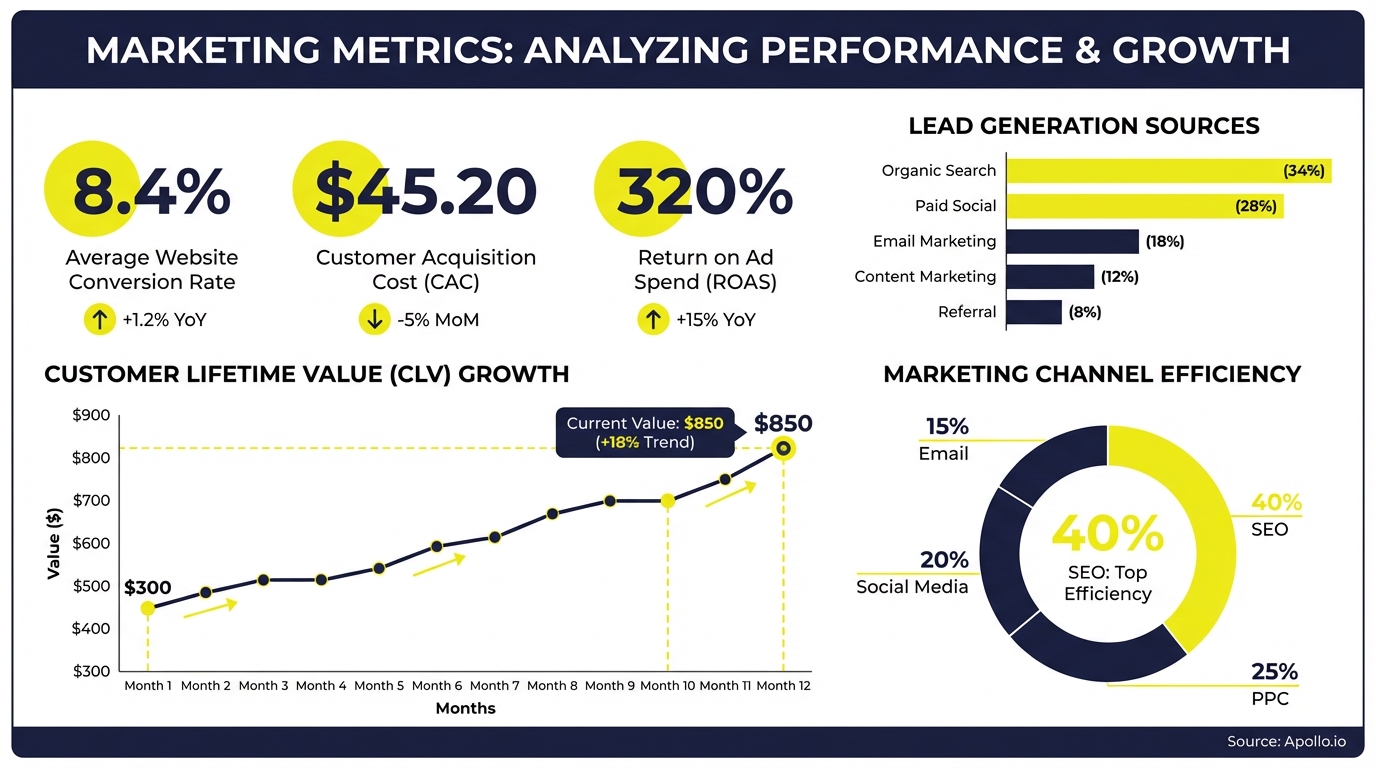
- Customer Acquisition Cost (CAC): Total sales and marketing cost per new customer
- Pipeline Velocity: Average days from MQL to closed-won
- Win Rate by Source: Close rates segmented by marketing channel or campaign
Retention and Expansion Metrics
- Customer Lifetime Value (CLV): Total revenue generated across customer lifespan
- Net Revenue Retention (NRR): Retained revenue including expansions minus churn
- Product Qualified Lead (PQL) Rate: Users who reach activation milestones
- Expansion Pipeline Influenced: Upsell/cross-sell opportunities driven by marketing
For a deeper dive into B2B marketing metrics that drive revenue growth, explore our comprehensive framework.
Spot Ready Buyers Before Forecasts Fail
Pipeline forecasting a guessing game? Apollo reveals which deals will close with buyer intent signals and real-time pipeline visibility. Built-In increased win rates 10% using Apollo's scoring.
Start Free with Apollo →Advanced Metrics for 2026
Modern B2B teams are adopting more sophisticated measurement approaches:
Incremental Pipeline: Pipeline generated above baseline, proving causal impact rather than just correlation. Run holdout experiments to measure true lift.
Marketing Efficiency Ratio (MER): Total revenue divided by total marketing spend. Simpler than complex attribution, more reliable for board-level reporting.
Buying Group Engagement: Percentage of target accounts with 3+ engaged stakeholders. Maps to actual buying committee dynamics.
Self-Service Conversion Rate: Percentage of deals that progress without sales involvement. Critical as 61% of B2B buyers prefer rep-free experiences.
First-Party Data Enrichment Rate: Percentage of records enhanced with verified, consented data. Foundation for privacy-compliant measurement.
"We benchmarked ZoomInfo versus Apollo, Clearbit, Lusha, and Seamless, and ultimately Apollo won on all fronts, especially in enrichment. Higher quality than ZoomInfo, greater breadth than Clearbit."
Solving the Data Fragmentation Crisis
Data silos remain the biggest measurement blocker. Marketing data lives in email platforms, CRM systems, ad networks, and analytics tools—each with different IDs, definitions, and time stamps.
Identity Resolution Blueprint:
- Establish a Single Customer ID: Use email as the primary key, supplemented by CRM IDs and cookies
- Build a Customer Data Platform: Centralize data from all sources into one unified view
- Create Data Dictionaries: Document metric definitions, calculation methods, and owners
- Implement Server-Side Tracking: Reduce reliance on third-party cookies and improve data accuracy
- Set Up Reverse ETL: Sync enriched data back to operational systems for activation
Your measurement foundation must handle consent management, data quality scoring, and cross-device tracking. Without identity resolution, attribution models produce unreliable results.
Want to eliminate data silos? Apollo's enrichment platform unifies contact data across your entire tech stack.

Building a Trustworthy Measurement Operating Model
Sixty-four percent of B2B marketing leaders don't trust their organization's marketing measurement for decision-making. Fixing this requires more than better tools—it requires governance.
Measurement Governance Framework:
| Component | Owner | Cadence |
|---|---|---|
| Metric definitions | RevOps + Marketing Ops | Quarterly review |
| Data quality SLAs | Marketing Ops | Weekly monitoring |
| Attribution model selection | CMO + CRO | Annual review |
| Dashboard accuracy audits | Finance + Marketing | Monthly validation |
| Forecast methodology | RevOps | Quarterly calibration |
Establish clear decision rights: Who can change metric definitions? Who approves new tracking implementations? What's the escalation path when data conflicts arise?
Create shared dashboards with marketing, sales, and finance. Use the same numbers in every meeting. Document assumptions and methodology changes.
Overcoming Common Measurement Challenges
According to NYT Licensing, common challenges in content marketing include attracting quality leads (45%), finding resources for faster content creation (38%), generating enough traffic (35%), and generating ROI and sales through content (34%).
Challenge 1: Multi-Touch Attribution Complexity
Solution: Start with simple models (first-touch, last-touch) and layer in multi-touch only when you have clean data. Run incrementality tests to validate attribution accuracy.
Challenge 2: Long Sales Cycles
Solution: Build a two-speed system with leading indicators (engagement, qualified leads) that predict lagging outcomes (pipeline, revenue). Report both.
Challenge 3: Privacy and Consent
Solution: Shift to first-party data collection, consent-based tracking, and aggregate measurement. Model data loss into forecasts.
Challenge 4: Sales and Marketing Misalignment
Solution: Co-create SLAs on lead quality, response times, and feedback loops. Use shared definitions and joint planning sessions.
Learn how to align your teams with our guide on structuring a marketing team for revenue.
How Apollo Strengthens Your Measurement Stack
Apollo consolidates your sales tech stack into one workspace, eliminating data fragmentation and measurement gaps:
- 224M Verified Contacts: Enrich every record with accurate firmographic, technographic, and behavioral data
- Automatic Data Enrichment: Keep CRM data clean without manual work
- Intent Signals: Trigger campaigns and scoring based on buying signals
- Unified Analytics: Track engagement, pipeline, and revenue in one platform
- Native Integrations: Sync data across Salesforce, HubSpot, and your entire GTM stack
Teams using Apollo report better data quality, faster pipeline velocity, and clearer attribution. When your data is clean and unified, measurement becomes trustworthy.
Explore our full platform at the best B2B marketing tools for 2026.
Implementing Your Metrics Framework
Start with a 12-week implementation roadmap:
Weeks 1-2: Audit and Baseline
Document current metrics, data sources, and reporting processes. Identify gaps and conflicts.
Weeks 3-4: Define North Star Metrics
Align leadership on 3-5 core KPIs that tie directly to revenue. Create metric definitions and calculation methods.
Weeks 5-8: Build Data Infrastructure
Implement identity resolution, set up tracking, create unified dashboards. Establish data quality SLAs.
Weeks 9-10: Train and Socialize
Run workshops with marketing, sales, and finance. Create documentation and playbooks.
Weeks 11-12: Launch and Iterate
Go live with new dashboards. Schedule weekly reviews for the first month, then move to regular cadences.
Measurement is never "done"—it evolves with your business. Build in quarterly reviews to refine definitions, add new metrics, and sunset vanity metrics.

Marketing Metrics That Drive Real Growth
The metrics you track shape the decisions you make and the outcomes you achieve. In 2026, winning teams are shifting from attribution-first to incrementality-first measurement, from lead-level to account-level tracking, and from siloed tools to unified platforms.
Focus on metrics that connect marketing activity to pipeline and revenue. Build measurement systems your leadership trusts.
Eliminate data fragmentation through identity resolution and first-party data architecture.
The credibility crisis is real, but solvable. With the right metrics framework, governance model, and unified data platform, you transform measurement from a reporting exercise into a strategic advantage.
Ready to build a measurement system that drives growth? Request a Demo to see how Apollo consolidates your tech stack and strengthens your marketing metrics.
Prove Apollo's ROI In Your First Week
Budget approval stuck on unclear metrics? Apollo tracks every touchpoint from first contact to closed deal. Built-In increased win rates 10% and ACV 10% with Apollo's scoring.
Start Free with Apollo →Don't miss these
Data
How to Structure a Marketing Team That Actually Drives Revenue in 2026
Data
Solving Data Synchronization Headaches Across Multiple Business Systems
Data
How to Verify Email Addresses: The 2026 Deliverability Guide
See Apollo in action
We'd love to show how Apollo can help you sell better.
By submitting this form, you will receive information, tips, and promotions from Apollo. To learn more, see our Privacy Statement.
4.7/5 based on 9,690 reviews
