
What Are Customer Engagement Metrics That Drive Revenue?
Customer engagement metrics aren't vanity stats. They're leading indicators of pipeline health, retention risk, and expansion opportunity. In 2026, B2B teams face a fundamental shift: 75% of B2B buyers prefer a rep-free experience, and only 5% of the buyer's journey is spent with a salesperson. That means your engagement measurement system must track what happens when no one's watching.
The problem? According to Extu research, only 29% of B2B customers are engaged, with 60% being indifferent and 11% actively disengaged. If you're measuring the wrong signals, you're optimizing for noise while your best accounts quietly churn.

Find Verified Contacts In Seconds With Apollo
Tired of spending hours hunting for contact info? Apollo delivers 224M+ verified contacts with 96% email accuracy. Join 550K+ companies who replaced manual research with instant results.
Start Free with Apollo →Key Takeaways
- Modern engagement metrics must track account-level behavior across self-serve buyer journeys, not just individual lead activity
- Companies that effectively engage B2B customers experience 63% lower attrition and 55% higher share of wallet
- The shift from lead-centric to account-centric measurement requires new frameworks for scoring persona-fit, stage-fit, and intent-fit signals
- Cross-channel attribution and stage velocity metrics directly correlate with revenue outcomes better than raw engagement volume
- Integrated platforms consolidate engagement data without manual stitching across disconnected tools
What Are Customer Engagement Metrics?
Customer engagement metrics measure how deeply prospects and customers interact with your brand, product, and content throughout the buying cycle and post-sale relationship. Unlike basic activity counts, they reveal behavioral patterns that predict conversion, expansion, and churn risk.
In B2B contexts, engagement is NOT a single person's click or download. It's the aggregate signal across a buying committee: how many stakeholders are active, which content stages they're consuming, and whether engagement is progressing or stalling. Research from Sprinklr shows companies that effectively engage their B2B customers experience 63% lower customer attrition and a 55% higher share of wallet.
Modern engagement measurement tracks three dimensions:
- Behavioral signals: Product usage, content consumption, feature adoption, session frequency
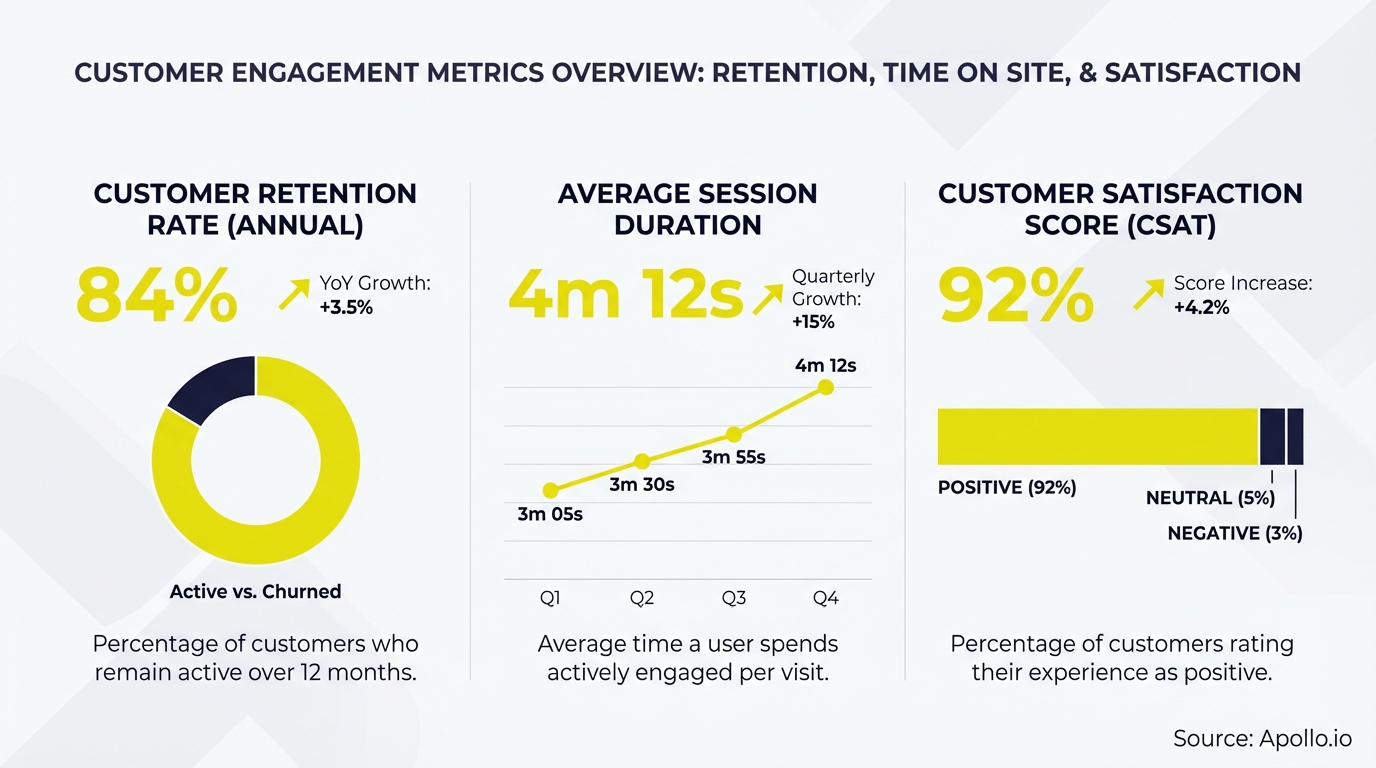
- Sentiment indicators: NPS, CSAT, support ticket trends, social mentions
- Progression metrics: Stage velocity, buying committee coverage, time-to-next-action
"Apollo enriches everything we have: contacts, leads, accounts... And we don't really have to touch it, it just works."
Why Traditional Engagement Metrics Fail in Rep-Free Buying
The rise of self-serve B2B buying exposes a critical flaw in legacy engagement models: they assume human handoffs and linear funnels. When buyers spend most of their journey researching independently, your measurement system must capture what happens between touchpoints.
Traditional MQL-centric models break down because:
- Lead-level scoring misses committee dynamics: One stakeholder downloading a whitepaper tells you nothing about whether procurement, IT, and the executive sponsor are aligned
- Last-touch attribution mis-credits late-stage channels: The demo request that converts often follows months of anonymous research your system never captured
- Vanity metrics don't predict outcomes: High email open rates and webinar attendance mean nothing if those engaged contacts aren't in buying mode or lack budget authority
Account-level engagement scoring solves this by aggregating signals across all known and anonymous contacts within a target company, then weighting them by role, stage-fit, and recency. Struggling to track engagement across your entire buying committee? Apollo enriches accounts in real-time so you never miss a stakeholder signal.
The Account-Level Engagement Framework for 2026
Modern B2B engagement measurement requires a three-layer scoring system that evaluates accounts, not just leads. Here's the framework high-growth teams are implementing:
Persona-Fit Scoring
Not all engagement is equal. A CFO reading your ROI calculator carries more weight than an intern downloading a generic ebook. Assign engagement weights based on:
- Role relevance: Decision-makers (3x), influencers (2x), researchers (1x)
- Seniority level: C-suite (3x), VP/Director (2x), Manager/IC (1x)
- Department alignment: Primary buyer persona (3x), adjacent stakeholder (1.5x), unrelated (0.5x)
Stage-Fit Scoring
Content consumption patterns signal where an account sits in the buying journey. Track which stage-specific assets each account is engaging with:
- Awareness: Blog posts, thought leadership, industry reports
- Consideration: Product comparisons, feature pages, case studies
- Decision: Pricing pages, ROI calculators, demo requests, trial signups
Accounts that jump stages (awareness → decision) without consideration-stage engagement often stall or churn faster. Those that progress sequentially show higher intent quality.
Intent-Fit Scoring
Blend first-party engagement with behavioral signals that indicate active buying mode:
- Frequency: Daily visits vs. monthly check-ins
- Recency: Active in last 7 days (high), 8-30 days (medium), 30+ days (low)
- Depth: Time on site, pages per session, return visits
- Actions: Form fills, content downloads, product interactions
For implementation guidance, see our ICP framework to ensure you're scoring the right accounts.
See Every Deal Stage In Real Time With Apollo
Forecasting feels like guesswork without live pipeline visibility. Apollo tracks deal progression across your entire funnel with real-time updates. Built-In improved win rates 10% with Apollo's scoring and signals.
Start Free with Apollo →Revenue-Linked Engagement Metrics That Matter
Here are the metrics that directly correlate with pipeline generation and revenue outcomes:
| Metric Category | Key Indicators | Why It Matters |
|---|---|---|
| Buying Committee Coverage | % of key personas engaged, stakeholder diversity score | Predicts deal velocity and close rates better than total engagement volume |
| Stage Progression Velocity | Days in stage, content sequence completion, stall rate | Early warning system for deals losing momentum |
| Engagement Depth | Feature adoption rate, session duration, return frequency | Differentiates tire-kickers from serious evaluators |
| Cross-Channel Activity | Email + web + product touchpoints, channel diversity | Multi-channel engagement correlates with 2-3x higher conversion rates |
| Intent Signal Strength | High-value action completion, pricing page visits, competitor comparison views | Identifies accounts entering active buying windows |
Research from Quality Incentive Company confirms that companies with high engagement scores outperform those with lower scores by as much as 30% across metrics such as sales, profitability, and customer retention.
"We reduced the complexity of three tools into one. We're getting higher reply rates, open rates are doubled, meetings are up, and speed to booking a meeting is cut in half."

How to Implement Cross-Channel Engagement Tracking
Building an engagement measurement system that actually drives decisions requires four operational components:
1. Unified Event Taxonomy
Create a canonical list of engagement events with consistent naming across all platforms. Define:
- Event categories: Page view, content download, product action, meeting booked
- Event properties: Timestamp, user ID, account ID, source, stage relevance
- Scoring weights: Pre-assigned values based on persona-fit and stage-fit
2. Attribution Governance
Establish UTM parameter standards and cross-platform tracking. Most teams fail here because:
- Marketing uses different UTM conventions than Sales
- Anonymous web visitors aren't stitched to known contacts post-conversion
- Multi-touch attribution models aren't agreed upon cross-functionally
Need help unifying your engagement data across platforms? Apollo centralizes email, phone, and web engagement in one system.
3. Account-Level Aggregation
Roll up individual contact engagement to the account level using weighted scoring. Build dashboards that show:
- Total engagement score by account
- Buying committee coverage percentage
- Stage progression status
- Recency and frequency trends
4. Velocity and Handoff Metrics
Track how fast accounts move between stages and how cleanly they transition between teams. Key metrics include:
- MQL → SQL conversion rate and time: Are marketing-qualified accounts truly sales-ready?
- SQL → Opportunity conversion rate and time: Is Sales engaging the right stakeholders?
- Opportunity → Close velocity: Are deals progressing or stalling?
For multi-channel sequence strategies, see how to build winning sales sequences and proven sequence templates.
The Engagement-to-Revenue Dashboard Template
Your engagement measurement system should answer three questions at a glance:
- Which accounts are engaged right now? Real-time engagement scores, recent activity feed, intent surge alerts
- Is engagement translating to pipeline? Engagement-to-opportunity conversion rate, influenced pipeline by source, velocity by engagement tier
- Where are we losing momentum? Stall rate by stage, drop-off analysis, buying committee gaps
Build views for each GTM function:
- Marketing: Engagement by campaign, content performance, channel attribution
- Sales: Account engagement scores, buying committee status, next-best actions
- Customer Success: Product usage trends, feature adoption, churn risk indicators
- RevOps: Cross-functional velocity metrics, handoff health, conversion funnels
For related frameworks, explore B2B marketing metrics that drive revenue and demand gen KPIs.
Common Engagement Tracking Mistakes to Avoid
Even sophisticated teams make these errors:

- Tracking activity instead of outcomes: High email open rates don't matter if no one's booking meetings
- Ignoring buying committee coverage: One engaged champion can't close a deal alone
- Using static scoring models: Engagement decay matters—last week's webinar attendee may have moved on
- Failing to align on definitions: Marketing's "engaged account" must match Sales' definition
- Not acting on the data: Dashboards without playbooks and alerts are vanity projects
How Apollo Consolidates Engagement Tracking
Most B2B teams struggle with engagement measurement because their data lives in 5+ disconnected systems. Apollo solves this by unifying prospecting, engagement, and intelligence in one platform:
- Automatic enrichment: Real-time contact and account data keeps engagement profiles current
- Multi-channel tracking: Email, phone, and web activity in one unified timeline
- Behavioral intent signals: Alerts when accounts show buying signals or drop-off patterns
- CRM-native dashboards: Engagement scores and activity visible where reps already work
- Sequence analytics: Track which outreach sequences drive the highest engagement and conversion
Teams using Apollo report significant efficiency gains. As Mark Turner from Built-In noted, "Apollo enriches everything we have: contacts, leads, accounts...
And we don't really have to touch it, it just works."
Customer Engagement Metrics: Start Measuring What Matters
Customer engagement metrics only drive revenue when they're tied to clear actions and outcomes. The shift to account-level scoring, stage progression velocity, and buying committee coverage represents a fundamental upgrade from legacy lead-centric models.
Start with these three steps:
- Define your account-level engagement scoring framework using persona-fit, stage-fit, and intent-fit dimensions
- Build a unified dashboard that surfaces engagement-to-pipeline conversion and velocity metrics
- Implement automated alerts and playbooks so teams act on engagement signals before they decay
Ready to consolidate your engagement tracking? Try Apollo Free to unify your prospecting, engagement, and intelligence data in one workspace.
Prove Apollo's ROI In Your First 30 Days
Budget approval stuck on unclear metrics? Apollo tracks every touchpoint from first contact to closed deal, giving you the pipeline impact data leadership demands. Built-In increased win rates 10% and ACV 10% with Apollo's signals.
Start Free with Apollo →Don't miss these
Sales
Inbound vs Outbound Marketing: Which Strategy Wins?
Sales
What Is a Sales Funnel? The Non-Linear Revenue Framework for 2026
Sales
What Is a Go-to-Market Strategy? The 2026 GTM Playbook
See Apollo in action
We'd love to show how Apollo can help you sell better.
By submitting this form, you will receive information, tips, and promotions from Apollo. To learn more, see our Privacy Statement.
4.7/5 based on 9,690 reviews
