Why Revenue Teams Are Adopting AI Sales Development Representatives
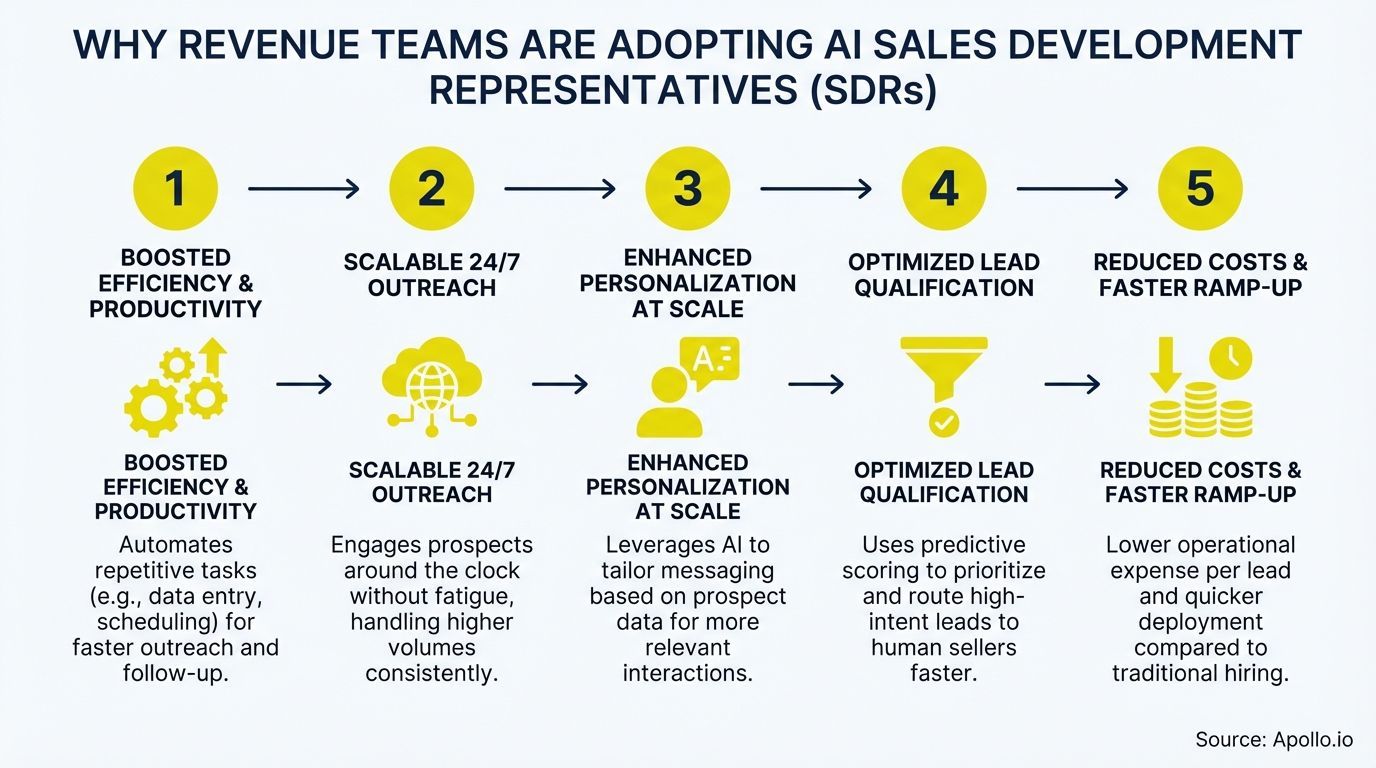
Revenue teams in 2026 are adopting AI sales development representatives because the math on manual prospecting no longer works. Nearly half of all sales reps say cold outreach is one of the worst parts of their job, and just as many say their team lacks the bandwidth to do it consistently. AI SDRs solve both problems by handling research, sequencing, and follow-up at scale, so human reps can focus on conversations that close. Tools like Apollo's AI Sales Assistant represent a new category: end-to-end GTM assistants that research accounts, build prospect lists, generate signal-based messaging, and launch workflows from a single natural-language prompt.
Understanding what sales development looks like in 2026 means recognizing that the role itself is being restructured around AI-assisted workflows, not replaced by them.

Let Apollo Find Your Next Buyer
Tired of your reps burning hours on manual research instead of closing deals? Apollo surfaces verified contacts instantly so your team spends time selling, not searching. Join 600K+ companies building pipeline on autopilot.
Start Free with Apollo →Key Takeaways
- AI SDRs are being adopted primarily to solve prospecting capacity constraints, not just to cut costs.
- Teams using AI agents in outbound workflows report measurably higher quota attainment than those relying on manual methods alone.
- Data quality is the single biggest blocker to successful AI SDR deployment — clean CRM data must come first.
- The most effective model is hybrid: AI handles top-of-funnel volume and research; humans own qualification conversations and relationship-building.
- Tool consolidation is a prerequisite — fragmented stacks prevent AI SDRs from operating across the full outbound motion.
Why Are Revenue Teams Starting to Use AI Sales Development Representatives?
Revenue teams are adopting AI SDRs because manual prospecting cannot scale to meet modern pipeline targets without a significant headcount increase. According to GM Insights, the global AI in sales market was valued at USD 31.2 billion in 2024 and is projected to reach USD 383.1 billion by 2034, growing at a 28.8% CAGR. That growth reflects real budget decisions by GTM leaders who need more pipeline from the same or smaller teams.
The shift is also driven by measurable performance differences. Research from Cirrus Insight shows that 56% of sales professionals now use AI daily, and those users are twice as likely to exceed their sales targets compared to non-users. AI SDRs are the natural extension of this individual productivity gain applied at the team level.
Spending hours building prospect lists manually? Search Apollo's 230M+ contacts with 65+ filters and let AI do the qualification work for you.
What Problems Do AI SDRs Actually Solve for SDRs and BDRs?
AI SDRs directly address the three core bottlenecks that limit SDR and BDR output: research time, outreach volume, and follow-up consistency. A traditional SDR spends a significant portion of their day on tasks that don't require human judgment — finding contact data, writing first-draft emails, scheduling follow-ups.
AI handles all three.
- Account research at scale: AI Research tools pull company signals, job changes, funding events, and tech stack data without manual tab-switching.
- Sequence generation: Multi-channel sequences (email, phone, social) generated from a single prompt, grounded in ICP context.
- Always-on coverage: AI SDRs respond to inbound signals and form fills 24/7, preventing lead decay from after-hours traffic.
- Consistent follow-up: Automated cadences ensure no prospect falls through the cracks after the first touch.
Erik Fernando Nieto, BDR at JumpCloud, put it directly: "Apollo's AI Assistant filters and cleans prospect data for me, so I can find the right people faster and run better searches. It saves me about an hour per prospecting session."
To understand the full scope of the modern sales development representative role and how AI is reshaping it, the underlying workflows matter as much as the tools.
What Is the Business Case for AI SDR Adoption in 2026?
The business case for AI SDRs rests on three pillars: pipeline capacity, quota attainment, and tech stack consolidation. Data from Insight Mark Research shows the AI SDR market is projected to reach USD 15.01 billion by 2030 at a 29.5% CAGR, reflecting sustained enterprise investment rather than early-adopter experimentation.
| Adoption Driver | Impact |
|---|---|
| Prospecting capacity | AI handles top-of-funnel volume so reps focus on qualified conversations |
| Quota attainment | AI users are twice as likely to exceed sales targets (2025 research) |
| Speed-to-lead | 24/7 coverage eliminates lead decay from after-hours inbound |
| Tech stack consolidation | Unified platforms reduce tool overhead and data fragmentation |
RevOps leaders find the consolidation argument especially compelling. "We cut our costs in half," reported a team at Census after consolidating onto Apollo. Explore how sales automation software drives revenue when it replaces fragmented point tools with a single workflow layer.

What Blockers Prevent AI SDR Success?
The most common reason AI SDR deployments underperform is poor data quality, not poor AI. When CRM records are incomplete or outdated, AI agents generate outreach to the wrong contacts, at the wrong companies, with the wrong context.
The result is worse than manual prospecting because it fails at scale.
Key blockers to address before deploying AI SDRs:
- Dirty contact data: Stale emails, missing job titles, and duplicate records corrupt AI research outputs and sequence targeting.
- Undefined ICP: AI can only match prospects to criteria you specify — vague ICP definitions produce vague prospect lists.
- Tool fragmentation: When prospecting data, sequencing, and CRM live in separate tools, AI agents cannot execute end-to-end workflows.
- No human-in-the-loop controls: Fully autonomous outreach without approval gates creates brand risk. Start with manual approval on new prospect additions.
Apollo addresses the data quality issue directly through AI Research that combines platform data with live web signals, and AI Scores that rank prospects by ICP fit before any outreach begins.
Turn Blind Forecasts Into Pipeline Clarity
Pipeline forecasting a guessing game because your deal stages never match reality? Apollo surfaces real-time buyer signals so your team acts on facts, not hunches. 600K+ companies finally forecast with confidence.
Schedule a Demo →How Do Revenue Teams Build a Hybrid AI-Human SDR Model?
A hybrid AI-human SDR model assigns AI to tasks requiring speed and volume, while humans own tasks requiring judgment and relationship-building. This is the operating model that produces consistent pipeline without sacrificing prospect experience.
| Task | AI Handles | Human Handles |
|---|---|---|
| Account research | Signal aggregation, firmographic filtering | Strategic account selection |
| Outreach sequencing | Drafting, scheduling, A/B testing | Tone review, persona alignment |
| Lead qualification | Initial scoring, intent signal monitoring | Discovery calls, needs assessment |
| Follow-up | Automated post-meeting emails with context | Complex objection handling |
Apollo's Outbound Copilot is built for this model: it automatically finds ICP-matching prospects, adds them to sequences, and supports both manual and automatic approval before any outreach fires. Sales leaders can set cadence (daily, weekly, monthly) and cap the number of prospects per run.
Tory Kindlick, Head of Revenue Ops at RapidSOS, described the effect: "Work that would've taken me hours was done before I even got off the train." That is the practical outcome of a well-structured hybrid model.
How Should Revenue Leaders Measure AI SDR Performance?
AI SDR performance should be measured on pipeline contribution, not activity volume. The goal is qualified meetings and sourced pipeline, not email sends or sequence enrollments.
- Meetings booked per week: The primary leading indicator of pipeline health from AI-assisted outbound.
- Sequence reply rate: Tracks whether AI-generated messaging resonates with the target segment.
- Prospect-to-opportunity conversion: Measures qualification quality, not just top-of-funnel volume.
- CAC payback period: Tracks whether AI SDR costs produce pipeline that justifies the investment.
- Data coverage rate: Percentage of target accounts with complete, verified contact data — a leading indicator of AI SDR effectiveness.
Spending too much time stitching together outreach tools? Automate your multi-channel sequences with Apollo's sales engagement platform and measure results from a single dashboard. For teams building out their measurement infrastructure, sales analytics that drive revenue growth start with unified data, not spreadsheets.

How Can Revenue Teams Get Started with AI SDRs in 2026?
Revenue teams should start with a focused pilot, not a full deployment. Choose one ICP segment, one outbound motion, and one measurement window.
This limits risk while generating the data needed to prove ROI before scaling.
AI SDR Readiness Checklist:
- ICP defined with at least 5 firmographic and behavioral filters
- CRM contact records verified and deduplicated
- Messaging grounded in a configured AI Content Center (value prop, pain points, CTA)
- Human approval gate active for first 30 days of new prospect additions
- Baseline KPIs set: meetings booked, reply rate, pipeline sourced
- Tech stack consolidated so prospecting, sequencing, and CRM data share a single source of truth
Teams that follow this sequence avoid the most common failure modes. Refer to the playbook for building a sales tech stack that scales to evaluate which tools to consolidate before deploying AI SDR workflows. The AI Assistant guide covers how to use natural-language prompts to run the full prospecting-to-sequence workflow without manual configuration.
Apollo's AI platform has seen 500% year-over-year growth, with 50K weekly users leveraging AI across prospecting, sequencing, and pipeline workflows. Trusted by Anthropic, Redis, Smartling, and nearly 100K paying customers, Apollo consolidates the tools that AI SDR workflows depend on into one platform. "Having everything in one system was a game changer," noted a team at Cyera.
Ready to see what an AI-assisted outbound motion looks like for your team? Start a free trial with Apollo and run your first AI-powered prospecting workflow today.
Prove Pipeline ROI From Day One
ROI pressure killing your next budget approval? Apollo delivers measurable pipeline impact fast — 46% more meetings with AI, real results your CFO can't ignore. Start free and show wins before the quarter ends.
Start Free with Apollo →Don't miss these
Sales
Inbound vs Outbound Marketing: Which Strategy Wins?
Sales
What Is a Sales Funnel? The Non-Linear Revenue Framework for 2026
Sales
What Is a Go-to-Market Strategy? The 2026 GTM Playbook
See Apollo in action
We'd love to show how Apollo can help you sell better.
By submitting this form, you will receive information, tips, and promotions from Apollo. To learn more, see our Privacy Statement.
4.7/5 based on 9,690 reviews
