
Who Typically Owns the Sales Intelligence Platform Budget in a Sales Org?
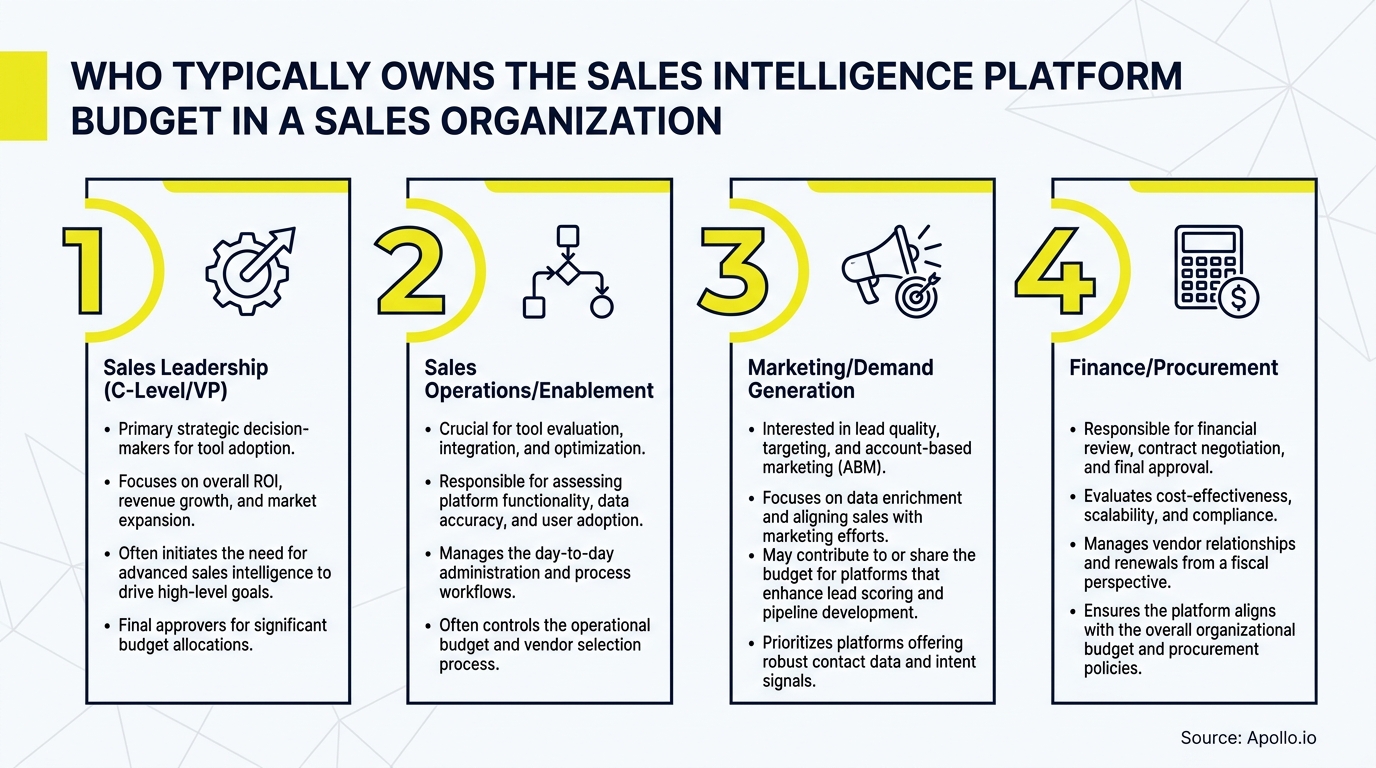
The answer has shifted dramatically. Sales intelligence used to be a tool sales leaders championed and funded. In 2026, it behaves more like shared infrastructure, touching CRM governance, data enrichment, lead routing, and AI readiness across multiple teams. That shift changes who owns the budget, who approves it, and who blocks it. If you're trying to buy, renew, or justify a sales intelligence platform, you need to know exactly who's in that room.

Apollo Turns Research Hours Into Pipeline
Tired of your reps burning the day on manual lead research instead of closing deals? Apollo surfaces verified contacts instantly so your team sells more and researches less. Join 600K+ companies building predictable pipeline.
Start Free with Apollo →Key Takeaways
- RevOps or Sales Ops is the most common day-to-day budget owner for sales intelligence platforms, especially as these tools become embedded in CRM and data workflows.
- Finance and Procurement hold final approval authority in most mid-market and enterprise orgs, even when RevOps runs the tool.
- Security and IT act as gatekeepers that can delay or kill renewals, particularly as AI features raise data governance scrutiny.
- Budget ownership varies by company size: founders and sales leaders often control it at smaller companies, while larger orgs distribute it across a formal buying group.
- Consolidating your sales tech stack into one platform simplifies the ownership model and accelerates budget approvals.
Who Actually Controls the Sales Intelligence Budget?
In most B2B sales orgs, RevOps or Sales Ops is the primary budget owner for sales intelligence platforms. These teams manage the systems, control data flows, and handle vendor renewals. Research from johnnygrow.com shows that 75% of high-growth companies planned to formalize a RevOps model by 2025, making RevOps the natural home for tools that span sales, marketing, and customer success.
That said, owning the tool day-to-day is not the same as controlling the budget. In practice, four distinct roles shape every sales intelligence purchasing decision:
| Role | Who Fills It | Decision Rights |
|---|---|---|
| Economic Buyer | VP of Sales, CRO, or CFO | Final sign-off on budget commitment |
| System Owner | RevOps / Sales Ops | Vendor selection, configuration, renewals |
| Security Gatekeeper | IT / InfoSec | Approval or veto based on data governance |
| Procurement | Finance / Legal | Contract terms, renewal leverage, compliance review |
The software segment, which includes sales intelligence platforms, constituted over 66% of the RevOps market in 2024, according to Grand View Research. That concentration confirms these tools are no longer a sales-team discretionary spend. They are core revenue infrastructure.
How Does Budget Ownership Change by Company Size?
Company size is the clearest predictor of who holds the sales intelligence budget. At smaller companies, one person often plays all four roles simultaneously.
At larger orgs, each role involves a separate stakeholder with distinct priorities.
| Company Size | Primary Budget Owner | Key Approvers | Common Friction Points |
|---|---|---|---|
| Startup (1–50) | Founder or Head of Sales | Founder | ROI justification, cost vs. headcount |
| SMB (50–250) | Sales Manager or Sales Ops | VP Sales, Finance | Seat count, annual vs. monthly billing |
| Mid-Market (250–1K) | RevOps | CRO, Procurement, IT | Security review, CRM integration, data governance |
| Enterprise (1K+) | RevOps + Procurement (co-owned) | CFO, Legal, InfoSec, CIO | Vendor risk, compliance, multi-year contracts |
Data from SNS Insider confirms that large enterprises dominated the Revenue Operations Market in 2025, largely due to their complex sales structures, higher budgets, and a greater need for centralized revenue management. For these orgs, centralized ownership is not a preference. It is an operational requirement.

Why Are RevOps Leaders Becoming the Default System Owners?
RevOps leaders become the default system owners because sales intelligence platforms now underpin enrichment pipelines, lead scoring, CRM hygiene, and AI workflows that span every revenue team. When a tool touches this many systems, it needs one team responsible for its configuration and governance.
That team is RevOps.
As Salesforce notes, the shift toward business-unit-led technology decisions empowers teams to implement tools that serve their specific needs faster. RevOps sits at the intersection of Sales, Marketing, and CS, making it the logical owner when a tool serves all three. For B2B sales organizations scaling past 100 reps, this structure also reduces duplication and prevents individual teams from buying overlapping tools independently.
Struggling to justify a consolidated platform to your RevOps or Finance team? See how Apollo unifies your entire GTM motion in one place.
Turn Funnel Gaps Into Closed Revenue
Pipeline forecasting a guessing game? Apollo surfaces verified, in-market buyers so your team stops chasing cold leads and starts converting. Nearly 100K paying customers now forecast with confidence.
Schedule a Demo →How Do Security and IT Gate the Budget Approval Process?
IT and InfoSec teams act as gatekeepers who can delay or block budget approval, especially for platforms that process contact data or power AI-driven workflows. This friction is increasing as AI features become standard in sales intelligence tools.
To prevent security reviews from stalling your purchase, RevOps leaders should prepare a vendor evaluation checklist that addresses the questions IT will ask:
- Data handling: How does the vendor store, process, and retain business contact information?
- Access controls: Does the platform support SSO, role-based permissions, and audit logs?
- Integration risk: What CRM and third-party systems does the tool connect to, and how is that access scoped?
- AI governance: How are AI-generated outputs reviewed before reaching reps or prospects?
- Vendor certifications: Does the vendor hold SOC 2, ISO 27001, or equivalent certifications?
Proactively sharing answers to these questions with your IT team shortens the security review cycle. You can review Apollo's approach to responsible AI in the Apollo AI Policy as a reference for what a transparent vendor response looks like.
How Should RevOps Leaders Build the ROI Case for Budget Approval?
RevOps leaders build the strongest ROI case by framing the sales intelligence budget as a productivity investment, not a data subscription. The economic buyer, typically the CRO or CFO, approves tools that demonstrably increase revenue output per rep or reduce cost per pipeline dollar.
Use this framework to structure your business case:
- Selling time recovered: Quantify how much time reps currently spend on non-selling work (research, list building, manual data entry) and project the pipeline impact of reclaiming that time.
- Data quality cost: Estimate the cost of bad data through bounced emails, wrong-number calls, and missed routing. Clean, verified contact data eliminates this waste.
- Stack consolidation savings: Show the cost of all tools the platform replaces. As Census found after switching to Apollo, "We cut our costs in half." That is a CFO-friendly headline.
- AI readiness: Frame the platform as a prerequisite for AI initiatives. Without clean, centralized data, AI tools cannot perform. This argument resonates with both RevOps and IT.
For SDRs and AEs making the case upward, connect the tool directly to quota. Show how faster prospect research and verified contacts translate to more conversations booked per week. Pair that with the sales performance management metrics your leadership already tracks.
Need verified contact data to back your pipeline projections? Explore Apollo's B2B data enrichment with 230M+ verified contacts.
What Is the Right Operating Model for Shared Budget Ownership?
The right operating model assigns clear ownership across all four roles while preventing any one team from creating a bottleneck. A simple RACI keeps everyone aligned:
| Activity | RevOps | Sales Leadership | IT / Security | Finance / Procurement |
|---|---|---|---|---|
| Vendor evaluation | Responsible | Consulted | Consulted | Informed |
| Security review | Accountable | Informed | Responsible | Informed |
| Budget approval | Consulted | Accountable | Informed | Responsible |
| Contract negotiation | Consulted | Informed | Informed | Responsible |
| Tool administration | Responsible | Informed | Consulted | Informed |
| Renewal decision | Accountable | Consulted | Consulted | Responsible |
Consolidating onto a single platform also simplifies this model significantly. When one tool handles prospecting, enrichment, engagement, and analytics, the RACI collapses and the number of vendor relationships RevOps must manage drops. Learn how to structure this in the Sales Tech Stack Playbook.
How Can RevOps Teams Justify Platform Consolidation to Finance?
RevOps teams justify platform consolidation by presenting a total cost of ownership comparison that includes all point-solution subscriptions, integration maintenance, and time spent switching between tools. Finance responds to concrete numbers, not feature lists.
The consolidation argument is strengthened by market momentum. As the global sales intelligence market grows toward USD 9.02 billion by 2034, according to Precedence Research, vendors are competing on breadth of capability, not just data volume. Platforms that combine contact data, sequencing, AI automation, and analytics in one workspace give Finance a simpler vendor landscape to manage and audit.
Predictable Revenue captured this benefit directly: "We reduced the complexity of three tools into one." That is the consolidation case in one sentence. Pair it with a cost comparison and a usage dashboard from your current tools, and Finance has everything it needs to approve the switch. You can see what a unified platform looks like in the Apollo on-demand demo.

Conclusion: Align the Right Stakeholders and Win the Budget
Sales intelligence platform budgets in 2026 are a team sport. RevOps owns the system, Sales leadership champions the outcome, IT clears the risk, and Finance controls the contract.
The orgs that move fastest are the ones that align all four stakeholders early, build an ROI case anchored to selling productivity and data quality, and consolidate onto a platform that reduces governance complexity rather than adding to it.
If you're making this case right now, start with a platform that is built to satisfy every stakeholder in that room. Apollo gives RevOps a unified data and engagement layer, gives Sales leadership pipeline visibility, and gives Finance a single vendor to manage instead of five.
Trusted by nearly 100K paying customers including Anthropic, Cyera, and Redis, Apollo is the all-in-one GTM platform that cuts your tech stack without cutting capability.
Start Your Free Trial and give every stakeholder a reason to say yes.
Prove Pipeline ROI With Apollo
ROI pressure killing your tool budget approval? Apollo delivers measurable pipeline impact your leadership can see — fast. Leadium 3x'd annual revenue. Get results that justify every dollar.
Start Free with Apollo →Don't miss these
Sales
Inbound vs Outbound Marketing: Which Strategy Wins?
Sales
What Is a Sales Funnel? The Non-Linear Revenue Framework for 2026
Sales
What Is a Go-to-Market Strategy? The 2026 GTM Playbook
See Apollo in action
We'd love to show how Apollo can help you sell better.
By submitting this form, you will receive information, tips, and promotions from Apollo. To learn more, see our Privacy Statement.
4.7/5 based on 9,690 reviews
