Who Should Use an AI SDR? Is It Right for Every Company in 2026?
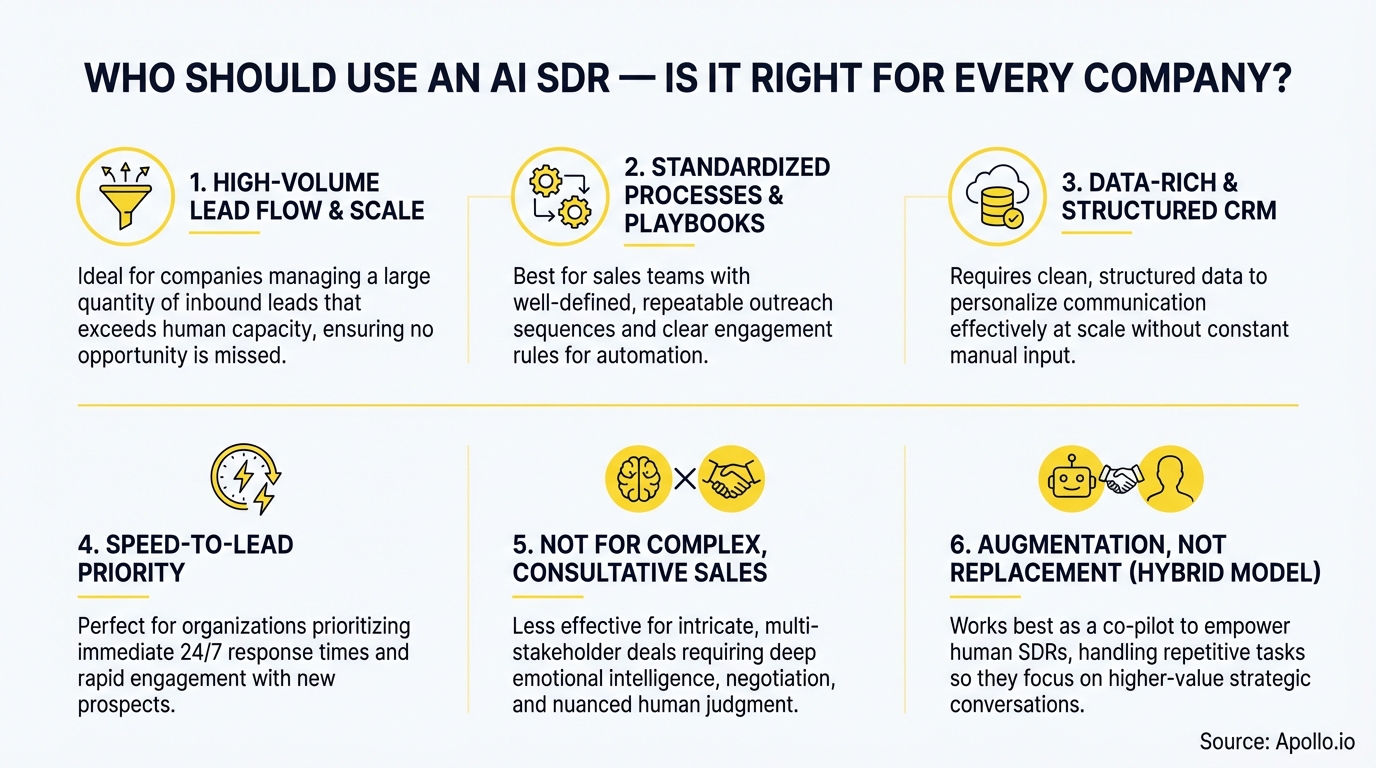
AI SDRs are not right for every company. The answer depends on four factors: data quality, ICP clarity, sales motion maturity, and governance readiness. Teams that deploy AI SDRs without these foundations in place often see worse results than they had before. Those that get it right unlock a measurable competitive edge. Tools like Apollo's AI Sales Assistant show what's possible when AI is embedded directly into the workflow rather than bolted on as another disconnected tool.
According to Cirrus Insight, 56% of sales professionals now use AI daily, and those users are twice as likely to exceed their targets compared to non-users. But adoption without readiness is a liability, not an advantage. Read on to find out whether your company is ready to benefit from an AI SDR in 2026.

Research Less, Pipeline More With Apollo
Tired of your reps burning hours verifying contact info instead of closing deals? Apollo delivers 230M+ accurate contacts so your team sells from minute one. Start building pipeline today.
Start Free with Apollo →Key Takeaways
- AI SDRs deliver strong results for teams with clean data, a defined ICP, and a repeatable outbound motion — but can hurt pipeline quality without those foundations.
- SDRs and BDRs benefit most from AI-assisted prospecting: less busywork, more time on high-value conversations.
- Data quality is the single biggest gating factor for AI SDR success — dirty data amplifies errors at scale.
- The best AI SDR deployments use a hybrid model: AI handles research, enrichment, and first-touch drafting; humans handle discovery and trust-building.
- RevOps leaders should treat AI SDR deployment as a systems project, not a tool purchase — governance, approval workflows, and measurement must come first.
What Is an AI SDR and How Does It Work?
An AI SDR is a software agent that automates the top-of-funnel tasks traditionally handled by a human Sales Development Representative: prospecting, list building, outreach drafting, follow-up sequencing, and meeting booking. It is not a chatbot or a generic email generator.
A properly deployed AI SDR is a domain-specific, workflow-embedded agent that operates inside your existing GTM stack.
AI SDRs differ from generic outreach automation in that they combine sales intelligence data, intent signals, and generative AI to personalize at scale. They qualify inbound leads, enrich contact records, draft context-aware outreach, and route high-intent prospects to human reps. The best implementations keep humans in the loop for discovery calls and multi-threading, while AI handles the high-frequency, low-judgment work. For a deeper look at the SDR role this technology augments, see Apollo's overview of SDR sales.
Is AI SDR Right for Every Company? The Honest Answer
No. An AI SDR is not right for every company, and deploying one prematurely is a common and costly mistake. The market is growing fast — Insight Mark Research projects the AI SDR market will grow from $4.12 billion in 2025 to $15.01 billion by 2030 at a CAGR of 29.5% — but market growth does not mean universal fit.
Use the table below to assess your readiness before committing to a deployment:
| Readiness Factor | Not Ready | Ready |
|---|---|---|
| Data Quality | High bounce rates, incomplete CRM records | Verified contacts, low bounce rate, enriched records |
| ICP Definition | Vague or untested ideal customer profile | Firmographic and behavioral ICP filters defined |
| Sales Motion | No repeatable outbound process yet | Human SDR motion exists and converts |
| Governance | No message approval or compliance process | Messaging review, brand guardrails, and audit trail in place |
| Tech Stack | Siloed tools with no integration | CRM connected, engagement platform unified |
What Are the Data Readiness Requirements for an AI SDR?
Data quality is the single biggest gating factor for AI SDR success. AI amplifies whatever data it works with — clean data produces better outreach; dirty data produces worse outreach at higher volume.
Before deploying an AI SDR, revenue teams must verify that their contact records are accurate, enriched, and compliant.
Key data readiness checks include:
- Email verification: Bounced emails damage sender reputation and reduce deliverability across all future outreach. Learn how to approach this in Apollo's guide to verifying email addresses for B2B sales.
- CRM hygiene: Duplicate records, missing job titles, and stale company data all degrade AI output quality.
- Enrichment coverage: Contacts without firmographic context (industry, headcount, tech stack) limit personalization quality.
- Consent and compliance records: AI SDRs operate at volume — outreach must be sent to businesses and professionals in their business capacity, with proper governance in place.
Struggling with stale or incomplete contact records? Enrich your pipeline with Apollo's 230M+ verified business contacts before you scale outreach.

How Do SDRs and BDRs Benefit Most from AI SDR Tools?
SDRs and BDRs benefit most because AI eliminates the administrative work that prevents them from spending time on actual selling. Research, list building, sequence creation, and follow-up drafting are all tasks that AI handles faster and more consistently than a human working manually through a fragmented tool stack.
For SDRs, the practical gains look like this:
- AI Research surfaces account context before outreach so messages reference real signals (job changes, funding rounds, tech stack).
- The Outbound Copilot automatically finds ICP-matching prospects and adds them to sequences without manual list-building.
- AI-generated lead scores help SDRs prioritize accounts by fit, so they focus calls on the highest-potential contacts first.
- AI drafts personalized follow-up emails after calls, so reps can send timely, relevant messages without starting from scratch.
Erik Fernando Nieto, BDR at JumpCloud, put it simply: "Apollo's AI Assistant filters and cleans prospect data for me, so I can find the right people faster and run better searches. It saves me about an hour per prospecting session."
For a practical look at how AI writing tools perform in real SDR workflows, Apollo's hands-on experiment with AI-generated outreach is worth reading before you commit to a deployment approach.
Turn Funnel Guesswork Into Pipeline Clarity
Tired of watching marketing leads stall before they ever reach your pipeline? Apollo surfaces in-market buyers and arms your team with the intelligence to act before deals go cold. Nearly 100K paying customers trust Apollo to keep their pipeline full and forecastable.
Schedule a Demo →What Does a Good Human-in-the-Loop AI SDR Model Look Like?
The most effective AI SDR deployments in 2026 use augmentation, not full replacement. AI handles research, enrichment, first-touch drafting, and routing.
Human reps handle discovery conversations, objection handling, and multi-threaded deal pursuit. This hybrid model reflects where buyer expectations are heading: Gartner projects that by 2030, 75% of B2B buyers will prefer sales experiences that prioritize human interaction over AI.
A practical workflow for a hybrid AI SDR model:
- Signal detection: AI identifies high-intent accounts based on firmographic fit and behavioral signals.
- List building: AI builds and enriches prospect lists matching defined ICP criteria.
- First-touch drafting: AI generates personalized outreach grounded in account context via the AI Content Center.
- Human review: Rep reviews and approves outreach before sending (or sets approval thresholds).
- Meeting booked: AI routes inbound responses and books meetings automatically.
- Human takeover: AE or senior rep conducts discovery and advances the deal.
This model also addresses the governance concerns that Forrester flagged in its 2026 predictions: ungoverned AI outreach creates brand risk. Building approval workflows into the process from day one keeps messaging on-brand and auditable.
Which Company Types Are Best Suited for an AI SDR in 2026?
AI SDRs are best suited for B2B companies with a defined ICP, a repeatable outbound motion, clean contact data, and volume-driven pipeline needs. They are not a good fit for companies still figuring out their first SDR process, selling highly bespoke deals with long consensus-building cycles, or operating in markets where relationship and trust are the dominant buying factors.
| Company Type | AI SDR Fit | Rationale |
|---|---|---|
| B2B SaaS with defined ICP | Strong fit | Repeatable motion, data-rich, high outreach volume |
| High-velocity SMB sales | Strong fit | Speed-to-lead advantage, inbound conversion |
| Enterprise with long sales cycles | Partial fit | AI handles top-of-funnel; humans own multi-threading and executive relationships |
| Early-stage startup, no SDR motion yet | Poor fit | No validated process for AI to automate |
| Highly regulated industries | Requires governance | Compliance review workflows must be in place first |
RevOps leaders at scaling companies often find that the biggest win is not the AI itself, but the consolidation it enables. As Cyera noted, "Having everything in one system was a game changer." Spending hours managing disconnected tools for prospecting, sequencing, and enrichment? See how Apollo's AI sales automation consolidates your stack into one unified platform.
Research from MarketBetter.ai shows that 89% of revenue organizations now use AI in some form, up from 34% in 2023. But usage is not the same as effective deployment. The companies getting the most value are those treating AI SDR as a systems project with defined inputs, outputs, and measurement — not a plug-and-play tool.
How Should RevOps Leaders Evaluate AI SDR ROI?
RevOps leaders should measure AI SDR ROI against pipeline contribution, meeting volume, sequence conversion rates, and rep productivity — not just cost savings. The baseline comparison is not "AI SDR vs. no outreach" but "AI SDR vs. current human SDR output with existing tools."
Key metrics to track from day one:
- Meetings booked per week (AI-assisted vs. baseline)
- Sequence reply rate (measures message quality and targeting precision)
- Lead-to-meeting conversion rate (measures qualification accuracy)
- Pipeline sourced by AI-assisted touches
- Deliverability metrics (bounce rate, spam complaints — critical as email filtering tightens)
Apollo's sales forecasting best practices offer a useful framework for building measurement infrastructure before you launch an AI SDR program. Measurement setup before deployment is not optional — it is how you distinguish signal from noise in early results. For teams connecting AI workflows to existing CRMs, Apollo's guide to CRM integration with HubSpot and Salesforce covers the technical setup required to get clean data flowing between systems.

Is an AI SDR Right for Your Company? Start Here
An AI SDR is right for companies with verified data, a defined ICP, and at least one working outbound motion. It is not a shortcut to building those foundations.
If your team is ready, the upside is real: Apollo's AI-powered messaging has driven a 35% increase in bookings for teams that deploy it with proper context and ICP grounding, as demonstrated in an Anthropic case study.
The practical starting point for most B2B teams in 2026 is not a full AI SDR replacement — it is augmenting existing SDRs with AI research, AI-drafted sequences, and automated enrichment. Tools like Apollo's AI Assistant let SDRs, BDRs, AEs, and RevOps leaders run end-to-end outbound workflows from a single platform, without the tool sprawl that kills productivity. Tory Kindlick at RapidSOS captured it well: "Work that would've taken me hours was done before I even got off the train."
If you're ready to put AI to work across your full GTM motion, Get Leads Now and see what Apollo can do for your pipeline.
Prove Pipeline ROI With Apollo
ROI pressure making every tool renewal a battle? Apollo delivers measurable pipeline impact your leadership can see — fast. Teams like Leadium 3x'd annual revenue after making the switch.
Start Free with Apollo →Don't miss these
Sales
Inbound vs Outbound Marketing: Which Strategy Wins?
Sales
What Is a Sales Funnel? The Non-Linear Revenue Framework for 2026
Sales
What Is a Go-to-Market Strategy? The 2026 GTM Playbook
See Apollo in action
We'd love to show how Apollo can help you sell better.
By submitting this form, you will receive information, tips, and promotions from Apollo. To learn more, see our Privacy Statement.
4.7/5 based on 9,690 reviews
