Who Owns the AI SDR Tool in a Sales Org? Sales Ops, Marketing, or Sales Leadership
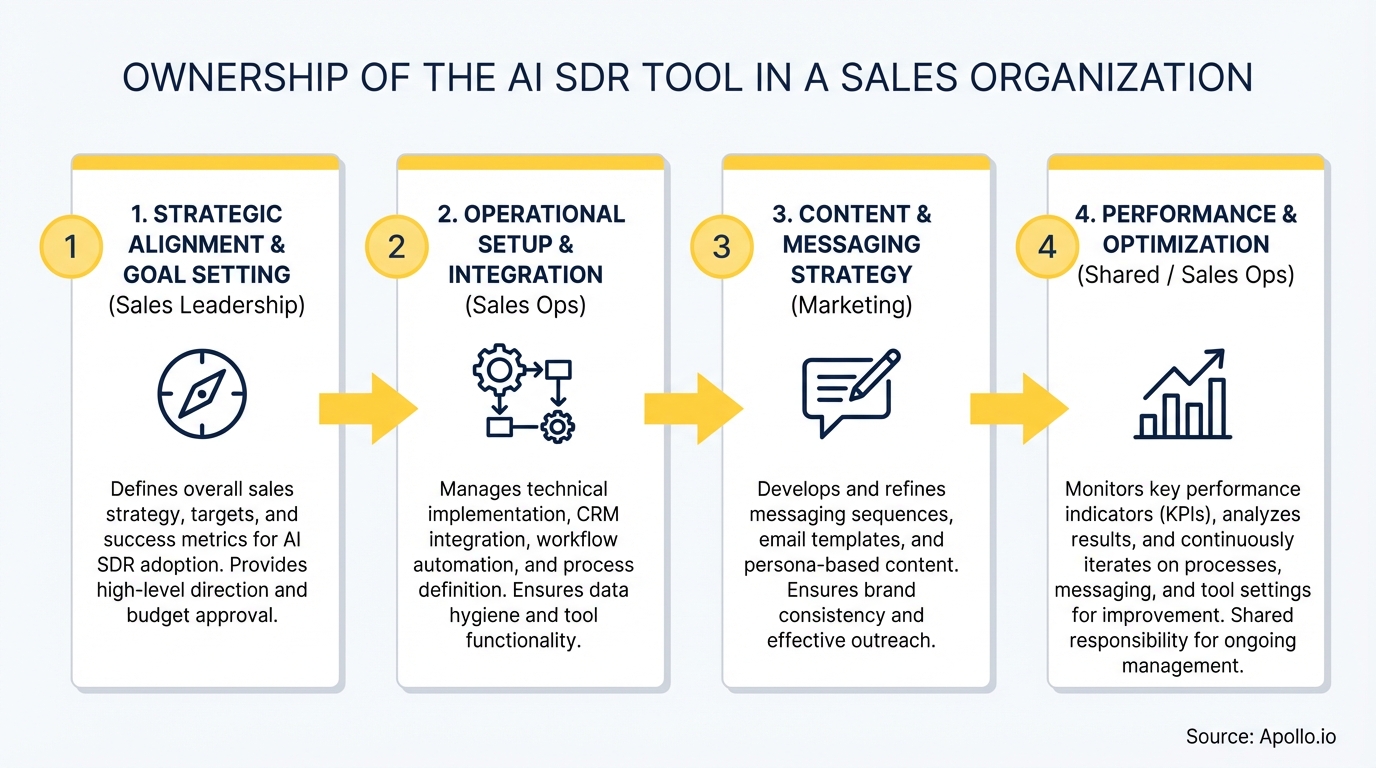
The question of AI SDR tool ownership is splitting GTM teams in 2026. Sales leadership wants the pipeline wins. Marketing wants to own the buyer journey. Sales Ops and RevOps are left reconciling conflicting sequences, duplicate outreach, and broken CRM data. Before your org buys another point solution, you need a clear answer on governance — not just budget authority. Tools like Apollo's AI Sales Assistant work best when a single team owns the workflow end-to-end, from ICP definition to sequence execution to CRM writeback. Understanding how SDR functions operate is the starting point for assigning ownership correctly.

Apollo Turns Research Hours Into Pipeline
Tired of your reps burning the day on manual research instead of closing deals? Apollo delivers verified contacts instantly, so your team spends time selling — not searching. Join 600K+ companies building predictable pipeline.
Start Free with Apollo →Key Takeaways
- No single function universally owns AI SDR tools — ownership depends on whether the motion is inbound or outbound, and how mature your RevOps function is.
- RevOps/Sales Ops is emerging as the governance layer, even when Marketing runs inbound and Sales runs outbound sequences.
- Ungoverned AI SDR deployment creates agent sprawl, data conflicts, and compliance risk — governance is the real ownership question.
- A RACI framework across Sales Ops, Marketing, Sales Leadership, and IT/Security prevents ownership gaps from becoming pipeline gaps.
- Platform consolidation is shifting tool ownership toward the team that owns the system of record and sales process, not the team that first bought a standalone tool.
Why Is AI SDR Ownership So Contested in 2026?
AI SDR ownership is contested because the tool touches three different teams' core mandates simultaneously. Forrester notes that RevOps leaders are expected to embrace new revenue orchestration platforms that harness AI to automate prospecting tasks, eliminate manual activity tracking, and centralize buyer signal capture — a description that sounds like Sales Ops territory. But per HubSpot's State of Sales research, the immediate operational ownership of SDR functions, and by extension their tools, often resides within the sales department.
The conflict intensifies as AI SDRs move from copywriting assistants to autonomous agents that send messages, book meetings, and update CRM records. Once a tool acts autonomously in your system of record, it stops being a "marketing experiment" and becomes an operational system requiring governance, audit trails, and process ownership.
What Are the Four AI SDR Ownership Models?
Four distinct ownership models have emerged in practice, each with different triggers, strengths, and failure modes.
| Model | Primary Owner | Best For | Key Risk |
|---|---|---|---|
| Sales-Led | VP Sales / CRO | Outbound-heavy orgs, SDR teams reporting to Sales | Weak data governance, no suppression rules |
| Marketing-Led | Marketing Ops / CMO | Inbound-heavy orgs, demand gen focus | Sales adoption resistance, attribution conflicts |
| RevOps-Led | RevOps / Sales Ops | Mature orgs with unified GTM motion | Slower iteration without direct rep input |
| Shared/Committee | Cross-functional steering group | Enterprise orgs with complex compliance needs | Decision paralysis, unclear accountability |
The split often follows motion type: inbound AI SDR ownership skews toward Marketing Ops; outbound AI SDR ownership skews toward Sales Ops. The governance and data layer, however, consistently lands with RevOps regardless of which team "runs" the tool. As Default's AI research observes, in some companies AI initiatives are driven by IT or data teams, while in others individual contributors experiment ad hoc — a fragmentation pattern that creates measurable pipeline risk.
Turn Funnel Guesswork Into Closed Deals
Pipeline forecasting a guessing game because leads stall before they ever reach your AEs? Apollo surfaces in-market buyers with real buying signals — so your team works pipeline that actually closes. Nearly 100K paying customers stopped guessing and started growing.
Schedule a Demo →How Should RevOps Leaders Govern an AI SDR Tool?
RevOps leaders govern AI SDR tools by owning the data layer, routing rules, and performance definitions — regardless of which team runs day-to-day sequences. According to Revenue Wizards, the "remaining gap" in AI adoption — including ownership, data quality, and workflow design — is considered classic RevOps territory.
A practical RACI for AI SDR governance looks like this:
- Responsible (does the work): Sales Ops / RevOps — configures ICP filters, sequence rules, CRM writeback logic, suppression lists
- Accountable (owns the outcome): CRO or VP Sales — pipeline targets, rep adoption, quota alignment
- Consulted (provides input): Marketing — messaging standards, brand compliance, inbound routing definitions; IT/Security — data permissions, audit logs, vendor risk review
- Informed (receives updates): Finance — usage-based costs; Legal — outreach compliance standards
KPIs owned by RevOps should include: sequence reply rate, meeting-booked rate per AI-sourced contact, CRM data completeness score, and suppression list coverage. Sales Leadership owns pipeline-to-close rates from AI-sourced leads.
Struggling to keep outbound organized across teams? Apollo's sales engagement platform gives RevOps centralized control over sequences, routing, and performance tracking.
How Do SDRs and Sales Leaders Fit Into the Ownership Model?
SDRs are the primary users of AI SDR tools, but they should not be the owners. SDRs benefit most when RevOps has already configured clean ICP filters, approved sequences, and CRM sync rules. When SDRs own tool configuration without governance, orgs end up with conflicting sequences hitting the same accounts from multiple reps — a silo problem that mirrors what TractionComplete identifies: despite eagerness to adopt AI, RevOps leaders and operators face challenges such as fragmented data and misaligned workflows, hindering measurable impact.
Sales leaders play a sponsorship role, not an administration role. The CRO or VP Sales should define pipeline targets and adoption expectations, then hand configuration authority to Sales Ops. This separation keeps Sales Leadership focused on outcomes while RevOps owns the operational controls. For sales productivity to scale with AI tooling, that division of responsibility is non-negotiable.
Tools like Apollo's Outbound Copilot are designed with this in mind — RevOps sets the ICP parameters and approval gates, while SDRs execute within those guardrails. Ian Kistner, Head of Sales Development at Crusoe, described the value directly: "We're using Apollo's AI Assistant to score and tier accounts, which makes it much easier to prioritize outbound in a quickly expanding market."

What Data Prerequisites Must Be Met Before Deploying an AI SDR Tool?
Clean data, defined ICP rules, and CRM writeback standards must be in place before any AI SDR tool can deliver consistent results. Without them, the AI amplifies existing data problems at scale.
Key prerequisites include:
- ICP definition: Firmographic filters (industry, headcount, revenue range, tech stack) documented and loaded into the tool
- Suppression lists: Current customers, active opportunities, DNC contacts — synced and enforced
- Territory rules: Account ownership defined before sequences run to prevent rep conflicts
- CRM writeback standards: Which activities log to which objects, and who reviews AI-generated fields
- Audit trail requirements: All AI-sent messages logged, timestamped, and attributable to an owner
Need cleaner contact data before scaling AI outreach? Apollo's data enrichment gives your team 230M+ verified contacts to build accurate ICP lists from day one. For teams already using Apollo, the AI Content Center lets RevOps encode ICP context, value propositions, and messaging guardrails directly into the platform — so every AI-generated sequence stays on-brand and on-strategy.
Building a sales tech stack that scales revenue requires this foundation. AI SDR tools that run on dirty data or undefined ICPs produce outreach that damages brand reputation and wastes rep time reviewing bad leads.
How Does Platform Consolidation Change Who Owns the AI SDR Tool?
Platform consolidation is shifting AI SDR ownership away from standalone tool buyers toward the team that manages the system of record. As AI SDR capabilities bundle into CRM and sales engagement suites, the "Marketing bought it" era is ending.
The team administering the core GTM platform — typically Sales Ops or RevOps — becomes the natural owner of embedded AI agent capabilities.
This shift has a practical implication: orgs evaluating AI sales tools should prioritize platforms where AI is embedded in the prospecting, sequencing, and enrichment workflow — not bolted on as a separate subscription. "Having everything in one system was a game changer," noted a team at Cyera. "We cut our costs in half," reported Census after consolidating their stack. These outcomes only happen when ownership is clear and the tool is unified.

What Is the Right Ownership Decision for Your Sales Org in 2026?
The right ownership decision depends on your org's GTM motion, RevOps maturity, and where your SDR team reports. Use this decision guide:
- If SDRs report to Sales and run outbound: Sales Ops owns tool configuration; CRO owns adoption and pipeline targets
- If SDRs report to Marketing and run inbound follow-up: Marketing Ops owns configuration; RevOps owns data standards and CRM sync
- If you have a dedicated RevOps function: RevOps owns the governance layer for both motions; Sales and Marketing are consulted on messaging and ICP
- If you are an early-stage team without dedicated Ops: Assign one owner (typically the most process-oriented sales leader) and document all configuration decisions from day one
The worst outcome is no owner. Ungoverned AI SDR deployment means duplicate outreach, suppression failures, attribution disputes, and compliance exposure. Forrester's 2026 B2B predictions explicitly warn of major losses from ungoverned generative AI use — a risk that applies directly to autonomous outbound agents operating without audit trails or approval gates. See how B2B sales organizations are structuring these decisions for guidance on aligning ownership to org design.
Ready to give your team a unified AI SDR platform with governance built in? Start Prospecting with Apollo for free and see how RevOps, Sales, and Marketing can work from one system of record.
Prove ROI Before Budget Gets Cut
ROI pressure killing your next tool renewal? Apollo delivers measurable pipeline impact fast — so you walk into budget reviews with wins, not excuses. Nearly 100K paying customers justified the spend.
Start Free with Apollo →Don't miss these
Sales
Inbound vs Outbound Marketing: Which Strategy Wins?
Sales
What Is a Sales Funnel? The Non-Linear Revenue Framework for 2026
Sales
What Is a Go-to-Market Strategy? The 2026 GTM Playbook
See Apollo in action
We'd love to show how Apollo can help you sell better.
By submitting this form, you will receive information, tips, and promotions from Apollo. To learn more, see our Privacy Statement.
4.7/5 based on 9,690 reviews
