Data Enrichment vs. Data Cleansing: What's the Difference?
Enrichment didn't break your pipeline. Dirty data did. If your outbound sequences are bouncing, your CRM segments are off, or your AI tools are producing unreliable outputs, the root cause is almost always the same: teams skip cleansing and jump straight to enrichment. Understanding the difference between data enrichment and data cleansing is the first step to fixing both problems permanently.
In 2026, with AI layered on top of every CRM and outreach tool, this distinction has moved from a data ops question to a revenue question. Get the sequence wrong, and you compound errors at scale.

Rich Data That Makes Outreach Land
Tired of sending generic outreach because your contact data is missing context? Apollo delivers enriched firmographic and technographic profiles so every message hits. Start turning research hours into revenue.
Start Free with Apollo →Key Takeaways
- Data cleansing removes errors, duplicates, and invalid records from existing data. Data enrichment adds new attributes to make that data more useful.
- Cleansing must come first. Enriching dirty data amplifies errors rather than fixing them.
- Poor data quality carries a steep financial cost. Organizations that ignore it risk losing a significant share of annual revenue.
- For RevOps and SDR teams in 2026, cleansing is now a continuous ops function, not a one-time project.
- Apollo combines verified contact data with built-in enrichment, helping GTM teams skip the patchwork of separate tools.
What Is the Difference Between Data Enrichment and Data Cleansing?
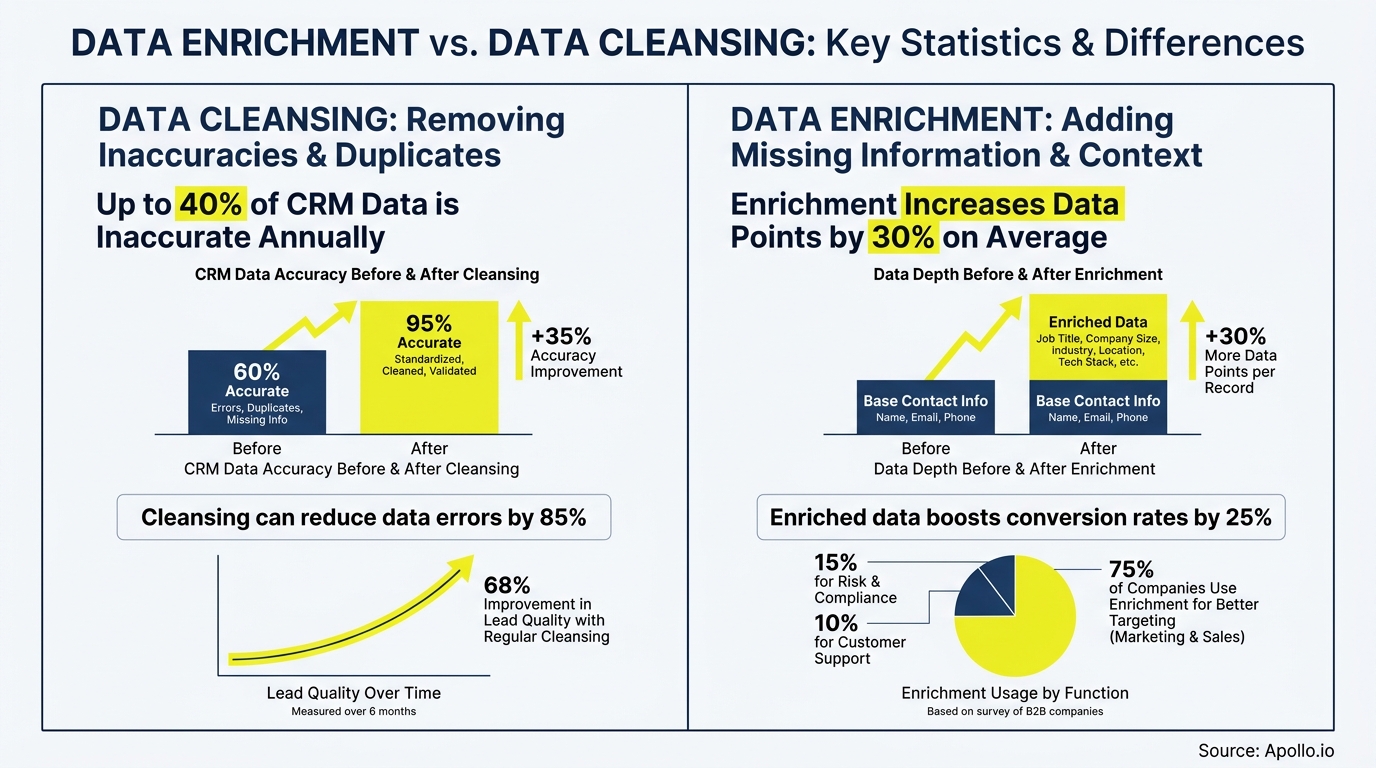
Data cleansing fixes what is wrong with your existing data. Data enrichment adds new information to what you already have.
These are two distinct operations that serve different purposes and should be executed in a specific order.
| Dimension | Data Cleansing | Data Enrichment |
|---|---|---|
| Purpose | Remove errors, duplicates, and invalid records | Append missing or additional attributes |
| Input | Existing records with quality issues | Clean records missing context |
| Output | Accurate, consistent, deduplicated data | Fuller profiles with more actionable fields |
| Example | Removing bounced emails, merging duplicate contacts | Adding job title, company size, technographics |
| When to run | Before enrichment, and continuously | After cleansing is complete |
| Primary owner | RevOps or data governance team | RevOps or marketing ops |
As noted by Datamaticsbpm, the US economy alone incurs approximately $3.1 trillion in annual costs due to poor data quality. That scale of waste makes the cleansing-first discipline non-negotiable for any team running revenue operations at volume.
Why Does Sequencing Matter: Cleansing Before Enrichment?
Enriching data before cleansing it compounds errors instead of correcting them. If a contact record has a wrong email domain or a duplicated company entry, appending additional fields to that record spreads the error further into your CRM, scoring models, and outreach sequences.
Research from AMarketForce shows companies can lose up to 12% to 15% of their annual revenue due to poor data quality. For a $10M business, that is $1.2M to $1.5M lost annually to avoidable data errors. Cleansing is cost avoidance. Enrichment is growth investment. Both matter, but order determines outcome.
According to StarsSMP, data cleansing should typically precede data enrichment to ensure that new data is added to an accurate foundation. This sequencing principle applies equally to B2B CRM data, marketing lists, and AI training datasets.
Tired of bounced emails killing your deliverability? Apollo's verified contact database keeps your outreach hitting real inboxes.
Turn Funnel Guesswork Into Qualified Pipeline
Pipeline forecasting a guessing game because marketing leads never convert? Apollo surfaces high-intent prospects so your funnel fills with opportunities that actually close. Nearly 100K paying customers stopped guessing and started growing.
Start Free with Apollo →How Do RevOps and SDR Teams Apply This in Practice?
RevOps leaders treat cleansing as an ongoing ops function and enrichment as a targeted augmentation step. SDRs and BDRs feel the downstream impact most directly: bounced emails, wrong phone numbers, and misrouted leads all trace back to skipped cleansing.
A practical two-phase workflow looks like this:
Phase 1: Cleansing Checklist
- Deduplicate contacts and accounts in CRM
- Validate and remove invalid or bounced email addresses
- Standardize field formats (phone numbers, job titles, company names)
- Flag and remove records with missing required fields
- Merge or resolve conflicting records
Phase 2: Enrichment Targets
- Append missing firmographic data (industry, headcount, revenue range)
- Add technographic signals to prioritize accounts by tech stack fit
- Layer in intent data to surface in-market accounts
- Use job change alerts to trigger re-engagement with moved contacts
- Enrich inbound leads with company data to enable faster routing
For Account Executives managing active pipeline, enrichment provides the pre-meeting context that shortens discovery and improves conversion. For founders building outbound from scratch, cleansing the initial import before enriching it prevents wasted sequences from day one.
Learn more about how contact data enrichment drives measurable ROI for B2B GTM teams.

What Are the AI and Compliance Risks of Skipping Cleansing?
In 2026, skipping cleansing before enrichment creates two compounding risks: degraded AI outputs and increased compliance exposure.
AI tools trained or run on dirty CRM data produce unreliable scoring, flawed segmentation, and biased recommendations. The cleansing layer is the AI risk-control layer.
Enrichment then becomes the context expansion step that improves model accuracy, but only when the base is clean.
On the compliance side, fragmented or duplicate data increases the surface area for data governance failures. Deletion and correction workflows required under data rights regulations become significantly harder to execute when records exist in multiple conflicting states.
Clean, governed data reduces that exposure.
For teams building an enrichment strategy that supports AI workflows, the governance model should assign clear ownership: RevOps owns cleansing SLAs, and marketing ops owns enrichment coverage targets. Both teams report against shared data quality KPIs.
Which Data Enrichment Tools Should GTM Teams Use in 2026?
The right tooling consolidates cleansing signals and enrichment sources into a single workflow, rather than requiring separate vendors for each step. Teams that run cleansing in one tool, enrichment in another, and verification in a third introduce integration risk and delay.
Apollo provides an all-in-one GTM platform that combines a 230M+ person database with built-in enrichment, verification, and CRM sync. This means SDRs and RevOps teams can validate, enrich, and activate contact data without stitching together multiple point solutions.
"Having everything in one system was a game changer," noted a team at Cyera. Apollo's contact enrichment tool appends verified business contact information, firmographics, and technographics directly into your CRM, with 97% email accuracy reducing bounce risk before sequences launch.
For teams evaluating options, see the full breakdown of which data enrichment tools drive revenue in 2026.
Frequently Asked Questions
Is Data Cleansing the Same as Data Quality?
Data cleansing is one component of data quality, not a synonym. Data quality is the broader standard covering accuracy, completeness, consistency, and timeliness.
Cleansing is the process that corrects specific errors to improve that quality score.
Can You Enrich Data Without Cleansing It First?
Technically yes, but it is not advisable. Enriching uncleansed data adds valid attributes to invalid base records, which means those enriched fields will be attached to contacts that are duplicated, outdated, or unreachable.
The result is inflated record counts with no improvement in usable data quality.
How Often Should B2B Teams Cleanse Their CRM Data?
Continuous cleansing is the current best practice, replacing quarterly batch projects. Job changes, company rebrands, and contact departures happen constantly in B2B markets. Teams using job change alerts and automated enrichment maintain data freshness without manual intervention.

Start with Clean Data, Then Build from There
The difference between data enrichment and data cleansing comes down to sequence and purpose. Cleansing removes what is wrong.
Enrichment adds what is missing. Running them in the right order turns a leaky data foundation into a reliable revenue asset.
For B2B GTM teams under pipeline pressure, the fastest path to better data is a platform that handles both. Apollo consolidates contact verification, enrichment, and outreach into one workspace, eliminating the need to manage separate cleansing and enrichment vendors.
Ready to build on a clean, enriched foundation? Schedule a Demo and see how Apollo helps your team go from dirty data to booked meetings.
Prove Pipeline ROI From Day One
ROI pressure killing your next budget approval? Apollo delivers measurable pipeline impact fast, so justifying the investment is a no-brainer. Leadium 3x'd annual revenue — your results start now.
Start Free with Apollo →Don't miss these
Sales
Inbound vs Outbound Marketing: Which Strategy Wins?
Sales
What Is a Sales Funnel? The Non-Linear Revenue Framework for 2026
Sales
What Is a Go-to-Market Strategy? The 2026 GTM Playbook
See Apollo in action
We'd love to show how Apollo can help you sell better.
By submitting this form, you will receive information, tips, and promotions from Apollo. To learn more, see our Privacy Statement.
4.7/5 based on 9,690 reviews
