
What Is Tech Sales? Definition, Career Path, and Salary Guide
Tech sales is the process of selling technology products and services to businesses and professionals in their business capacity. In 2026, it's one of the fastest-growing career paths, with Gartner projecting worldwide IT spending to reach $5.74 trillion, marking a 9.3% increase year-over-year. Unlike traditional sales roles, tech sales professionals navigate complex buying committees, lengthy sales cycles, and technical product demonstrations while helping organizations solve critical business problems through B2B sales strategies.

Skip Manual Research - Apollo Finds Contacts Fast
Tired of spending 4+ hours daily hunting for contact info? Apollo delivers 224M verified contacts with 96% email accuracy. Join 550K+ companies closing deals faster.
Start Free with Apollo →Key Takeaways
- Tech sales professionals sell software, hardware, cloud services, and AI solutions to businesses, earning average base salaries of $75K-$120K plus commission.
- The global tech market will reach $5.74 trillion in 2026, with generative AI spending alone hitting $644 billion, creating massive opportunities for sales professionals.
- Success requires a blend of technical knowledge, consultative selling skills, and the ability to navigate complex enterprise buying processes.
- SDRs and AEs use modern sales tech stacks to prospect, engage, and close deals, with all-in-one platforms replacing 3-5 separate tools.
- Regional expansion strategies in APAC and Europe require localized approaches, with 30% of first-time geographic expansions remaining unprofitable without proper planning.
What Is Tech Sales?
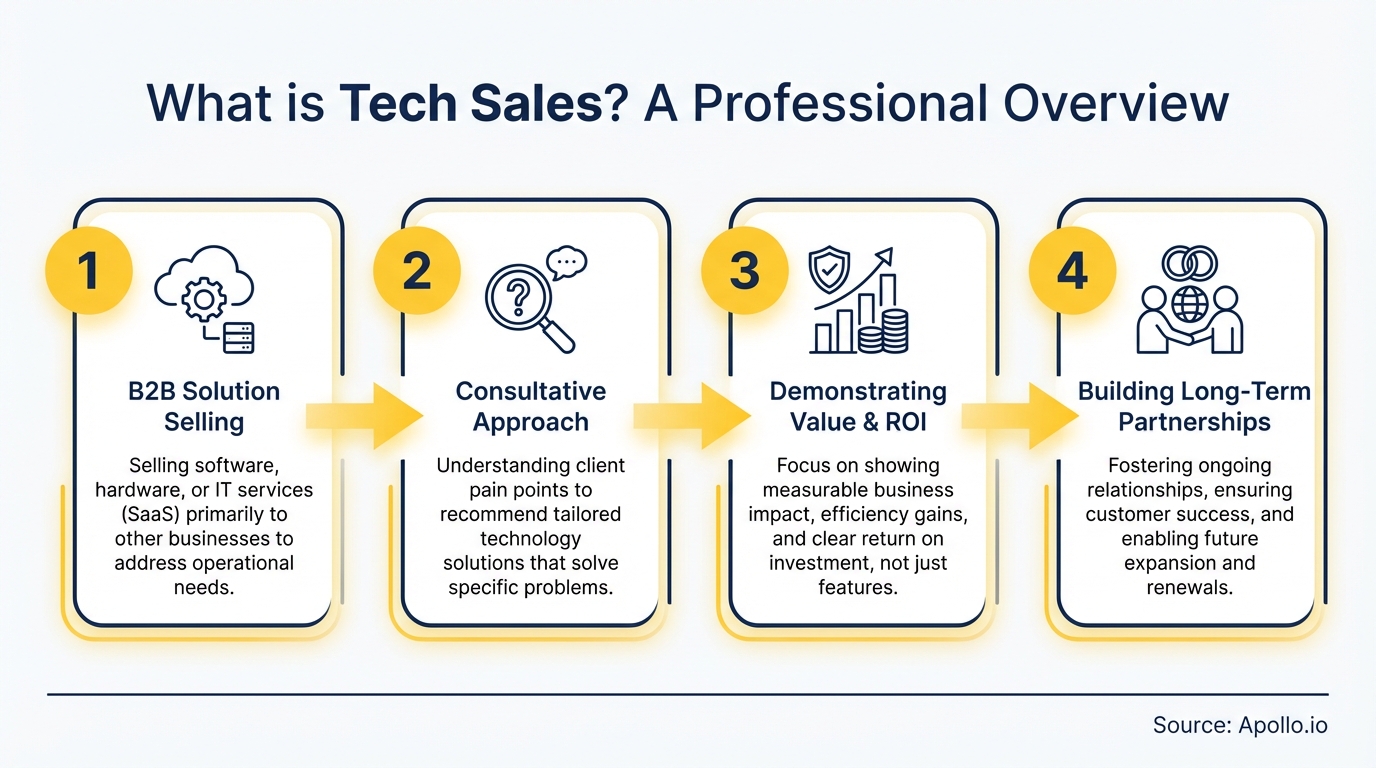
Tech sales is the profession of selling technology solutions (software, hardware, cloud services, AI tools, cybersecurity, and IT infrastructure) to businesses and professionals in their business capacity. Tech sales professionals act as trusted advisors who understand both the technical capabilities of their products and the business problems their prospects face.
The role differs from traditional sales in several key ways. Tech sales involves longer sales cycles (3-18 months for enterprise deals), multiple stakeholders (IT, finance, operations, C-suite), and requires technical fluency to demonstrate product value. According to Forrester, global technology expenditure is expected to grow by 5.6% in 2026, totaling $4.9 trillion, driven by rapid adoption of software, IT services, generative AI, and cloud technologies.
Common tech sales categories include SaaS (Software as a Service), cloud infrastructure, cybersecurity solutions, AI and machine learning platforms, data analytics tools, and hardware systems. Sales professionals in this field earn competitive compensation packages combining base salary, commission, and equity, with top performers making $200K+ annually.
How Does the Tech Sales Process Work?
The tech sales process follows a structured methodology tailored to complex B2B buying cycles. It starts with prospecting and lead generation, where SDRs identify target accounts and decision-makers using data platforms and sales development strategies.
Once leads are qualified, the process moves through distinct stages:
- Discovery: Understanding prospect pain points, current tech stack, budget, timeline, and decision-making process
- Demo/Presentation: Showcasing product capabilities aligned to specific business needs
- Proof of Concept (POC): Providing trial periods or pilot programs to demonstrate ROI
- Negotiation: Working through pricing, contract terms, implementation scope, and legal requirements
- Closing: Securing signatures and transitioning to customer success teams
Struggling to find qualified tech buyers? Search Apollo's 224M+ contacts with 65+ filters targeting IT decision-makers.
Throughout this process, tech sales professionals leverage CRM systems, sales tech stacks, and collaboration tools. Modern sellers use all-in-one platforms to consolidate prospecting, engagement, and pipeline management instead of juggling 3-5 separate tools.
What Are the Main Tech Sales Roles?
Tech sales teams are structured with specialized roles, each focusing on specific stages of the buyer journey. Understanding these roles helps you identify the right career path or build effective sales organizations.
| Role | Primary Responsibility | Key Metrics | Typical Experience |
|---|---|---|---|
| SDR/BDR | Outbound prospecting, booking qualified meetings | Meetings booked, SQLs generated | Entry-level, 0-2 years |
| Account Executive (AE) | Running demos, managing deals, closing revenue | Revenue closed, quota attainment | 2-5 years |
| Solutions Engineer (SE) | Technical demos, answering product questions | Demo-to-close rate, technical win rate | 3-7 years technical background |
| Customer Success Manager | Post-sale adoption, renewals, expansion revenue | Net revenue retention, expansion ARR | 2-5 years |
| Sales Leader/Manager | Team coaching, strategy, forecast accuracy | Team quota attainment, pipeline health | 5+ years |
For SDRs managing outbound campaigns, having everything in one workspace accelerates meeting bookings. RevOps leaders report that tool consolidation eliminates data silos and improves forecast accuracy. As Predictable Revenue shared, "We reduced the complexity of three tools into one," cutting costs while improving team performance.
Turn Forecast Chaos Into Revenue Certainty
Pipeline forecasting a guessing game? Apollo tracks every deal stage in real-time with buyer intent signals. Built-In increased win rates 10% with Apollo's scoring and visibility.
Start Free with Apollo →How Do SDRs and AEs Succeed in Tech Sales?
SDRs succeed by mastering high-volume, personalized outreach at scale. Top-performing SDRs research accounts thoroughly, craft tailored messaging referencing specific pain points, and leverage multi-channel sequences (email, LinkedIn, phone) to break through noise.
They focus on booking meetings with qualified prospects who have budget, authority, need, and timeline (BANT criteria).
Key SDR success factors include:
- Researching prospects using intent data and company signals before outreach
- Testing subject lines, email copy, and call scripts to optimize response rates
- Following up persistently (8-12 touchpoints) without being pushy
- Qualifying leads rigorously to pass only sales-ready opportunities to AEs
Account Executives win deals by becoming trusted advisors who deeply understand customer business challenges. Top AEs conduct thorough discovery calls using frameworks like MEDDIC (Metrics, Economic Buyer, Decision Criteria, Decision Process, Identify Pain, Champion). They build business cases showing quantifiable ROI, navigate complex buying committees, and leverage proven closing techniques to overcome objections.
Spending hours on manual outreach and research? Automate your sequences with Apollo's multi-channel engagement platform.
Why Is Tech Sales Growing So Fast in 2026?
Tech sales is experiencing explosive growth driven by three converging forces: digital transformation acceleration, AI adoption, and cloud migration. Research by Gartner forecasts worldwide generative AI spending to reach $644 billion in 2026, reflecting a 76.4% increase from the previous year.
Businesses are replacing legacy systems with modern cloud platforms, creating massive opportunities for sales professionals who can articulate migration benefits. Every company is becoming a tech company, requiring software for operations, customer engagement, data analysis, and automation.
This trend creates demand across industries (healthcare, finance, manufacturing, retail) beyond traditional tech sectors.
Geographic expansion is fueling growth, particularly in APAC and Europe. Data from Gartner shows IT spending in Europe will total $1.28 trillion in 2026, an 8.7% increase, with AI-related IT services spending growing 21%. However, Gartner research also reveals that 30% of software providers' first-time geographic expansions remain unprofitable after two years, highlighting the need for strategic market entry planning.
The shift to remote and hybrid work models has accelerated adoption of collaboration tools, cybersecurity solutions, and AI-powered GTM systems. Companies are consolidating vendors to reduce complexity, creating opportunities for all-in-one solutions that replace fragmented tech stacks.
What Skills Do You Need for Tech Sales Success?
Tech sales requires a unique blend of soft skills, technical knowledge, and business acumen. Unlike pure technical roles, success comes from translating complex product capabilities into business outcomes that resonate with decision-makers.
Essential skill categories include:
- Communication: Articulating value clearly to both technical and non-technical audiences
- Active Listening: Understanding unstated needs and pain points through discovery
- Technical Fluency: Grasping product architecture, APIs, integrations, and security without needing engineering expertise
- Business Acumen: Connecting product features to revenue growth, cost reduction, and competitive advantage
- Relationship Building: Developing trust with multiple stakeholders across long sales cycles
- Resilience: Handling rejection, maintaining motivation through quota pressure
- Time Management: Prioritizing high-value activities using frameworks like sales funnel optimization
Successful tech sales professionals continuously learn through product training, industry research, and peer collaboration. They master consultative sales techniques and stay current on competitor offerings, market trends, and emerging technologies. Sales Leaders coaching teams emphasize skill development in discovery questioning, objection handling, and deal progression strategies.
How to Break Into Tech Sales in 2026
Breaking into tech sales is accessible even without a technical background. Most companies hire entry-level SDRs based on coachability, work ethic, and communication skills rather than requiring engineering degrees or coding experience.
Start by researching companies and products that interest you. Choose a category (SaaS, cybersecurity, data analytics, AI) where you can authentically articulate value.
Many successful sellers begin at high-growth startups or established tech companies with strong training programs (Salesforce, HubSpot, Oracle, Microsoft).

Proven entry strategies include:
- Applying directly to SDR roles at companies with clear career progression paths
- Leveraging your existing network to get warm introductions to sales leaders
- Completing free sales training (HubSpot Academy, LinkedIn Learning) to demonstrate commitment
- Showcasing transferable skills from customer service, account management, or other client-facing roles
- Practicing sales pitch techniques by doing mock demos of products you use daily
Once hired, focus on ramping quickly by shadowing top performers, role-playing discovery calls, and seeking feedback from managers. Most SDRs who consistently hit quota get promoted to AE roles within 12-18 months.
Founders building sales teams should implement structured onboarding programs and pair new reps with experienced mentors.
Start Your Tech Sales Journey With the Right Tools
Tech sales success in 2026 requires the right combination of skills, strategy, and technology. The most successful sales professionals leverage all-in-one platforms that consolidate prospecting, engagement, and pipeline management, eliminating the complexity and cost of managing 3-5 separate tools.
Whether you're an SDR booking your first meetings, an AE closing enterprise deals, or a Sales Leader building a high-performing team, having a unified workspace accelerates results. As Census reported after consolidating their tech stack, "We cut our costs in half," while Cyera emphasized that "Having everything in one system was a game changer."

Apollo provides 2M+ sales professionals with access to 224M verified business contacts, AI-powered engagement tools, and complete pipeline visibility in one platform. From prospecting to closing, Apollo helps tech sales teams work faster, sell smarter, and hit quota consistently.
Ready to accelerate your tech sales career or scale your team? Start a trial and experience how Apollo consolidates your entire sales workflow into one powerful platform.
Prove Apollo's ROI In Your First 30 Days
Budget approval stuck on unclear metrics? Apollo tracks every dollar impact—pipeline generated, time saved, deals closed. Customer. io achieved 50% YoY growth with measurable ROI.
Start Free with Apollo →Don't miss these
Sales
Inbound vs Outbound Marketing: Which Strategy Wins?
Sales
What Is a Sales Funnel? The Non-Linear Revenue Framework for 2026
Sales
What Is a Go-to-Market Strategy? The 2026 GTM Playbook
See Apollo in action
We'd love to show how Apollo can help you sell better.
By submitting this form, you will receive information, tips, and promotions from Apollo. To learn more, see our Privacy Statement.
4.7/5 based on 9,690 reviews
