What Is SaaS Sales? Definition, Models, and Strategies
SaaS sales is selling cloud-based software through subscription models where customers access applications online rather than installing them locally. Unlike traditional software sales with one-time licenses, SaaS companies build recurring revenue through monthly or annual subscriptions. This model has transformed how businesses buy and sell software, with Gartner reporting the enterprise SaaS market reached $218.5 billion in 2024, growing 16.7% year-over-year.
The shift to SaaS sales requires different strategies than selling traditional software. Sales teams focus on demonstrating value quickly, reducing friction in the buying process, and proving ROI through trial periods or freemium models. For SDRs and AEs, this means shorter sales cycles for lower-tier products but longer, more complex deals for enterprise solutions requiring executive buy-in.

Apollo Eliminates 4+ Hours Of Daily Research
Tired of spending hours hunting for accurate contact info? Apollo delivers 224M verified contacts with 96% email accuracy instantly. Join 550K+ companies who closed deals faster.
Start Free with Apollo →Key Takeaways
- SaaS sales focuses on recurring revenue through subscriptions, requiring different strategies than one-time software purchases
- The enterprise SaaS market hit $218.5 billion in 2024, with AI-powered solutions driving unprecedented growth
- Modern SaaS sales teams use hybrid approaches combining human touchpoints with digital self-serve channels
- SDRs and AEs need tools that consolidate prospecting, engagement, and pipeline management into one platform
- Success in SaaS sales depends on proving value quickly through trials, demos, and clear ROI metrics
What Is SaaS Sales?
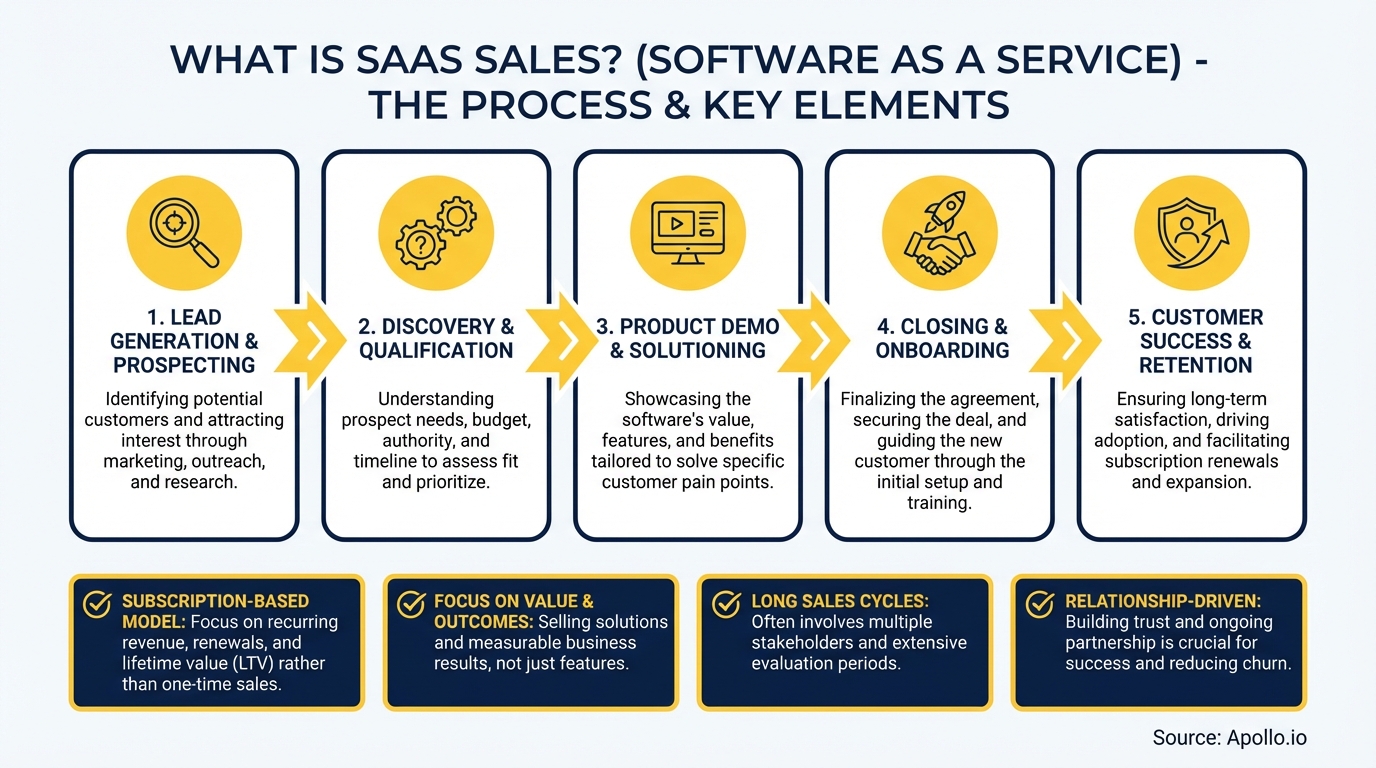
SaaS sales is the process of selling subscription-based cloud software to businesses and professionals. Unlike traditional software requiring installation and upfront licensing fees, SaaS products are accessed through web browsers with recurring payments.
Sales reps focus on demonstrating immediate value, reducing time-to-value, and building long-term customer relationships since revenue depends on retention.
The model creates predictable revenue streams but requires constant attention to churn rates and expansion opportunities. According to Gartner research, 72% of B2B buyers still complete transactions through sales rep-led channels, while 28% prefer digital-led channels. This data shows that human touchpoints remain critical even as self-serve options grow.
SaaS sales professionals must understand both B2B sales fundamentals and the unique aspects of cloud software delivery models.
How Does the SaaS Sales Process Work?
The SaaS sales process typically follows a structured path from prospecting to closing, but varies significantly based on deal size and customer segment. Most SaaS companies use one of three primary models: self-serve for small businesses, transactional sales for mid-market, or enterprise sales for large organizations.
Self-Serve Model: Customers sign up online, use free trials or freemium tiers, and upgrade without speaking to sales. This works for products under $100/month with simple use cases.
Transactional Sales: SDRs qualify inbound leads, AEs conduct demos, and deals close within 30-60 days. Contract values range from $5,000 to $50,000 annually. This is where most sales development teams focus their efforts.
Enterprise Sales: Complex deals requiring multiple stakeholders, custom implementations, and 6-12 month sales cycles. Annual contract values exceed $100,000 and often require executive buy-in.
| Sales Model | Deal Size | Sales Cycle | Key Focus |
|---|---|---|---|
| Self-Serve | $50-$1,200/year | 0-7 days | Product-led growth, conversion optimization |
| Transactional | $5K-$50K/year | 30-60 days | Qualification, demo excellence, ROI proof |
| Enterprise | $100K+/year | 6-12 months | Multi-threading, executive access, custom solutions |
How Do SDRs Succeed in SaaS Sales?
SDRs in SaaS sales book meetings by identifying prospects with specific pain points their software solves. Success depends on rapid qualification, personalized outreach, and understanding buyer intent signals.
Top-performing SDRs research accounts thoroughly before reaching out, reference relevant use cases, and articulate value in the prospect's language.
The best SDRs use multi-channel approaches combining email, phone, and social selling. They track engagement across touchpoints and know when to pivot strategies. Struggling to find qualified leads? Search Apollo's 224M+ contacts with 65+ filters to build targeted prospect lists based on company size, technology usage, and buying signals.
Modern SDRs leverage AI sales tools to automate research, personalize outreach at scale, and prioritize high-intent accounts. This allows them to focus on conversations rather than administrative tasks.
Turn Forecast Guesswork Into Revenue Certainty
Pipeline forecasting a guessing game? Apollo gives you real-time deal visibility and intent signals to predict revenue with confidence. Built-In increased win rates 10% with Apollo's scoring and guidance.
Start Free with Apollo →What Makes SaaS Sales Different From Traditional Software Sales?
SaaS sales differs fundamentally because customers can cancel subscriptions anytime, making customer success critical to revenue retention. Traditional software sales focused on closing large upfront deals, while SaaS emphasizes land-and-expand strategies where initial deals are smaller but grow through upsells and cross-sells.
The subscription model means sales teams care deeply about product adoption and usage metrics. Low engagement signals churn risk, so AEs work closely with customer success teams to ensure value realization.
This collaborative approach requires different skills than transactional selling.
SaaS buyers expect free trials, transparent pricing, and self-serve resources before talking to sales. Research by Forrester shows that more than half of large B2B transactions over $1 million will be processed through digital self-serve channels by 2025, fundamentally changing how enterprise deals close.
Why Are SaaS Sales Teams Consolidating Their Tech Stacks in 2026?
SaaS sales teams are cutting their tech stacks because managing multiple disconnected tools creates data silos, integration headaches, and unnecessary costs. The average sales team uses 6-10 separate tools for prospecting, engagement, data enrichment, and pipeline management.
This fragmentation slows reps down and makes accurate forecasting nearly impossible for RevOps leaders.
Tool consolidation delivers immediate benefits: cleaner data, unified workflows, and significant cost savings. Census reported cutting their costs in half by consolidating tools, while Cyera noted that having everything in one system was a game changer for their go-to-market execution.

Spending hours switching between prospecting databases, email tools, and CRM systems? Automate your sequences with Apollo's all-in-one platform that combines 224M+ verified contacts, multi-channel engagement, and pipeline management in one workspace.
For sales leaders managing distributed teams, a unified platform provides visibility into activities, conversion metrics, and rep performance without requiring data from multiple systems. This is why RevOps teams prioritize platform consolidation as a strategic initiative.
What Skills Do Account Executives Need for SaaS Sales?
Account Executives in SaaS sales need consultative selling skills, technical fluency, and the ability to articulate ROI quickly. Top AEs act as trusted advisors who understand their prospect's business challenges, not just product features.
They map software capabilities to specific pain points and quantify expected outcomes.
AEs must excel at running discovery calls, conducting product demos, handling objections, and navigating complex buying committees. They need to multi-thread within accounts, building relationships with end users, managers, and executives simultaneously.
This requires strong relationship management and political awareness.
Technical skills matter increasingly as buyers expect AEs to answer detailed implementation questions.
Understanding APIs, integrations, security protocols, and data architecture helps AEs build credibility with technical buyers.
Successful AEs also master sales email techniques and follow-up strategies that keep deals moving forward.
How Is AI Transforming SaaS Sales in 2026?
AI is transforming SaaS sales by automating research, personalizing outreach, and providing real-time conversation intelligence. Sales teams use AI to analyze millions of data points, identify high-intent prospects, and generate tailored messaging that resonates with specific buyer personas.
This technology handles time-consuming tasks so reps focus on relationship-building and closing.
AI-powered tools now write prospecting emails, summarize sales calls, suggest next steps, and predict deal outcomes based on historical patterns. For founders and sales leaders, this means faster team ramp times and more predictable revenue.
New SDRs reach quota 40% faster when supported by AI research and messaging assistance.

The shift toward AI-enabled selling doesn't replace human judgment. Instead, it augments rep capabilities by surfacing insights they'd miss manually. AEs using AI call assistants report 35% more meetings booked because they capture every detail and follow up strategically. This is why adoption of modern sales tools has accelerated dramatically across SaaS organizations.
Conclusion: The Future of SaaS Sales
SaaS sales in 2026 requires balancing human expertise with AI-powered efficiency, consolidating fragmented tech stacks, and adapting to buyer preferences for hybrid purchasing experiences. The most successful teams use unified platforms that eliminate tool sprawl while maintaining the personalized touchpoints that close deals.
Whether you're an SDR prospecting new accounts, an AE managing complex deals, or a sales leader building scalable processes, the fundamentals remain constant: understand your buyer, prove value quickly, and build relationships that drive retention and expansion. The difference now is having tools that make these activities faster, smarter, and more predictable.
Ready to modernize your SaaS sales approach? Start prospecting with Apollo's all-in-one platform and see how consolidating your tools accelerates pipeline growth.
Prove Apollo's ROI In 30 Days, Not 90
Budget approval stuck on unclear metrics? Apollo delivers measurable pipeline impact from day one—quantifiable time savings, faster deal velocity, and revenue growth your CFO will love. Built-In increased win rates 10% and ACV 10% with Apollo's scoring.
Start Free with Apollo →Don't miss these
Sales
Inbound vs Outbound Marketing: Which Strategy Wins?
Sales
What Is a Sales Funnel? The Non-Linear Revenue Framework for 2026
Sales
What Is a Go-to-Market Strategy? The 2026 GTM Playbook
See Apollo in action
We'd love to show how Apollo can help you sell better.
By submitting this form, you will receive information, tips, and promotions from Apollo. To learn more, see our Privacy Statement.
4.7/5 based on 9,690 reviews
