What Is Prospecting in Sales? Definition, Process, and Best Practices
Sales prospecting in 2026 looks nothing like the cold-call blitzes of the past. Buyers research independently, avoid irrelevant outreach, and expect relevance before they'll engage. According to Flowlu, 96% of prospects research before speaking to a sales representative. The challenge: how do you earn attention when B2B buyers control the journey?

Apollo Eliminates 4+ Hours Of Daily Research
Tired of spending 4+ hours daily hunting for contact info? Apollo delivers 224M verified contacts with 96% email accuracy. Join 550K+ companies closing more deals.
Start Free with Apollo →Key Takeaways
- Prospecting means earning permission to engage through relevance, not just initiating contact with volume tactics
- Buyers prefer self-serve experiences and avoid suppliers who send irrelevant outreach
- Signal-based prospecting (intent data, triggers, buyer actions) outperforms static list-building approaches
- SDRs and BDRs spend most time on non-selling activities, making automation and targeting critical for efficiency
- Multi-channel orchestration (email, phone, social) drives higher engagement than single-channel approaches
What Is Prospecting in Sales?
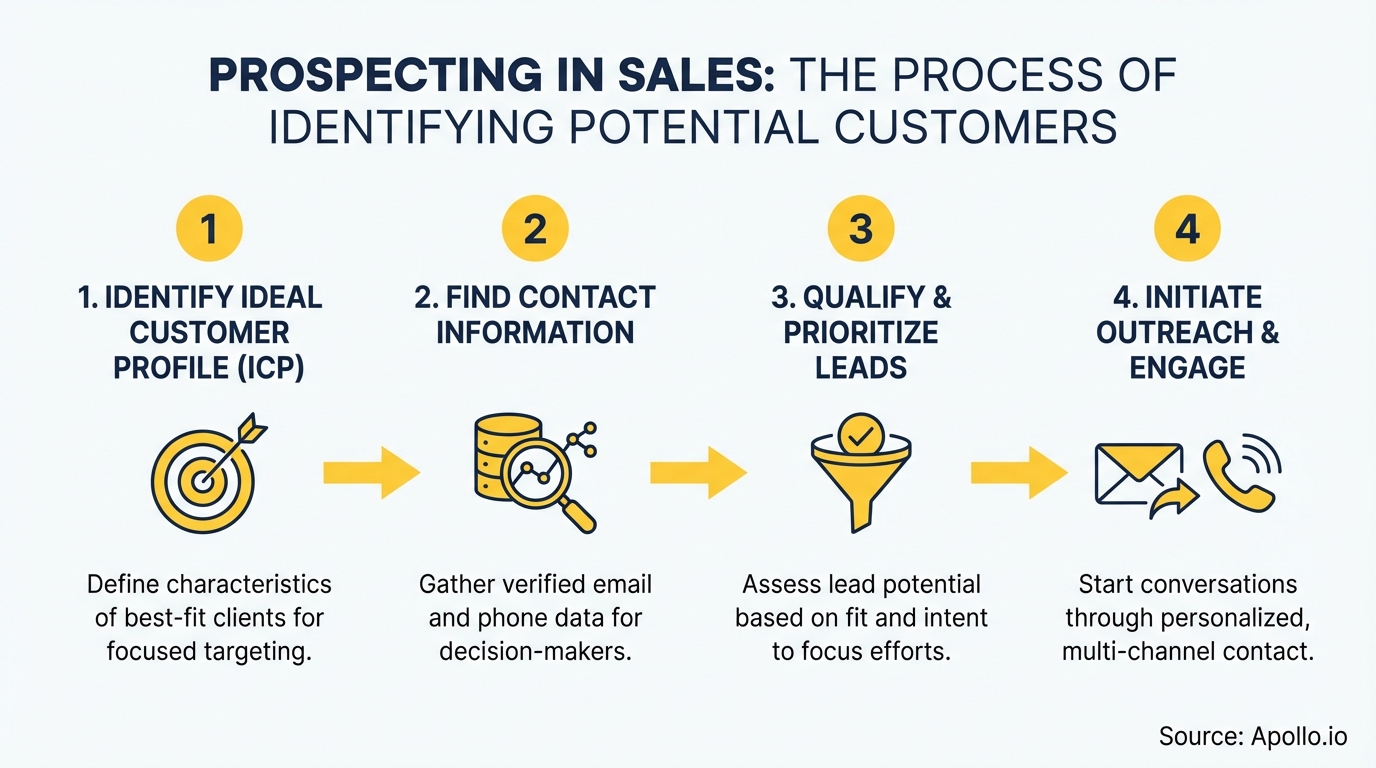
Sales prospecting is the process of identifying and engaging potential customers who match your ideal customer profile. It involves researching accounts, finding decision-makers, and initiating contact to qualify leads for your sales funnel. In 2026, prospecting prioritizes earning buyer attention with relevant, personalized outreach rather than high-volume cold approaches.
Modern prospecting combines data intelligence, trigger-based timing, and multi-channel engagement. Landbase reports that sales representatives spend only 28-34% of their time on actual selling activities, with the rest consumed by administrative tasks and research. This makes efficient prospecting systems essential for sales productivity.
Why Does Sales Prospecting Matter in 2026?
Research from Gartner found that 61% of B2B buyers prefer an overall rep-free buying experience. This shift means prospecting must happen where buyers already research and on their timeline. Traditional interruption tactics create brand damage rather than pipeline.
Buyers now form Day One shortlists before engaging sales teams. If your company isn't on that shortlist, outreach rarely changes the outcome.
Prospecting in 2026 focuses on influencing early consideration through content, social proof, and strategic visibility before direct contact occurs.
What Challenges Do SDRs Face With Modern Prospecting?
SDRs managing prospecting workflows face three core constraints: time allocation, channel effectiveness, and relevance requirements. Lead Forensics reports that salespeople spend an average of only two hours per day actively selling. The rest goes to research, data entry, and administrative work.
Channel performance adds pressure. Cold email open rates hover around 15-25% for well-targeted B2B campaigns, according to Martal. Cold calling faces similar resistance. Without strong targeting and multi-touch sequencing, prospecting volume creates minimal pipeline.
Struggling to find qualified leads? Search Apollo's 224M contacts with 65+ filters to build targeted prospect lists faster.
How Do Sales Teams Prospect Effectively Today?
Effective prospecting in 2026 combines three elements: signal-based targeting, omnichannel orchestration, and automation for non-selling tasks. Teams use intent data, hiring triggers, funding announcements, and buyer engagement signals to time outreach when prospects actively evaluate solutions.
Multi-channel sequences perform better than single-channel approaches. High-performing outbound teams allocate their time with 57% on phone outreach, 27% on social activity, and 15% on email, according to Cognism. This balanced approach meets buyers across their preferred channels.
What Tools Support Signal-Based Prospecting?
Modern prospecting tools integrate contact data, intent signals, and engagement automation in one platform. Sales intelligence platforms provide verified contact information, company technographics, funding data, and job change alerts. These signals help teams prioritize accounts showing buying intent.
Automation handles repetitive tasks like email sequencing, follow-up scheduling, and activity logging. This frees SDRs and BDRs to focus on personalization, calls, and qualification conversations.
Teams using unified platforms report consolidating three to five separate tools, reducing costs and simplifying workflows.
Turn Forecasting Chaos Into Revenue Certainty
Missing quota because your pipeline data is outdated? Apollo delivers real-time deal visibility and intent signals that make forecasting reliable. Built-In boosted win rates 10% with Apollo's scoring.
Start Free with Apollo →What Are the Key Components of a Prospecting Strategy?
A complete prospecting strategy includes five components: ideal customer profile definition, contact discovery, multi-channel engagement, qualification criteria, and performance measurement. Start by defining your ICP with firmographic filters (company size, industry, location) and behavioral signals (technology usage, recent funding, hiring patterns).
Build prospect lists using sales intelligence databases with verified contact data. Layer in trigger events and intent signals to prioritize accounts. Design multi-touch sequences that combine email, phone, social, and video prospecting across 8-12 touchpoints over 3-4 weeks.

How Should Teams Structure Prospecting Workflows?
| Stage | Activities | Key Metrics |
|---|---|---|
| Research & Targeting | ICP definition, account selection, contact discovery | List size, target account fit score |
| Initial Outreach | First email, social connection, voicemail | Open rate, reply rate, connection acceptance |
| Multi-Touch Follow-Up | Email sequences, calls, social engagement | Response rate, meeting booking rate |
| Qualification | Discovery calls, needs assessment, handoff to AE | SQL conversion rate, pipeline created |
Spending hours on manual outreach? Automate your sequences with Apollo's multi-channel platform.

How Do Account Executives Use Prospecting Data?
Account Executives rely on prospecting intelligence to personalize discovery calls and shorten sales cycles. Pre-call research reveals pain points, competitive context, and buying triggers. AEs use this data to lead with relevant insights rather than generic discovery questions.
Prospecting data also supports account-based strategies for enterprise sales. AEs identify multiple stakeholders within target accounts, map buying committees, and coordinate multi-threaded engagement. This approach increases deal sizes and win rates for complex opportunities.
What Metrics Define Prospecting Success?
Track four core prospecting metrics: activity volume (emails sent, calls made), engagement rates (opens, replies, connections), conversion rates (meetings booked, SQLs created), and pipeline contribution (revenue influenced, deals sourced). Compare your performance against industry benchmarks to identify improvement areas.
Leading indicators like reply rates and meeting booking rates predict pipeline health 30-60 days ahead. Monitor these weekly to catch performance issues early.
Lagging indicators like pipeline created and revenue influenced measure long-term prospecting ROI and justify resource allocation.
What Benchmarks Should Teams Target?
- Cold Email Open Rate: 15-25% (campaigns with strong subject lines and sender reputation)
- Email Reply Rate: 5-8% (targeted outreach with personalization)
- Meeting Booking Rate: 1-2% of total emails sent (qualified prospects)
- Dial-to-Connect: 15-20% of calls (proper timing and list quality)
- Connect-to-Meeting: 10-15% of conversations (strong qualification)
Use these benchmarks to calculate required activity levels. For example, booking 10 meetings per week at a 1.5% email-to-meeting rate requires sending 667 emails weekly.
Factor in multi-touch sequences and follow-up cadences when planning capacity.
Start Building Your Prospecting Engine
Sales prospecting in 2026 rewards relevance, timing, and efficiency over volume. Buyers expect personalized outreach triggered by genuine signals, not spray-and-pray tactics.
Teams succeeding today use sales intelligence platforms to identify high-fit accounts, automate repetitive tasks, and orchestrate multi-channel engagement.
The shift toward signal-based, buyer-centric prospecting creates opportunities for teams willing to invest in better data, smarter workflows, and unified technology. Companies consolidating their tech stack report significant cost savings and faster rep ramp times.
As one customer shared: "We reduced the complexity of three tools into one" (Predictable Revenue).
Ready to transform your prospecting motion? Get Leads Now with Apollo's all-in-one platform for prospecting, engagement, and pipeline management.
Prove ROI In Days, Not Quarters With Apollo
Budget approval stuck on unclear metrics? Apollo delivers measurable pipeline impact from day one—quantifiable meetings booked, opportunities created, deals closed. Customer. io achieved 50% YoY growth with Apollo.
Start Free with Apollo →Don't miss these
Sales
Inbound vs Outbound Marketing: Which Strategy Wins?
Sales
What Is a Sales Funnel? The Non-Linear Revenue Framework for 2026
Sales
What Is a Go-to-Market Strategy? The 2026 GTM Playbook
See Apollo in action
We'd love to show how Apollo can help you sell better.
By submitting this form, you will receive information, tips, and promotions from Apollo. To learn more, see our Privacy Statement.
4.7/5 based on 9,690 reviews
