
What Is Outside Sales? Definition, Strategy, and Best Practices
Outside sales is evolving faster than most teams can adapt. While 61% of B2B buyers now prefer self-service buying experiences, field reps still close the deals that matter most.
The winning approach in 2026 combines face-to-face relationship building with digital tools that eliminate busywork and accelerate pipeline velocity.
This guide shows you how to build a modern outside sales strategy that blends field expertise with AI-powered automation. You'll discover frameworks used by top-performing teams, implementation playbooks, and metrics that prove ROI. Whether you're an SDR building territory or a sales leader scaling your team, this is your blueprint for 2026.

Scale Your Team Without The Growing Pains
Struggling with inconsistent processes as your team grows? Apollo standardizes playbooks and automates workflows so every rep performs like your best. Join 550K+ companies scaling smarter.
Start Free with Apollo →Key Takeaways
- Outside sales reps close deals face-to-face in customer locations, combining field expertise with digital enablement tools
- Hybrid models outperform pure field or inside approaches, with 70% of companies investing in blended teams
- Modern outside sales requires tool consolidation to eliminate context switching and boost productivity
- Account Executives using AI-powered prospecting and enrichment tools report 35% higher booking rates
- Success metrics now include digital engagement alongside traditional pipeline and revenue KPIs
What Is Outside Sales?
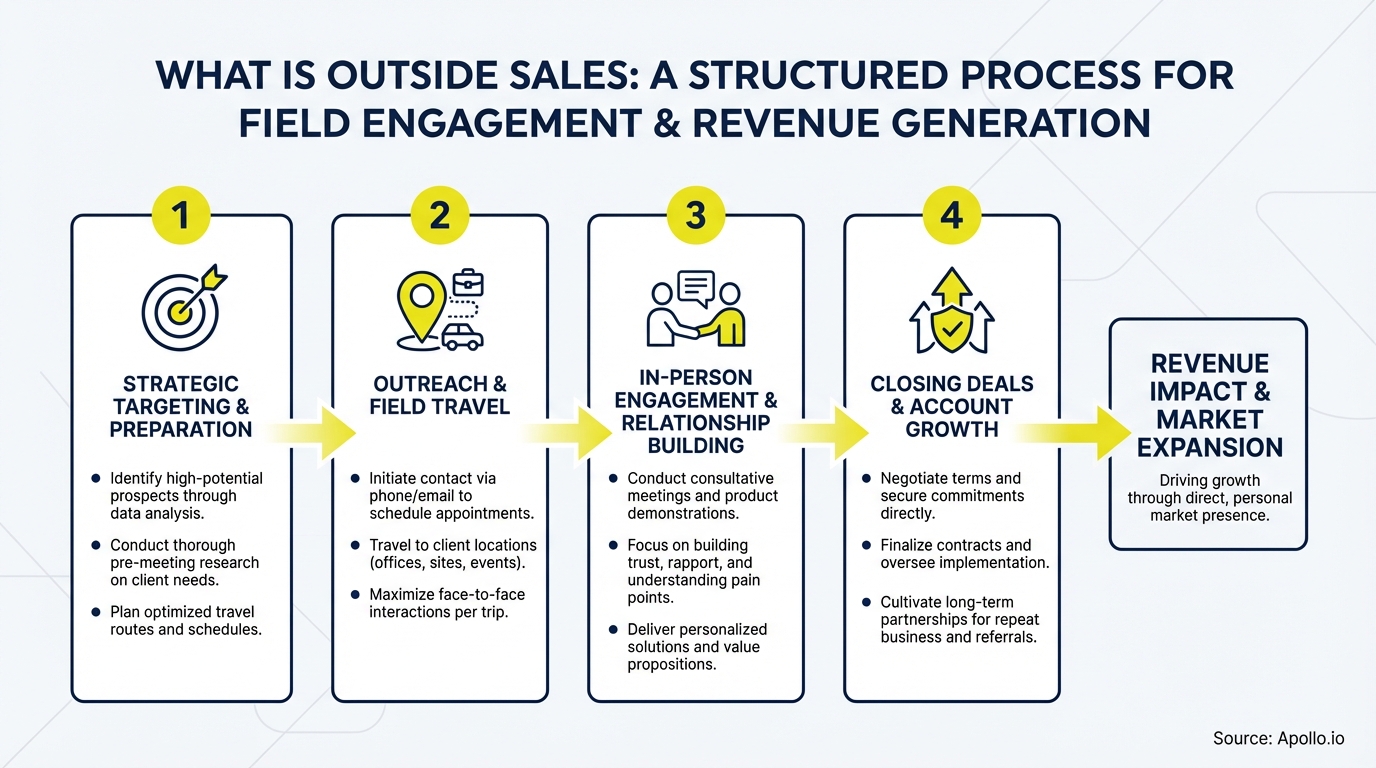
Outside sales is a sales model where representatives meet prospects and customers face-to-face, typically at customer locations, trade shows, or neutral meeting spaces. Unlike inside sales reps who work from an office using phones and digital channels, outside sales professionals travel to build relationships and close complex, high-value deals in person.
The role focuses on consultative selling for enterprise accounts, strategic partnerships, and transactions requiring extensive product demonstrations or relationship building. Outside sales reps manage territories, conduct site visits, and leverage in-person interactions to navigate multi-stakeholder buying committees. According to Gartner research, even as 61% of buyers prefer self-service experiences, outside sales remains critical for deals requiring executive alignment and custom solutions.
Modern outside sales integrates digital tools with field activities. Reps use B2B prospecting platforms to research accounts before meetings, mobile CRMs to log interactions in real-time, and AI assistants to automate follow-up tasks. This hybrid approach combines the trust-building power of face-to-face meetings with the efficiency of automation.
How Does Outside Sales Differ From Inside Sales?
Outside sales and inside sales use fundamentally different approaches to reach buyers. Outside reps travel to customer locations and focus on complex, high-touch deals.
Inside reps work remotely using phones, video calls, and email to handle higher volumes of smaller transactions.

| Factor | Outside Sales | Inside Sales |
|---|---|---|
| Location | Customer sites, trade shows, field | Office or remote workspace |
| Deal Size | $50K-$5M+ enterprise contracts | $5K-$100K mid-market deals |
| Sales Cycle | 3-18 months, multi-stakeholder | 1-3 months, faster velocity |
| Activities | Site visits, demos, executive dinners | Cold calls, email sequences, video demos |
| Territory | Geographic regions, named accounts | Vertical markets, inbound leads |
| Cost per Rep | $150K-$300K (travel, comp, tools) | $80K-$150K (lower overhead) |
The lines between these models are blurring. Research by McKinsey shows 70% of companies now deploy hybrid teams that combine field presence with digital outreach. Account Executives handle strategic accounts in person while SDRs qualify leads remotely, creating a coordinated sales funnel that maximizes efficiency and relationship depth.

Find In-Market Buyers Before Your Competitors Do
Missing ready-to-buy prospects while competitors close your deals? Apollo's buyer intent signals reveal who's actively searching right now. Built-In increased win rates 10% with Apollo scoring.
Start Free with Apollo →Why Do Companies Still Invest in Outside Sales?
Outside sales delivers measurable advantages for complex B2B transactions despite higher costs. Companies invest in field teams because certain deals require executive presence, hands-on product validation, and trust that only face-to-face interaction builds.
Key reasons organizations maintain outside sales teams:
- Enterprise deal complexity: Multi-million dollar contracts involve procurement, legal, IT, and C-suite stakeholders who expect in-person engagement
- Product demonstration needs: Industrial equipment, software implementations, and technical solutions require on-site validation
- Relationship-driven industries: Healthcare, manufacturing, and financial services prioritize long-term partnerships built through consistent face-to-face contact
- Competitive differentiation: Field presence signals commitment and separates vendors in crowded markets
- Geographic market penetration: Local presence accelerates trust in new territories and international expansion
Data from McKinsey research reveals that 75% of outperforming B2B companies excel at solution selling, a consultative approach that thrives in outside sales environments. The ability to conduct discovery, tailor presentations, and address objections in real-time creates conversion rates that justify the investment for strategic accounts.
Struggling to identify high-value accounts worth field visits? Search Apollo's 224M+ contacts with 65+ filters to build targeted account lists.
How Do Account Executives Structure Outside Sales Territories?
Account Executives structure territories using a combination of geographic boundaries, account potential, and resource allocation. Effective territory design balances travel efficiency with revenue opportunity, ensuring reps can maintain consistent customer contact while hitting quota.
Common territory design approaches:
- Geographic regions: Assign states, metro areas, or zip codes based on customer density and travel logistics
- Named account ownership: Allocate specific enterprise customers to senior AEs regardless of location
- Vertical market focus: Organize by industry (healthcare, fintech, manufacturing) to build specialized expertise
- Hybrid models: Combine geographic boundaries with account size tiers (enterprise vs. mid-market)
Sales leaders use account scoring to prioritize territory assignments.
They evaluate factors like company size, technology stack, growth trajectory, and buying signals.
AEs focus field visits on accounts showing strong intent while using email sequences and video calls for lower-priority prospects.
RevOps teams monitor territory performance using metrics like accounts per rep, average deal size, win rate by region, and travel cost as a percentage of revenue. They rebalance territories quarterly based on pipeline coverage and quota attainment to prevent burnout and optimize capacity.
What Tools Do Modern Outside Sales Teams Use?
Modern outside sales teams consolidate their tech stack to eliminate context switching and boost productivity. The best-performing reps use integrated platforms that combine prospecting, engagement, and pipeline management in one workspace rather than juggling five separate tools.
Essential technology categories:
| Tool Category | Core Functions | Impact on Outside Sales |
|---|---|---|
| Prospecting & Data | Contact discovery, enrichment, intent signals | Identify high-value accounts before territory visits |
| Sales Engagement | Multi-channel sequences, follow-up automation | Maintain momentum between in-person meetings |
| Mobile CRM | Real-time activity logging, pipeline updates | Capture meeting notes and next steps on-site |
| Meeting Intelligence | Call recording, AI summaries, action items | Focus on conversation, not note-taking |
| Route Planning | Territory mapping, visit optimization | Reduce travel time, increase face-time |
Tool consolidation delivers measurable ROI. Teams using all-in-one platforms like Apollo report significant time savings and cost reductions.
As one customer shared, "We reduced the complexity of three tools into one" (Predictable Revenue), while another noted, "We cut our costs in half" (Census).
For AEs managing complex deals, AI-powered sales tools automate research, draft personalized outreach, and surface buying signals. This frees field reps to focus on relationship building and strategic selling rather than administrative tasks. SDRs benefit from sales automation that handles repetitive follow-up while they focus on booking qualified meetings.
Tired of juggling multiple tools and losing context between systems? Consolidate your tech stack with Apollo's unified platform for prospecting, outreach, and pipeline management.
How Can Sales Leaders Measure Outside Sales Performance?
Sales leaders measure outside sales performance using a balanced scorecard that tracks both traditional revenue metrics and modern engagement indicators. The goal is to evaluate field effectiveness, resource allocation, and ROI on travel and territory investments.
Critical KPIs for outside sales teams:
- Pipeline generation: New opportunities created per rep per quarter
- Win rate by territory: Closed-won percentage segmented by region and account size
- Average deal size: Contract value trends over time, compared to inside sales benchmarks
- Sales cycle length: Days from first meeting to closed deal, broken down by stage
- Activity metrics: Customer visits per week, meetings per account, touchpoints per opportunity
- Cost per acquisition: Total territory costs (salary, travel, tools) divided by closed deals
- Customer retention: Logo retention and expansion revenue from field-managed accounts
Advanced teams layer in digital engagement data. They track email response rates, content consumption, and CRM activity to identify which accounts show buying intent.
This helps prioritize field visits and allocate travel budgets to opportunities most likely to close.
Sales Leaders also monitor team health metrics like quota attainment distribution, ramp time for new hires, and rep turnover rates. For scaling guidance, review proven B2B sales strategies and enterprise sales solutions that combine field presence with digital efficiency.
What Does the Future Hold for Outside Sales?
Outside sales is shifting toward a hybrid model where field reps leverage AI and automation to maximize face-time impact. The role is becoming more strategic and consultative, with technology handling research, follow-up, and administrative work that previously consumed 60% of rep time.
Emerging trends reshaping outside sales:
- AI-powered pre-meeting intelligence: Reps arrive at customer sites with complete account context, buying signals, and personalized talking points generated by AI
- Virtual-physical blending: Strategic accounts receive quarterly executive visits supplemented by weekly video check-ins and automated nurture sequences
- Outcome-based territory design: Territories built around revenue potential and customer lifetime value rather than geographic convenience
- Real-time coaching: Sales leaders use conversation intelligence to provide feedback immediately after customer meetings
- Self-service buyer enablement: Field reps curate digital buying experiences that prospects explore independently between meetings
The data supports this evolution. Research shows 37% of B2B transactions now occur outside traditional office hours, requiring reps to blend synchronous meetings with asynchronous digital engagement. Buyers expect both high-touch relationship building and low-friction self-service options.
Successful outside sales teams in 2026 focus on trust, consistency, and value delivery across all channels. They use unified platforms to ensure messaging alignment between field conversations and digital touchpoints. As one customer put it, "Having everything in one system was a game changer" (Cyera). This integrated approach eliminates the inconsistencies that 69% of buyers report experiencing between website information and seller conversations.
Ready to Modernize Your Outside Sales Strategy?
Outside sales remains a powerful growth driver for companies selling complex, high-value solutions. The winning approach in 2026 combines field expertise with AI-powered automation, creating a hybrid model that respects buyer preferences while delivering the relationship depth that closes enterprise deals.
The teams that thrive consolidate their technology, eliminate busywork, and focus field time on strategic accounts. They use data to prioritize territory visits, automation to maintain momentum between meetings, and AI to arrive prepared with insights that accelerate trust and decision-making.
Whether you're an SDR building pipeline, an Account Executive managing enterprise deals, or a Sales Leader scaling your team, the path forward is clear: blend the irreplaceable value of face-to-face selling with the efficiency of modern sales technology.
Try Apollo Free to see how top outside sales teams consolidate their tech stack, automate research and follow-up, and focus field time on what matters most—building relationships and closing deals.
Prove Apollo's ROI In Your First 30 Days
Budget approvals stuck on unclear metrics? Apollo tracks every dollar—from prospect to closed deal. Customer. io achieved 50% YoY growth with measurable pipeline impact.
Start Free with Apollo →Don't miss these
Sales
Inbound vs Outbound Marketing: Which Strategy Wins?
Sales
What Is a Sales Funnel? The Non-Linear Revenue Framework for 2026
Sales
What Is a Go-to-Market Strategy? The 2026 GTM Playbook
See Apollo in action
We'd love to show how Apollo can help you sell better.
By submitting this form, you will receive information, tips, and promotions from Apollo. To learn more, see our Privacy Statement.
4.7/5 based on 9,690 reviews
