What Is Lifecycle Marketing? The B2B Revenue Framework for 2026
Lifecycle marketing is the practice of delivering targeted, stage-specific messages to buyers and customers across every phase of their relationship with your company, from first awareness through renewal and expansion. Unlike campaign-based marketing that targets anonymous audiences, lifecycle marketing treats each contact as an individual with a specific history, need, and next best action.
For B2B teams in 2026, the stakes are higher than ever. Northbeam reports that acquiring a new customer is 5 to 25 times more expensive than retaining an existing one, making post-sale lifecycle programs a financial necessity, not a nice-to-have.

Research Less, Close More With Apollo
Tired of burning hours verifying contact info that leads nowhere? Apollo delivers 96% email accuracy across 224M contacts so your team spends time selling, not searching. Start building real pipeline today.
Start Free with Apollo →Key Takeaways
- Lifecycle marketing maps messaging and content to every stage of the buyer and customer journey, from awareness to renewal.
- B2B organizations with advanced lifecycle revenue marketing strategies significantly outperform those with less mature approaches, according to Forrester.
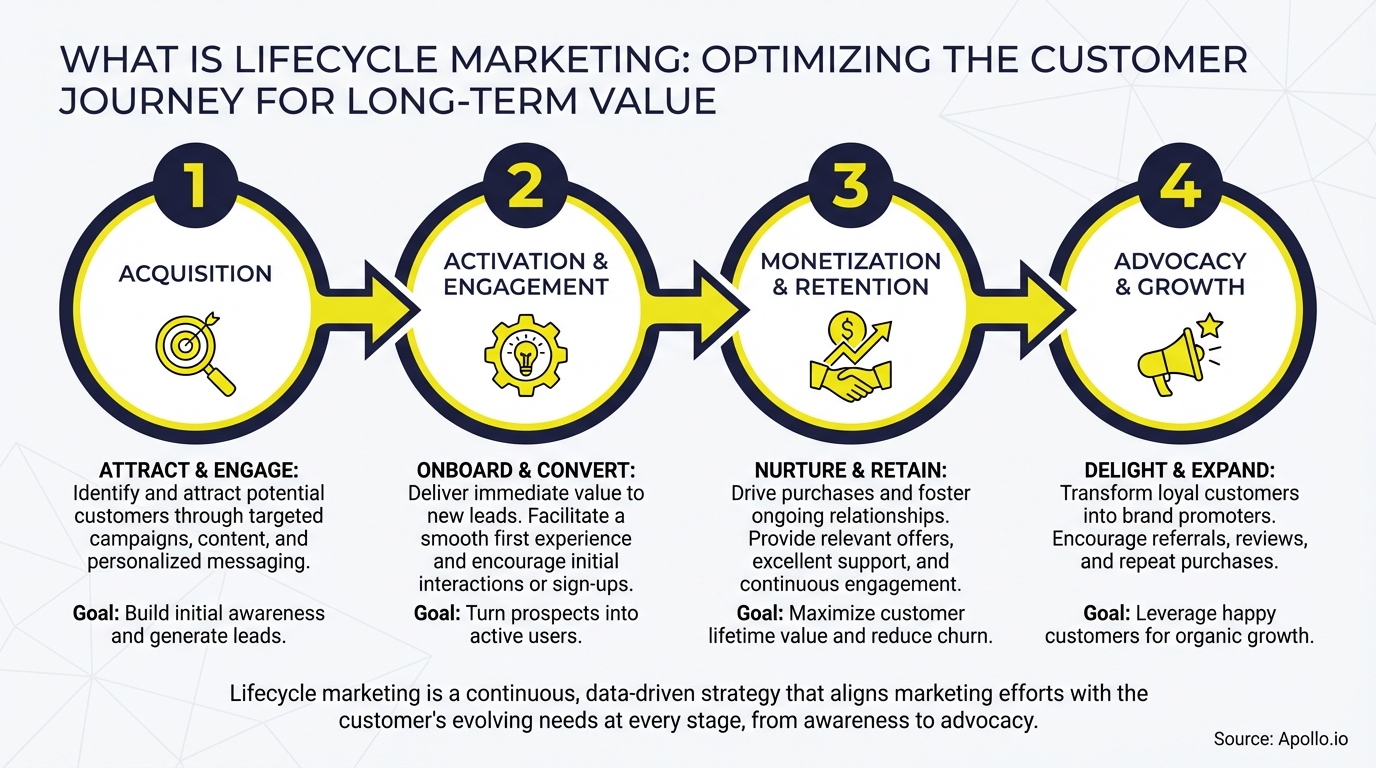
- The modern B2B lifecycle has expanded beyond the funnel: acquire, nurture, onboard, adopt, expand, and renew are now distinct stages requiring distinct plays.
- Most companies still overspend on acquisition relative to retention, leaving significant revenue on the table post-sale.
- Lifecycle marketing works best when sales, marketing, and customer success share ownership through a RevOps governance model.
What Lifecycle Marketing Is (and What It Is Not)
Lifecycle marketing IS: a systematic, data-driven approach to engaging the right person with the right message at the right stage of their journey. It spans the full revenue arc: generating demand, nurturing prospects, onboarding new customers, driving product adoption, expanding accounts, and preventing churn.
Lifecycle marketing IS NOT: a single email nurture sequence, a one-time campaign, or the same as a marketing funnel. It is not owned exclusively by marketing. It is not about volume. It is about relevance at scale across the entire customer relationship.
For a deeper look at how lifecycle marketing connects to broader revenue strategy, see What Marketing Frameworks Drive Revenue in 2026?
The Six Stages of B2B Lifecycle Marketing
Each stage requires different content, channels, and success metrics. Here is a practical stage-by-stage breakdown:
| Stage | Goal | Key Assets | Primary KPI |
|---|---|---|---|
| Acquire | Generate awareness and capture demand | Thought leadership, paid ads, SEO content, outbound sequences | MQLs, pipeline sourced |
| Nurture | Build trust and move prospects toward a decision | Case studies, webinars, comparison guides, drip emails | Engagement rate, stage velocity |
| Onboard | Accelerate time-to-value for new customers | Welcome sequences, implementation guides, check-in calls | Time-to-first-value, activation rate |
| Adopt | Drive deep product usage and habit formation | In-app prompts, feature tutorials, usage reports | Feature adoption rate, DAU/MAU |
| Expand | Grow revenue within existing accounts | Upsell sequences, ROI reviews, stakeholder briefings | Net Revenue Retention (NRR), expansion ARR |
| Renew / Winback | Retain customers and recover churned accounts | Renewal campaigns, executive outreach, win-back offers | Renewal rate, churn rate |
B2B sales cycles are getting longer, not shorter. Pipeline360's 2025 State of B2B Pipeline Growth survey found that 74% of marketers saw longer sales cycles, with 41% reporting increases of two to six months.
That makes the nurture and onboard stages more critical than ever, since buyers need sustained, relevant engagement to move forward.
For tactical execution of email-based nurture, see What Is Drip Email Marketing? B2B Automation Guide.

Why Lifecycle Marketing Drives Revenue (Not Just Engagement)
Lifecycle marketing is increasingly recognized as a revenue driver, not a marketing cost center. Forrester's B2B Frontline Marketing Survey (2024) found that B2B marketing organizations with advanced Lifecycle Revenue Marketing strategies significantly outperformed those with less mature approaches on revenue plan attainment.
The business case is straightforward: retaining and expanding existing customers costs less than acquiring new ones, and lifecycle programs are the operational mechanism that makes retention and expansion systematic rather than accidental. According to Customer.io's State of Lifecycle Marketing Report, 68% of brands indicate they are likely or very likely to hit their lifecycle marketing goals in 2025, signaling growing confidence in the model.
Ready to build the acquisition side of your lifecycle with precision? Search Apollo's 224M+ verified contacts to fill the top of your lifecycle funnel.
"Apollo gets us the people we need to speak to. Without that, there's no business."
The Omnichannel Imperative: Mapping Touchpoints to Stages
B2B buyers do not move through a single channel. McKinsey's 2024 B2B Pulse Survey found buyers use an average of 10 interaction modes across all steps of their journey.
A lifecycle program that lives only in email will miss the majority of buyer touchpoints.
Effective omnichannel lifecycle marketing maps channel mix to stage:
- Acquire: SEO, paid search, outbound email, social outreach, events
- Nurture: Email sequences, retargeting, webinars, direct mail for high-value accounts
- Onboard: Email, in-app messaging, phone check-ins, customer success calls
- Adopt: In-product prompts, usage-triggered emails, community content
- Expand: Account-based campaigns, executive outreach, QBR decks, multi-channel sequences
- Renew: Personalized email, phone outreach, peer reviews, success story content
Personalization across these channels is no longer optional. According to Madison Logic, 71% of B2B buyers expect personalized interactions and become frustrated when those expectations are not met. Lifecycle marketing is the framework that makes personalization scalable, because each stage carries built-in context about who the buyer is and what they need next.
For a full view of the tools that support multi-channel execution, see What Multi-Channel Marketing Tools Should You Use?
Turn Funnel Guesswork Into Pipeline Wins
Tired of watching marketing leads stall before they ever reach your pipeline? Apollo surfaces in-market buyers the moment they're ready, so your team stops chasing and starts closing. Join 550K+ companies building predictable revenue.
Schedule a Demo →Lifecycle Marketing Measurement: The KPI Stack That Matters
The right metrics for lifecycle marketing go beyond top-of-funnel volume. In 2026, leading teams measure across the full revenue arc:
- Pipeline sourced and influenced (acquire and nurture stages)
- Time-to-first-value (onboard stage)
- Feature adoption rate and DAU/MAU (adopt stage)
- Net Revenue Retention (NRR) and expansion ARR (expand stage)
- Renewal rate and churn rate (renew stage)
- Customer Lifetime Value (CLV) across all stages
Attribution remains one of the hardest problems in B2B lifecycle marketing. With buyers using 10+ touchpoints, last-touch attribution systematically undercounts the contribution of mid-funnel and post-sale programs. Multi-touch attribution models, combined with revenue-stage reporting in your CRM, give a more accurate picture of lifecycle impact. For guidance on which metrics matter most, see What B2B Marketing Metrics Actually Drive Revenue Growth?

RevOps Governance: Who Owns the Lifecycle?
One of the most common failure modes in lifecycle marketing is unclear ownership. Marketing owns acquisition but not onboarding.
Sales owns the deal but not expansion. Customer success owns renewal but not the data to trigger it.
The result: gaps at every handoff.
A RevOps governance model assigns clear ownership by stage:
- Marketing: Acquire, Nurture (leads and MQLs)
- Sales: Nurture (opportunities), Onboard handoff
- Customer Success: Onboard, Adopt, Renew
- RevOps: Data infrastructure, attribution, shared dashboards, and SLA enforcement across all stages
- Account Management / Sales: Expand
The shift toward account- and buying-committee orchestration makes cross-functional alignment even more important. Modern B2B purchases involve multiple stakeholders across multiple roles.
Lifecycle programs need to address the whole buying group, not just the primary contact. This requires shared data, shared tooling, and agreed handoff criteria between teams.
"I love the fact that everything is in there together. It's all streamlined and connected."
When sales and marketing operate from a single platform, lifecycle handoffs become far less error-prone. Apollo's unified sales engagement platform connects prospecting, outreach, and pipeline tracking in one workspace, reducing the coordination overhead that breaks lifecycle programs at the seams.
Budget Prioritization Under Pressure
Marketing budgets are under sustained pressure. Gartner's 2024 CMO Spend Survey reported marketing budgets fell to 7.7% of company revenue in 2024.
With less to spend, teams must prioritize programs with measurable revenue impact.
The case for investing in post-acquisition lifecycle stages is compelling: retention and expansion generate revenue at a fraction of the cost of new customer acquisition. Teams that continue to overweight acquisition at the expense of post-sale programs are leaving their highest-ROI opportunities untouched.
A practical prioritization framework for tight budgets:
- Audit current lifecycle coverage: which stages have no program, thin coverage, or poor measurement?
- Rank gaps by revenue impact: onboard and renew gaps typically have the highest immediate revenue cost.
- Build minimum viable programs for the highest-impact gaps before adding complexity.
- Measure and report on stage-specific KPIs to defend spend with finance and leadership.
For a broader look at how to align your B2B digital strategy with revenue goals, see What B2B Digital Marketing Strategy Works in 2026?
Conclusion: Lifecycle Marketing as a Revenue Operating System
Lifecycle marketing is not a campaign tactic. It is a revenue operating model that treats every stage of the buyer and customer relationship as an opportunity to deliver value, build trust, and drive measurable outcomes.
In 2026, with longer sales cycles, tighter budgets, and buyers using more touchpoints than ever, lifecycle marketing is one of the highest-leverage investments a B2B team can make.
The teams that win will be the ones who map their programs to every stage, align sales and marketing around shared data, measure the full revenue arc, and continuously optimize based on what the data shows.
Apollo gives you the unified platform to execute lifecycle programs end to end, from finding your first prospect to expanding your best accounts. Request a Demo to see how Apollo can power your lifecycle marketing strategy.
Prove Pipeline ROI Before Next Quarter
Budget approval stuck on unclear metrics? Apollo delivers measurable pipeline impact from day one — teams like Leadium 3x'd revenue after switching. Start your free trial and show leadership real numbers fast.
Start Free with Apollo →Don't miss these
Sales
Inbound vs Outbound Marketing: Which Strategy Wins?
Sales
What Is a Sales Funnel? The Non-Linear Revenue Framework for 2026
Sales
What Is a Go-to-Market Strategy? The 2026 GTM Playbook
See Apollo in action
We'd love to show how Apollo can help you sell better.
By submitting this form, you will receive information, tips, and promotions from Apollo. To learn more, see our Privacy Statement.
4.7/5 based on 9,690 reviews
