
What Is Growth Marketing? The B2B Revenue-Centric Guide for 2026
Growth marketing is a data-driven, full-funnel discipline that treats every stage of the customer lifecycle — acquisition, activation, retention, and expansion — as a lever for compounding revenue. Unlike traditional marketing, which optimizes for awareness or lead volume, growth marketing optimizes for outcomes: pipeline created, revenue retained, and customer lifetime value grown.
In B2B, this distinction matters more than ever. With budgets under pressure and buyers self-educating across more channels before ever contacting sales, growth marketing has evolved into a revenue operations function, not just a demand gen one.

Research Less, Close More With Apollo
Tired of your reps burning hours verifying contacts instead of selling? Apollo delivers 224M verified contacts with 96% email accuracy so your team hits the phones faster. Join 550K+ companies building pipeline on autopilot.
Start Free with Apollo →Key Takeaways
- Growth marketing spans acquisition through expansion — it is not synonymous with lead generation or demand gen alone.
- B2B buyers now interact across an average of 10 touchpoints before a decision; growth marketing must enable every one of them.
- Budget constraints are making AI-enabled content operations and buyer enablement the primary growth levers in 2026.
- Measurement is shifting from MQLs to pipeline integrity, decision velocity, and revenue attribution.
- The most effective growth teams align marketing, sales, and RevOps around shared definitions of pipeline quality and experiment outcomes.
What Is Growth Marketing, and How Does It Differ From Traditional Marketing?
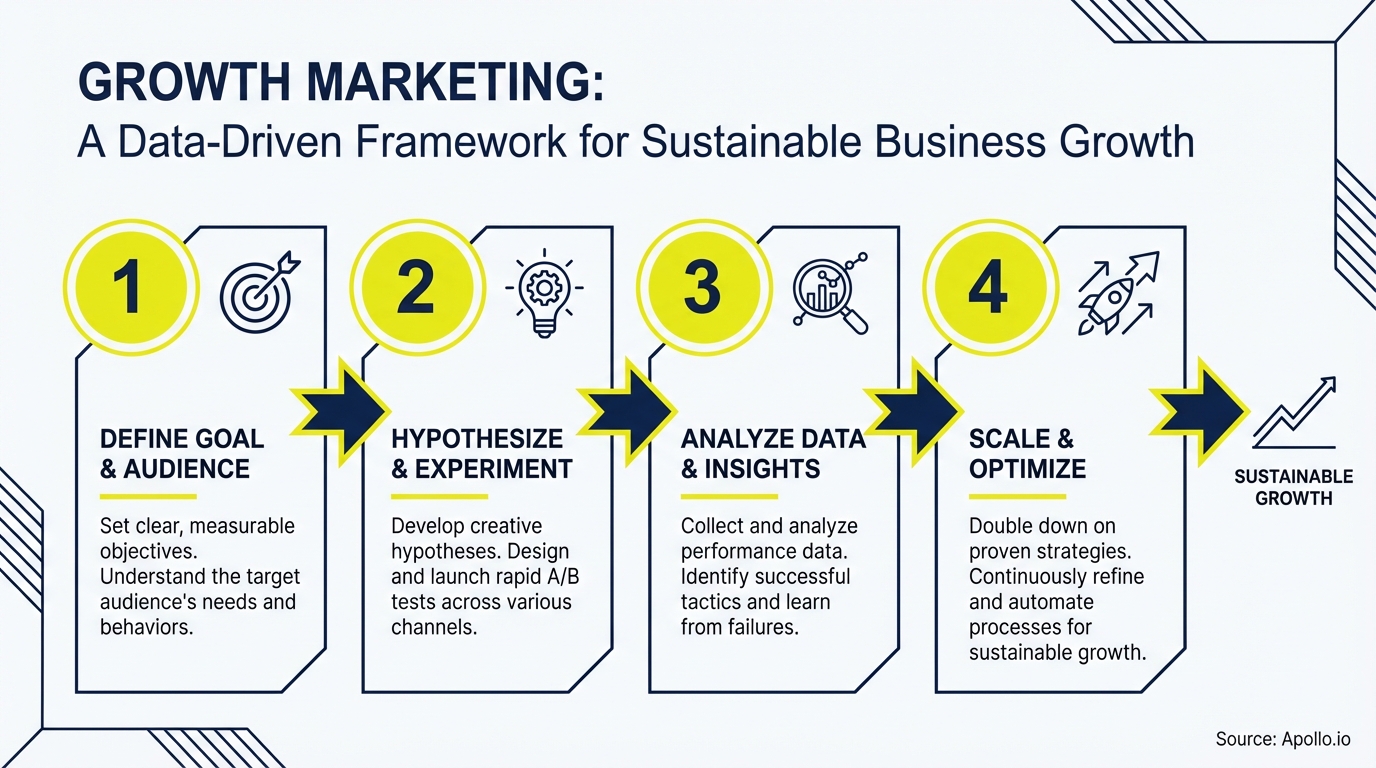
Growth marketing is the systematic application of experimentation, data analysis, and cross-functional execution across the full customer lifecycle to drive sustainable revenue growth. It is not a campaign — it is an operating model.
Traditional marketing focuses on top-of-funnel awareness: brand campaigns, event sponsorships, and lead capture. Growth marketing asks a different question: At every stage where a customer could convert, expand, or churn, what is the highest-leverage experiment we can run?
| Dimension | Traditional Marketing | Growth Marketing |
|---|---|---|
| Primary goal | Brand awareness, lead volume | Revenue, retention, LTV |
| Funnel focus | Top-of-funnel | Full lifecycle |
| Success metric | MQLs, impressions | Pipeline created, revenue retained |
| Operating cadence | Quarterly campaigns | Weekly experiment cycles |
| Team alignment | Marketing-only | Marketing + Sales + RevOps |
For a deeper look at how growth marketing sits within broader marketing frameworks that drive revenue, see Apollo's guide on the topic.
How Does Growth Marketing Work in B2B? The Omnichannel Reality
B2B growth marketing must account for long sales cycles, multiple stakeholders, and high-consideration purchases. Buyers do not follow a linear funnel — they loop, pause, and re-evaluate across dozens of touchpoints before committing.
This means growth marketing in B2B is fundamentally about buyer enablement: removing friction at every evaluation stage so buyers can reach a confident decision faster. The growth lever is not more leads — it is faster time-to-decision and higher conversion at each stage.
Effective B2B growth marketing includes:
- Ungated proof assets: Case studies, ROI calculators, and implementation guides available without a form fill.
- Stakeholder-specific content: One-pagers for economic buyers, technical docs for IT, security packs for legal.
- Self-serve decision tools: Pricing transparency, comparison pages, and interactive demos that let buyers qualify themselves.
- Multi-channel sequences: Coordinated email, phone, and social outreach timed to buying signals, not arbitrary cadences.
Struggling to identify which accounts are actually in-market? Build and prioritize your pipeline with Apollo's account scoring and sequencing tools — so your growth plays reach the right buyers at the right moment.
According to Root Digital, 36% of B2B marketing budgets are allocated toward generating new leads — yet acquisition alone does not compound. Growth marketing captures value across the full lifecycle, not just at the top.
Turn Funnel Guesswork Into Pipeline Confidence
Tired of watching marketing leads stall before they ever reach your pipeline? Apollo surfaces high-intent prospects and arms your team with the signals to act first. 550K+ companies stopped guessing and started closing.
Start Free with Apollo →What Are the Core Stages of Growth Marketing?
Growth marketing is often organized around the AARRR framework (Acquisition, Activation, Retention, Referral, Revenue), adapted for B2B realities:
- Acquisition: Attracting the right ICP accounts through SEO, paid media, outbound sequences, and content that builds category preference before intent signals appear.
- Activation: Converting interest into meaningful engagement — a booked meeting, a completed trial, a key product action. This is where lifecycle marketing intersects with growth.
- Retention: Reducing churn through onboarding optimization, health scoring, and proactive expansion plays. Retained revenue is the highest-margin growth lever.
- Referral: Turning satisfied customers into advocates through case studies, community programs, and structured referral motions.
- Revenue: Expanding accounts through upsell and cross-sell sequences tied to product usage data and customer milestones.
"Apollo gets us the people we need to speak to. Without that, there's no business."
How Does GenAI Change Growth Marketing Operations in 2026?
GenAI has moved from experimentation into operational content supply chains. Growth teams are using it to compress the time between insight and execution: drafting personalized outreach, generating content variants for A/B tests, building stakeholder-specific proof assets at scale, and automating first-pass research on target accounts.
The productivity gain is real — but governance matters. Agentic AI workflows that generate, test, and deploy content without human review create brand risk and attribution confusion.
The teams winning in 2026 have guardrails: human-in-the-loop review at key quality gates, brand voice standards applied to AI outputs, and clear ownership of experiment results.
For B2B teams running B2B email marketing at scale, AI-assisted personalization is now table stakes — not a differentiator. The differentiator is the quality of the underlying data and the relevance of the message to the buyer's actual stage.
"With this kind of AI system, my BDRs can send 10x more personalized emails. Their productivity and growth has skyrocketed."
Spending hours on manual outreach instead of running experiments? Automate personalized outreach at scale with Apollo's AI sales automation — so your growth team focuses on strategy, not copy-paste.

How Do Growth Marketing Teams Measure What Actually Works?
The shift from MQL-centric measurement to revenue-centric measurement is the defining trend in B2B growth marketing for 2026. MQLs are a proxy — they measure marketing activity, not buyer progress.
Growth teams are replacing them with metrics that reflect actual pipeline health and revenue outcomes.
A practical metrics hierarchy for B2B growth marketing:
| Level | Metric | What It Signals |
|---|---|---|
| Leading | Engaged accounts (multi-touch) | Pipeline coverage and ICP fit |
| Pipeline | Opportunities created, stage conversion rates | Funnel efficiency |
| Velocity | Time-to-first-meeting, time-to-close | Buyer enablement effectiveness |
| Revenue | New ARR, expansion ARR, net revenue retention | Lifecycle growth, not just acquisition |
| Efficiency | CAC payback period, pipeline ROI by channel | Budget allocation decisions |
Attribution remains the hardest problem. Last-click models misattribute value in long B2B cycles. Growth teams are moving toward multi-touch attribution, incremental measurement (holdout groups, geo tests), and first-party data signals to connect marketing activities to downstream revenue. For a deeper framework, see Apollo's guide on B2B marketing metrics that actually drive revenue growth.
Budget context matters here: according to Avid Demand, Gartner Research projects average B2B marketing spend at 8.4% of revenue in 2025 — meaning every dollar allocated to growth experiments must be justified against measurable pipeline outcomes, not just activity volume.
What Does a Growth Marketing Team Look Like in 2026?
The modern B2B growth marketing team is not a campaign factory — it is a cross-functional revenue unit. In 2026, the clearest trend is convergence: growth marketers are operating as RevOps partners, aligning with sales on routing logic, sequence design, ABM plays, and activation workflows.
Core roles in a growth-oriented B2B marketing team:
- Growth lead / head of growth: Owns the experimentation roadmap and cross-functional alignment with sales and RevOps.
- Demand generation manager: Manages paid and organic acquisition channels with a pipeline-first lens.
- Content strategist: Builds the proof asset library, thought leadership, and buyer enablement content.
- Marketing ops / RevOps: Owns the marketing database, attribution model, and tooling integrations.
- SDR / BDR alignment: Translates marketing signals into outbound sequences and feedback loops.
According to B2B Growth Essentials, 72% of global marketers anticipated higher annual budgets in 2024 — yet many teams are still structured for campaign execution rather than continuous experimentation. The structural shift is as important as the budget.
For more on how demand generation fits within a growth marketing operating model, Apollo's guide covers the distinction and the overlap in detail.
Conclusion: Growth Marketing Is a System, Not a Campaign
Growth marketing in B2B is the discipline of building compounding revenue systems — not running one-off campaigns. It requires full-funnel thinking, buyer enablement infrastructure, AI-assisted content operations, and measurement that connects activity to actual pipeline and revenue outcomes.
The teams that win in 2026 are not the ones running the most experiments. They are the ones who can architect safe, governed growth systems, align marketing with sales and RevOps around shared revenue definitions, and enable buyers to reach confident decisions faster.
Apollo gives growth-oriented revenue teams a unified platform to prospect the right accounts, engage buyers across every channel, enrich contact data automatically, and track pipeline from first touch to closed won — all in one workspace. Ready to build your growth system on a foundation that compounds? Start your free trial of Apollo today.
Prove Pipeline ROI With Apollo
Budget approval stuck on unclear metrics? Apollo gives sales teams measurable pipeline impact from day one. Leadium 3x'd their annual revenue — see your ROI before the next budget cycle.
Start Free with Apollo →Don't miss these
Sales
Inbound vs Outbound Marketing: Which Strategy Wins?
Sales
What Is a Sales Funnel? The Non-Linear Revenue Framework for 2026
Sales
What Is a Go-to-Market Strategy? The 2026 GTM Playbook
See Apollo in action
We'd love to show how Apollo can help you sell better.
By submitting this form, you will receive information, tips, and promotions from Apollo. To learn more, see our Privacy Statement.
4.7/5 based on 9,690 reviews
