
What Is Firmographic Data and Why Does It Matter for Outbound Prospecting?
Firmographic data is the B2B equivalent of demographic data: it describes companies instead of individuals. For SDRs, AEs, and RevOps leaders building outbound programs, firmographics determine who gets contacted before a single email is sent or a call is dialed. Getting this layer wrong wastes quota capacity. Getting it right turns outbound into a precision instrument. Learn more about building a strong outbound foundation in our Outbound Prospecting guide.

Research Less, Close More With Apollo
Tired of your reps burning hours hunting down contact info that's already outdated? Apollo surfaces verified leads instantly, so your team spends time selling — not searching. Join 600K+ companies building pipeline faster.
Start Free with Apollo →Key Takeaways
- Firmographic data describes company-level attributes (industry, size, location, growth stage, ownership) used to qualify and prioritize outbound accounts.
- A 2024 Gartner survey found 73% of B2B buyers actively avoid suppliers that send irrelevant outreach, making firmographic precision a buyer-experience requirement.
- High data quality correlates directly with pipeline goal attainment: organizations prioritizing data accuracy were significantly more likely to meet lead generation goals.
- In 2026, firmographics serve as the base filter in signal-based outbound, with intent, technographics, and hiring triggers layered on top.
- SDRs and RevOps teams that govern firmographic data with defined refresh cadences and suppression rules maintain outbound quality at scale.
What Is Firmographic Data?
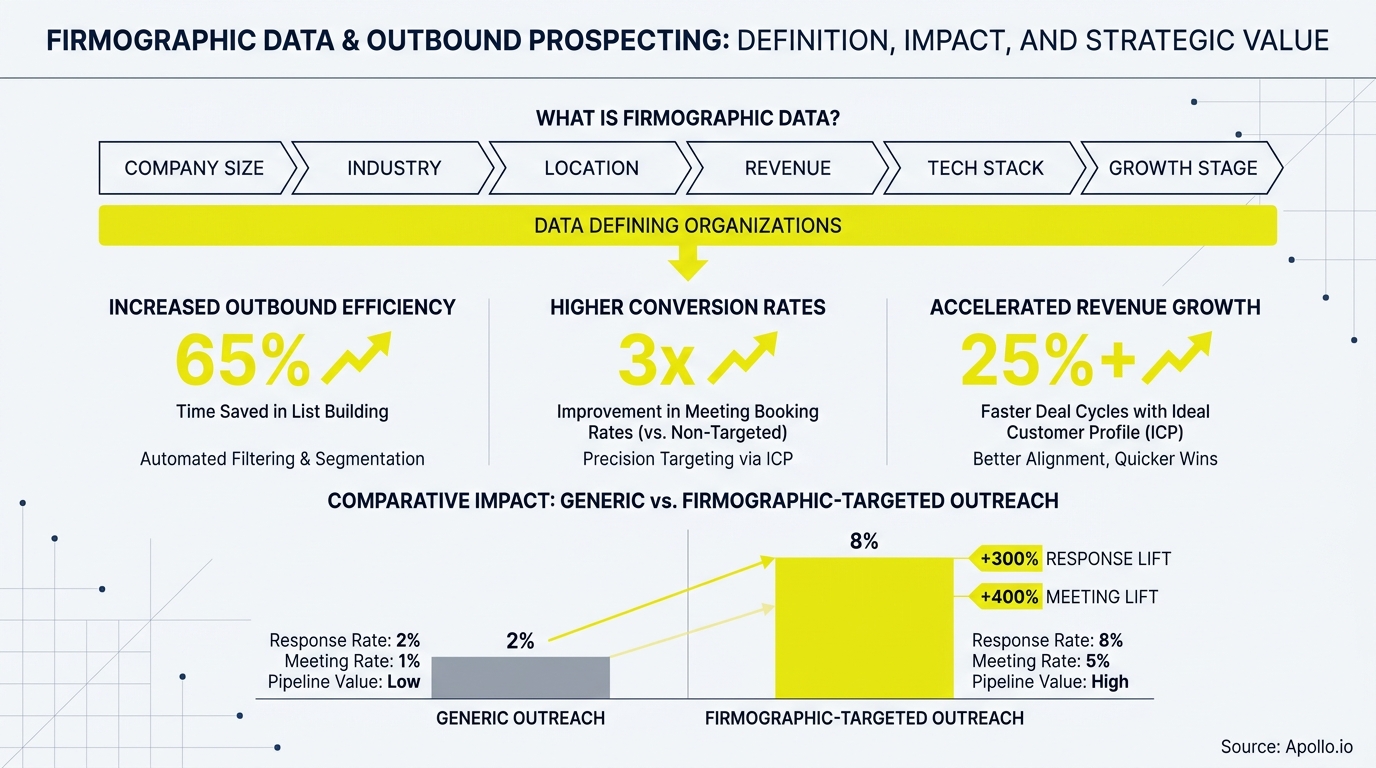
Firmographic data is structured, company-level information used to classify and segment business accounts. According to Crunchbase, this data provides a comprehensive snapshot of a company, including details such as industry type, company size (number of employees or revenue), geographical location, ownership structure, and growth rate.
Firmographics are distinct from contact-level data (names, titles, emails) and from behavioral data (intent signals, web visits). They answer: Is this company a fit for what we sell? before you ask: Who should we contact there?
| Firmographic Attribute | Examples | Why It Matters for Outbound |
|---|---|---|
| Industry / Vertical | SaaS, Healthcare, Manufacturing | Determines messaging and pain points |
| Employee Count | 10–50, 51–200, 1,000+ | Signals deal size and buying complexity |
| Annual Revenue | $1M–$10M, $50M–$250M | Qualifies budget capacity |
| Geography | Region, country, metro area | Aligns territory assignments |
| Ownership Structure | Private, public, PE-backed, subsidiary | Shapes procurement and decision authority |
| Growth Stage | Seed, Series B, pre-IPO, mature | Predicts urgency and budget cycles |
Why Does Firmographic Data Matter for Outbound Prospecting?
Firmographic data matters because irrelevant outreach now actively damages your pipeline. A 2024 Gartner survey (fielded August–September 2024, published June 2025) found that 73% of B2B buyers actively avoid suppliers that send irrelevant outreach.
The same survey found 61% of buyers prefer a rep-free buying experience overall, raising the bar for how precisely outbound teams must pre-qualify accounts before making contact.
The pipeline math is equally clear. A 2024 Pipeline360/Demand Metric report found that organizations making data accuracy a high priority were more likely to meet lead generation goals (50% met goals to a great or very great extent) compared to those with medium or low data priority (34%).
Firmographic quality is not a nice-to-have: it is a pipeline lever.
Struggling to build a target account list that actually converts? Search Apollo's 230M+ contacts using 65+ firmographic filters to find accounts that match your ICP exactly.
How Do SDRs Use Firmographic Data to Book More Meetings?
SDRs use firmographic data to prioritize their outreach queue so every touch goes to an account that plausibly fits, rather than burning sequences on companies that will never buy. The practical workflow has three steps:
- Set firmographic ICP criteria: define industry verticals, employee band, revenue range, geography, and ownership type that match your best closed-won accounts.
- Apply suppression rules: exclude existing customers, churned accounts, industries with regulatory conflicts, and company sizes outside your deal-size range.
- Layer signals on top: once firmographic filters define the eligible universe, add intent topics, recent funding, or headcount growth to prioritize who now within that universe.
For RevOps leaders, the key insight from 2026 outbound practice is that firmographics function as the join key across systems. When CRM, marketing automation, intent data, and web analytics need to be reconciled, company name, industry, and size band are the common fields that unify records. Treating firmographic fields as governed data (defined values, refresh cadence, allowed formats) prevents the data drift that corrupts segmentation over time.
Research from Demandbase confirms that firmographic data includes industry type, company size, geographical location, ownership structure, and growth rate, making it the foundational layer for any account-based strategy.
Turn Funnel Gaps Into Predictable Pipeline
Tired of watching quality leads stall before they ever become opportunities? Apollo surfaces in-market buyers at the right moment, so your forecast reflects reality. Trusted by 600K+ companies building pipeline they can actually count on.
Start Free with Apollo →What Is the Cost of Poor Firmographic Data Quality?
Poor firmographic data quality sends the wrong message to the wrong company, burning sender reputation, wasting rep time, and training buyers to ignore your brand. The risks are concrete:
- Sequence waste: SDRs burn 5–8 touch sequences on companies outside the ICP, leaving fewer touches for qualified accounts.
- Brand damage: Buyers who receive irrelevant outreach share experiences internally, reducing the probability of a future response from any rep at your company.
- Forecast distortion: Opportunities from mis-targeted accounts inflate pipeline but convert at lower rates, making forecast accuracy unreliable for sales leaders.
- Email deliverability harm: High bounce and low-engagement rates from mis-targeted sends damage domain health, reducing deliverability for your entire outbound program.
A basic suppression checklist for outbound teams should include: existing customers, churned accounts, companies below minimum employee threshold, industries excluded from your ICP, companies in active legal disputes with your firm, and accounts flagged as "not a fit" in CRM disposition codes. Run this suppression check before every sequence launch, not after.

How Do Firmographics Connect to Intent Data and Signal-Based Outbound?
Firmographics define the eligible universe; signals determine timing. In 2026, signal-based outbound has become the dominant model: teams use firmographic filters to build a qualified account pool, then apply intent topics, hiring signals, funding announcements, and technographic changes to select which accounts to activate this week.
This layered approach directly addresses the self-directed buyer reality. Because buyers research independently before engaging sales, outbound that arrives at the right firmographic profile and at a moment of genuine buying activity (a signal) is far less likely to feel irrelevant. For a deeper look at the intent layer, see our guide on what intent data is and how it works.
Firmographics also enable better contact data enrichment: when you know a company's industry, size, and growth stage, you can enrich records with the right persona-level fields (title, function, seniority) that match your buyer profile for that segment.
How Should RevOps Teams Govern Firmographic Data?
RevOps teams should treat firmographic fields as governed data assets with defined ownership, refresh cadences, and validation rules. Ad-hoc enrichment produces inconsistent values (e.g., "SaaS" vs. "Software" vs. "Technology") that break segmentation and routing logic.
A practical governance framework includes:
- Standardized field values: use a fixed taxonomy for industry (e.g., NAICS codes or a defined internal list) so filters and reports work consistently.
- Quarterly enrichment cadence: re-enrich CRM accounts every 90 days to catch headcount changes, funding rounds, and ownership shifts.
- Data steward role: assign ownership of firmographic data quality to a RevOps analyst or data owner responsible for auditing field completeness and accuracy.
- ICP feedback loop: review closed-won and closed-lost accounts quarterly to update firmographic ICP definitions based on what actually converts.
For teams building or refreshing this process, the data enrichment vs. data cleansing guide covers the key differences and when to use each approach. Tired of stale CRM records killing your outbound quality? Enrich your CRM with Apollo's verified firmographic and contact data to keep your segmentation accurate.

How to Put Firmographic Data to Work: A Seven-Step Checklist
Use this checklist to operationalize firmographic data across your outbound program:
- Define your ICP using closed-won data: identify the top 3 industries, employee ranges, and revenue bands in your best accounts.
- Map firmographic attributes to messaging: tailor subject lines, pain points, and case studies by industry and company size segment.
- Build suppression lists: exclude existing customers, churned accounts, and out-of-ICP segments before launching sequences.
- Enrich your CRM: fill gaps in industry, employee count, revenue, and geography fields using a verified data source.
- Layer buying signals: apply intent, hiring, funding, or technographic triggers to prioritize accounts within your firmographic universe.
- Set a refresh cadence: schedule quarterly re-enrichment to catch company changes that affect ICP fit.
- Review and update ICP definitions quarterly: use conversion data to refine which firmographic profiles actually close.
A note on data sources: as multi-provider enrichment stacks have become standard practice in 2026, firmographic fields serve as the key matching layer across vendors. Ensure your CRM is the system of record for firmographic values, with enrichment tools writing to standardized fields rather than creating parallel records. The data enrichment strategy guide walks through how to structure this architecture end to end.
Start Prospecting with Firmographic Precision
Firmographic data is the foundation of every high-performing outbound program. It determines which accounts enter your funnel, which sequences get activated, and which messages get written.
Without it, outbound is guesswork. With it, every SDR touch, AE sequence, and marketing campaign starts from a qualified position.
Apollo gives B2B GTM teams a unified platform to search, filter, enrich, and engage accounts using firmographic data alongside intent signals, all without stitching together multiple tools. As Cyera put it: "Having everything in one system was a game changer."
Start Prospecting with Apollo's 230M+ verified contacts and 65+ firmographic filters, free.
Prove Pipeline ROI With Apollo
Budget approval stuck on unclear metrics? Apollo delivers measurable pipeline impact from day one, so you can justify every dollar spent. Leadium 3x'd annual revenue — your ROI story starts now.
Start Free with Apollo →Don't miss these
Sales
Inbound vs Outbound Marketing: Which Strategy Wins?
Sales
What Is a Sales Funnel? The Non-Linear Revenue Framework for 2026
Sales
What Is a Go-to-Market Strategy? The 2026 GTM Playbook
See Apollo in action
We'd love to show how Apollo can help you sell better.
By submitting this form, you will receive information, tips, and promotions from Apollo. To learn more, see our Privacy Statement.
4.7/5 based on 9,690 reviews
