What Is Enterprise Sales? Definition, Process, and Winning Strategies
Enterprise sales represents the pinnacle of B2B selling: complex deals worth $100K+ that involve multiple decision-makers, extended sales cycles, and strategic partnerships. In 2026, enterprise SaaS spending reached $218.5 billion, with companies increasingly consolidating vendors to control costs and complexity. If you're an AE targeting Fortune 500 accounts or a sales leader building an enterprise sales motion, understanding this high-stakes game is critical to your revenue goals.

Apollo Cuts Research Time From Hours To Seconds
Tired of spending 4+ hours daily hunting for contact info? Apollo delivers 224M verified contacts with 96% email accuracy instantly. Join 550K+ companies who turned research time into selling time.
Start Free with Apollo →Key Takeaways
- Enterprise sales targets large organizations with deals typically exceeding $100K and sales cycles lasting 6-18 months
- Success requires navigating complex buying committees of 6-10 stakeholders across multiple departments
- AI-powered tools and account-based strategies accelerate deal cycles by 35% while reducing manual research time
- RevOps alignment and tech stack consolidation are essential for scaling enterprise motions profitably
- ROI calculators, compliance documentation, and executive-level business cases close more deals faster
What Is Enterprise Sales?
Enterprise sales is the process of selling high-value solutions to large organizations with 1,000+ employees. Unlike traditional B2B sales, enterprise deals involve lengthy negotiations, formal procurement processes, and multiple stakeholders including C-suite executives, IT teams, legal departments, and end users.
According to Gartner, worldwide IT spending reached $5.61 trillion in 2025, growing 9.8% from 2024. Enterprise SaaS alone expanded by 16.7% to $218.5 billion, with CRM solutions accounting for 51.4% of that revenue. These numbers reflect the massive opportunity for sales professionals who master enterprise selling.
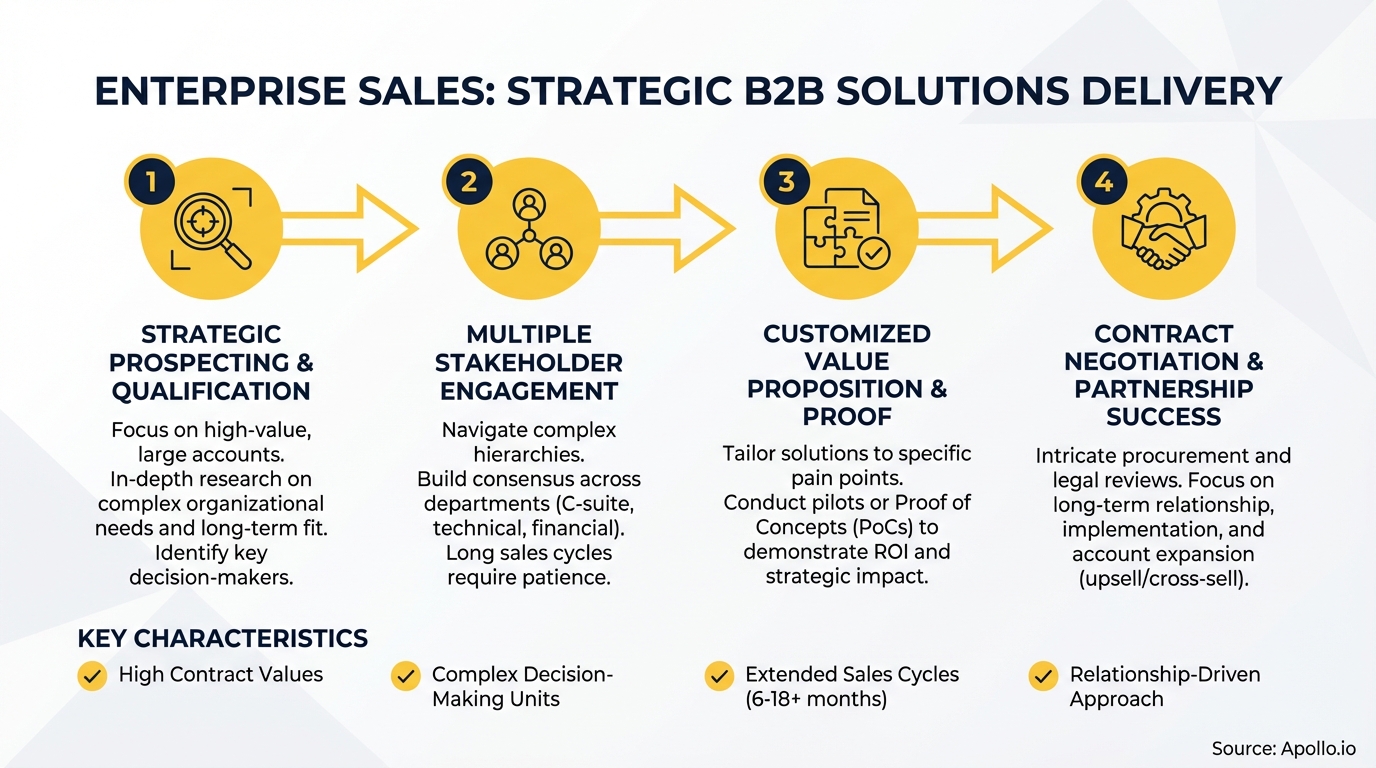
The defining characteristics include deal sizes starting at $100K (often reaching millions), sales cycles spanning 6-18 months, and buying committees of 6-10 decision-makers. Enterprise sales requires strategic account planning, executive relationship building, and cross-functional collaboration between sales, marketing, customer success, and product teams.
How Does Enterprise Sales Differ from SMB Sales?
Enterprise sales operates on a completely different timeline and complexity level than SMB or mid-market selling. The table below highlights the key distinctions:

| Factor | SMB Sales | Enterprise Sales |
|---|---|---|
| Deal Size | $5K-$25K | $100K-$10M+ |
| Sales Cycle | 1-3 months | 6-18 months |
| Decision Makers | 1-2 people | 6-10+ stakeholders |
| Sales Motion | Transactional, volume-based | Consultative, relationship-driven |
| Procurement | Credit card purchase | RFPs, legal review, security audits |
| Implementation | Self-service or light touch | Dedicated success team, custom integration |
Enterprise buyers demand comprehensive ROI justification, rigorous security and compliance documentation, and proof of scalability. They evaluate not just product features but vendor stability, support infrastructure, and strategic roadmap alignment. Struggling to identify the right enterprise contacts and navigate complex org charts? Search Apollo's 224M+ business contacts with 65+ filters to find decision-makers.
What Are the Key Stages of an Enterprise Sales Process?
Enterprise sales follows a structured methodology with distinct phases, each requiring specific strategies and resources:
1. Account Research & Targeting: Identify ideal customer profiles using firmographic data, technographic signals, and intent data.
Build target account lists with key stakeholders mapped to buying committee roles (economic buyer, technical buyer, champion, influencers).
2. Initial Outreach & Discovery: Engage multiple stakeholders through personalized, multi-channel sequences. Conduct discovery calls to understand business challenges, current tech stack, budget cycles, and success metrics. Top enterprise AEs focus on executive-level conversations that uncover strategic priorities.
3. Solution Presentation & Demo: Deliver customized presentations addressing specific business outcomes.
Involve technical teams for deep-dive demos. Address security, compliance, and integration requirements proactively.
4. Business Case Development: Create ROI calculators showing cost savings, efficiency gains, and revenue impact. Provide case studies from similar-sized companies in their industry. Build compelling executive summaries for C-suite approval.
5. Proposal & Negotiation: Navigate procurement processes, RFP responses, and legal reviews. Negotiate pricing, terms, SLAs, and implementation timelines. Coordinate internal resources (legal, finance, product) to address objections.
6. Contract & Close: Finalize MSAs, SOWs, and order forms. Ensure smooth handoff to implementation and customer success teams. Establish executive sponsor relationships for ongoing strategic alignment.
Turn Forecast Guesswork Into Revenue Certainty
Pipeline forecasting a guessing game? Apollo delivers real-time deal visibility and intent signals that make your numbers predictable. Built-In improved win rates 10% with Apollo's scoring and guidance.
Start Free with Apollo →How Do Account Executives Navigate Enterprise Buying Committees?
Account Executives selling into enterprise accounts must orchestrate consensus across diverse stakeholders, each with different priorities and concerns. The typical buying committee includes economic buyers (CFO, VP), technical buyers (CTO, IT Director), end users (department heads, managers), legal/compliance teams, and procurement specialists.
Successful AEs map stakeholder roles early using tools like org charts and relationship intelligence. They identify the champion (internal advocate who sells on your behalf) and coach them to navigate internal politics.
Multi-threading relationships across the organization prevents single points of failure when champions leave or lose influence.
AEs must speak different languages to different buyers. CFOs care about ROI and total cost of ownership. CTOs evaluate technical architecture, security, and scalability. End users focus on usability and daily workflow improvements. Tailoring messaging to each persona while maintaining a consistent value narrative is critical. For Account Executives managing complex deal pipelines, Apollo's deal management platform provides complete visibility across stakeholders and deal stages.
What Role Does AI Play in Enterprise Sales in 2026?
AI has fundamentally transformed enterprise selling by automating research, personalizing outreach, and accelerating deal cycles. According to Gartner, GenAI spending reached $644 billion in 2025, growing 76.4% year-over-year as companies invested heavily in sales automation and intelligence platforms.
AI-powered platforms now handle time-consuming tasks like account research, contact discovery, email personalization, and meeting scheduling. Sales teams using AI research agents report 46% more meetings booked, while AI messaging tools deliver 35% increases in conversion rates.
These tools analyze millions of data points to surface buying signals, recommend next best actions, and generate contextually relevant content.
Key AI applications in enterprise sales include:
- Intelligent Prospecting: AI identifies high-fit accounts based on firmographics, technographics, and behavioral signals
- Automated Personalization: Generates custom messaging based on prospect role, industry, and pain points
- Conversation Intelligence: Analyzes calls to extract insights, track objections, and coach reps
- Predictive Analytics: Forecasts deal likelihood and recommends optimal engagement strategies
- RFP Response Automation: Accelerates proposal creation using historical responses and product knowledge bases
Sales leaders implementing AI sales tools report significant time savings and revenue acceleration. The key is balancing automation with human relationship building, using AI to eliminate busywork while AEs focus on strategic conversations.
How Do Sales Leaders Build Scalable Enterprise Sales Teams?
Building an enterprise sales organization requires different talent, compensation structures, and enablement strategies than SMB teams. Sales leaders must hire experienced AEs with proven enterprise track records, consultative selling skills, and executive presence.
Average enterprise AE tenure at top companies is 3-5 years, with ramp times of 6-9 months.
Compensation typically includes lower base salaries (40-50% of OTE) with higher variable pay tied to annual quota achievement. Enterprise quotas range from $1M-$3M+ per rep annually.
Top performers earn $200K-$500K+ in total compensation.
Enablement programs focus on industry expertise, technical product knowledge, and strategic account planning. Sales leaders invest in:
- Account-Based Everything: Aligned marketing, SDR, and AE motions targeting named accounts
- Executive Engagement Programs: C-suite sponsorship and peer-to-peer selling initiatives
- Deal Desk Support: Pricing, legal, and finance resources to accelerate proposals
- Customer Success Integration: Seamless handoffs and expansion revenue strategies
RevOps leaders consolidating sales tech stacks report significant efficiency gains. As Census noted, they "cut costs in half" by replacing multiple point solutions with unified platforms. Cyera found "having everything in one system was a game changer" for visibility and collaboration. RevOps alignment between sales, marketing, and customer success is critical for enterprise scaling.
What Tools and Tech Stack Do Enterprise Sales Teams Need?
Enterprise sales teams require robust technology to manage complexity, but tool sprawl creates inefficiency and data silos. In 2026, leading organizations prioritize platform consolidation over best-of-breed point solutions.
Essential capabilities include:
- CRM Platform: Salesforce, HubSpot, or Microsoft Dynamics for pipeline management and forecasting
- Sales Intelligence: Contact data, account insights, and technographic information
- Sales Engagement: Multi-channel sequencing, email tracking, and cadence automation
- Conversation Intelligence: Call recording, transcription, and coaching insights
- Proposal Software: RFP response management and document automation
- Contract Management: E-signature and legal workflow tools
The average sales team uses 10+ tools, creating integration headaches and data quality issues. Smart organizations consolidate wherever possible.
Predictable Revenue reported they "reduced the complexity of three tools into one" by adopting unified platforms that combine prospecting, engagement, and intelligence.
When evaluating sales tech stack options, prioritize platforms with native CRM integration, data accuracy guarantees, and comprehensive feature sets that eliminate the need for multiple vendors. Apollo's all-in-one GTM platform provides 224M+ verified contacts, multi-channel engagement, AI-powered automation, and conversation intelligence in a single workspace.
Conclusion
Enterprise sales in 2026 demands a sophisticated blend of strategic thinking, relationship building, and technology leverage. Success requires patience for long sales cycles, skill navigating complex buying committees, and discipline executing structured processes.
AEs who master account-based strategies, leverage AI intelligently, and build genuine executive relationships will capture their share of the $5.61 trillion enterprise IT market.
The winners consolidate their tech stacks to eliminate data silos and tool fatigue. They align cross-functional teams around named accounts.
They use AI to automate research and personalization while focusing human energy on high-value strategic conversations. Most importantly, they treat enterprise sales as relationship marathons, not transactional sprints.
Ready to accelerate your enterprise sales motion? Start Your Free Trial of Apollo's all-in-one GTM platform and access 224M+ verified contacts, AI-powered workflows, and unified sales intelligence that helps teams close deals faster.
Prove Apollo's ROI In Your First 30 Days
Budget approval stuck on unclear metrics? Apollo tracks every touchpoint from prospect to closed deal, giving you quantifiable pipeline impact and time savings. Built-In increased win rates 10% and ACV 10% with Apollo's scoring.
Start Free with Apollo →Don't miss these
Sales
Inbound vs Outbound Marketing: Which Strategy Wins?
Sales
What Is a Sales Funnel? The Non-Linear Revenue Framework for 2026
Sales
What Is a Go-to-Market Strategy? The 2026 GTM Playbook
See Apollo in action
We'd love to show how Apollo can help you sell better.
By submitting this form, you will receive information, tips, and promotions from Apollo. To learn more, see our Privacy Statement.
4.7/5 based on 9,690 reviews
