
What Is Direct Sales? Definition, Strategies, and Modern Best Practices
Direct sales has evolved dramatically from door-to-door product pitches to sophisticated, AI-enabled B2B strategies that power modern revenue teams. In 2026, direct sales combines personal outreach with data-driven automation, allowing SDRs, AEs, and sales leaders to reach decision-makers without intermediaries while leveraging technology to scale personalized engagement. According to DSA research, the U.S. direct selling industry generated $36.7 billion in retail sales in 2023, serving 37.7 million customers. This guide explains what direct sales is today, how hybrid models reshape the approach, and actionable strategies to implement B2B sales at scale.

Apollo Finds Verified Contacts In Seconds
Tired of spending 4+ hours daily hunting for contact info? Apollo delivers 224M+ contacts with 96% email accuracy—verified and ready to reach. Join 550K+ companies closing more deals.
Start Free with Apollo →Key Takeaways
- Direct sales eliminates intermediaries by connecting sellers directly with buyers through personal relationships and AI-powered outreach
- Data-driven direct selling uses verified contact databases and intent signals to target high-fit accounts and personalize engagement
- AI tools automate research, messaging, and follow-up while preserving the personalized approach that drives conversions
- Direct sales careers offer flexibility and scalability, with SDRs and AEs using consolidated platforms to manage full sales cycles
What Is Direct Sales?
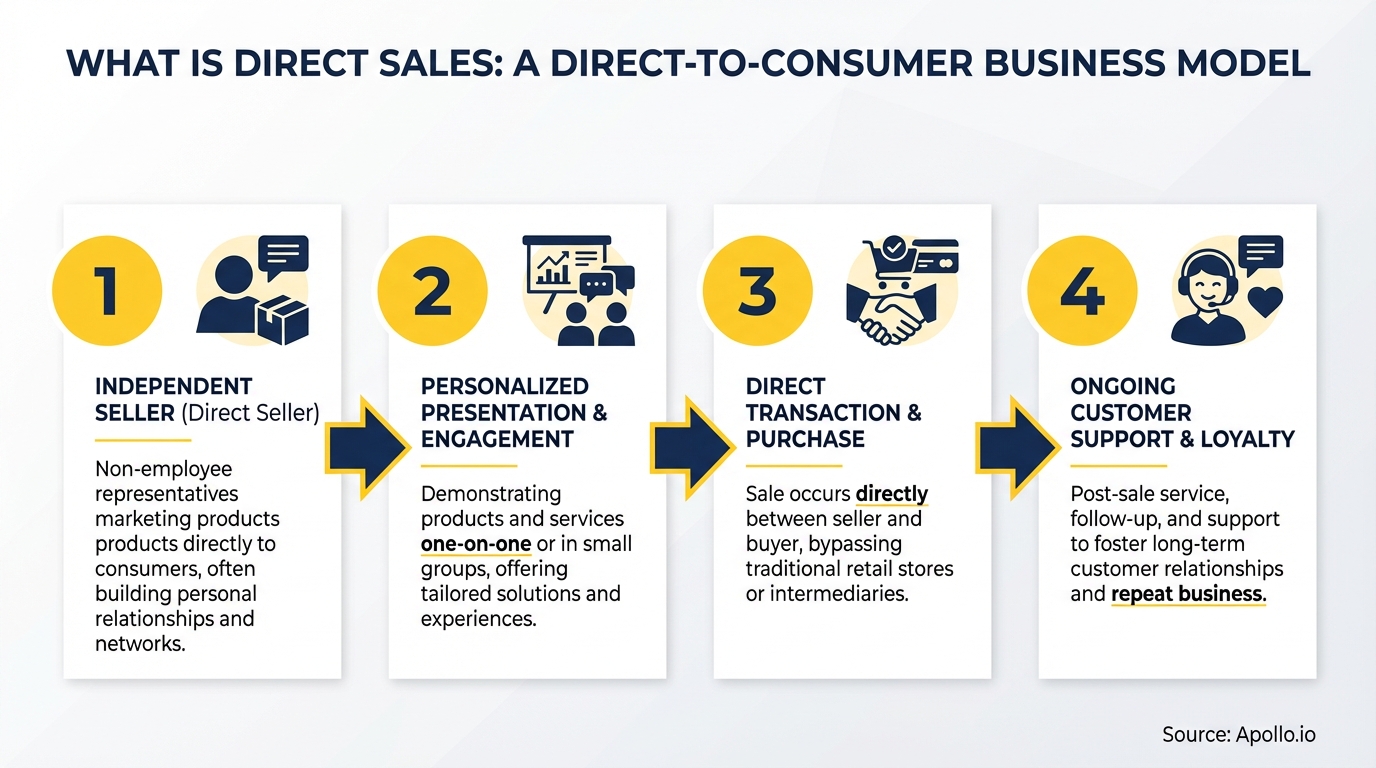
Direct sales is a distribution method where sellers engage buyers directly without retail stores, third-party distributors, or intermediaries. Instead of relying on traditional sales channels, direct sales professionals build relationships through one-on-one conversations, personalized outreach, and consultative selling.
In B2B contexts, this means SDRs prospecting decision-makers, AEs running demos, and sales leaders coaching teams to close deals through direct communication.
Unlike retail or channel sales, direct sales prioritizes personal connection and targeted engagement. Sellers identify prospects, initiate contact through email, phone, or social channels, and guide buyers through the entire purchasing journey. The model scales through technology like CRM systems, sales automation platforms, and AI assistants that handle repetitive tasks while preserving human touchpoints.
Modern direct sales integrates digital tools with traditional relationship-building. Research by McKinsey confirms that 85% of B2B organizations now expect hybrid sales roles to be the most common, reflecting a shift towards omnichannel strategies that blend in-person meetings, virtual demos, and automated nurture sequences.
How Does Direct Sales Work in B2B?
B2B direct sales operates through a structured process that moves prospects from discovery to closed deals. The cycle starts with prospecting, where SDRs use databases and intent signals to identify high-fit accounts.
Next comes outreach through personalized emails, LinkedIn messages, or cold calls that address specific pain points. Qualified leads enter the pipeline where AEs conduct discovery calls, demos, and negotiations before closing.
Struggling to find qualified leads? Search Apollo's 224M+ contacts with 65+ filters to build targeted prospect lists.
The direct sales workflow in 2026 relies on three core components:
- Data intelligence: Verified contact information, firmographics, and technographics to identify ideal customers
- Multi-channel engagement: Coordinated outreach across email, phone, social media, and video to meet buyers where they are
- Pipeline management: CRM tracking, deal stages, and forecasting to maintain visibility and accountability
For Account Executives managing complex deals, direct sales means controlling the entire relationship from first touch to contract signature. AEs leverage AI-powered sales processes to automate research, generate personalized messaging, and prioritize high-value opportunities based on engagement signals and buying intent.
Why Is Direct Sales Important in 2026?
Direct sales delivers measurable advantages over traditional distribution models, especially in B2B markets where purchasing decisions involve multiple stakeholders and lengthy evaluation cycles. The approach gives sellers control over messaging, timing, and relationship-building while providing buyers with personalized guidance and immediate access to product expertise.
| Benefit | Impact | Example |
|---|---|---|
| Higher margins | Eliminate distributor costs | B2B SaaS companies retain 100% of revenue |
| Faster feedback | Direct customer insights | SDRs surface objections that inform product roadmaps |
| Relationship control | Own the buyer journey | AEs nurture accounts through multi-year expansions |
| Scalable personalization | AI-powered customization | Automated sequences with dynamic content insertion |
Data from Gartner indicates that by 2026, 65% of B2B sales organizations will transition from intuition-based to data-driven decision-making. This shift makes direct sales more effective as teams use verified data, predictive analytics, and AI recommendations to prioritize accounts and personalize outreach at scale.
See Every Deal Stage In Real Time With Apollo
Pipeline forecasting a guessing game? Apollo gives you real-time visibility into every deal stage so you can forecast with confidence. Built-In boosted win rates 10% with Apollo's signals.
Start Free with Apollo →What Are the Types of Direct Sales Models?
Direct sales encompasses several models, each suited to different products, markets, and buyer preferences. B2B teams typically combine elements from multiple models to create hybrid approaches that balance efficiency with personalization.
What Is Single-Level Direct Sales?
Single-level direct sales involves individual sellers earning commissions on their own sales without recruiting others. In B2B, this translates to SDRs booking meetings, AEs closing deals, and account managers expanding existing customers.
Each seller operates independently within defined territories or accounts, compensated based on personal performance.
What Is Multi-Level Direct Sales?
Multi-level models (also called network marketing) allow sellers to recruit and earn commissions from their team's sales. While common in B2C industries, B2B rarely uses pure multi-level structures. Instead, sales organizations create hierarchies where managers coach teams and earn bonuses based on team quota attainment, similar to how sales leaders at companies like HubSpot structure their teams around proven inside sales playbooks.
What Is Hybrid Direct Sales?
Hybrid direct sales combines human sellers with digital self-service options. Buyers can research independently, interact with chatbots, or request live demos based on their preference.
Research shows that 61% of B2B buyers now prefer rep-free buying experiences for certain stages of the journey, making hybrid models essential for modern direct sales teams.
How Do SDRs Use Direct Sales Strategies to Book More Meetings?
SDRs drive pipeline through targeted prospecting and personalized outreach that addresses specific pain points. The direct sales approach for SDRs starts with identifying high-fit accounts using firmographic filters (industry, company size, technology stack) and intent signals (website visits, content downloads, competitor research).
Once prospects are identified, SDRs craft sequences that combine email, phone, and social touches tailored to each buyer's role and challenges.

Spending hours on manual outreach? Automate your sequences with Apollo's multi-channel platform while maintaining personalization.
Successful SDRs using direct sales strategies focus on:
- Research-driven targeting: Understanding prospect challenges before first contact
- Value-first messaging: Leading with insights, not product pitches
- Multi-touch persistence: 8-12 touchpoints across 3-4 weeks to break through noise
- Data-backed personalization: Referencing specific triggers like funding rounds, leadership changes, or product launches
Modern SDRs consolidate their tech stack to maintain velocity. Instead of juggling separate tools for prospecting, enrichment, and outreach, high-performing teams use unified platforms.
As Predictable Revenue noted: "We reduced the complexity of three tools into one," allowing SDRs to focus on conversations instead of tool switching.
What Tools Do Direct Sales Teams Use?
Direct sales in 2026 relies on integrated technology that handles data management, outreach automation, and pipeline tracking. The core stack includes CRM systems for relationship management, prospecting databases for contact discovery, engagement platforms for multi-channel sequences, and analytics tools for performance tracking.
Essential tools for B2B direct sales teams:
- Contact databases: Verified business contact information with email, phone, and company data
- Sales engagement platforms: Email sequencing, call logging, and task automation
- Conversation intelligence: Call recording, transcription, and AI-powered analysis
- Pipeline management: Deal tracking, forecasting, and revenue visibility
- Data enrichment: Automated contact and company information updates
RevOps leaders increasingly prioritize tool consolidation to reduce complexity and cost. Census reported cutting costs in half by moving to an all-in-one platform, while Cyera found that "having everything in one system was a game changer" for team productivity. Modern sales tech stacks eliminate the need for 5-7 separate tools by combining prospecting, engagement, and intelligence in unified workspaces.
How Can Sales Leaders Scale Direct Sales Teams?
Scaling direct sales requires balancing human relationships with automated efficiency. Sales leaders build scalable processes through standardized playbooks, data-driven coaching, and technology that amplifies rep productivity.
The goal is consistent execution across growing teams while preserving the personalized approach that makes direct sales effective.
Key strategies for scaling direct sales organizations:
- Documented playbooks: Repeatable frameworks for prospecting, discovery, demos, and objection handling
- Territory design: Strategic account assignment based on industry expertise, company size, or geography
- Performance analytics: Activity metrics, conversion rates, and pipeline velocity to identify coaching opportunities
- Onboarding programs: Structured ramp plans that accelerate new hire productivity
- Technology enablement: Tools that automate research, generate messaging, and surface next-best actions
Founders building outbound teams benefit from platforms that consolidate prospecting, engagement, and deal management. By eliminating tool sprawl, sales leaders reduce onboarding time, improve data quality, and gain complete visibility into team performance. Modern RevOps practices emphasize unified data models and integrated workflows that support rapid scaling.

Ready to Implement Direct Sales Strategies?
Direct sales in 2026 combines the relationship-building power of personal outreach with AI-enabled automation that scales engagement across thousands of prospects. Whether you're an SDR prospecting new accounts, an AE managing complex deals, or a sales leader building a high-performing team, the direct sales approach delivers measurable results through targeted, data-driven strategies.
The shift towards hybrid models, data-driven decision-making, and consolidated technology stacks makes direct sales more accessible and effective than ever. By leveraging verified contact databases, multi-channel engagement platforms, and AI-powered intelligence, modern sales teams achieve the personalization buyers expect without sacrificing the efficiency organizations demand.
Start building your direct sales strategy with the right foundation. Try Apollo Free to access 224M+ verified business contacts, automate personalized outreach sequences, and manage your entire sales pipeline in one unified platform.
Prove Apollo's ROI In Your First 30 Days
Budget approvals stuck on unclear metrics? Apollo delivers measurable pipeline impact from day one—Built-In increased win rates 10% and ACV 10%. Join 550K+ companies with quantifiable ROI.
Start Free with Apollo →Don't miss these
Sales
Inbound vs Outbound Marketing: Which Strategy Wins?
Sales
What Is a Sales Funnel? The Non-Linear Revenue Framework for 2026
Sales
What Is a Go-to-Market Strategy? The 2026 GTM Playbook
See Apollo in action
We'd love to show how Apollo can help you sell better.
By submitting this form, you will receive information, tips, and promotions from Apollo. To learn more, see our Privacy Statement.
4.7/5 based on 9,690 reviews
