
What Is an SDR in Sales? Definition, Responsibilities, and Career Path
Sales Development Representatives (SDRs) are the specialized prospecting professionals who identify, qualify, and convert cold prospects into sales-ready opportunities for Account Executives. In 2026, the SDR role has evolved from high-volume outreach to buyer-experience design, with 6sense reporting that 80% of SDRs now report directly to sales teams. This shift reflects a fundamental repositioning: SDRs are no longer just lead qualifiers but revenue architects who protect Account Executive selling time while navigating an increasingly rep-free buyer landscape. For companies building B2B sales engines, understanding the modern SDR function is critical to pipeline predictability and efficient revenue operations.

Scale Your Team Without The Growing Pains
Struggling with inconsistent processes as your team grows? Apollo standardizes winning playbooks across your entire sales org. Built-In boosted win rates 10% with unified workflows.
Start Free with Apollo →Key Takeaways
- SDRs specialize in prospecting and qualifying leads to protect closer time and improve sales efficiency
- Modern SDRs design buyer experiences rather than push products, with relevance now a competitive advantage
- 80% of SDR teams now report to sales (up from 60% in 2022), reflecting revenue-focused positioning
- AI-augmented SDR workflows are table stakes in 2026, with automation handling research and sequencing
- Effective SDR org design balances structure, governance, and measurable ROI metrics beyond activity volume
What Is an SDR in Sales?
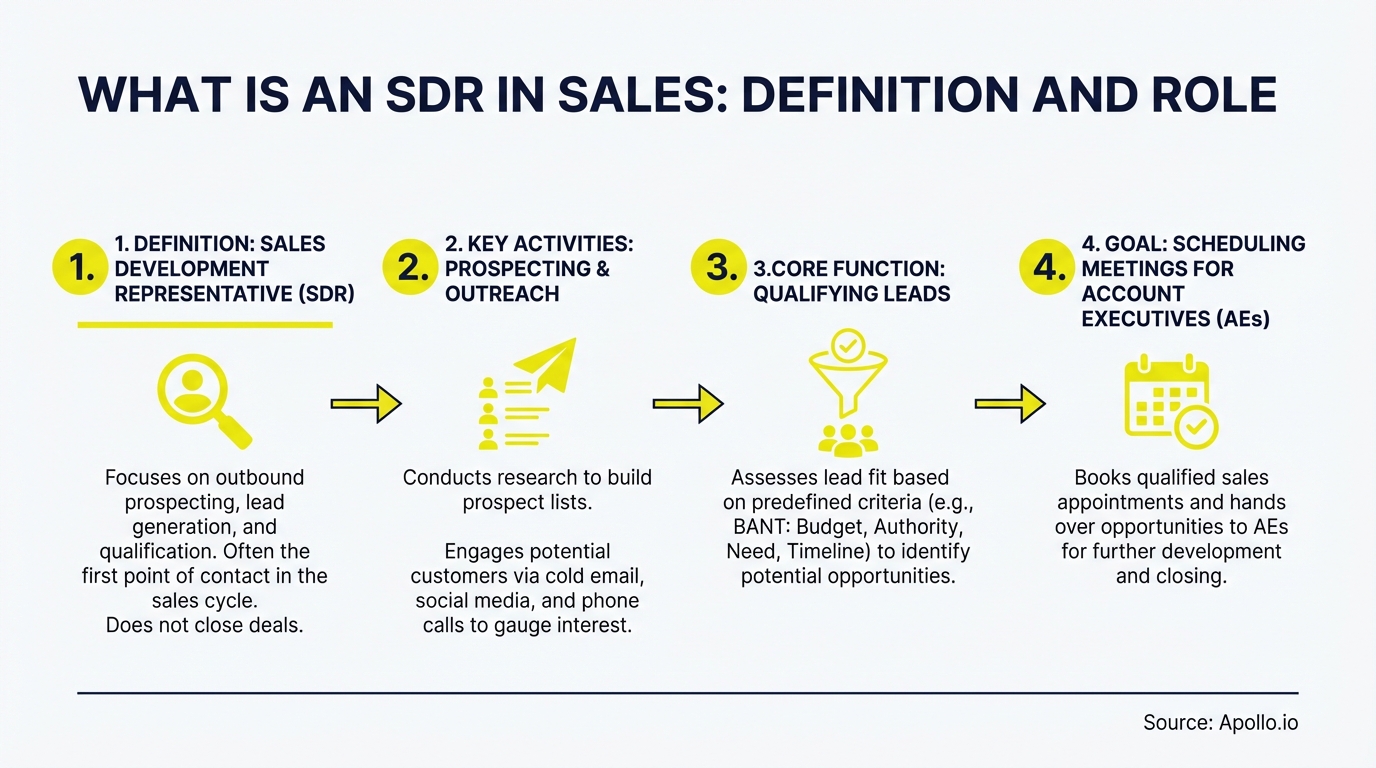
An SDR (Sales Development Representative) is a pre-sales specialist who identifies potential customers, qualifies their fit and intent, and schedules qualified meetings for Account Executives to close. SDRs operate at the top of the sales funnel, focusing exclusively on outbound prospecting, inbound lead follow-up, and opportunity creation rather than deal closure.
The SDR role exists because specialization drives efficiency. While AEs spend time on demos, negotiations, and closing, SDRs handle the time-intensive work of research, outreach, and qualification. This division of labor protects AE selling time and creates a predictable pipeline engine. Research from Scribd's 2025 Sales Development Report shows the average ratio is 1 SDR to 2.4 Account Executives, demonstrating how organizations balance prospecting capacity with closing resources.
How Does an SDR Differ From a BDR or AE?
SDRs typically handle outbound prospecting (cold outreach to targeted accounts), while BDRs (Business Development Representatives) often focus on inbound lead qualification from marketing campaigns. Account Executives (AEs) take qualified opportunities from SDRs and manage the full sales cycle through contract signature.
| Role | Primary Focus | Key Activities | Success Metric |
|---|---|---|---|
| SDR | Outbound prospecting | Cold outreach, account research, qualification calls | Qualified meetings booked |
| BDR | Inbound lead qualification | MQL follow-up, demo scheduling, lead scoring | SQL conversion rate |
| AE | Deal closure | Discovery, demos, negotiation, contract execution | Revenue closed, quota attainment |
Struggling to find qualified prospects for your SDR team? Search Apollo's 224M contacts with 65+ filters to build targeted lists in minutes.
Why Do Companies Hire SDRs?
Companies hire SDRs to create predictable pipeline, improve sales efficiency, and protect expensive closer time. The specialized SDR model allows AEs to focus on revenue-generating activities while SDRs handle prospecting volume. According to PeerSignal, about half of B2B SaaS companies have an SDR team, with this becoming dominant in larger organizations (82% of companies with 1000+ employees have an SDR function).

The business case is straightforward: SDRs generate more opportunities per dollar spent than having AEs prospect themselves. A typical AE earning $120K+ annually should spend time on high-value activities like demos and negotiations. SDRs earning $50-70K can generate 15-25 qualified meetings monthly, feeding multiple AEs and creating measurable ROI through pipeline contribution and sales productivity gains.
What ROI Do SDRs Deliver?
- Pipeline Generation: SDRs create 40-60% of new pipeline in sales-led organizations
- Time Protection: AEs gain 15-20 hours weekly to focus on active deals and closing
- Qualification Quality: Dedicated qualification improves close rates by filtering unfit prospects early
- Scalability: SDR teams can scale prospecting capacity faster than hiring expensive AEs
See Every Deal Stage In Real Time With Apollo
Forecasting unreliable because you can't see deal progress. Apollo gives you instant pipeline visibility across every stage. Built-In improved win rates 10% with real-time insights.
Start Free with Apollo →How Do SDRs Book More Meetings in 2026?
SDRs book meetings by designing relevant buyer experiences across multiple channels: personalized email sequences, strategic phone outreach, social engagement, and multi-touch cadences. The key shift in 2026 is from volume to relevance. According to Sales Science, prospects require an average of 11.3 attempts in the SDR sequence, but success depends on message quality and timing, not just activity count.
Modern SDRs leverage three core capabilities:
- Research Intelligence: Deep account and persona research before first touch
- Multi-Channel Orchestration: Coordinated email, phone, and social outreach sequences
- Personalization at Scale: AI-assisted message customization based on firmographics, intent signals, and behavioral data
SDRs using Apollo report significant efficiency gains through unified prospecting. "We reduced the complexity of three tools into one," says Collin Stewart of Predictable Revenue. The platform consolidates contact data, engagement sequencing, and meeting scheduling into one workspace, eliminating context-switching and tool sprawl that slow SDR workflows.
What Skills Do Successful SDRs Need?
Successful SDRs combine research discipline, communication adaptability, resilience, and technical proficiency. The role demands both soft skills (empathy, active listening, objection handling) and hard skills (CRM mastery, data analysis, tool proficiency).
In 2026, AI literacy has become non-negotiable as SDRs augment manual workflows with automation.
| Skill Category | Core Competencies | Application |
|---|---|---|
| Research | Account prioritization, persona mapping, trigger identification | Identifying high-fit prospects and relevant outreach angles |
| Communication | Written messaging, phone presence, active listening | Crafting compelling emails and running qualification calls |
| Resilience | Rejection management, persistence, motivation | Maintaining activity levels despite low response rates |
| Technical | CRM proficiency, sequencing tools, data enrichment platforms | Executing efficient workflows and tracking pipeline contribution |
For more on evaluating SDR candidates, explore our guide on sales interview questions that assess these competencies.
How Should Companies Structure SDR Teams?
Companies structure SDR teams based on reporting alignment (sales vs. marketing), specialization model (inbound vs. outbound), and account segmentation (SMB vs. enterprise). Research from 6sense shows 80% of BDR/SDRs now report to sales, reflecting the shift toward revenue-process ownership rather than marketing-led qualification.
What Are the Common SDR Org Models?
- Sales-Led Model (80% of teams): SDRs report to Sales leadership, aligned with AE teams by territory or vertical. This model prioritizes pipeline contribution and revenue metrics.
- Marketing-Led Model: SDRs report to Marketing, focusing on MQL conversion and campaign effectiveness. More common in companies under $10M ARR or with strong inbound engines.
- Hybrid Model: Split teams with inbound BDRs reporting to Marketing and outbound SDRs reporting to Sales, balancing lead qualification with proactive prospecting.
The choice depends on go-to-market motion, company stage, and whether pipeline generation is primarily inbound-driven or outbound-led. For insights on building effective sales development organizations, consider how your structure aligns with revenue goals and buyer journey design.
What Metrics Should SDR Leaders Track?
SDR leaders should track activity metrics (calls, emails, social touches), conversion metrics (connect rate, meeting-set rate, show rate), and outcome metrics (qualified opportunities created, pipeline contribution, SQL-to-close rate). The shift in 2026 is toward outcome-based measurement rather than pure activity volume, reflecting the buyer-experience imperative.
| Metric Type | Key Indicators | Benchmark Target |
|---|---|---|
| Activity | Daily calls, emails sent, accounts touched | 50-80 activities daily |
| Conversion | Connect rate, meeting-set rate, qualification rate | 2-5% connect, 20-30% meeting-set from connects |
| Outcome | Qualified opportunities, pipeline $$ generated, SQL conversion | 15-25 qualified meetings monthly |
| Efficiency | Time to qualification, tool utilization, sequence performance | Sub-24hr lead response, 8-12 touch sequences |
Spending hours manually tracking SDR activities across multiple tools? Get complete pipeline visibility with Apollo's unified deal management and activity tracking.
Learn more about tracking the right indicators in our guide to sales KPIs that drive revenue performance.
Start Building Your SDR Engine With Apollo
The SDR role in 2026 demands more than high activity volume. Successful SDRs design relevant buyer experiences, leverage AI-augmented workflows, and operate as revenue architects within sales-led organizations.
With 80% of SDR teams now reporting directly to sales and buyers actively avoiding irrelevant outreach, the bar for SDR effectiveness has never been higher.
Apollo provides the all-in-one platform SDR teams need to consolidate their tech stack and accelerate pipeline generation. With 224M verified contacts, multi-channel engagement sequencing, AI-powered research, and unified pipeline tracking, Apollo eliminates the tool sprawl that slows prospecting workflows. "Having everything in one system was a game changer," reports Cyera's sales team.
Ready to equip your SDR team with the tools they need to hit quota consistently? Request a Demo to see how Apollo helps SDRs at 90K+ companies book more qualified meetings and build predictable pipeline.
Prove ROI Fast With Apollo's Built-In Metrics
Budget approval stuck on unclear metrics? Apollo tracks pipeline impact, time savings, and win rates in real-time. Built-In boosted rates 10% and ACV 10% with measurable insights.
Start Free with Apollo →Don't miss these
Sales
Inbound vs Outbound Marketing: Which Strategy Wins?
Sales
What Is a Sales Funnel? The Non-Linear Revenue Framework for 2026
Sales
What Is a Go-to-Market Strategy? The 2026 GTM Playbook
See Apollo in action
We'd love to show how Apollo can help you sell better.
By submitting this form, you will receive information, tips, and promotions from Apollo. To learn more, see our Privacy Statement.
4.7/5 based on 9,690 reviews
