What Is a Sales Manager? Role, Responsibilities, and Skills for 2026
The sales manager role has evolved beyond simple quota tracking and team oversight. In 2026, sales managers orchestrate hybrid teams, integrate AI tools, and align cross-functional revenue operations while maintaining the human connection buyers still demand. With Gartner research showing sellers who partner with AI are 3.7 times more likely to meet quota, today's managers must balance technology adoption with team development. This guide explores what sales managers actually do, the skills that matter, and how to build modern B2B sales organizations that scale.

Apollo Finds Verified Contacts In Seconds
Tired of spending 4+ hours daily hunting for contact info? Apollo delivers 224M verified contacts with 96% email accuracy. Join 550K+ companies closing more deals.
Start Free with Apollo →Key Takeaways
- Sales managers in 2026 lead hybrid teams, integrate AI tools, and orchestrate data-driven selling across digital and human touchpoints
- Effective managers balance quota achievement with diversity initiatives, as women represent only 31% of senior sales roles despite proven performance
- Modern sales leadership requires cross-functional alignment between sales, marketing, and RevOps to deliver seamless buyer experiences
- AI governance and tool consolidation reduce complexity while enabling reps to focus on high-value conversations and relationship building
- Hybrid sales models combining inside and field teams are becoming standard, requiring new coaching frameworks and measurement systems
What Is a Sales Manager?
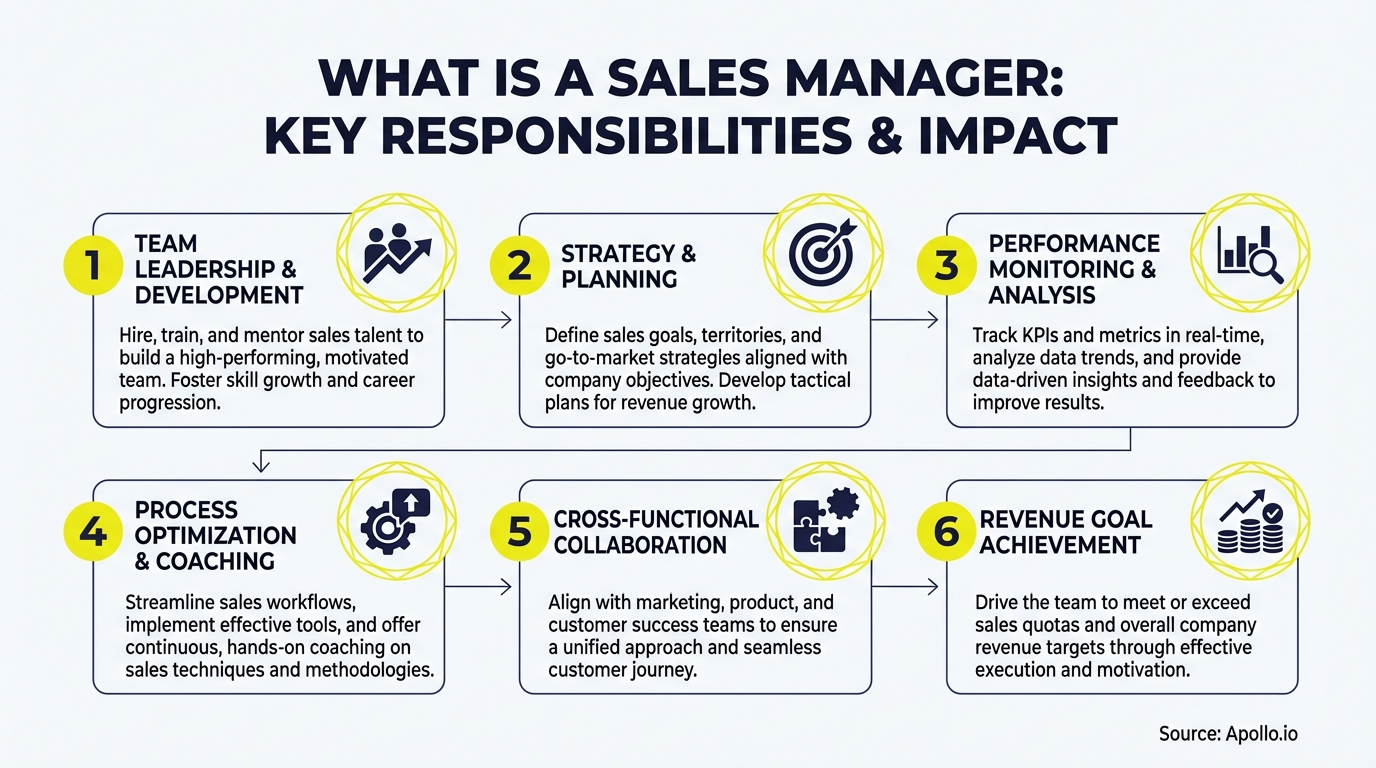
A sales manager is a leader who directs a team of sales representatives to achieve revenue targets while developing talent, optimizing processes, and aligning sales strategy with business goals. Unlike individual contributors who focus on closing deals, sales managers multiply impact through coaching, resource allocation, and strategic planning. They bridge executive leadership and frontline reps, translating company objectives into actionable sales funnels and territory plans.
In 2026, this role has expanded significantly. Sales managers now oversee hybrid selling motions, govern AI tool adoption, and collaborate with RevOps teams to maintain data integrity across the tech stack. According to Gartner, 80% of B2B sales interactions now occur in digital channels, requiring managers to coach reps on both virtual engagement and in-person relationship building.
What Are the Core Responsibilities of Sales Managers?
Sales managers handle a diverse set of responsibilities that directly impact team performance and revenue outcomes. These responsibilities extend beyond traditional quota management into strategic territory.

| Responsibility | Key Activities | Success Metrics |
|---|---|---|
| Team Development | Hiring, onboarding, coaching, performance reviews | Ramp time, quota attainment, retention rate |
| Pipeline Management | Forecast accuracy, deal reviews, stage progression | Pipeline coverage, conversion rates, win rate |
| Process Optimization | Playbook creation, workflow design, tool adoption | Sales cycle length, activity efficiency, tool usage |
| Strategic Planning | Territory design, quota setting, account segmentation | Revenue growth, market penetration, account expansion |
| Cross-Functional Alignment | Marketing coordination, RevOps collaboration, customer success handoffs | Lead quality, data accuracy, customer retention |
For SDRs and AEs, managers provide deal coaching and objection handling frameworks. For the broader organization, they ensure sales data flows correctly into CRM systems and reporting dashboards. Struggling to maintain pipeline visibility across your team? Get complete deal tracking and forecasting with Apollo's unified platform.
Turn Forecasting Chaos Into Revenue Certainty
Struggling with unreliable forecasts and blind spots in your pipeline? Apollo tracks every deal stage in real-time so you can predict revenue with confidence. Built-In boosted win rates 10% with Apollo's scoring and visibility.
Start Free with Apollo →How Do Sales Managers Integrate AI Tools in 2026?
AI integration has become a core competency for sales managers. Research by Gartner shows sellers who effectively partner with AI are 3.7 times more likely to meet quota, making AI governance a management priority.
Effective AI integration follows a structured framework:
- Tool Selection: Evaluate AI tools based on specific use cases (prospecting, email drafting, call analysis) rather than features. Prioritize platforms that integrate with existing CRM and data systems.
- Governance Structure: Establish clear ownership for AI outputs. Reps remain accountable for personalization and accuracy, while AI handles research and initial drafts.
- Training Programs: Build prompt engineering skills and teach reps when to use AI versus human judgment. Focus on AI as an assistant, not a replacement.
- Performance Measurement: Track AI adoption rates, time savings, and quality metrics. Monitor for over-reliance or misuse that damages buyer relationships.
Sales managers should consolidate AI capabilities within their existing tech stack rather than adding point solutions. As Census reported, "We cut our costs in half" by moving to unified platforms that combine AI features with core sales tools. This reduces training overhead and improves data consistency across the sales process.
Why Is Diversity in Sales Leadership Critical?
Gender diversity remains a significant challenge in sales management. Data from Gartner shows women represent only 31% of senior-level B2B sales employees despite comprising nearly half of the global workforce. This gap limits perspective diversity and talent pool depth.
Sales managers can drive measurable progress through specific initiatives:
- Structured Career Pathing: Create transparent promotion criteria with skills-based assessments rather than subjective evaluations. Document advancement timelines and required competencies.
- Sponsorship Programs: Pair high-potential women with executive sponsors who advocate for stretch assignments and visibility opportunities.
- Compensation Audits: Conduct regular pay equity reviews to eliminate gender-based compensation gaps. Publish aggregate results to demonstrate commitment.
- Flexible Work Models: Design hybrid arrangements that accommodate diverse life circumstances without penalizing career progression.
Sales leaders who prioritize diversity gain access to broader talent pools and improve team performance through varied problem-solving approaches. Organizations with inclusive cultures also see higher retention rates and stronger employer brands.
How Do Sales Managers Lead Hybrid Teams Effectively?
Hybrid sales models combining inside and field selling have become the dominant approach. Research from McKinsey indicates 85% of companies expect hybrid roles to become the most common sales position within three years.
Managing hybrid teams requires adapted frameworks:
| Challenge | Solution | Implementation |
|---|---|---|
| Unequal coaching access | Structured 1-on-1 cadence | Weekly video calls + monthly in-person sessions |
| Activity visibility gaps | Unified activity tracking | CRM integration + conversation intelligence tools |
| Inconsistent messaging | Centralized playbooks | Digital sales rooms + templated email sequences |
| Performance measurement | Outcome-based metrics | Focus on pipeline generation and win rate vs activity volume |
Effective hybrid managers create equal development opportunities regardless of location. They use video call recording for coaching, maintain shared deal review calendars, and celebrate wins publicly in team channels.
The key is consistency in communication rhythms and performance standards.

How Can Sales Managers Align With Marketing and RevOps?
Cross-functional alignment between sales, marketing, and revenue operations eliminates friction in the buyer journey. According to MarTech research, 50% of B2B marketers missed 2024 goals due to misalignment with sales, highlighting the cost of siloed operations.
Sales managers drive alignment through specific mechanisms:
- Service Level Agreements (SLAs): Define lead response times, qualification criteria, and feedback loops between teams. Document handoff processes and escalation paths.
- Shared KPIs: Align on metrics like MQL-to-SQL conversion, lead quality scores, and customer acquisition cost. Create joint dashboards with real-time visibility.
- Regular Governance: Schedule weekly sales-marketing syncs and monthly RevOps reviews. Use these forums to address data quality issues and process gaps.
- Integrated Tech Stack: Consolidate tools to eliminate data silos. As Cyera noted, "Having everything in one system was a game changer" for cross-team collaboration.
Tired of juggling multiple disconnected tools? Unify your go-to-market motion with Apollo's all-in-one platform that connects prospecting, engagement, and deal management in a single workspace.
When sales managers actively participate in marketing planning and RevOps initiatives, teams move faster and achieve higher conversion rates. This collaboration becomes especially critical as buyers increasingly expect seamless, personalized experiences across all touchpoints.
What Skills Do Successful Sales Managers Need in 2026?
The skill requirements for sales managers have expanded beyond quota management and team motivation. Modern managers need a blend of technical, strategic, and interpersonal capabilities.
Critical skills include:
- Data Analysis: Interpret pipeline metrics, forecast accuracy, and activity patterns to identify coaching opportunities and process improvements
- AI Literacy: Understand how AI tools work, their limitations, and appropriate use cases to guide team adoption effectively
- Change Management: Lead teams through process changes, tool migrations, and organizational shifts with clear communication and training
- Strategic Thinking: Connect daily activities to quarterly objectives and market dynamics to prioritize team focus
- Coaching Excellence: Diagnose skill gaps, deliver actionable feedback, and create development plans that accelerate rep performance
- Digital Fluency: Navigate virtual selling environments, social selling platforms, and digital engagement tools
Sales managers who combine these skills create high-performing teams that adapt quickly to market changes. They leverage AI sales tools to automate administrative work while investing coaching time in strategic selling skills and relationship development.
Start Building Your Modern Sales Management Approach
The sales manager role in 2026 demands more than quota oversight. Today's managers orchestrate hybrid teams, govern AI adoption, champion diversity initiatives, and align cross-functional revenue operations.
They balance data-driven decision making with the human connection that buyers increasingly value.
Success requires embracing new tools while maintaining focus on fundamental management principles: clear expectations, consistent coaching, and strategic resource allocation. Sales managers who consolidate their tech stack, build inclusive teams, and create structured AI governance frameworks position their organizations for sustainable growth.
Ready to simplify your sales management workflow? Start free with Apollo and give your team a unified platform for prospecting, engagement, and deal management that reduces complexity while improving results.
Prove Apollo's ROI In Your First 30 Days
Budget approval stuck on unclear metrics? Apollo tracks every dollar of pipeline impact from day one. Built-In boosted win rates 10% and ACV 10% with Apollo's real-time ROI tracking.
Start Free with Apollo →Don't miss these
Sales
Inbound vs Outbound Marketing: Which Strategy Wins?
Sales
What Is a Sales Funnel? The Non-Linear Revenue Framework for 2026
Sales
What Is a Go-to-Market Strategy? The 2026 GTM Playbook
See Apollo in action
We'd love to show how Apollo can help you sell better.
By submitting this form, you will receive information, tips, and promotions from Apollo. To learn more, see our Privacy Statement.
4.7/5 based on 9,690 reviews
