
What Is a Sales Contract? Elements, Types, and Best Practices for 2026
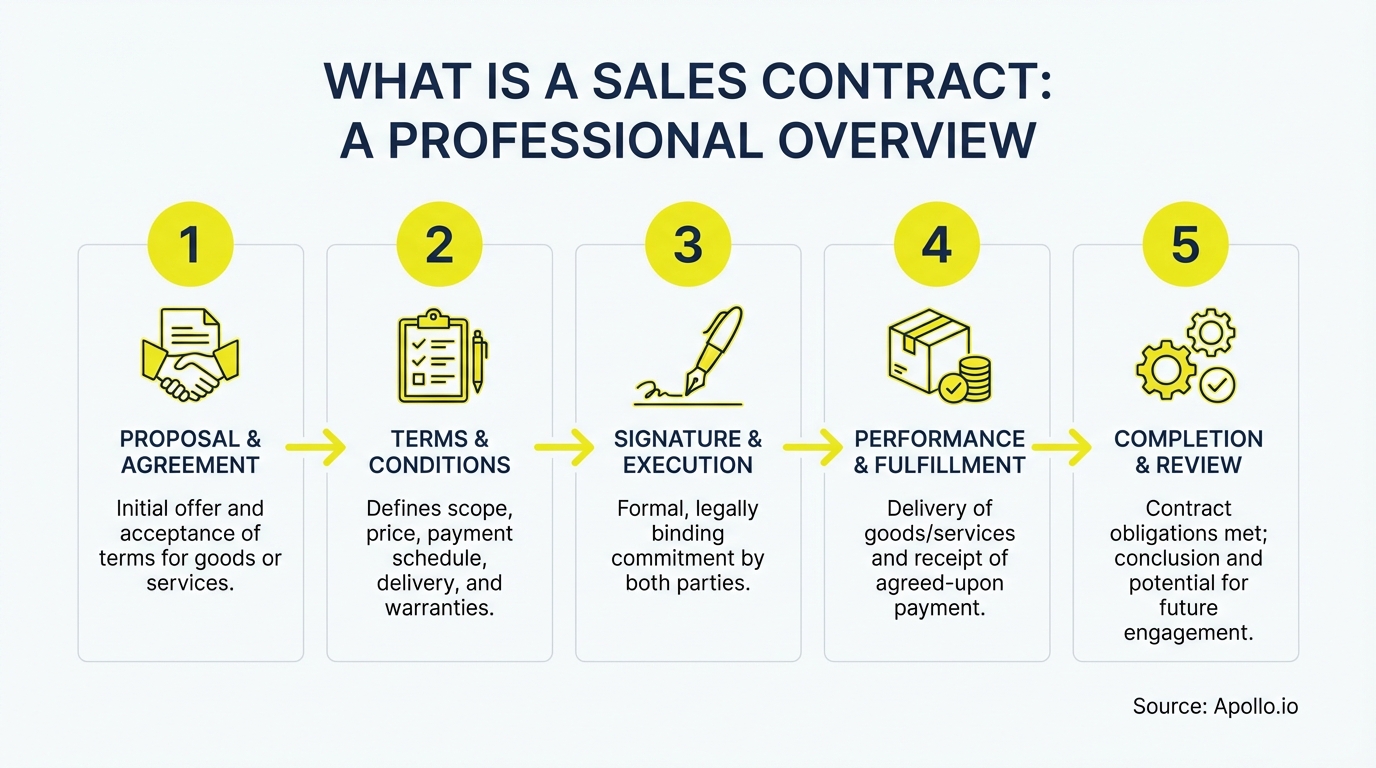
A sales contract is a legally binding agreement between a buyer and seller that defines the terms of a transaction: what is being sold, at what price, under what conditions, and what happens when either party fails to deliver. It is the document that converts a verbal commitment into an enforceable obligation.
Yet contracts are underperforming. According to a Gartner survey, 61% of B2B buyers now prefer a rep-free buying experience, which means your contract must communicate terms clearly enough to close deals without a human explaining every clause. That is a higher standard than most contracts currently meet.

Research Less, Close More With Apollo
Tired of burning hours verifying contact info that goes nowhere? Apollo delivers 96% email accuracy across 224M contacts so your team sells instead of searches. Start building real pipeline today.
Start Free with Apollo →Key Takeaways
- A sales contract requires six core elements to be legally enforceable: offer, acceptance, consideration, capacity, legality, and mutual assent.
- Contracts differ by subject matter (goods vs. services), duration (one-time vs. subscription), and governing framework (UCC vs. CISG for cross-border deals).
- Post-signature governance, not just drafting, determines whether a contract delivers its intended value.
- AI is now being used by legal and sales teams to accelerate contract processing significantly.
- Winning more deals starts before the contract: Apollo's deal management tools help you track every opportunity through close.
What Are the Essential Elements of a Sales Contract?
Every enforceable sales contract must contain six foundational elements. Missing any one of them can render the agreement void or unenforceable.
| Element | What It Means in Practice |
|---|---|
| Offer | A specific proposal to sell defined goods or services at a stated price |
| Acceptance | Unambiguous agreement to the exact terms of the offer (counter-offers restart the process) |
| Consideration | Something of value exchanged by both parties (money, services, or goods) |
| Capacity | Both parties must have legal authority to enter the agreement |
| Legality | The subject matter must be lawful in the relevant jurisdiction |
| Mutual Assent | Both parties understand and agree to the same terms (no misrepresentation) |
Beyond these six elements, every sales contract should specify: payment terms and schedule, delivery obligations and timelines, acceptance criteria, warranties and disclaimers, termination conditions, and dispute resolution procedures.
What Are the Main Types of Sales Contracts?
Sales contracts are not one-size-fits-all. The right structure depends on what you are selling, to whom, and over what timeframe.
| Contract Type | Best For | Key Characteristics |
|---|---|---|
| Purchase Order (PO) | One-time goods transactions | Buyer-initiated, specific quantities and prices, short-term |
| Master Service Agreement (MSA) | Ongoing service relationships | Sets standard terms; individual SOWs define scope per engagement |
| Subscription Agreement | SaaS and recurring revenue | Auto-renewal clauses, usage limits, upgrade/downgrade provisions |
| Enterprise License Agreement (ELA) | High-ticket enterprise deals | Multi-year, volume pricing, custom SLAs, dedicated support tiers |
| Distributor/Reseller Agreement | Channel sales | Territory rights, margin structures, co-marketing obligations |
| Letter of Intent (LOI) | Pre-contract alignment | Non-binding (usually), signals intent before full contract drafting |
Goods contracts in the US are typically governed by the Uniform Commercial Code (UCC). Cross-border goods transactions between signatory countries fall under the CISG (Convention on Contracts for the International Sale of Goods). Services contracts rely primarily on common law principles unless the parties specify otherwise.
How Do Sales Contracts Differ From Other Business Agreements?
Sales contracts are often confused with adjacent documents. The distinctions matter operationally and legally.
- Sales contract vs. NDA: An NDA protects information exchanged during negotiations. A sales contract governs the transaction itself. Both may coexist for the same deal.
- Sales contract vs. proposal/quote: A proposal is an invitation to negotiate. A signed contract with defined terms is the binding commitment.
- Sales contract vs. MSA + SOW: An MSA establishes the relationship framework; a Statement of Work (SOW) defines specific deliverables for each project within that framework.
- Sales contract vs. order form: An order form is a short-form transactional document that typically incorporates an MSA or Terms of Service by reference.
For B2B sales, the most common pattern is an MSA paired with an order form or SOW. This separates legal boilerplate (negotiated once) from commercial terms (updated per deal), which speeds up the sales cycle considerably.
Turn Weak Leads Into Real Pipeline
Tired of marketing leads that never become real opportunities? Apollo surfaces in-market buyers at the right moment so your team stops guessing and starts closing. Join 550K+ companies building predictable pipeline.
Start Free with Apollo →What Critical Clauses Protect Both Parties?
Well-drafted contracts protect revenue, relationships, and remedies. These are the clauses that most often determine outcomes in disputes or renewals.
- Payment terms: Net-30/60/90, late payment penalties, accepted payment methods, and invoicing cadence.
- Delivery and acceptance: Clear milestones, acceptance criteria, and what constitutes a material breach of delivery obligations.
- Limitation of liability: Caps on damages (typically tied to contract value) and exclusions for consequential or indirect losses.
- Indemnification: Which party bears costs if a third-party claim arises from the other's actions or IP.
- Termination for cause vs. convenience: Notice periods, cure windows, and what happens to pre-paid fees on early exit.
- Auto-renewal and notice windows: Critical for subscription contracts; missed renewal windows are a primary source of unintended commitment.
- Price escalation: Annual uplift clauses (e.g., CPI-linked increases) protect margin over multi-year terms.
- Governing law and dispute resolution: Jurisdiction, arbitration vs. litigation, and applicable law.
"Now we know exactly what we want to say and who we want to say it to. It's just a matter of going into Apollo and making it happen."

Post-Signature Governance: Where Contract Value Is Won or Lost
Signing the contract is not the finish line. Most contract value leakage happens after signature, through missed obligations, untracked renewals, and SLA drift.
Building a post-signature governance process is the highest-leverage improvement most sales and RevOps teams can make.
A practical post-signature governance framework includes four components:
- Obligations register: A shared log of every commitment made by both parties (delivery dates, reporting cadences, SLA thresholds), with owners and due dates assigned.
- Renewal calendar: Every contract renewal window flagged at 90, 60, and 30 days before the notice deadline. Missing a termination window can lock you or your customer into an unwanted renewal.
- SLA performance tracking: Dashboards that measure actual delivery against contracted commitments. This data supports QBRs and renewal negotiations.
- Amendment log: A version-controlled record of every change order, price adjustment, or scope modification, linked to the original contract.
According to Malbek, legal teams using AI-powered solutions have cut contract processing time by over 77%. That efficiency gain is only possible when contracts have structured data fields and standardized clauses from the start.
If you want to connect contract performance to broader sales KPIs, build your obligations register into your CRM so that contract milestones trigger pipeline and revenue recognition events automatically.
How AI and Digital Workflows Are Changing Sales Contracts in 2026
Contract management is one of the fastest-digitizing areas in B2B. According to Astute Analytica, the CLM market was valued at US$3.61 billion in 2024 and is projected to reach US$11.95 billion by 2033, growing at a CAGR of 13.55%. Investment in CLM tools is now a mainstream roadmap item, not a niche capability.
The practical implications for sales teams:
- AI clause extraction: AI tools can automatically tag and categorize contract clauses, making it easier to compare terms across agreements and identify non-standard language.
- Automated redlining: Clause libraries allow legal teams to pre-approve acceptable variations, reducing back-and-forth negotiation cycles.
- Digital self-serve terms: More buyers expect to review and sign standard agreements online without scheduling a call. Plain-language contracts reduce friction in this workflow.
- Structured data fields: Contracts built with structured metadata (renewal dates, SLA thresholds, payment terms) integrate directly with CRM and revenue operations workflows.
The shift toward rep-free buying makes contract clarity a competitive advantage. If a buyer can read your agreement, understand it without legal assistance, and sign it digitally in under 10 minutes, your close rate improves.
Complexity is no longer a negotiating asset; it is a deal-killer.
"A lot of deals at the enterprise level are driven through outbound. Apollo has been huge in helping us to get our foot in the door with those accounts."
Managing deals from first touch to signed contract requires visibility across every stage. Apollo's deal management tools give your team a unified view of pipeline status, stakeholder engagement, and deal health so nothing falls through the cracks before the contract is sent.
Sales Contract Best Practices for 2026
The following practices separate high-performing sales organizations from those that lose value at the contracting stage.
- Use plain language. If a clause requires a lawyer to explain it to your buyer, rewrite it. Clarity accelerates signature velocity and reduces post-signature disputes.
- Separate legal boilerplate from commercial terms. Negotiate the MSA once; use order forms for deal-specific terms. This shortens negotiation cycles for repeat business.
- Standardize your clause library. Pre-approved fallback positions for key clauses (liability caps, payment terms, termination) reduce legal review time and enable faster redlining.
- Tag every contract with structured metadata. Renewal dates, contract value, SLA thresholds, and key contacts should be machine-readable fields, not buried in paragraphs.
- Build renewal management into your sales performance process. Treat renewal as a sales motion with its own pipeline stage, not an administrative task.
- Review contract performance data before renewal negotiations. SLA adherence, support ticket volume, and usage data are your leverage for price protection or upsell conversations.

Conclusion: Contracts as a Revenue Operations Asset
A sales contract is not just a legal formality. It is a revenue protection tool, a governance framework, and increasingly a competitive differentiator.
Teams that treat contracting as a cross-functional discipline, connecting sales, legal, finance, and RevOps, consistently extract more value from their agreements and lose less to leakage, disputes, and missed renewals.
The foundation of a strong contract is a strong pipeline. Ready to fill yours? Start free with Apollo and give your team the prospecting, engagement, and deal management tools to close more deals, faster.
Prove Pipeline ROI From Day One
Budget approval stuck on unclear metrics? Apollo delivers measurable pipeline impact fast — Leadium 3x'd their annual revenue after switching. Start your free trial and show ROI before your next review.
Start Your Free Trial →Don't miss these
Sales
Inbound vs Outbound Marketing: Which Strategy Wins?
Sales
What Is a Sales Funnel? The Non-Linear Revenue Framework for 2026
Sales
What Is a Go-to-Market Strategy? The 2026 GTM Playbook
See Apollo in action
We'd love to show how Apollo can help you sell better.
By submitting this form, you will receive information, tips, and promotions from Apollo. To learn more, see our Privacy Statement.
4.7/5 based on 9,690 reviews
