
What Guardrails Should You Put in Place When Deploying an AI SDR?
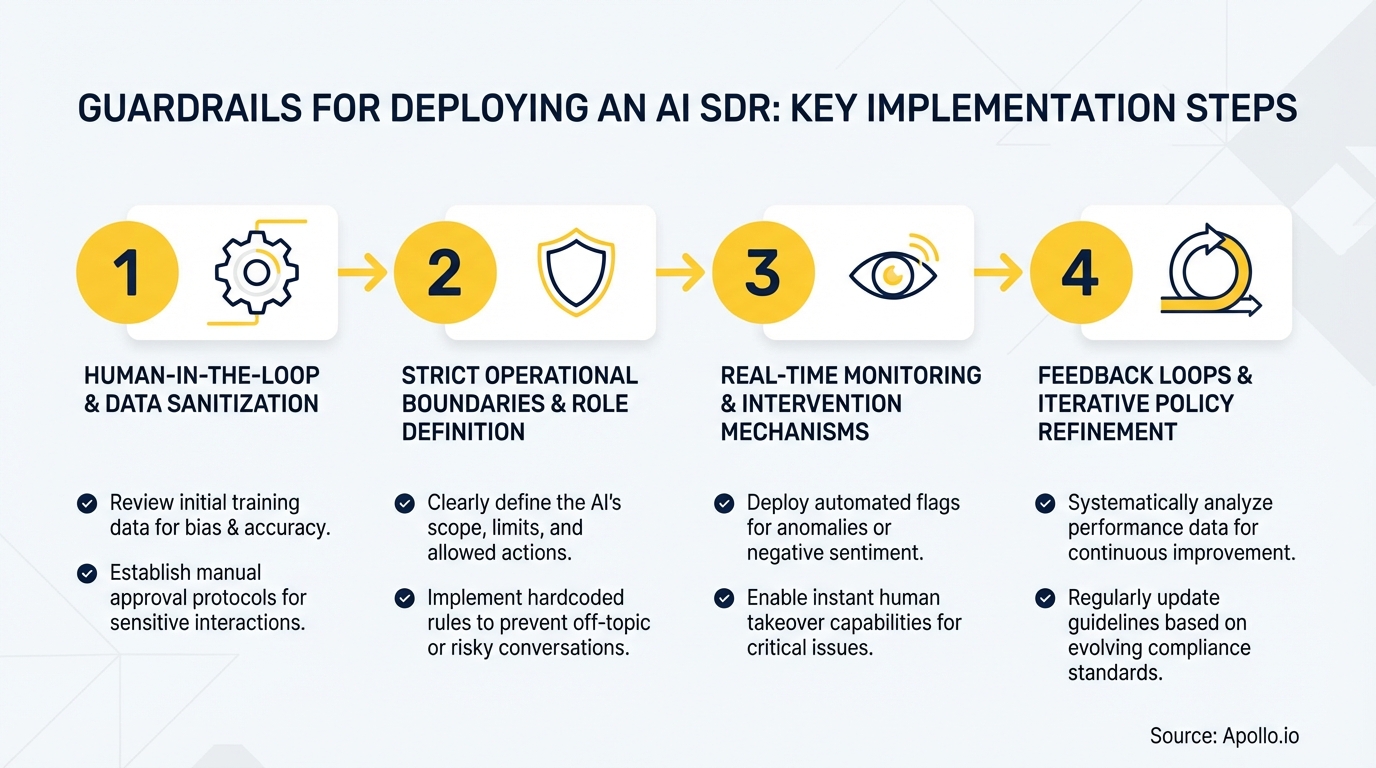
Deploying an AI SDR without guardrails is like hiring a rep and skipping onboarding entirely. The AI will prospect, message, and follow up at scale — but without defined boundaries, it can damage deliverability, erode buyer trust, and create compliance exposure before you book a single meeting. Tools like Apollo's AI Sales Assistant are built with governance in mind, grounding outreach in your ICP, value proposition, and approved messaging — but every team still needs its own operating rules before go-live.
The good news: the right guardrails don't slow you down. They let you scale AI outbound with confidence. This guide covers the essential controls SDR teams and revenue leaders need before, during, and after deploying an AI SDR in 2026.

Build Pipeline, Not Spreadsheets
Tired of your reps burning hours verifying contact info instead of selling? Apollo delivers accurate, ready-to-work leads so your team scales outreach without scaling headcount. Start building real pipeline today.
Start Free with Apollo →Key Takeaways
- Data and privacy controls must come first — most teams underestimate how much sensitive information flows through AI SDR workflows.
- Human-on-the-loop governance (policy gating + exception review) is more scalable than approving every message manually.
- Deliverability guardrails are non-negotiable in 2026, with major mailbox providers actively enforcing bulk sender requirements.
- Ethical AI use builds measurable trust — buyers notice when outreach feels transparent and respectful.
- Stage-based rollout (pilot, partial, full) reduces risk and gives your team time to validate controls before scaling volume.
Why Do AI SDR Guardrails Matter So Much in 2026?
AI SDR guardrails matter because uncontrolled AI outbound creates compounding risks: data exposure, deliverability collapse, off-brand messaging, and regulatory liability — all at the speed of automation. According to AI Business, 92% of generative AI users have leaked company data, even when employers had AI data guidelines in place. That figure should reset every assumption about "it won't happen to us."
Buyer trust is equally at stake. Research from Nutshell found that nearly 64% of customers believe companies are reckless with customer data — a concern that intensifies when AI is involved in customer interactions. Guardrails aren't just a compliance exercise. They're a competitive advantage.
What Are the Core Guardrail Categories for an AI SDR?
The essential guardrail categories for an AI SDR cover data handling, messaging quality, deliverability, human oversight, and compliance. Each category addresses a distinct failure mode.

| Guardrail Category | What It Controls | Primary Risk Prevented |
|---|---|---|
| Data Input Controls | What prospect data the AI can access and use | Data leakage, privacy violations |
| Messaging Boundaries | Approved claims, tone, offers, and topics | Off-brand copy, false claims, legal exposure |
| Deliverability Rules | Send volume, authentication, complaint thresholds | Domain damage, inbox placement collapse |
| Human Oversight | Escalation paths, review triggers, approval workflows | Unchecked automation errors at scale |
| Compliance Controls | Disclosure, opt-out, data retention, audit logs | Regulatory penalties (EU AI Act, CAN-SPAM, GDPR) |
How Should RevOps Leaders Structure a Stage-Based Rollout?
RevOps leaders should structure AI SDR deployment in three stages: pilot, partial automation, and full-scale — with explicit decision gates between each. SalesHive recommends a "guarded automation" approach where AI proposes segments and scores, but sales operations or a senior SDR spot-checks early batches before scaling volume.
- Pilot stage: AI drafts all outreach; humans approve every send. Define ICP filters, blocked topics, and approved value props before the first sequence launches. Limit to one segment or persona.
- Partial automation: AI handles follow-up sequences within approved templates. Humans review first-touch messages and any outreach touching enterprise accounts, pricing discussions, or legal claims.
- Full scale: Policy-gated automation with exception-based human review. Audit logs capture every action. Escalation triggers fire automatically for high-risk scenarios (e.g., prospect replies with legal or compliance language).
Struggling to build ICP-matched prospect lists before your pilot launches? Search Apollo's 230M+ contacts with 65+ filters to define exactly who your AI SDR should — and shouldn't — target.
Turn Funnel Guesswork Into Closed Deals
Tired of watching marketing leads stall before they ever reach your pipeline? Apollo surfaces high-intent prospects and keeps your funnel moving with 230M+ verified contacts. Top revenue teams trust Apollo to forecast with confidence.
Schedule a Demo →What Data and Privacy Controls Should You Enforce?
Data controls for an AI SDR should specify exactly what information the system can access, what it cannot store, and how long logs are retained. This is the highest-risk area for most teams.
Minimum viable data guardrails include:
- Blocked inputs: No internal deal notes, contract terms, pricing tiers, or customer health scores fed into AI prompts without explicit policy approval.
- Field-level access rules: AI SDR accesses job title, company, and firmographic data only — not CRM notes, open opportunity values, or support history by default.
- Retention limits: AI-generated drafts and research outputs not saved to a record should expire within a defined window (e.g., 30 days).
- Vendor risk review: Confirm the platform does not use your prospect data to improve shared AI models. Apollo, for example, does not allow customer data to be used to train external AI models, with SOC2 and ISO 27001 certifications covering data handling.
- Audit logging: Every AI action (list built, message sent, record enriched) should produce an immutable log entry for incident response and compliance review.
What Deliverability Guardrails Are Non-Negotiable in 2026?
Deliverability guardrails are non-negotiable because major mailbox providers — including Microsoft, Google, and Yahoo — now actively enforce bulk sender requirements. Your AI SDR's volume can silently destroy domain reputation before you notice meeting rates drop. See our full guide on sender reputation best practices for the complete framework.
Required deliverability controls before scaling AI outbound:
- SPF, DKIM, and DMARC authentication configured on every sending domain
- Spam complaint rate monitoring with automatic send throttling above threshold
- One-click unsubscribe included in every sequence (now a mailbox provider requirement)
- Domain warming schedule enforced — no cold domains sending at full volume on day one
- List hygiene rules: suppress unverified emails, bounced addresses, and opt-outs before each campaign run
- Daily and weekly send caps per domain to prevent sudden volume spikes
Understanding the mechanics of drip email marketing and pacing is essential context for AI SDR sequence design.
How Do SDRs and Sales Leaders Maintain Human Oversight at Scale?
SDRs and sales leaders maintain oversight at scale through "human-on-the-loop" governance: policy-based automation with defined escalation triggers, rather than approving each message individually. This model keeps humans in control without creating a bottleneck that defeats the purpose of AI automation.
Practical oversight controls to implement:
- Escalation triggers: Auto-pause AI outreach when a prospect replies, when a sequence hits a defined negative sentiment signal, or when a contact matches a suppression list (existing customers, active opportunities, competitors).
- Approval workflows for high-risk scenarios: Any message referencing pricing, legal terms, or specific ROI claims routes to a human reviewer before sending.
- Weekly QA sampling: RevOps or a senior SDR reviews a random sample of AI-generated messages for brand compliance, factual accuracy, and tone.
- Performance KPIs with drift detection: Track reply rate, positive reply rate, and meeting rate weekly. A sudden drop signals a guardrail failure or model drift — investigate before scaling further.
Research from MarketBetter found that the winning formula for AI in B2B sales involves augmentation (human plus AI), with approximately 55% of teams running AI-augmented workflows achieving the highest overall performance. Full autonomy without oversight consistently underperforms.
Spending too much time manually reviewing outreach quality? Apollo's sales engagement platform keeps sequences grounded in your approved messaging and ICP — reducing the QA burden from day one.
For SDRs using Apollo's Outbound Copilot, the platform surfaces credit cost transparency before each run and supports manual approval before new prospects are added to sequences — a built-in human-on-the-loop checkpoint. The AI Content Center grounds every message in your approved value proposition, pain points, and differentiators, reducing off-brand output at the source.
What Compliance and Ethical Guardrails Should You Include?
Compliance guardrails for an AI SDR must address disclosure, opt-out mechanics, data retention, and — for teams selling into the EU — documentation requirements under the EU AI Act. Transparency rules for AI-generated content take effect in August 2026, making disclosure a near-term operational requirement, not a future consideration.
Ethical controls also have a measurable business impact. Data from Auxis shows that 62% of consumers report greater trust in companies whose AI-driven decisions are perceived as ethical. Trust directly affects reply rates and pipeline quality.
Minimum compliance checklist:
- Disclose AI involvement when prospects ask directly — do not instruct the AI to deny being AI-assisted
- Maintain suppression lists updated in real time (opt-outs honored within 24 hours)
- Document the AI system used, the data sources accessed, and the human oversight controls in place
- Define a data retention policy for AI-generated outreach records and prospect research outputs
- Run a vendor risk assessment confirming your AI SDR platform's data handling, security certifications, and sub-processor policies
Tracking the right sales KPIs alongside compliance metrics gives leadership a complete picture of AI SDR health — not just volume, but quality and risk posture.

Ready to Deploy an AI SDR With the Right Guardrails Built In?
Guardrails are what separate AI SDR deployments that scale sustainably from ones that create reputational and operational damage. The teams winning with AI outbound in 2026 are those that defined their boundaries first and automated second.
Apollo's AI Sales Assistant is built for exactly this model: workflow-native AI grounded in your ICP, messaging policies, and GTM best practices — with human approval controls, credit transparency, and SOC2-certified data handling. "Work that would've taken me hours was done before I even got off the train," said Tory Kindlick, Head of Revenue Ops at RapidSOS — because the guardrails were already in place.
Start a free trial with Apollo and deploy AI-assisted outbound with governance built in from day one.
Prove Pipeline ROI Before Next QBR
ROI pressure killing your tool budget? Apollo delivers measurable pipeline impact fast — 46% more meetings with AI, trackable from day one. Stop guessing. Start showing numbers that get approved.
Start Free with Apollo →Don't miss these
Sales
Inbound vs Outbound Marketing: Which Strategy Wins?
Sales
What Is a Sales Funnel? The Non-Linear Revenue Framework for 2026
Sales
What Is a Go-to-Market Strategy? The 2026 GTM Playbook
See Apollo in action
We'd love to show how Apollo can help you sell better.
By submitting this form, you will receive information, tips, and promotions from Apollo. To learn more, see our Privacy Statement.
4.7/5 based on 9,690 reviews
