What Separates a Great AI SDR Platform from Basic Automation
Not all AI SDR platforms are created equal. Basic automation tools send sequences.
Great AI SDR platforms execute revenue workflows end-to-end, from ICP research and list building through personalized outreach, meeting prep, and follow-up. The difference shows up in pipeline, not just activity metrics.
Platforms like Apollo's AI Sales Assistant represent this shift: an end-to-end GTM assistant that researches accounts, builds prospect lists, generates context-grounded messaging, and launches full workflows from a plain-English prompt. Understanding what separates these platforms from basic automation tools helps SDRs, RevOps leaders, and sales managers make smarter buying decisions in 2026.

Research Less, Pipeline More With Apollo
Tired of your reps burning hours verifying contact info instead of selling? Apollo delivers accurate business contacts so your team spends time closing, not searching. Join 600K+ companies building predictable pipeline.
Start Free with Apollo →Key Takeaways
- Great AI SDR platforms are workflow-native — AI is embedded across prospecting, sequencing, and analytics, not isolated in a separate writing tab.
- Context-grounded personalization (using real account signals) outperforms template-based automation in both open rates and meeting conversions.
- AI-powered lead scoring reduces qualification time, letting SDRs focus effort on the highest-fit prospects.
- Agentic AI — capable of taking multi-step actions across systems — is becoming the new benchmark for enterprise-grade platforms.
- Governance controls (audit trails, human-in-the-loop approvals, deliverability management) separate platforms built for scale from tools built for pilots.
What Separates a Great AI SDR Platform from Basic Automation?
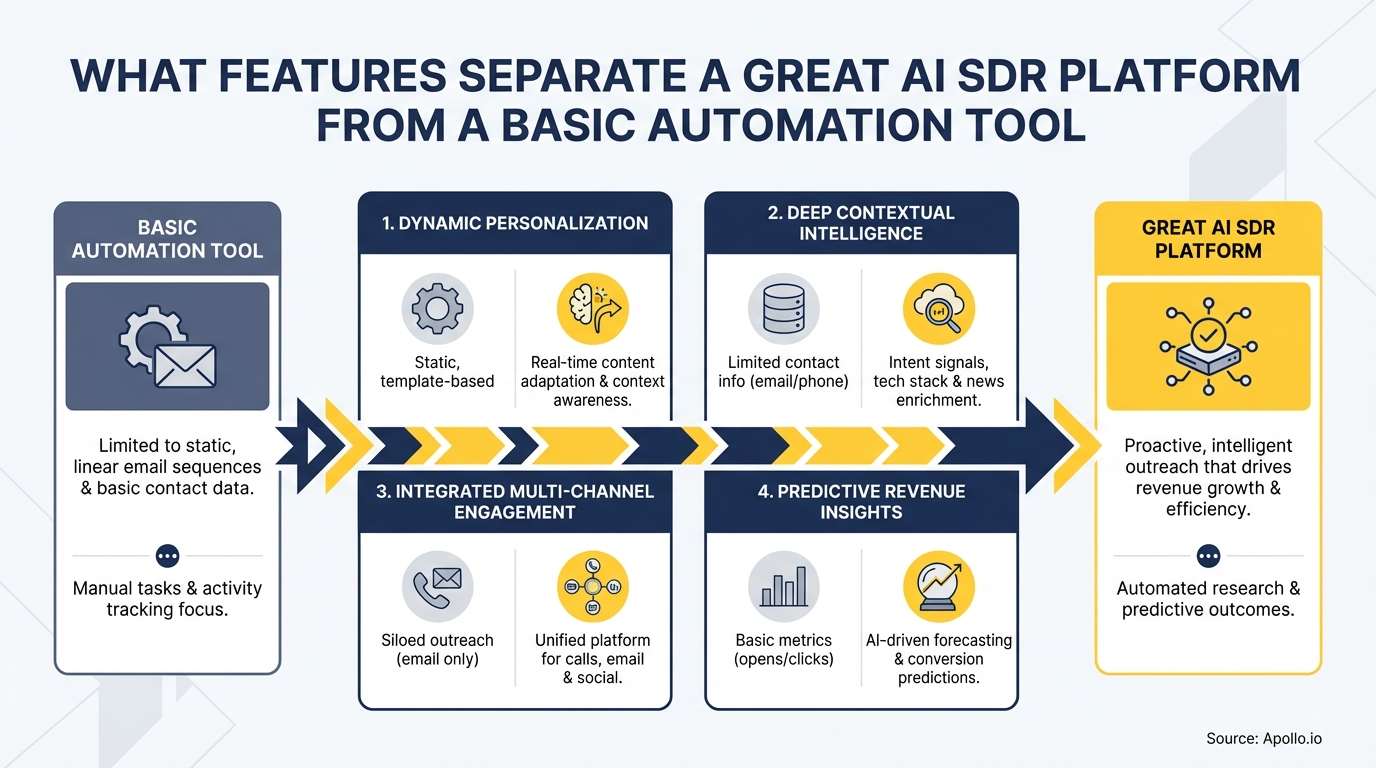
A great AI SDR platform executes the full outbound motion autonomously, while basic automation tools handle only discrete tasks like scheduling send steps or rotating templates.
The core difference is scope: basic tools automate individual actions; great platforms orchestrate entire workflows with intelligence at every step.
Basic automation handles what to send and when. A great AI SDR platform also handles who to target, why they're a fit, what to say based on real account context, and how to prioritize follow-up based on engagement signals. Learn more about the foundations in this guide on what sales automation actually means and where AI changes the equation.
What Are the Core Features That Define a Great AI SDR Platform?
| Feature | Basic Automation Tool | Great AI SDR Platform |
|---|---|---|
| Prospecting | Manual list import | Web-powered list building from natural-language prompts |
| Personalization | Merge tags (name, company) | Signal-based context (funding, job changes, tech stack) |
| Lead Scoring | Not included or static rules | AI-generated ICP scores updated dynamically |
| Sequence Building | Manual step creation | Multi-channel sequences generated from one prompt |
| Workflow Execution | Single-lane send steps | End-to-end agentic workflows across prospecting, outreach, and analytics |
| Governance | None or minimal | Audit trails, human-in-the-loop approvals, deliverability controls |
According to Autobound, Gartner predicts 40% of enterprise apps will feature task-specific AI agents by the end of 2026, up from less than 5% in 2025. This shift underscores why the evaluation bar has moved from "does it automate?" to "does it orchestrate?"
Turn Funnel Guesswork Into Real Pipeline
Pipeline forecasting a guessing game because leads stall before they ever reach your AEs? Apollo surfaces high-intent prospects and moves them faster through your funnel. Join 600K+ companies building pipeline they can actually count on.
Start Free with Apollo →How Does Context-Grounded Personalization Drive Better Results?
Context-grounded personalization uses real account signals — recent funding, job changes, technology stack, news mentions — to craft messages that feel relevant, not templated.
This is fundamentally different from inserting {{first_name}} into a generic sequence.
Research from Landbase found that organizations deploying AI-driven personalization saw email open rates increase by 42%, meeting booking rates rise by 31%, and proposal acceptance odds improve by 27%. Basic automation can send volume; it cannot replicate this level of contextual relevance at scale.
Apollo's AI Content Center grounds every email, call script, and follow-up in your actual value proposition, ICP pain points, and product differentiators. Sequences reference real prospect context rather than generic copy. Struggling to make your outreach feel human at scale? Automate your sequences with Apollo's multi-channel platform.
How Do SDRs Benefit from AI-Powered Lead Scoring and Qualification?
SDRs using AI-powered lead scoring spend less time on low-fit prospects and more time on accounts most likely to convert. AI scores evaluate ICP match across dozens of firmographic and behavioral signals simultaneously, something a manual process cannot replicate consistently.
Data from Rapid Innovation shows AI-powered lead scoring can reduce qualification time by up to 30%. For SDRs managing hundreds of accounts, that time compounds into significantly more selling capacity per week.
Apollo's AI Scores automatically rate prospects as Excellent, Good, Fair, or Not a Fit based on ICP criteria. Ian Kistner, Head of Sales Development at Crusoe, uses Apollo's AI Assistant to score and tier accounts, noting it "makes it much easier to prioritize outbound in a quickly expanding market." RevOps leaders can configure custom scoring signals on top of auto-scores for even tighter prioritization.

Why Does Workflow-Native AI Matter More Than a Standalone AI Tab?
Workflow-native AI means intelligence is embedded inside every step reps already take — prospecting, sequencing, analytics — rather than living in a separate chat window they have to context-switch into. Adoption and output quality both suffer when AI is a detour, not a default.
The practical cost of fragmented AI is real: reps manually copy research from one tool into another, outputs lose account context in transit, and teams end up stitching together single-use tools to complete one outbound motion. Apollo's AI Sales Automation platform embeds AI across prospecting, sequences, workflows, and analytics so reps never leave their workspace to get intelligent outputs.
"Work that would've taken me hours was done before I even got off the train," said Tory Kindlick, Head of Revenue Ops at RapidSOS, describing how Apollo's AI Assistant handled account research, lookalike identification, and outreach prep in a single session. That kind of productivity is only possible when AI is native to the workflow, not bolted on. Explore the full AI Assistant guide to see how this works in practice.
What Governance and Control Features Do Enterprise Teams Require?
Enterprise GTM teams require governance features that give them control over what AI does, when it acts, and how it behaves at scale. Autonomy without guardrails creates compliance risk, deliverability damage, and pipeline waste.
Key governance capabilities that separate platforms from point tools include:
- Human-in-the-loop approvals: Manual review before prospects are added to sequences or campaigns launch
- Audit trails: Logs of AI-generated actions for compliance and performance review
- Deliverability controls: Domain and inbox health monitoring, throttling, and list hygiene built into the platform
- Credit transparency: Visibility into what actions consume credits before they run
- Data privacy standards: SOC2 and ISO 27001 compliance; customer data not used to train external models
For RevOps leaders evaluating enterprise sales solutions, these controls are non-negotiable. A platform that can run autonomously but stays within policy boundaries is an asset. One that can't is a liability. Apollo's workflow engine includes configurable approval gates and cadence controls so enterprise teams can scale outbound without losing oversight.
How Do You Evaluate an AI SDR Platform Against Basic Automation Tools?
Evaluate AI SDR platforms across five dimensions: data depth, workflow coverage, personalization quality, governance controls, and measurable revenue outcomes. Tools that score well on the first two but poorly on the last three are basic automation tools with AI branding.
Use this quick scorecard when evaluating vendors:
- Data depth: Does it include a verified B2B contact database, or does it only work with imported lists?
- Workflow coverage: Does AI assist across prospecting, sequencing, scoring, and analytics — or only one step?
- Personalization quality: Does it use real account signals, or template variables?
- Governance: Are there approval controls, audit logs, and deliverability safeguards?
- Revenue measurement: Can you attribute pipeline and meetings booked directly to AI-assisted actions?
For a deeper look at how AI and automation combine in modern B2B prospecting, or to explore what AI sales tools actually close more deals, both resources offer practical frameworks for evaluation.

The Bottom Line: Choose a Platform, Not a Point Tool
The gap between a great AI SDR platform and basic automation is the difference between a system that executes revenue workflows and a tool that automates individual tasks. For SDRs trying to hit quota, RevOps teams consolidating their stack, and sales leaders demanding measurable ROI, that gap is the whole game.
Apollo consolidates prospecting, AI research, multi-channel sequencing, scoring, conversation intelligence, and workflow automation into one platform. Customers like Predictable Revenue note "we reduced the complexity of three tools into one," while Census reports "we cut our costs in half." That kind of consolidation is only possible when AI is built into the platform architecture, not added as a feature.
Ready to see what an end-to-end AI SDR platform looks like in practice? Start a free trial of Apollo and experience the difference between automation and true GTM intelligence.
Prove Pipeline ROI With Apollo
Budget approval stuck on unclear pipeline metrics? Apollo delivers measurable impact from day one — 46% more meetings, trackable deal velocity, and results leadership can see. Start free today.
Start Free with Apollo →Don't miss these
Sales
Inbound vs Outbound Marketing: Which Strategy Wins?
Sales
What Is a Sales Funnel? The Non-Linear Revenue Framework for 2026
Sales
What Is a Go-to-Market Strategy? The 2026 GTM Playbook
See Apollo in action
We'd love to show how Apollo can help you sell better.
By submitting this form, you will receive information, tips, and promotions from Apollo. To learn more, see our Privacy Statement.
4.7/5 based on 9,690 reviews
