
What Does Inside Sales Mean? Definition and Modern Best Practices
Inside sales has evolved far beyond phone calls and emails. In 2026, it's the AI-powered engine driving B2B revenue through digital channels, data intelligence, and hybrid workflows. Unlike traditional field sales, inside sales reps close deals remotely using technology platforms that consolidate prospecting, engagement, and analytics into one workspace. According to Gartner, 80% of B2B sales interactions now occur in digital channels, making inside sales the dominant model for modern B2B sales organizations.

Reclaim 4+ Hours Daily With Apollo's Data
Finding accurate emails and phone numbers takes forever. Apollo delivers 96% verified contacts instantly—no more manual research. Join 550K+ companies who turned data chaos into pipeline velocity.
Start Free with Apollo →Key Takeaways
- Inside sales reps close deals remotely using phone, email, video, and AI tools instead of in-person meetings
- Inside sales costs 30-50% less than field sales while delivering faster deal cycles and higher rep productivity
- Modern inside sales teams use AI-powered platforms to consolidate prospecting, engagement, and analytics into one workspace
- By 2026, 65% of B2B sales teams will shift from gut decisions to data-driven workflows powered by AI and analytics
- Hybrid sales models combining inside and field strategies are now the standard for enterprise accounts and complex deals
What Is Inside Sales?
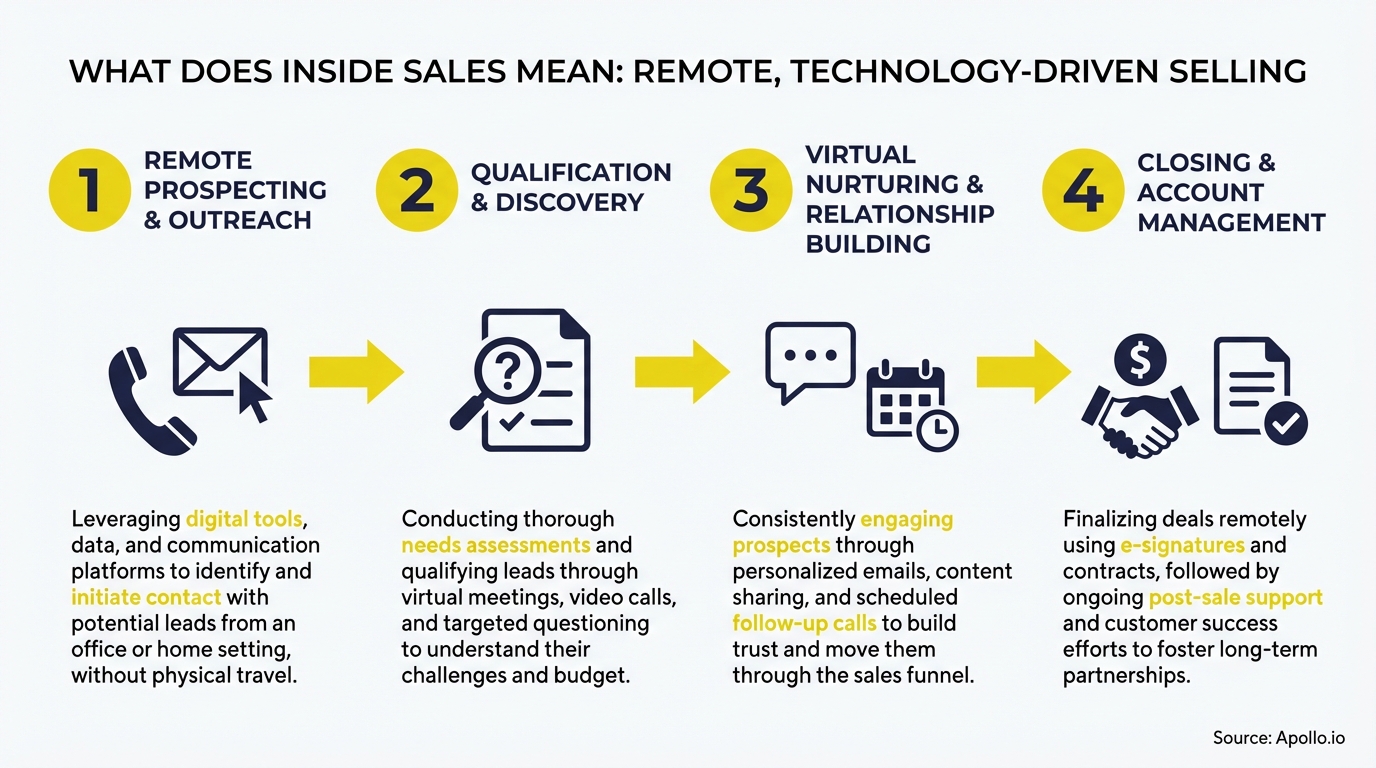
Inside sales is a remote selling model where sales professionals engage prospects and close deals entirely through digital channels like phone, email, video conferencing, and messaging platforms. Inside sales reps work from a central office or remotely, using technology to manage the entire sales funnel without traveling to meet buyers face-to-face.
Inside sales differs fundamentally from outside sales (field sales), where reps travel to meet prospects in person. The inside sales model prioritizes efficiency, scalability, and data-driven decision-making. Research by National Association of Wholesaler-Distributors shows inside sales costs 30-50% less per rep than field sales while enabling faster deal cycles.
Modern inside sales teams handle everything from initial prospecting to deal closure. SDRs and BDRs focus on lead generation and qualification, while Account Executives manage demos, negotiations, and closing.
This division of labor lets teams scale efficiently while maintaining personalized engagement at every stage.
How Does Inside Sales Work in 2026?
Inside sales in 2026 operates through AI-powered platforms that unify prospecting, engagement, and analytics. Instead of juggling separate tools for contact discovery, email sequencing, call tracking, and CRM updates, inside sales teams use consolidated platforms that handle everything in one workspace.
The workflow typically follows this pattern:

- Prospecting: Reps search databases of 224M+ contacts using 65+ filters to identify ideal buyers based on company size, industry, technology stack, and buying signals
- Research: AI agents analyze prospect data, recent company news, and engagement history to surface relevant talking points and personalized messaging angles
- Outreach: Multi-channel sequences combine email, LinkedIn messages, and phone calls with AI-generated personalization at scale
- Engagement: Video calls, screen sharing, and conversation intelligence tools capture insights and automate follow-up tasks
- Pipeline Management: Real-time dashboards track deal progress, forecast accuracy, and rep performance across the entire sales cycle
Struggling to find qualified leads across multiple prospecting tools? Search Apollo's 224M+ verified contacts with 65+ filters in one platform.
Turn Weak Leads Into Sales-Ready Opportunities
Marketing leads stalling at the top of your funnel. Apollo scores and enriches every prospect with buying signals and verified contacts. Built-In increased win rates 10% using Apollo's intelligence.
Start Free with Apollo →Why Do SDRs and BDRs Prefer Inside Sales Models?
SDRs and BDRs thrive in inside sales environments because the model eliminates travel time and lets them focus entirely on high-value activities like research, outreach, and qualification. Instead of spending hours on the road, inside sales reps can engage 50-100+ prospects daily using automated sequences and AI-powered personalization.
Inside sales platforms provide SDRs with instant access to verified contact data, buying signals, and conversation intelligence. When an SDR at a company like HubSpot books a meeting, they've typically researched the prospect using AI insights, sent personalized sequences across three channels, and tracked engagement before ever picking up the phone.
The data advantage is significant. According to Gartner, 65% of B2B sales organizations will transition to data-driven decision-making by 2026. For SDRs, this means replacing gut instincts with AI-powered insights on which prospects to prioritize, what messaging resonates, and when to follow up.
What Are the Cost Benefits of Inside Sales?
Inside sales delivers 30-50% lower costs per rep compared to field sales by eliminating travel expenses, reducing time-to-close, and enabling higher rep productivity. A field sales rep might close 20-30 deals annually while managing a territory.
An inside sales rep can close 50-100+ deals by engaging more prospects in less time.

| Cost Factor | Field Sales | Inside Sales | Savings |
|---|---|---|---|
| Annual Rep Cost | $150K-$200K | $80K-$120K | 40-50% |
| Travel & Expenses | $20K-$40K | $0-$2K | 90-100% |
| Deals Closed/Year | 20-30 | 50-100+ | 2-3x volume |
| Sales Cycle Length | 90-180 days | 30-60 days | 50-66% |
Tool consolidation amplifies these savings. Sales teams using Apollo report cutting costs in half by replacing 3-5 separate tools with one unified platform.
As Census shared: "We cut our costs in half" by consolidating their tech stack. For founders and sales leaders managing budgets, inside sales plus platform consolidation creates a compounding cost advantage.
How Do Inside Sales Teams Use AI and Automation?
Inside sales teams in 2026 use AI to automate research, personalize outreach at scale, and extract insights from every customer conversation. AI call assistants transcribe calls, generate summaries, and surface action items automatically.
AI research agents analyze prospect companies and suggest relevant talking points before every call.
The AI advantage shows up in conversion metrics. Teams using AI sales tools report 46% more meetings booked and 35% increases in deal velocity. AI handles the repetitive tasks (data entry, note-taking, sequence management) while reps focus on strategic conversations and relationship building.
Key AI capabilities transforming inside sales:
- Predictive Lead Scoring: AI ranks prospects by conversion likelihood based on engagement signals, company fit, and historical patterns
- Dynamic Personalization: AI generates custom email copy, voicemail scripts, and LinkedIn messages tailored to each prospect's role, industry, and pain points
- Conversation Intelligence: AI analyzes call recordings to identify winning talk tracks, objection patterns, and coaching opportunities
- Automated Enrichment: AI updates contact records, fills data gaps, and flags buying signals without manual research
Spending hours on manual outreach and data entry? Automate your inside sales workflows with Apollo's AI-powered platform.
What Is the Hybrid Inside/Outside Sales Model?
The hybrid sales model combines inside sales efficiency with strategic field sales for high-value accounts. Research from McKinsey shows 70% of companies increased hybrid sales teams in 2021, and that trend has accelerated through 2026.
In a hybrid model, inside sales teams handle prospecting, qualification, and smaller deals entirely remotely. When deal size exceeds a threshold (typically $50K-$100K+), Account Executives layer in strategic in-person meetings for demos, executive presentations, and contract negotiations.
This approach maximizes efficiency while preserving high-touch engagement for enterprise accounts.
RevOps leaders building hybrid models focus on clear handoff processes. Inside sales teams use sales development frameworks to qualify leads to specific criteria before passing to field AEs. Unified platforms ensure both teams access the same contact data, conversation history, and deal intelligence.
How Should Sales Leaders Build Inside Sales Teams?
Sales leaders building inside sales teams in 2026 prioritize platform consolidation, data quality, and AI enablement over headcount growth. The most effective teams use one unified platform for prospecting, engagement, pipeline management, and analytics instead of stitching together 5-10 separate tools.
Key implementation steps:
- Consolidate Your Tech Stack: Replace separate tools for contact data, email sequences, dialers, and CRM with an all-in-one platform. Cyera reported: "Having everything in one system was a game changer."
- Define Clear Roles: Separate SDR/BDR functions (prospecting, qualification) from AE responsibilities (demos, negotiation, closing). Specialization drives efficiency.
- Implement AI Workflows: Deploy AI call assistants, research agents, and automated enrichment to eliminate manual tasks and boost rep productivity.
- Build Data-Driven Processes: Use sales analytics to track conversion rates, activity metrics, and pipeline health. Make decisions based on data, not intuition.
- Create Hybrid Playbooks: Define when inside sales hands off to field sales based on deal size, complexity, and buyer preferences.
For founders competing against funded competitors, inside sales levels the playing field. Lower costs and faster cycles let smaller teams outperform larger field sales organizations through superior efficiency and technology leverage.
Conclusion
Inside sales in 2026 is the data-driven, AI-enabled foundation of modern B2B revenue engines. Teams that consolidate their tech stack, embrace automation, and build hybrid workflows will dominate their markets through superior efficiency and customer engagement.
The shift from intuition to intelligence, from fragmented tools to unified platforms, and from manual processes to AI-powered workflows isn't coming; it's already here.
Ready to transform your inside sales operation? Request a Demo to see how Apollo consolidates prospecting, engagement, and analytics into one AI-powered workspace.
Prove Apollo's ROI In Your First 30 Days
Budget approval stuck on unclear metrics? Apollo tracks every dollar—pipeline generated, meetings booked, deals closed. Built-In increased win rates 10% and ACV 10% with measurable signals.
Start Free with Apollo →Don't miss these
Sales
Inbound vs Outbound Marketing: Which Strategy Wins?
Sales
What Is a Sales Funnel? The Non-Linear Revenue Framework for 2026
Sales
What Is a Go-to-Market Strategy? The 2026 GTM Playbook
See Apollo in action
We'd love to show how Apollo can help you sell better.
By submitting this form, you will receive information, tips, and promotions from Apollo. To learn more, see our Privacy Statement.
4.7/5 based on 9,690 reviews
