
What Does B2B Sales Mean? Definition and Process Explained
B2B sales drives $1.94 trillion in digital commerce annually and powers the growth engines of manufacturing, distribution, and SaaS companies worldwide. Whether you're an SDR booking your first meetings or a sales leader building a revenue team, understanding what B2B sales means in 2026 is critical for hitting your targets.
This guide breaks down the definition, processes, and technology reshaping how businesses sell to other businesses.

Scale Your Team Without The Growing Pains
Tired of inconsistent processes slowing down new reps? Apollo standardizes your entire GTM playbook—from prospecting to follow-up. Built-In increased win rates 10% with unified workflows.
Start Free with Apollo →Key Takeaways
- B2B sales means selling products or services to other businesses, not individual consumers, with longer cycles and multiple stakeholders
- AI adoption in B2B sales reached 100% among enablement leaders in 2025, with 48% reporting increased revenue and 51% experiencing shorter sales cycles
- Modern B2B sales combines traditional relationship-building with AI automation, data enrichment, and multi-channel engagement to drive predictable revenue
- The B2B marketplace sector is growing 15-20% annually as digital transformation reshapes traditional sales channels
- Successful B2B teams consolidate their tech stack into unified platforms that handle prospecting, engagement, and deal management in one workspace
What Does B2B Sales Mean?
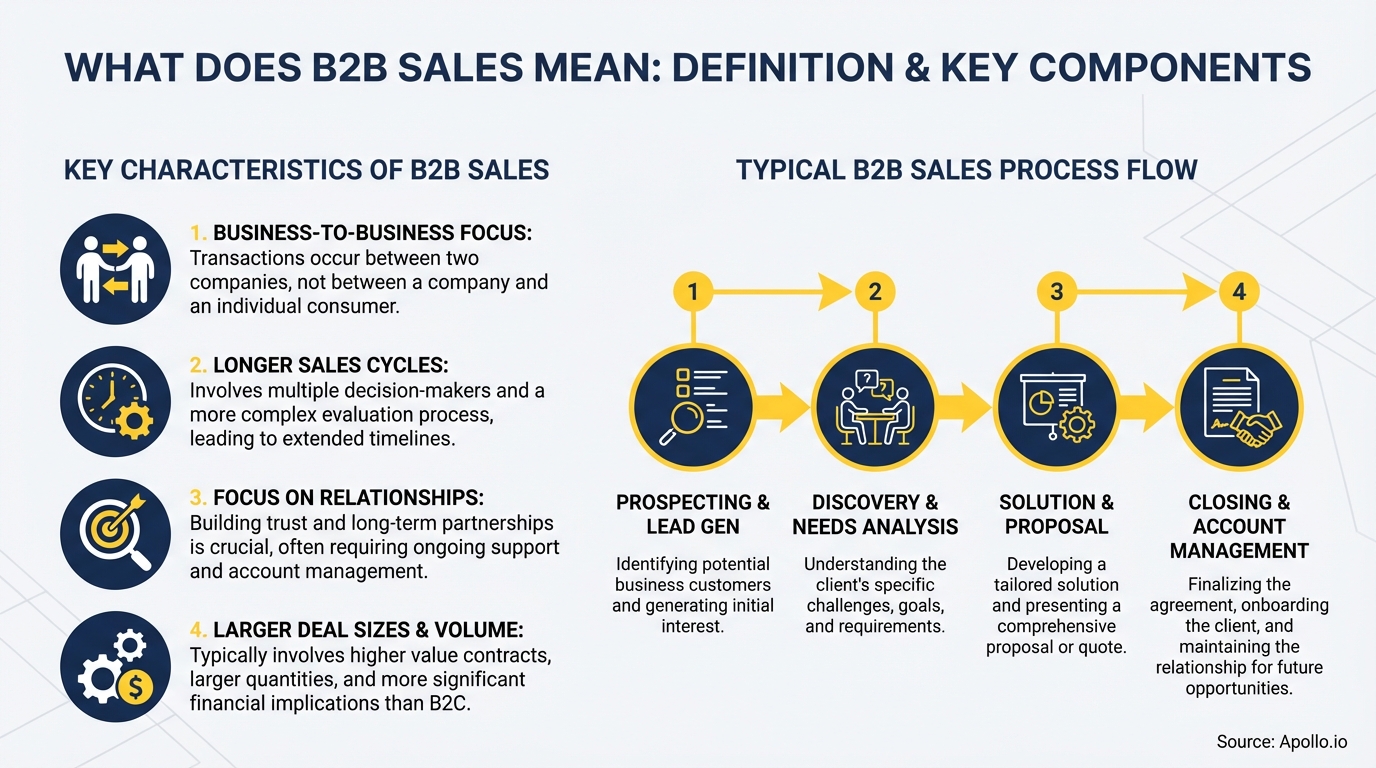
B2B sales (business-to-business sales) refers to transactions where one company sells products or services to another company rather than to individual consumers. Unlike B2C sales, B2B involves longer sales cycles, higher deal values, and multiple decision-makers who evaluate purchases based on ROI and business impact.
The core distinction lies in the buyer's intent. B2B buyers purchase solutions to solve business problems, increase efficiency, or drive revenue growth. They evaluate vendors through formal procurement processes, require detailed product demonstrations, and involve stakeholders from procurement, finance, IT, and executive leadership. Understanding B2B sales fundamentals helps teams navigate complex buying committees and close deals faster.
According to the B2B E-Commerce Association, U.S. B2B digital sales grew by 19% in 2022 to reach $1.94 trillion, now accounting for 13% of all manufacturing and distribution sales. This shift toward digital channels is reshaping how SDRs prospect, how AEs engage buyers, and how revenue teams measure success.
How Does B2B Sales Differ From B2C Sales?
B2B and B2C sales operate on fundamentally different principles, timelines, and decision-making processes. The key differences impact how sales teams structure their approach, allocate resources, and measure success.
| Factor | B2B Sales | B2C Sales |
|---|---|---|
| Sales Cycle | Weeks to months (often 3-12 months) | Minutes to days |
| Decision Makers | Multiple stakeholders (6-10 average) | Individual or household |
| Purchase Drivers | ROI, efficiency, business outcomes | Personal needs, emotions, convenience |
| Deal Value | $10K to $1M+ (enterprise deals) | $10 to $10K (high-ticket items) |
| Relationship Length | Multi-year contracts, ongoing partnerships | One-time or occasional repeat purchases |
| Sales Approach | Consultative, solution-focused, demo-driven | Marketing-driven, self-service, transactional |
For Account Executives managing enterprise deals, these differences mean investing heavily in relationship-building, technical demonstrations, and business case development. Sales cycles require persistent follow-up, executive alignment, and proof of value through customer success stories and case studies.
What Are the Core Stages of the B2B Sales Process?
The B2B sales process follows a structured framework that moves prospects from initial awareness through closed deals. Each stage requires specific activities, metrics, and handoffs between SDRs, AEs, and customer success teams.
1. Prospecting and Lead Generation: SDRs identify target accounts using intent data and firmographic filters. They build lists of companies matching ideal customer profiles and research decision-makers within target accounts. Struggling to find qualified leads? Search Apollo's 224M+ contacts with 65+ filters to build targeted prospect lists.
2. Qualification and Discovery: Sales teams assess whether prospects have budget, authority, need, and timeline (BANT). Discovery calls uncover pain points, technical requirements, and buying committee structure. This stage determines if a prospect is worth pursuing or should be nurtured for future opportunities.
3. Solution Presentation and Demo: AEs deliver customized product demonstrations showing how their solution solves the prospect's specific challenges.
Presentations address technical requirements, integration capabilities, and ROI projections tailored to stakeholder priorities.
4. Proposal and Negotiation: Sales teams provide formal proposals with pricing, implementation timelines, and contract terms. Negotiation involves procurement, legal, and executive stakeholders who evaluate competing vendors and negotiate pricing, payment terms, and service level agreements.
5. Closing and Onboarding: Final contracts are signed, payment terms are established, and customers transition to implementation teams. Strong onboarding processes reduce time-to-value and set the foundation for renewals and expansion opportunities. Revenue operations teams track metrics across this entire lifecycle to identify bottlenecks and optimize conversion rates.
Turn Forecast Chaos Into Revenue Clarity
Pipeline forecasting a guessing game? Apollo gives you real-time deal visibility and AI-powered insights that make your forecast reliable. Built-In increased win rates 10% with accurate pipeline data.
Start Free with Apollo →How Do SDRs and AEs Use Technology to Drive B2B Sales?
Modern B2B sales teams leverage integrated technology platforms that consolidate prospecting, engagement, and pipeline management into unified workspaces. This approach eliminates data silos, reduces tool sprawl, and accelerates revenue cycles.
Research by E-Commerce North America found that 100% of B2B sales enablement leaders now use AI, with 48% reporting increased revenue and 51% experiencing shorter sales cycles. SDRs use AI to automate research, personalize outreach at scale, and prioritize accounts showing buying intent.

The core technology stack for B2B sales in 2026 includes:
- Contact and Company Data: Access to verified business contacts with email addresses, phone numbers, job titles, and firmographic details
- Sales Engagement Platforms: Multi-channel sequencing across email, phone, and LinkedIn with automated follow-ups and A/B testing
- Conversation Intelligence: AI-powered call recording, transcription, and analysis that surfaces coaching opportunities and tracks deal risks
- Pipeline Management: CRM integration with deal tracking, forecasting, and revenue analytics across the entire sales organization
- Intent Data and Signals: Real-time alerts when prospects research solutions, visit competitor websites, or show buying behavior
Sales leaders report significant cost savings by consolidating multiple tools into unified platforms. Census noted "We cut our costs in half" while Cyera found "Having everything in one system was a game changer." Tired of juggling multiple sales tools? Unify your entire go-to-market tech stack with Apollo's all-in-one platform.
What Trends Are Reshaping B2B Sales in 2026?
Three major forces are transforming how businesses sell to other businesses: AI automation, digital marketplaces, and immersive technologies. These trends create both opportunities and challenges for sales organizations adapting to buyer expectations.
AI-Powered Sales Automation: AI handles repetitive tasks like research, email personalization, and lead scoring. It analyzes conversation patterns to recommend next steps, predicts deal close probability, and generates meeting summaries automatically. Teams using AI report 46% more meetings booked and 35% increases in conversion rates.
B2B Marketplace Growth: Data from E-Commerce Update shows B2B marketplaces growing 15-20% annually as buyers prefer self-service purchasing experiences. Distributors' e-commerce sales grew 25% in 2022 to reach $1.4 trillion, driven by younger buyers favoring digital channels.
Immersive Product Experiences: AR and VR technologies enable virtual product demonstrations, facility tours, and interactive training sessions. Complex manufacturing equipment, software platforms, and enterprise solutions can be demonstrated remotely with immersive experiences that accelerate buyer education.

These trends require sales teams to develop new skills. Sales development teams must learn to leverage AI tools effectively, adapt to hybrid digital-physical sales motions, and compete in marketplace environments while maintaining differentiation through consultative selling.
How Can Sales Leaders Build High-Performing B2B Teams?
Building successful B2B sales organizations requires clear role definitions, structured processes, and performance metrics that align individual activities with revenue goals. Sales leaders must balance hiring, training, and technology investments to scale predictably.
Start by defining distinct roles with specific responsibilities. SDRs focus exclusively on prospecting and booking qualified meetings. AEs manage opportunities from discovery through close. Customer success teams drive retention, expansion, and referrals. B2B sales organizations that separate these functions achieve higher specialization and performance.
Implement consistent processes with documented playbooks for each sales stage. Standardize discovery questions, demo flows, objection handling, and negotiation frameworks.
Track metrics including pipeline generation, conversion rates by stage, average deal size, and sales cycle length. RevOps leaders use these metrics to identify bottlenecks and optimize resource allocation.
Invest in technology that consolidates your tech stack rather than adding more point solutions. Predictable Revenue reported "We reduced the complexity of three tools into one" after consolidating their sales platform.
Unified systems improve data quality, reduce training time, and provide complete visibility across the revenue lifecycle.
Create ongoing training programs that develop both technical product knowledge and soft skills like discovery questioning, active listening, and executive presence. Enterprise sales requires different skills than SMB sales, including account mapping, multi-threading, and C-level engagement.
Start Driving Predictable B2B Revenue Growth
B2B sales in 2026 combines traditional relationship-building with AI-powered automation, data intelligence, and multi-channel engagement. Sales teams that master this balance close deals faster, achieve higher win rates, and build sustainable revenue engines.
The most successful B2B organizations consolidate their technology stack into unified platforms that handle prospecting, engagement, and pipeline management in one workspace. This approach eliminates data silos, reduces costs, and accelerates team ramp time.
Whether you're an SDR booking your first meetings or a sales leader scaling a revenue team, the right platform makes the difference between hitting quota and falling short.
Ready to transform your B2B sales process? Start Your Free Trial and access 224M+ verified business contacts, AI-powered automation, and the complete sales engagement platform trusted by 550K+ companies worldwide.
Prove Apollo's ROI In Your First Week
Budget approval stuck on unclear metrics? Apollo tracks every touchpoint from first contact to closed deal—quantifying exactly how much pipeline and revenue you're generating. Built-In increased win rates 10% with measurable impact.
Start Free with Apollo →Don't miss these
Sales
Inbound vs Outbound Marketing: Which Strategy Wins?
Sales
What Is a Sales Funnel? The Non-Linear Revenue Framework for 2026
Sales
What Is a Go-to-Market Strategy? The 2026 GTM Playbook
See Apollo in action
We'd love to show how Apollo can help you sell better.
By submitting this form, you will receive information, tips, and promotions from Apollo. To learn more, see our Privacy Statement.
4.7/5 based on 9,690 reviews
