What Does a Sales Manager Do? Role, Responsibilities, and Skills for 2026
Sales managers in 2026 face a radically different landscape than their predecessors. With AI tools reshaping workflows and 61% of B2B buyers preferring self-service experiences, today's sales manager must balance technology adoption with human connection. This role now demands expertise in AI sales tools, data-driven decision making, and transformation leadership—all while coaching teams to hit quota in an increasingly digital-first world.

Apollo Cuts Research Time From Hours To Seconds
Tired of spending 4+ hours daily hunting for contact info? Apollo delivers 224M verified contacts with 96% email accuracy instantly. Join 550K+ companies who eliminated manual research.
Start Free with Apollo →Key Takeaways
- Sales managers lead teams by setting strategy, coaching reps, and optimizing sales processes with AI-powered tools and data insights
- Sellers who partner with AI are 3.7 times more likely to meet quota, making AI adoption a critical managerial responsibility
- Modern sales managers must balance digital self-service channels with personalized human engagement to meet evolving buyer preferences
- Only 11% of sales organizations successfully execute transformations, highlighting the need for strong change management skills
- Data-driven selling, consensus-building frameworks, and tech stack consolidation are essential competencies for 2026 sales leaders
What Does a Sales Manager Do in 2026?
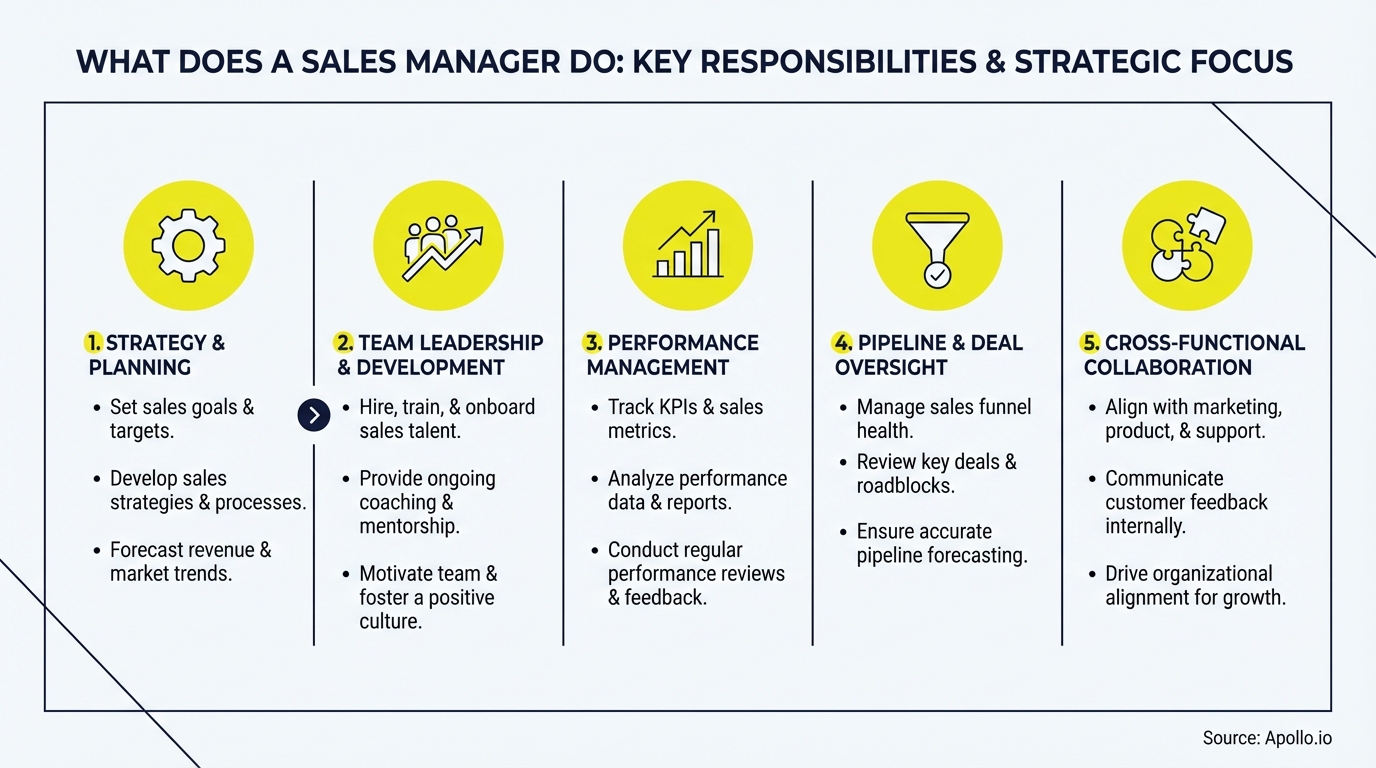
A sales manager is a leader who directs sales teams toward revenue goals by developing strategy, coaching individual reps, and optimizing processes with technology. They bridge executive vision and frontline execution.
The role encompasses four core functions: team leadership (hiring, training, motivating), pipeline management (forecasting, deal reviews, resource allocation), process optimization (implementing tools, refining workflows), and performance analysis (tracking KPIs, identifying improvement areas). Research by Gartner shows sellers who effectively partner with AI tools are 3.7 times more likely to meet their sales quotas, making technology enablement a critical managerial responsibility.
Unlike individual contributors focused on closing deals, sales managers multiply results through their team. They diagnose why reps miss targets, implement corrective coaching, and ensure consistent execution across the entire sales funnel.
How Do Sales Managers Lead AI-Enabled Teams?
Sales managers integrate AI into daily workflows by selecting tools, training teams, and measuring adoption impact. This involves three practical steps: tool selection aligned to team needs, hands-on training with real scenarios, and ongoing optimization based on performance data.
Start by auditing current workflows to identify repetitive tasks AI can automate. For SDRs, this might include prospect research and email personalization. For AEs, focus on meeting prep and follow-up automation. According to Gartner, 92% of businesses are investing in AI-powered software in 2024, but success requires deliberate implementation.

Struggling to coach your team on AI adoption? Apollo's AI automation handles research, outreach, and follow-ups so your reps focus on selling.
What AI Tools Should Sales Managers Prioritize?
Focus on platforms that consolidate multiple functions rather than adding point solutions. The best sales tech stacks in 2026 replace 3-5 separate tools with unified systems.
| Function | AI Capability | Manager Benefit |
|---|---|---|
| Prospecting | Automated lead scoring | Focus team on high-intent accounts |
| Outreach | Message personalization | Scale quality without sacrificing relevance |
| Meetings | Call summaries & coaching insights | Coach at scale with specific examples |
| Forecasting | Predictive deal analysis | Accurate pipeline visibility for leadership |

Why Is Consensus-Building Important for Sales Managers?
Consensus-building helps sales managers navigate complex buyer committees where 74% of teams experience unhealthy conflict during decisions. Managers must equip reps with frameworks to align diverse stakeholders.
Data from Gartner indicates that 74% of B2B buyer teams demonstrate unhealthy conflict during the decision process. Sales managers address this by teaching reps to map stakeholder priorities, identify potential objections early, and create alignment documents that memorialize agreements.
Implement stakeholder mapping in deal reviews. Have reps identify each decision-maker's goals, concerns, and influence level. This visibility helps AEs proactively address conflicts before they derail deals. Enterprise sales solutions require particularly strong consensus-building skills.
Turn Forecast Guesswork Into Revenue Certainty
Unreliable pipeline data killing your forecast accuracy. Apollo delivers real-time deal visibility and intent signals that make revenue planning predictable. Built-In boosted win rates 10% with Apollo's scoring.
Start Free with Apollo →How Do Sales Managers Balance Digital and Human Selling?
Sales managers create hybrid models that offer self-service options while maintaining personalized touchpoints at critical moments. This approach respects buyer preferences for autonomy while providing expert guidance when needed.
With Gartner research showing 61% of B2B buyers prefer a rep-free buying experience, managers must redesign team coverage models. Assign junior SDRs to digital-first prospects while having senior AEs focus on accounts requiring consultative selling.
Define clear triggers for human intervention: technical questions, customization requests, multi-stakeholder alignment needs. Train reps to recognize when prospects need expertise versus when to step back and let buyers self-serve through content and product demos.
What Metrics Track Hybrid Selling Effectiveness?
- Digital engagement rate: Percentage of prospects engaging with self-service content before rep contact
- Time-to-engagement: How quickly reps respond when prospects signal readiness for human interaction
- Channel preference accuracy: Match rate between buyer preferred channel and rep outreach method
- Conversion by channel: Close rates for digital-first versus human-first buyer journeys
How Do Sales Managers Drive Successful Transformations?
Sales managers lead transformation by creating clear change roadmaps, communicating benefits consistently, and celebrating early wins. Only 11% of sales organizations successfully execute transformations, making strong change management essential.
According to Gartner research, only 11% of sales organizations drive commercial success while executing a transformation. Success requires three elements: executive sponsorship, frontline buy-in, and measurable milestones.
Start transformations with pilot teams rather than full rollouts. Select high-performing reps who can become internal advocates. Document their wins with specific metrics, then share those stories in team meetings. For RevOps leaders managing cross-functional changes, align sales transformation with broader revenue operations initiatives.
Can't track your team's deal progress effectively? Get complete pipeline visibility with Apollo's deal management platform.
What Data Should Sales Managers Track in 2026?
Sales managers track leading indicators (activity metrics, pipeline velocity) and lagging indicators (revenue, quota attainment) to diagnose performance issues before they impact results. Effective dashboards combine both metric types.
Focus on metrics that drive behavior change. Activity metrics alone don't matter if they don't correlate with revenue.
Build dashboards showing: pipeline creation by rep and source, conversion rates at each funnel stage, average deal size and sales cycle length, win/loss reasons by competitor and objection type.
| Metric Category | Key Indicators | Action Trigger |
|---|---|---|
| Activity | Calls, emails, meetings booked | Below-average activity = coaching on time management |
| Pipeline Health | Coverage ratio, stage velocity | Low coverage = increase prospecting focus |
| Conversion | Lead-to-opp, opp-to-close rates | Stage drop-off = process or skill gap |
| Quality | Deal size, discount frequency | Small deals = targeting or positioning issue |
How Do Sales Managers Use Data for Coaching?
Transform data into coaching conversations by identifying patterns, not just isolated incidents. If a rep consistently loses deals at the proposal stage, that signals a specific skill gap requiring targeted training.
Review call recordings and email sequences to diagnose root causes.
Does the rep fail to uncover budget constraints? Do they skip discovery questions? Use proven email templates and talk tracks to provide concrete improvement examples rather than vague feedback.
Start Leading High-Performance Sales Teams
Sales managers in 2026 must master AI adoption, consensus-building, hybrid selling, transformation leadership, and data-driven coaching. These skills separate managers who simply track activity from those who multiply team results and drive predictable revenue growth.
The most successful sales leaders consolidate their tech stack to give teams a unified workspace. As the team at Cyera discovered, "Having everything in one system was a game changer." Tool consolidation eliminates context switching, reduces training time, and provides the single source of truth managers need for accurate forecasting.
Ready to lead your team more effectively? Start your free Apollo trial and access the all-in-one platform that gives you prospecting, engagement, AI automation, and analytics in one workspace. Join 550K+ companies using Apollo to cut costs, accelerate ramp time, and hit revenue targets consistently.
Prove Apollo ROI In Your First 30 Days
Budget approval stuck on unclear metrics? Apollo tracks every dollar spent to pipeline generated—quantify time saved, meetings booked, and deals closed. Built-In increased win rates 10% and ACV 10% with measurable Apollo impact.
Start Free with Apollo →Don't miss these
Sales
Inbound vs Outbound Marketing: Which Strategy Wins?
Sales
What Is a Sales Funnel? The Non-Linear Revenue Framework for 2026
Sales
What Is a Go-to-Market Strategy? The 2026 GTM Playbook
See Apollo in action
We'd love to show how Apollo can help you sell better.
By submitting this form, you will receive information, tips, and promotions from Apollo. To learn more, see our Privacy Statement.
4.7/5 based on 9,690 reviews
