
How to Lead a Board-Level Agentic GTM Conversation at Series B
Your Series B board just asked about agentic GTM. Most revenue leaders freeze.
The question sounds like a product roadmap conversation, but boards want to know three things: What's the ROI case? Who controls the risk?
How does this change our headcount and cost model?
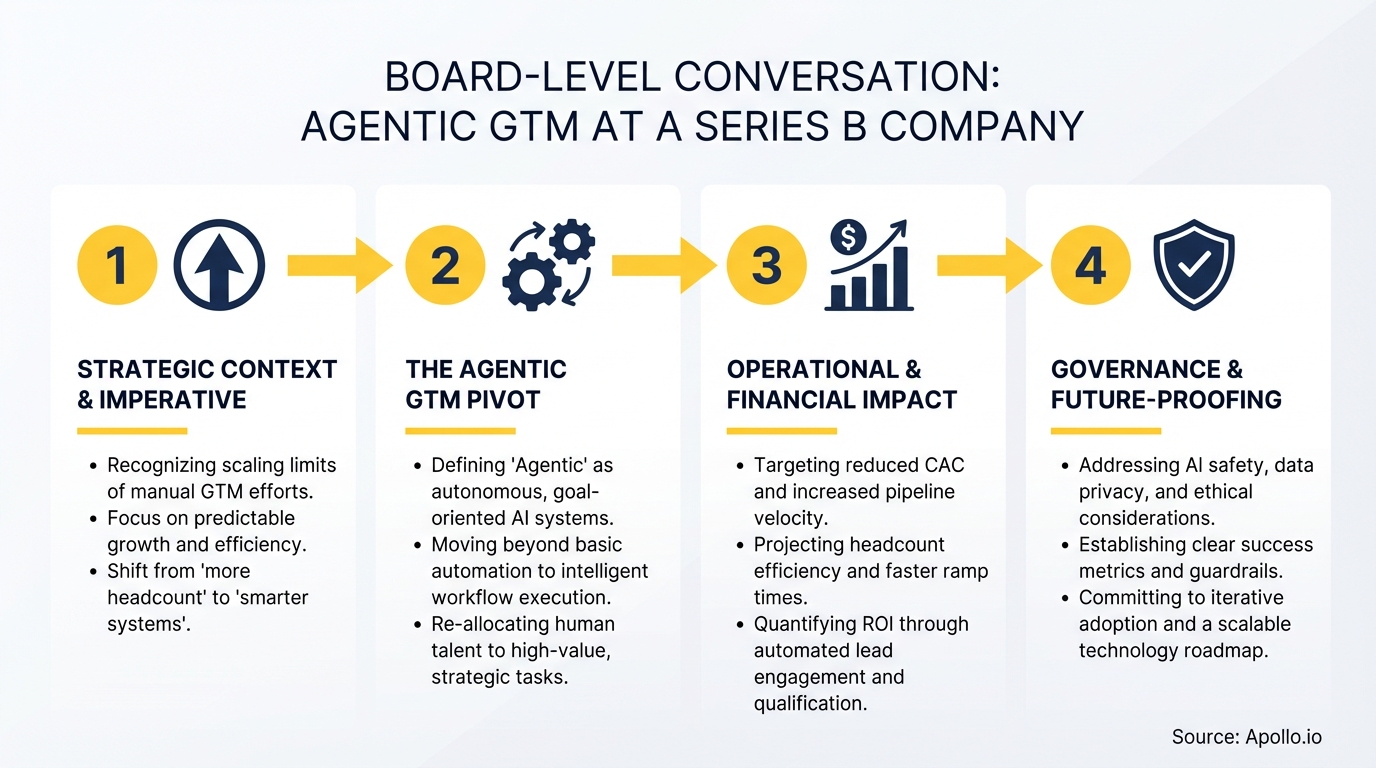
This guide gives you the exact structure for that conversation, including the KPIs to lead with, a lightweight governance framework sized for a Series B, and the cross-functional workflow that makes agents actually work. Apollo's own Series B milestone was built on making GTM more intelligent and accessible, and the same principles apply to board-ready agentic GTM today.

Research Less, Close More With Apollo
Tired of your reps burning hours hunting down contact info that bounces? Apollo delivers verified business emails and phone numbers so your team spends time selling, not searching. Join 600K+ companies building pipeline faster.
Start Free with Apollo →Key Takeaways
- Boards at high-AI-ROI organizations treat agentic GTM as a standing agenda item, not a one-time briefing.
- The board conversation must cover three layers: pipeline ROI, governance controls, and cost model implications.
- Data readiness, not model selection, is the primary constraint for Series B companies deploying agents.
- RevOps leaders are the critical bridge between agentic tooling and board-level accountability.
- Outcome-based pricing from major vendors is forcing boards to rethink COGS and expansion margin assumptions.
What Is a Board-Level Agentic GTM Conversation at a Series B?
A board-level agentic GTM conversation is a structured briefing where revenue leaders present AI agent deployment decisions as business investments, not technology experiments, tied directly to pipeline, CAC, and margin outcomes.
Research from Protiviti reveals a stark governance gap: high-ROI organizations discuss AI at every board meeting, compared to just 13% of low-ROI organizations. The cadence itself is a leading indicator. At the Series B stage, this conversation typically covers:
- Investment thesis: Why agents now, what problem they solve, and what success looks like in 90 days
- Risk and control posture: Who owns agent decisions, what the escalation path is, and where human approval gates sit
- Cost model shift: How agents change headcount assumptions, tool spend, and gross margin
- Pipeline impact: Specific metrics connecting agent activity to qualified pipeline and win rate
According to MediaPost, 96% of B2B companies believe AI agents with full-funnel context would significantly improve execution. Your board will assume you have a plan. The question is whether it's board-ready.
What KPIs Should Revenue Leaders Present to the Board?
Revenue leaders should anchor the board conversation to four KPI clusters: pipeline generation, conversion efficiency, cost-per-acquisition, and data quality as a gating metric.
| KPI Cluster | Metric | Why It Matters to the Board |
|---|---|---|
| Pipeline Generation | Qualified pipeline created by agents vs. reps | Shows coverage capacity without proportional headcount growth |
| Conversion Efficiency | Meeting-to-opportunity rate, win rate by source | Validates that agent-sourced pipeline converts at acceptable rates |
| CAC Payback | Blended CAC (agents + rep time + tool cost) | Connects AI spend to unit economics investors care about |
| Data Readiness | CRM data completeness score, enrichment coverage | Boards increasingly recognize data quality as the constraint, not model capability |
Struggling to keep pipeline data clean enough for agents to act on? Apollo's pipeline tools give RevOps a single source of truth for agent-ready GTM data.
What Governance Framework Do Boards Require for Agentic GTM?
Boards require a lightweight RACI that defines who approves agent actions, what triggers human review, and how errors are audited, before agents touch live pipeline.
The governance conversation is shifting from ethics frameworks to operational accountability. At Series B, governance does not need to be heavy, but it must be explicit.
A practical agentic GTM RACI for a Series B looks like this:
- Responsible: RevOps owns agent configuration, data inputs, and weekly performance review
- Accountable: CRO or VP Sales owns outcomes; agents act under their authority
- Consulted: Legal reviews outreach templates and data handling; Product consults on ICP signal logic
- Informed: Board receives a quarterly dashboard: pipeline attribution, error rate, and cost per agent-sourced opportunity
Approval gates matter. Define which agent actions are fully autonomous (contact enrichment, sequence enrollment) and which require human confirmation (pricing discussions, contract-stage outreach).
Auditability is non-negotiable: every agent action should log the trigger, the decision, and the outcome.
Understanding your ICP definition is a prerequisite here: agents can only be governed effectively when the targeting logic is explicit and board-visible.
Turn Blind Forecasts Into Pipeline Clarity
Pipeline forecasting still a guessing game across your reps? Apollo's real-time signals and buyer intelligence give your team a clean view of what's moving and what's stalled. Nearly 100K paying customers stopped guessing and started closing.
Schedule a Demo →How Should RevOps Leaders Structure the Cross-Functional Workflow?
RevOps leaders should map agent responsibilities across the full revenue funnel, assigning each agent a defined scope, a data dependency, and a human handoff point.
The most common Series B deployment follows a three-layer model:
- Top of funnel (SDR/BDR layer): Agents handle ICP matching, contact enrichment, and initial sequence enrollment. SDRs review agent-selected accounts before sequences activate.
- Mid-funnel (AE layer): Agents surface pre-meeting research, flag deal risk signals, and draft follow-up communications. AEs approve before sending.
- RevOps layer: Agents maintain CRM hygiene, flag data gaps, and generate pipeline attribution reports. RevOps audits weekly.
Data from MEV indicates approximately three-quarters of organizations are already using AI agents or actively testing them. The gap between pilots and production-grade workflows is almost always a data and handoff problem, not a model problem. Agents fail when CRM data is incomplete or when handoff points between agent and human are ambiguous.
Spending too much time on manual outreach when agents could handle sequencing? Apollo's AI sales automation gives SDRs and AEs a unified workspace that consolidates prospecting, sequencing, and pipeline management into one platform.

How Does Outcome-Based Pricing Change the Board's Cost Model Assumptions?
Outcome-based pricing for AI agents forces boards to shift from headcount-per-segment planning to a blended model of agent throughput plus human oversight, which changes COGS, margin, and expansion assumptions.
Major vendors are already moving in this direction. When boards see vendors charging per resolved conversation or per qualified meeting booked rather than per seat, they will ask: how does this change our unit economics model?
For a Series B, the practical implication is to build a cost model with three scenarios:
- Seat-based (current state): Predictable cost, limited scale leverage
- Usage-based: Variable cost tied to activity volume; requires RevOps oversight to avoid runaway spend
- Outcome-based: Cost tied to results (meetings booked, pipeline created); most board-friendly framing but requires rigorous attribution
The Harvard Law School Forum on Corporate Governance notes that scrutiny around AI transparency, responsibility, and ROI is intensifying. Boards that have not yet defined how they evaluate AI agent spend will face this question from investors. Building a clear pricing model framework now, before the vendor landscape forces it, positions you ahead of the conversation.
For more on building the underlying GTM strategy that makes agentic workflows defensible at the board level, the fundamentals of ICP, sequencing, and pipeline attribution still apply.
What Should a One-Page Board Briefing on Agentic GTM Include?
A one-page board briefing on agentic GTM should cover: the decision being requested, the ROI case in three metrics, the governance posture in three bullet points, and the 90-day milestone that proves or disproves the thesis.
Use this template structure:
- Decision requested: Approve [specific agent deployment] with [budget] for [90-day pilot]
- ROI case: Expected impact on pipeline volume, CAC payback, and rep productivity
- Governance posture: Who owns it, what the approval gates are, how errors are caught
- 90-day milestone: One number that proves the thesis (e.g., agent-sourced meetings at or above rep-sourced conversion rate)
- Risk and mitigation: Data readiness gap, vendor pricing risk, and mitigation plan
The RevOps function typically owns the briefing document, but the CRO presents it. Boards respond best when the business case is written in financial language, not GTM jargon. Replace "agentic workflow" with "automated pipeline coverage" and "agent orchestration" with "blended capacity model."
How Do You Build Toward This Conversation Over Time?
Building toward a board-ready agentic GTM conversation requires three sequential investments: data foundation, pilot governance, and attribution infrastructure, each completed before the next begins.
A practical 6-to-12-month roadmap for a Series B:
- Months 1-3: Audit CRM data completeness. Establish ICP criteria in a system of record. Deploy one agent (enrichment or sequence enrollment) with full audit logging.
- Months 4-6: Run a controlled pilot with agent-sourced vs. rep-sourced pipeline tracked separately. Build the attribution model. Present first results to board as a data update, not a funding request.
- Months 7-12: Expand agent scope based on pilot results. Formalize the RACI. Add agentic GTM as a standing board agenda item with a quarterly KPI dashboard.
According to The Smarteters, Gartner predicts 40% of enterprise applications will include task-specific AI agents by 2026. Series B companies that build governance infrastructure now will have a meaningful head start over those scrambling to retrofit controls after scaling. The sales acceleration formula changes when agents handle volume, but the underlying discipline of measurement and iteration stays the same.

Start Your Agentic GTM Infrastructure Before the Board Asks
The board conversation about agentic GTM is coming. Revenue leaders who arrive with a governance framework, a defined KPI set, and a 90-day pilot result will control the narrative.
Those who arrive with a demo will face skepticism.
The foundation is always the same: clean data, a clear ICP, and pipeline attribution that works. Apollo gives GTM teams a unified platform that consolidates prospecting, sequencing, enrichment, and deal management into one workspace, making it significantly easier to build the data foundation that agentic workflows require.
As one customer put it: "Having everything in one system was a game changer" (Cyera).
Get Leads Now and build the GTM foundation your board will want to see.
Prove Pipeline ROI Before Next Board Meeting
ROI pressure killing your tool budget? Apollo delivers measurable pipeline impact from day one. Leadium 3x'd annual revenue — see your own numbers before the next approval cycle.
Schedule a Demo →Don't miss these
Sales
Inbound vs Outbound Marketing: Which Strategy Wins?
Sales
What Is a Sales Funnel? The Non-Linear Revenue Framework for 2026
Sales
What Is a Go-to-Market Strategy? The 2026 GTM Playbook
See Apollo in action
We'd love to show how Apollo can help you sell better.
By submitting this form, you will receive information, tips, and promotions from Apollo. To learn more, see our Privacy Statement.
4.7/5 based on 9,690 reviews
