
What a 6-Month GTM Engineering Roadmap Looks Like at Mid-Market B2B
Most mid-market B2B teams have the tools. They have the data. What they're missing is a system that connects strategy to execution without constant human duct-taping. A 6-month GTM engineering roadmap solves this — not by adding more tools, but by designing a unified motion where targeting, scoring, messaging, and retention instrumentation all compound on each other. If you're building or refining your go-to-market strategy, this roadmap gives you the concrete phase-by-phase structure to execute it.
The best GTM Engineer isn't a tool sommelier stitching together a Frankenstack. They're a revenue strategist. The 6-month roadmap below reflects that philosophy: consolidate, instrument, automate, and optimize.

Let Apollo Find Leads While You Close
Tired of burning hours verifying contact info instead of selling? Apollo delivers accurate, ready-to-work leads so your team spends time closing, not researching. Join 600K+ companies building pipeline faster.
Start Free with Apollo →Key Takeaways
- A 6-month GTM engineering roadmap at a mid-market B2B company progresses through four phases: data foundation, intelligence layer, automation and orchestration, and retention instrumentation.
- Data-ops work (TAM unification, enrichment, deduplication, ICP scoring) is the prerequisite for ABM performance — messaging strategy alone won't move the needle.
- Consensus-enabling assets (mutual action plans, proof packs, decision logs) belong in the roadmap because buyer-side alignment directly improves deal quality.
- Retention and expansion instrumentation should be built in months 4-6, not treated as a post-launch project — NRR growth compounds GTM ROI over time.
- Stack consolidation beats integration overhead: RevOps leaders who unify data, processes, and engagement on one platform reduce maintenance burden and accelerate iteration cycles.
What Should a 6-Month GTM Engineering Roadmap Actually Achieve?
A 6-month GTM engineering roadmap at a mid-market B2B company should deliver four outcomes: a unified TAM with clean, enriched data; a scoring and messaging system that prioritizes by signal rather than gut feel; automated outreach workflows with human review at key decision points; and retention instrumentation that feeds expansion signals back into the GTM motion.
According to Intelligent Demand, a 6-month roadmap focused on RevOps maturity should unify data, optimize processes, and align teams with shared KPIs. That framing maps directly to GTM engineering: the deliverable isn't a campaign, it's a system that compounds.
Research from Partner2B shows B2B organizations leveraging RevOps are 1.4 times more likely to surpass their revenue targets by 10% or more. GTM engineering is the operational expression of that model.
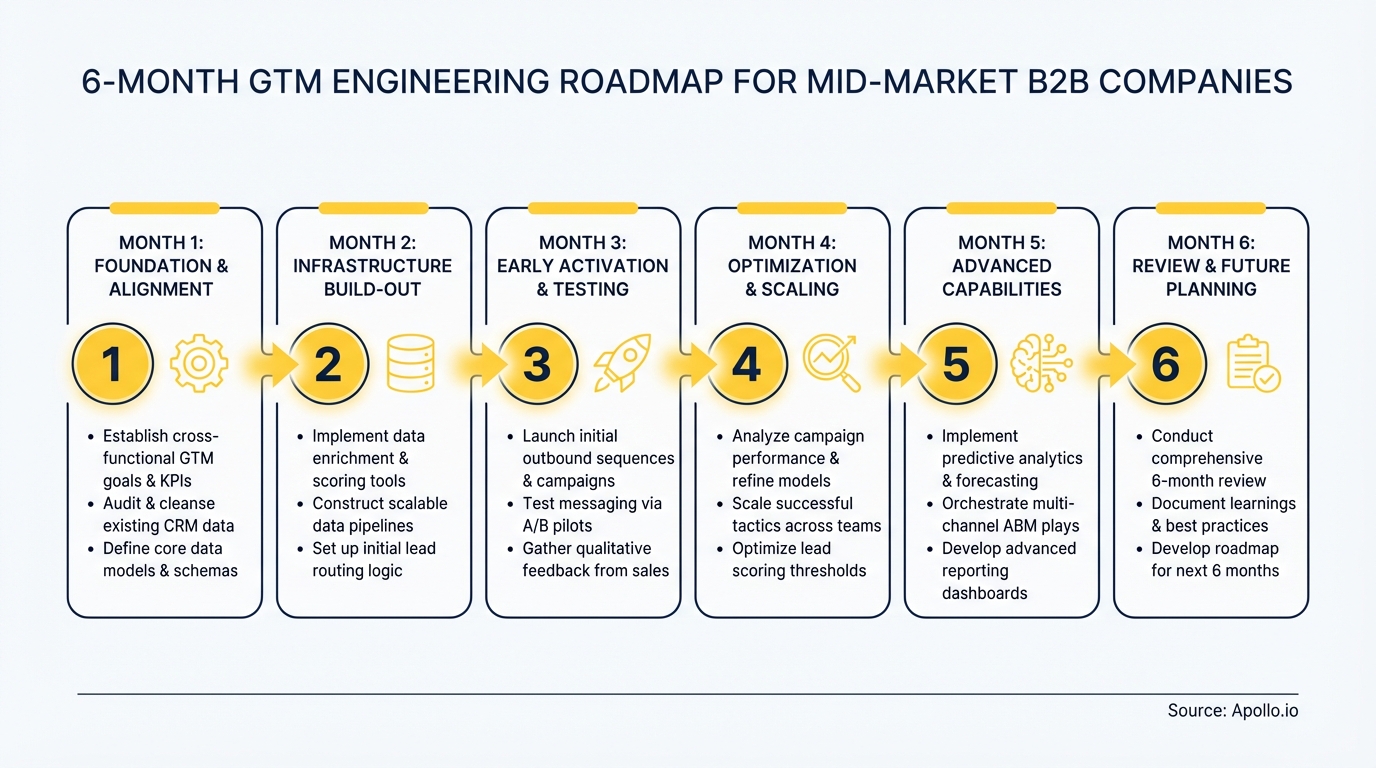
What Does the Month-by-Month Roadmap Look Like?
The 6-month roadmap breaks into four sequential phases, each building on the last. Skipping phases creates fragility — a scoring model built on dirty data produces garbage prioritization.
| Phase | Months | Primary Deliverables | Owner |
|---|---|---|---|
| Foundation | 1-2 | TAM unification, CRM deduplication, ICP definition, enrichment pipeline, deliverability infrastructure | RevOps |
| Intelligence | 3 | Multi-signal scoring model, buying-group mapping, consensus assets (proof packs, mutual action plans), persona messaging variations | RevOps + Marketing Ops |
| Orchestration | 4 | Data workflow automation, human-in-the-loop review queues, sequence launch, SDR training | RevOps + Sales Management |
| Retention + Optimization | 5-6 | Usage telemetry, expansion signals, renewal risk scoring, performance dashboards, signal weight tuning | RevOps + Product + CS |
How Do RevOps Leaders Build the Data-Ops Foundation in Months 1-2?
RevOps leaders start by centralizing the entire addressable market into one list — not a campaign export, not a territory spreadsheet, but a single, AI-qualified TAM. This is the prerequisite for everything else.
Month 1 priorities:
- Define ICP criteria with firmographic and behavioral filters (industry, revenue band, tech stack, hiring signals)
- Run deduplication and contact enrichment across the CRM
- Build the deliverability infrastructure: dedicated domains, warmed mailboxes, send-limit math based on TAM size
Month 2 priorities:
- AI-qualify the suspected market to remove accounts that pass broad filters but fail qualitative criteria
- Segment TAM by ICP tier (Tier 1 = highest fit + intent, Tier 2 = high fit, Tier 3 = nurture)
- Connect 1st-party data (CRM, website) with 2nd-party data (Apollo enrichment) into a unified record
Struggling to keep contact data clean across campaigns? Apollo's data enrichment keeps your TAM accurate and continuously refreshed.
Turn Funnel Guesswork Into Real Pipeline
Pipeline forecasting a guessing game because leads stall before they ever reach your AEs? Apollo surfaces high-intent prospects and moves them faster through your funnel. Nearly 100K paying customers stopped forecasting on hope.
Schedule a Demo →How Do You Build the Intelligence Layer in Month 3?
Month 3 is where strategy gets encoded into math. The scoring model assigns weighted values to every signal that predicts a win — fit, intent, timing, and engagement — so the system can prioritize without human guesswork.
Key deliverables for the intelligence layer:
- Multi-signal scoring model: Distribute 100 points across signals. High-weight signals (20+ points) should be validated against historical closed-won data.
- Buying-group mapping: For each target account, identify the economic buyer, champion, and blockers. Gartner research found that buying groups demonstrating consensus are 2.5x more likely to report a high-quality deal.
- Consensus assets: Build proof packs, mutual action plan templates, and security/compliance packets that prospects can circulate internally. These reduce buyer-side friction without requiring rep involvement at every touchpoint.
- Persona messaging variations: CFO messaging emphasizes ROI and risk reduction. VP Sales messaging emphasizes pipeline velocity. Same account, different angles — generated from the same signal data that drives scoring.
This is also the phase where intent data gets integrated as a scoring signal — not as a campaign trigger, but as a weight that elevates accounts already matching fit and engagement criteria.

How Do SDRs and AEs Operate When the Orchestration Layer Goes Live in Month 4?
SDRs shift from list-building to reviewing AI-surfaced priorities when orchestration goes live. The system handles research and draft messaging; SDRs apply judgment, refine when needed, and approve sequences for top-scored accounts.
Month 4 orchestration deliverables:
- Automated enrichment workflows that keep contact data current without manual intervention
- Human-in-the-loop review queues: top-scored accounts route to SDR review before sequences launch
- Evergreen execution logic: Sort by score → select top X → sequence → measure → repeat (replaces campaign-by-campaign thinking)
- SDR training on review workflow: what to look for, how to override AI outputs, how feedback improves the model over time
For Account Executives, this phase means pre-meeting intelligence is pre-populated — account score, signal rationale, buying-group contacts, and relevant proof assets are surfaced before every call. The B2B buyer journey has grown more complex, and AEs need that context to navigate multi-stakeholder deals efficiently.
Spending hours manually building sequences for each account? Apollo's multi-channel sales engagement platform automates sequences while keeping reps in control.

What Retention and Expansion Instrumentation Gets Built in Months 5-6?
Months 5-6 extend GTM engineering into the post-sale motion: usage telemetry, lifecycle nudges, renewal risk signals, and expansion scoring that feeds back into the outbound TAM.
Retention instrumentation deliverables:
- Usage telemetry: Track product engagement events and surface low-usage accounts to CS as renewal risk signals 90+ days before renewal
- Expansion scoring: Identify accounts showing growth signals (headcount increase, new funding, new product lines) and route them to AEs as expansion opportunities
- Lifecycle nudges: Automated touches tied to product milestones, QBR timing, and onboarding completion — not generic drip campaigns
- Signal-to-outcome dashboards: Track which acquisition signals correlate with long-term retention. Adjust ICP weighting accordingly.
This matters because the GTM motion doesn't end at close. According to The B2B Mix, Gartner predicted that by the end of 2025, 75% of the highest-growth companies would adopt a RevOps model — a 30% increase from two years prior. The companies winning on NRR are the ones treating retention as an engineered system, not an afterthought. Mid-market teams also face real talent constraints here: data from Trelliswork shows 78% of mid-market employers find it difficult to hire qualified AI talent, making systematic automation — not headcount — the scalable path.
What Does the GTM Engineering Stack Look Like at Month 6?
At month 6, a well-built GTM engine runs on one consolidated platform rather than a fragmented collection of point solutions. The anti-Frankenstack thesis holds: every integration adds a failure point, a maintenance burden, and a data fidelity risk.
The target state at month 6:
- Single TAM list with continuous AI enrichment and qualification
- Scoring model tuned monthly based on signal-to-outcome correlation data
- Automated outreach with human review at Tier 1 accounts
- Retention signals feeding back into acquisition scoring
- Dashboards that answer: What's our TAM coverage? Which signals predict wins? What's our pipeline velocity by ICP tier?
Apollo's GTM Engineering (GTME) Program operationalizes exactly this architecture — a dedicated GTM Engineer builds the seven-pillar system alongside your current operations, so your team keeps selling while the new engine goes live. As Cyera put it: "Having everything in one system was a game changer."
The trajectory from here is agentic GTM: a state where most of the research, scoring, sequencing, and routing runs autonomously, with humans focused on judgment and relationships rather than data entry. The GTME who wins long-term isn't the one with the most elaborate workflow.
It's the one who deploys the most elegant strategy at the highest velocity.
Start Building Your GTM Engine
A 6-month GTM engineering roadmap at a mid-market B2B company moves from scattered lists and one-off campaigns to a self-optimizing system where strategy executes without translation loss. The phases are sequential by design: clean data enables accurate scoring, accurate scoring enables targeted messaging, targeted messaging enables efficient automation, and retention instrumentation closes the loop.
The best place to start is a unified TAM and a scoring model that encodes your actual ICP criteria. Everything else compounds from there. Explore how Apollo's GTME methodology structures the seven pillars — or start your free trial and begin building your GTM engine today.
Prove Pipeline ROI Before Next QBR
Budget approval stuck on unclear metrics? Apollo delivers measurable pipeline impact fast — so you walk into every QBR with wins, not excuses. Nearly 100K paying customers made the ROI case and never looked back.
Schedule a Demo →Don't miss these
Sales
Inbound vs Outbound Marketing: Which Strategy Wins?
Sales
What Is a Sales Funnel? The Non-Linear Revenue Framework for 2026
Sales
What Is a Go-to-Market Strategy? The 2026 GTM Playbook
See Apollo in action
We'd love to show how Apollo can help you sell better.
By submitting this form, you will receive information, tips, and promotions from Apollo. To learn more, see our Privacy Statement.
4.7/5 based on 9,690 reviews
