
What Channels Can an AI SDR Operate Across in 2026?
An AI SDR can operate across email, phone, and social outreach channels — but the real question in 2026 isn't which channels are possible. It's how to sequence them intelligently based on buyer signals, compliance requirements, and channel-specific rules. For SDR teams scaling outbound, the difference between a channel checklist and a channel orchestration strategy is the difference between noise and pipeline. Tools like Apollo's AI Sales Assistant help revenue teams move from manual, single-channel sends to end-to-end GTM workflows that coordinate research, messaging, and outreach across every touchpoint.
According to professional networks, 88% of sales professionals now integrate AI into their workflows — a signal that AI-assisted multichannel outreach is no longer experimental. It's operational.

Let Apollo Find Your Next Deal
Tired of burning hours verifying contact info instead of closing deals? Apollo surfaces accurate, ready-to-engage prospects so your team spends time selling — not researching. Over 600K companies have already made the switch.
Start Free with Apollo →Key Takeaways
- AI SDRs operate across email, phone, and social channels — but intelligent channel selection by signal and policy outperforms simple blast sequences.
- Email remains the highest-volume channel, but deliverability infrastructure (DMARC, SPF, DKIM) is now the primary scaling constraint.
- Social outreach on professional networks requires a human-in-the-loop model: AI drafts and queues, humans approve and send.
- Phone is most effective as a signal-triggered channel — reserved for prospects who have already engaged via email or social.
- Governance, CRM logging, and audit trails across channels are now buying criteria for enterprise GTM teams, not just nice-to-haves.
What Channels Can an AI SDR Actually Use?
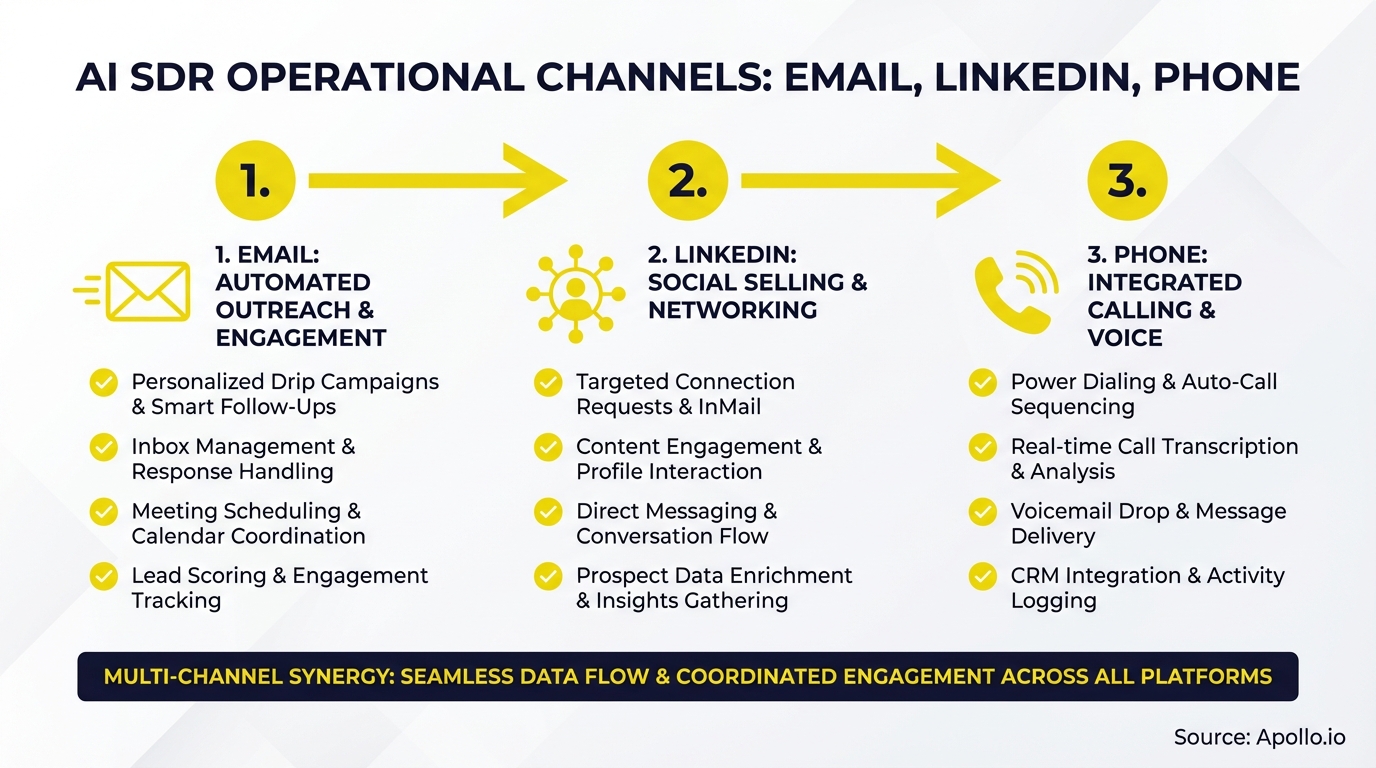
AI SDRs operate across three primary outbound channels: email, social outreach (via professional networks), and phone. Each channel has a distinct role, automation ceiling, and compliance profile in 2026.
| Channel | Automation Level | Primary Use | Key Constraint |
|---|---|---|---|
| High (fully automated sends) | Volume prospecting, nurture sequences | DMARC/SPF/DKIM compliance, sender reputation | |
| Social Outreach | Low (human-in-the-loop required) | Relationship building, warm touches | Platform automation restrictions |
| Phone | Medium (AI-assisted dialing and scripts) | Signal-triggered follow-up | TCPA consent, do-not-call compliance |
As MarketingProfs notes, generative AI can streamline outreach across channels by timing and sequencing interactions to create a natural progression — not just automate individual sends.
How Does Email Channel Orchestration Work for AI SDRs?
Email is the highest-volume channel for AI SDRs, but scaling it in 2026 is an infrastructure problem as much as a copywriting problem. Google, Yahoo, and Microsoft enforced stricter bulk-sender rules through 2025, requiring proper DMARC, SPF, and DKIM authentication for outbound at scale.
Teams that skip domain setup and warming strategy find deliverability collapse before personalization even matters.
For SDRs and RevOps leaders building outbound programs, the email channel checklist includes:
- Domain authentication: DMARC, SPF, DKIM configured before any sends
- Domain warming: Gradual ramp-up on new sending domains
- List hygiene: Verified contacts only — bounces damage sender score
- Unsubscribe handling: One-click unsubscribe required for bulk senders
- Personalization grounding: AI messaging anchored to real account context, not generic templates
Struggling to keep your outreach running at scale? Automate your multi-channel sequences with Apollo's sales engagement platform — built with deliverability controls and AI messaging built in.
Apollo's AI Content Center grounds every email in your value proposition, ICP pain points, and differentiators — so AI-generated messages reference real account context rather than producing generic copy. This matters because, as research from SalesHive shows, 83% of marketers report improved lead generation directly from personalization efforts.

How Should SDRs Handle Social Outreach as an AI SDR Channel?
Social outreach on professional networks operates under a human-in-the-loop model — AI drafts and queues messages, but humans approve and send within normal usage patterns. Fully automated activity on professional networks violates platform terms of service, and enforcement has tightened through 2025 and into 2026.
The practical architecture for SDRs is: AI writes, suggests, and schedules; the rep clicks send.
This constraint doesn't make social outreach less valuable — it makes the AI's drafting role more important. The Apollo Outbound Copilot generates complete multi-channel sequences including social touch steps, with messaging grounded in account research so reps aren't writing connection requests from scratch.
For B2B outreach strategies that coordinate email and social, the sequencing logic typically looks like:
- Email touch 1 (AI-personalized, automated send)
- Social connection request (AI-drafted, human sends)
- Email touch 2 referencing social connection
- Phone call triggered by email open or social accept
Turn Funnel Guesswork Into Pipeline Wins
Tired of watching marketing leads stall before they ever reach your pipeline? Apollo surfaces high-intent prospects and keeps your funnel moving with real-time signals. Nearly 100K paying customers stopped forecasting blind.
Start Free with Apollo →When Should AI SDRs Use Phone as an Outreach Channel?
Phone is most effective as a signal-triggered channel — reserved for prospects who have already engaged via email or social, not as the first touch. Calling cold without prior engagement wastes rep time on low-intent contacts. Understanding the difference between hot and cold calls is essential for AI SDR sequencing: phone belongs in the warm-signal tier.
AI SDR phone workflows in 2026 also carry compliance weight. The FCC has clarified that AI-generated voices are treated as artificial or prerecorded calls under TCPA, making consent, disclosure, and audit trails non-negotiable for AI voice outbound. For teams using AI-assisted dialing (where AI supports scripts and call prep rather than replacing the human voice), the Apollo AI Call Assistant provides conversation intelligence, call summaries, and next-step recommendations — keeping reps informed without requiring full manual note-taking.
How Do SDRs Build a Governed AI SDR Channel Strategy?
SDRs and RevOps leaders building AI outbound programs need governance built in from the start, not added later. Governed AI SDR stacks require explainability, CRM logging, and audit trails across every channel — who sent what, when, on which channel, with what consent.
A practical governance checklist for AI SDR channel orchestration:
- Email: DMARC/SPF/DKIM authenticated, unsubscribe honored within 10 days, complaint rate monitored
- Social: Human approval required before every send, pacing mimics organic usage
- Phone: Do-not-call list checked, consent documented for AI voice use, calls logged to CRM
- Cross-channel: All activity synced to CRM, easy human takeover at any sequence step
- Messaging: Brand voice and value proposition grounded in AI Content Center configuration
Apollo's platform consolidates these controls in one workspace — replacing the need to stitch together separate tools for prospecting, sequencing, and call management. As Cyera's team put it: "Having everything in one system was a game changer."
What Metrics Should You Track for AI SDR Multichannel Performance?
Multichannel AI SDR performance requires channel-specific metrics plus cross-channel attribution. Tracking open rates in isolation misses whether social or phone follow-up drove the actual reply.
| Channel | Primary KPI | Secondary KPI |
|---|---|---|
| Reply rate | Deliverability rate, spam complaint rate | |
| Social Outreach | Connection accept rate | Message reply rate post-connect |
| Phone | Connect rate | Meeting booked per call |
| Cross-channel | Meetings booked per sequence | Pipeline generated per AI workflow |
For demand gen teams tracking pipeline metrics, the right dashboard connects channel activity to revenue outcomes — not just activity volume. Apollo's analytics surface sequence performance, rep activity, and bottlenecks in one view, so sales leaders can optimize channel mix without pulling data from multiple tools.

Start Running Smarter Multichannel Outreach in 2026
AI SDRs operate most effectively when channel selection is driven by buyer signals and governance rules — not by simply adding more touchpoints. Email handles volume with AI-personalized messaging grounded in real account context.
Social outreach builds relationships through a human-in-the-loop model where AI drafts and reps send. Phone converts warm, signal-triggered prospects at the right moment in the sequence.
The teams winning pipeline in 2026 aren't running more channels — they're orchestrating them. Apollo brings prospecting, AI sequencing, call intelligence, and analytics into one platform, so SDRs and RevOps leaders can execute a governed, multichannel strategy without stitching together five separate tools.
As Erik Fernando Nieto, BDR at JumpCloud, put it: "It saves me about an hour per prospecting session."
Ready to run coordinated AI outreach across every channel from one workspace? Start Prospecting with Apollo and build your first multichannel AI sequence today.
Prove Pipeline ROI Before Next Quarter
Budget approval stuck on unclear pipeline metrics? Apollo delivers measurable wins fast — 46% more meetings with AI Research Agent, tracked and reportable from day one. Start free and show ROI before your next review.
Start Free with Apollo →Don't miss these
Sales
Inbound vs Outbound Marketing: Which Strategy Wins?
Sales
What Is a Sales Funnel? The Non-Linear Revenue Framework for 2026
Sales
What Is a Go-to-Market Strategy? The 2026 GTM Playbook
See Apollo in action
We'd love to show how Apollo can help you sell better.
By submitting this form, you will receive information, tips, and promotions from Apollo. To learn more, see our Privacy Statement.
4.7/5 based on 9,690 reviews
