What Are the Top Lead Generation Tools for B2B Teams in 2026?
Most "top lead generation tools" lists hand you a catalog and call it a day. But a list of tools without a framework for choosing, implementing, and actually using them is just more noise. According to Cirrus Insight, lead generation is the top priority for 91% of B2B marketers in 2025, yet Bookyourdata reports that 61% say generating high-quality leads remains their biggest challenge. The problem isn't a shortage of tools. It's choosing the right ones and making them work together.
This guide cuts through the noise with a lifecycle framework, a comparison of tool categories, and practical guidance on stack consolidation and AI adoption, so you can build a lead generation system that actually drives revenue.

Let Apollo Do the Research for You
Tired of your reps burning hours on manual lead research and data entry instead of closing? Apollo delivers verified contacts and syncs clean data to your CRM automatically. Join 550K+ companies building pipeline without the busywork.
Start Free with Apollo →Key Takeaways
- The top lead generation tools in 2026 span five categories: prospecting and data, sales engagement, CRM, intent data, and inbound capture.
- Tool underutilization and sales/marketing misalignment are bigger ROI killers than tool selection itself.
- Consolidated platforms that combine prospecting, enrichment, and outreach in one workspace outperform fragmented point-solution stacks.
- AI is shifting from an assist layer to an execution layer: research, routing, enrichment, and personalization are increasingly automated.
- Matching tools to buyer journey stages (Awareness, Evaluation, Validation, Conversion) is the highest-leverage framework for tool selection.
What Is a Lead Generation Tool (and What It Is Not)?
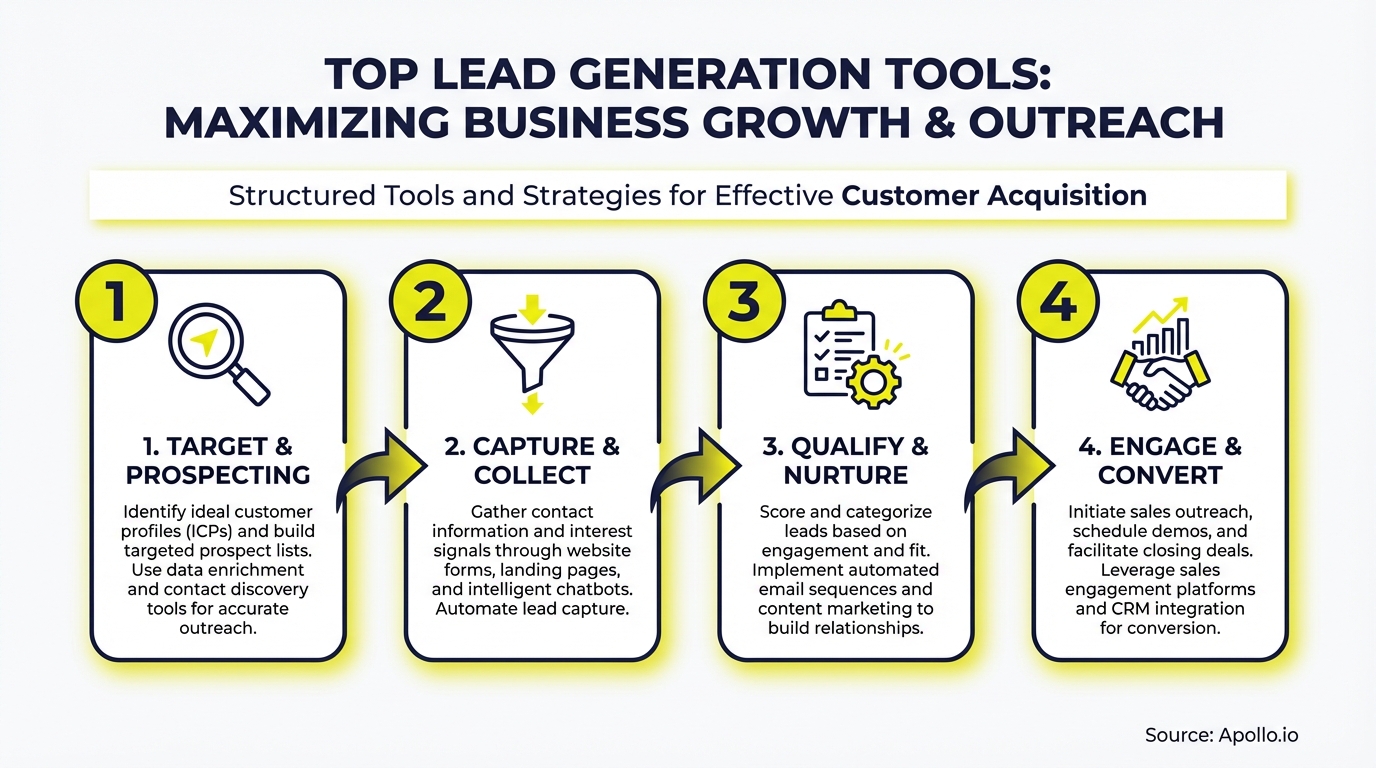
A lead generation tool is any platform that helps you identify, capture, qualify, or engage potential buyers. This includes B2B data and prospecting platforms, sales engagement tools, CRMs, intent signal platforms, and inbound lead capture tools like forms and chat.
What lead gen tools are not: a substitute for strategy, a replacement for sales process, or a guarantee of pipeline. Tools amplify your go-to-market motion. They don't create one from scratch. If your ICP is unclear or your MQL/SQL handoff is broken, no tool will fix that.
The Five Core Categories of Lead Generation Tools
Rather than a ranked list of 30 platforms, here's the category map that matters. Every effective B2B lead gen stack needs coverage across these five areas:
| Category | What It Does | Key Capability to Evaluate |
|---|---|---|
| Prospecting & Data | Find and verify contacts matching your ICP | Database size, data freshness, filter depth |
| Sales Engagement | Automate multi-channel outreach sequences | Email + phone + social in one workflow |
| CRM | Track, score, route, and report on leads | Native lead scoring, routing rules, attribution |
| Intent Data | Surface in-market buyers before they raise their hand | Signal accuracy, CRM sync speed |
| Inbound Capture | Convert website visitors into qualified leads | Enrichment on capture, instant routing |
For a deeper look at which tools within each category drive measurable results, see What Lead Generation Tools Drive Measurable ROI?
How to Map Tools to Your Buyer Journey Stage
The biggest gap in most lead gen stacks is that tools aren't matched to where buyers actually are. With Gartner reporting that 61% of B2B buyers now prefer a rep-free buying experience, your tools need to support self-service evaluation, not just outbound prospecting.
| Buyer Stage | Buyer Behavior | Tools to Activate |
|---|---|---|
| Awareness | Searching, consuming content | SEO content tools, webinar platforms, intent data |
| Evaluation | Comparing options, reading reviews | Interactive demos, comparison pages, chat capture |
| Validation | Building internal business case | ROI calculators, case studies, enrichment on inbound leads |
| Conversion | Ready to buy or talk | Instant routing, meeting scheduling, CRM handoff |
The tools that win in 2026 aren't just outbound engines. They capture and convert buyers who arrive through content, review sites, and referrals, then route them instantly to the right rep. Explore the best lead generation examples for 2026 to see this lifecycle in action.
Why Tool Consolidation Beats a Best-of-Breed Point Stack
The lead generation software market is growing fast. According to Zion Market Research, the global lead generation software market was USD 7.78 billion in 2024 and is anticipated to surpass USD 12.59 billion by 2034, growing at a CAGR of 10.2%. More tools are entering the market, but more tools don't mean better results.
The trend running counter to tool proliferation is consolidation. Teams are replacing fragmented stacks (separate prospecting, engagement, enrichment, and reporting tools) with unified platforms that handle the full workflow.
The operational benefit is real: fewer integrations to maintain, faster onboarding, cleaner attribution, and a single source of truth for pipeline data.
"The thing that made me most excited as somebody who's been in sales development a long time was Apollo's integration between sales data and sales engagement and the magic that you can make happen when those two are together on the same platform."
Struggling to find qualified leads without juggling five tabs? Search Apollo's 224M+ contacts with 65+ filters and build your list in one workspace.
For a detailed playbook on outbound prospecting inside a consolidated stack, see our full guide.
Turn Weak Leads Into Qualified Pipeline
Tired of watching marketing leads stall before they ever reach your AEs? Apollo surfaces verified contacts and buying signals so your team reaches the right prospects at right moment. 550K+ companies trust Apollo to fill their pipeline with deals that actually close.
Start Free with Apollo →The AI Layer: Where It Actually Works in Lead Generation
AI in lead generation has moved from "nice-to-have feature" to core infrastructure. The shift in 2025-2026 is from AI as an assist layer (suggesting next steps) to AI as an execution layer (completing tasks).
Here's where AI delivers real value versus where it still needs human oversight:
| AI Task | Maturity Level | What to Watch For |
|---|---|---|
| Contact enrichment & verification | High | Data accuracy rates; stale data risk |
| Personalized email drafting | High | Over-reliance on templates; review before sending |
| Lead scoring & routing | Medium-High | Requires clean CRM data to train on |
| Intent signal prioritization | Medium | Signal noise; validate with direct outreach |
| Autonomous multi-step outreach | Emerging | Compliance and brand risk; keep humans in loop |
"With this kind of AI system, my BDRs can send 10x more personalized emails. Their productivity and growth has skyrocketed."
Spending hours on manual outreach? Automate your sequences with Apollo and let AI handle personalization at scale.
For a deeper dive on AI-powered workflows, see Apollo's AI and automation resource hub.

The Adoption Problem: Why Your Current Stack May Already Be Enough
Before you buy another tool, consider this: the Content Marketing Institute's 2025 B2B benchmarks report found that 38% of B2B marketers say they have the technology but aren't using its full potential, up from 30% the previous year. Tool underutilization is growing faster than tool adoption.
The fix isn't always a new platform. It's often better onboarding, clearer use-case ownership, and tighter integration between what you already have.
A three-question audit before any new tool purchase:
- Who owns this tool? If there's no named admin and champion, adoption will fail.
- How does it connect to CRM? If it doesn't sync bidirectionally, you'll have data silos.
- What does success look like in 90 days? If you can't define the metric, you can't evaluate the tool.
See the automated lead generation guide for a practical implementation checklist that covers setup, integration, and adoption milestones.
Sales and Marketing Alignment: The Hidden ROI Driver
No tool fixes a broken MQL-to-SQL handoff. The Anteriad/Ascend2 2024 B2B Marketing Outlook found that 56% of B2B-only marketers are challenged by marketing and sales alignment, the most cited operational blocker in the study.
Your lead gen tools need to enforce shared definitions, not just pass data between teams.
The four alignment requirements every lead gen stack must support:
- Shared lead scoring: Marketing and sales agree on what constitutes a qualified lead before routing.
- Instant routing rules: Inbound leads route to the right rep within minutes, not hours.
- Closed-loop attribution: Revenue ties back to the campaign or channel that sourced the lead.
- Shared dashboards: Both teams see the same pipeline data, not separate reports.
For strategies on aligning outbound and inbound efforts, the lead generation best practices guide covers the full pipeline fill methodology.
How to Evaluate Any Lead Generation Tool Before You Buy
Use this six-point framework to evaluate any platform before committing budget:
- Data quality: What is the verified accuracy rate for emails and phone numbers? Ask for a sample test against your ICP.
- Integration depth: Does it sync natively with your CRM, or does it require middleware?
- Workflow coverage: Does it handle the full lifecycle (find, enrich, engage, route) or only one step?
- Usage-based vs. seat-based pricing: Overage charges on contact exports can inflate costs significantly.
- Adoption path: What does onboarding look like? Is training included?
- Attribution support: Can you tie pipeline and closed revenue back to this tool's activity?
For a comparison of top lead generation companies across these criteria, see our tested vendor breakdown.

Conclusion: Build a System, Not a Stack
The top lead generation tools in 2026 are not the ones with the longest feature list. They're the ones your team actually uses, that connect cleanly to your CRM, and that support buyers at every stage of a self-directed journey.
The market is moving toward consolidated platforms that combine prospecting, enrichment, engagement, and routing in one place, reducing integration overhead and improving attribution.
Start by auditing what you have, mapping tools to buyer stages, and tightening your MQL/SQL definitions before adding new platforms. Then build from a unified foundation outward.
Ready to consolidate your lead gen stack into one workspace? Start Prospecting with Apollo for free and see how prospecting, enrichment, and outreach work better together.
Prove Pipeline ROI With Apollo
ROI pressure making every tool renewal a battle? Apollo delivers measurable pipeline impact your leadership can see — faster. Leadium 3x'd their revenue. Start yours today.
Start Free with Apollo →Don't miss these
Sales
Inbound vs Outbound Marketing: Which Strategy Wins?
Sales
What Is a Sales Funnel? The Non-Linear Revenue Framework for 2026
Sales
What Is a Go-to-Market Strategy? The 2026 GTM Playbook
See Apollo in action
We'd love to show how Apollo can help you sell better.
By submitting this form, you will receive information, tips, and promotions from Apollo. To learn more, see our Privacy Statement.
4.7/5 based on 9,690 reviews
