
What Are the Best Signals to Use When Identifying High-Fit Accounts for Outbound Targeting?
Most outbound targeting fails before the first email sends. The problem is not the message or the channel. It is the list. B2B buyers are harder to reach than ever, and sales intelligence tools now make it possible to move beyond gut-feel account selection toward signal-backed targeting that reaches the right accounts at the right time.
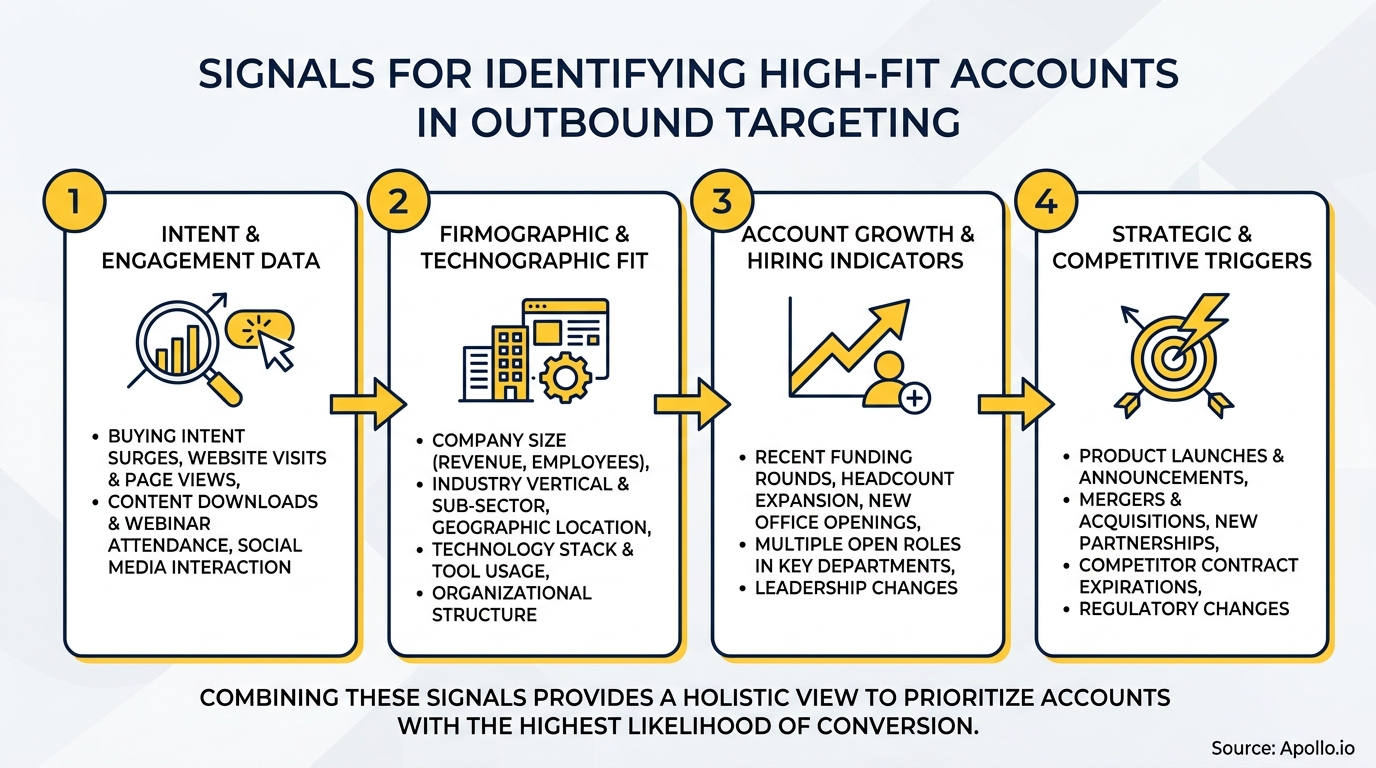
The best signals to use when identifying high-fit accounts for outbound targeting combine firmographic fit, technographic relevance, behavioral intent, and trigger events into a layered scoring model. No single signal is enough.
Accounts that match on multiple signal types convert at measurably higher rates than those selected by intuition alone.

Research Less, Close More With Apollo
Tired of your reps burning hours on manual lead research instead of selling? Apollo delivers verified contacts instantly, so your team spends time closing — not digging. Join 600K+ companies building pipeline faster.
Start Free with Apollo →Key Takeaways
- High-fit accounts require signal stacking: firmographic fit + intent activity + trigger events, not one signal in isolation.
- Negative signals matter as much as positive ones. Suppression rules prevent wasted outreach on accounts that will never convert.
- Stage-aware scoring separates research-mode accounts (nurture) from purchase-mode accounts (sequence now).
- Intent data shapes outreach for 67% of ABM teams, and intent-based campaigns drive significantly higher conversion rates than traditional list-based approaches.
- SDRs and RevOps leaders who operationalize signals inside their GTM stack, rather than just collecting them, win the speed-to-lead advantage.
What Are the Four Core Signal Categories for Outbound Targeting?
The four core signal categories are firmographic fit, technographic fit, behavioral intent, and trigger events. Each category answers a different question about account readiness.
| Signal Category | What It Reveals | Example Signals |
|---|---|---|
| Firmographic | Structural fit with your ICP | Company size, industry, revenue, headcount growth, geography |
| Technographic | Technology stack alignment or displacement opportunity | Current tools, recent installs, contract renewal indicators |
| Behavioral / Intent | Active research and purchase-mode activity | Content downloads, topic spikes, repeated web visits, buying-group engagement |
| Trigger Events | Timing signals that indicate a buying window | Funding rounds, new executive hires, job postings, product launches, M&A activity |
According to Landbase, using detailed firmographic data for account targeting achieves 73% larger deal sizes. Firmographics anchor your ICP definition. Every other signal layer filters and prioritizes within that foundation.
As noted by B2B Geek, technographic data provides an in-depth understanding of a company's technology stack and its potential plans to purchase technical solutions. For SDRs building outbound sequences, technographic signals identify accounts actively evaluating replacements for tools you compete with or complement.
How Does Intent Data Improve Account Prioritization?
Intent data improves account prioritization by surfacing which accounts are actively researching solutions like yours before they ever raise their hand. As defined by MarketsandMarkets, intent data tracks digital signals like content downloads, website visits, search queries, and social media engagement to reveal when prospects are in active research mode.
Research from Landbase shows companies see 93% conversion rate improvements and 220% higher click-through rates with intent-based campaigns compared to traditional approaches. The practical implication: intent-ranked accounts should move to the top of your sequence queue, while non-intent accounts stay in lower-priority nurture tracks.
Data from MarketingLTB indicates 67% of ABM teams already use intent data to shape outreach. If your team is not yet using intent signals, you are working with a targeting disadvantage relative to most competitors.
Struggling to find accounts showing real buying intent? Search Apollo's 230M+ contacts with 65+ filters to surface high-intent prospects.
Turn Funnel Gaps Into Pipeline Gold
Tired of watching marketing leads stall before they ever reach your pipeline? Apollo surfaces verified, in-market prospects with buying signals so your team reaches the right buyer at right moment. Join 600K+ companies building predictable pipeline.
Start Free with Apollo →What Are Negative Signals and Why Do They Matter for Outbound?
Negative signals are data points that indicate an account is a poor fit or poor timing for outbound, and suppressing these accounts is as important as identifying high-fit ones. Wasted sequences on low-fit accounts damage sender reputation, consume SDR capacity, and inflate CAC.
Key negative signals to build into suppression rules:
- Recent customer or open opportunity: Already in your CRM as an active deal or current account.
- Competitor employee: Contact works at a direct competitor.
- Wrong company stage: Too early (pre-revenue) or too late (public enterprise with long procurement cycles) for your motion.
- Recent churn: Churned within the past 12 months without a clear re-engagement trigger.
- Headcount contraction: Company is actively downsizing, indicating budget pressure.
- Out-of-territory: Geography or vertical outside your current coverage model.
- Do-not-contact flags: Previously opted out or marked as DNC in your CRM.
Build suppression lists as live CRM segments and sync them to your sequencing platform so they auto-exclude without manual review. RevOps leaders who automate suppression logic report cleaner pipelines and fewer wasted sales cycles. For more on building targeted outreach that avoids these pitfalls, see lead generation examples for 2026.
How Should SDRs Score Accounts by Stage: Research Mode vs. Purchase Mode?
SDRs should score accounts differently depending on whether signals indicate early research activity or active purchase evaluation. Treating both stages identically leads to either premature outreach (alienating early-stage accounts) or missed windows (letting purchase-ready accounts go cold).
| Stage | Signals Present | Recommended Action | Sequence Priority |
|---|---|---|---|
| Research Mode | Single topic spike, one content download, no repeat visits | Add to nurture track; monitor for escalation | Low (watch list) |
| Evaluation Mode | Multiple topic spikes, repeat web visits, buying-group engagement across 2+ contacts | Enrich account, route to SDR for personalized outreach | Medium (queue within 5 days) |
| Purchase Mode | High-intensity intent + trigger event (funding, hire, job posting) + ICP firmographic match | Immediate sequence + AE alert for parallel outreach | High (contact same day) |
The speed-to-lead advantage is real. Accounts in purchase mode have short windows.
Batch scoring reviewed weekly misses these windows entirely. In 2026, signal orchestration needs to route accounts to sequences in hours, not days.
For Account Executives managing a book of business, monitoring trigger events for existing contacts who change companies is one of the highest-ROI signals available. A champion who moves to a new company is a warm outbound opportunity with built-in social proof. Pair this with proven cold calling strategies to reach those accounts fast.

What Is a Practical Signal Stack for Outbound in 2026?
A signal stack is a layered scoring model that combines multiple signal types into a single account score, enabling automated routing and prioritization. The key shift in 2026 is moving from signal collection to signal orchestration: connecting signals directly to sequencing actions without manual intervention.
A practical signal stack for most B2B GTM teams:
- Layer 1 (Gate): Firmographic fit. Does the account match ICP on industry, size, and revenue? If not, suppress regardless of other signals.
- Layer 2 (Qualify): Technographic fit. Does the account use complementary or competitive technology that creates a relevant hook for your message?
- Layer 3 (Prioritize): Intent signals. Are multiple contacts at the account consuming relevant topic content across multiple channels?
- Layer 4 (Accelerate): Trigger events. Has a recent event (funding, leadership change, expansion announcement) opened a buying window?
- Layer 5 (Suppress): Negative signals. Apply suppression rules before any account reaches a sequence.
Teams that operationalize this stack inside their GTM platform, rather than managing it across spreadsheets and disconnected tools, gain the workflow advantage. As one customer put it: "Having everything in one system was a game changer" (Cyera). Explore how the best B2B marketing tools for 2026 support this kind of signal-to-action workflow.
Spending hours manually enriching accounts before sequencing? Apollo's data enrichment automates account and contact enrichment across 65+ attributes so your SDRs sequence faster.
How Do RevOps Leaders Govern Signal Quality Over Time?
RevOps leaders govern signal quality by establishing a signal review cadence, defining scoring ownership, and measuring pipeline attribution back to signal sources. Signal data decays.
A firmographic filter that was accurate six months ago may now include accounts that have contracted, been acquired, or moved out of your ICP.
Signal governance basics to implement:
- Monthly ICP audit: Review won/lost deals against signal scores to recalibrate weights.
- Data freshness rules: Flag accounts enriched more than 90 days ago for re-enrichment before sequencing.
- Attribution tracking: Tag which signal triggered each account's entry into a sequence. Measure pipeline and close rates by signal type.
- Scoring ownership: Assign a RevOps owner to review scoring model changes quarterly.
For teams transitioning from sales-selected account lists to data-driven targeting, governance is the change management lever. Sales teams need to trust the signal model before they will follow its prioritization. Transparent attribution reporting, showing that signal-triggered accounts convert at higher rates, builds that trust faster than any internal presentation. Pair signal governance with the top market intelligence tools for B2B to keep data inputs clean and current.

Start Targeting High-Fit Accounts With Confidence
The best signals for outbound targeting are not the most exotic ones. They are the ones your team actually operationalizes.
Firmographic gates keep your ICP tight. Intent signals surface accounts already in motion.
Trigger events open timing windows. Negative signals protect your team from wasted effort.
Stage-aware scoring ensures the right action at the right moment.
Apollo brings signal-based prospecting, data enrichment, and multi-channel sequencing into one unified GTM platform, so SDRs, AEs, and RevOps leaders stop juggling tools and start converting more of the accounts that actually fit. Trusted by nearly 100,000 paying customers including Anthropic, Cyera, and Smartling, Apollo consolidates your signal stack and your outreach workflow in one place.
Get Leads Now and start identifying high-fit accounts with signals that actually drive pipeline.
Prove Pipeline ROI With Apollo
ROI pressure killing your tool budget? Apollo delivers measurable pipeline impact from day one — no guesswork, no waiting. Teams like Leadium 3x'd their annual revenue. Start free and show results fast.
Start Free with Apollo →Don't miss these
Sales
Inbound vs Outbound Marketing: Which Strategy Wins?
Sales
What Is a Sales Funnel? The Non-Linear Revenue Framework for 2026
Sales
What Is a Go-to-Market Strategy? The 2026 GTM Playbook
See Apollo in action
We'd love to show how Apollo can help you sell better.
By submitting this form, you will receive information, tips, and promotions from Apollo. To learn more, see our Privacy Statement.
4.7/5 based on 9,690 reviews
