
What Is Inside Sales? Definition, Benefits, and Modern Strategies
Inside sales has evolved from call centers into a strategic revenue engine. Modern buyers complete their research independently before engaging sellers, forcing inside sales representatives to shift from information gatekeepers to expert advisors. According to OnBoard CRM, inside sales representatives now constitute 40% of high-growth B2B sales teams, a significant increase from just 10% a few years ago.

Apollo Finds Verified Contacts In Seconds
Tired of spending 4+ hours daily hunting for contact info? Apollo delivers 224M+ verified contacts with 96% email accuracy. Join 550K+ companies closing more deals.
Start Free with Apollo →Key Takeaways
- Inside sales teams sell remotely using digital channels while building relationships through phone, email, and video calls
- SDRs and BDRs focus on outbound prospecting while inside sales teams manage the full sales cycle from qualification to close
- Modern buyers complete research independently before engaging sellers, requiring inside sales reps to provide expert guidance rather than basic information
- AI automation handles repetitive tasks while human sellers focus on high-value conversations and strategic deal management
- Successful inside sales teams consolidate their tech stack into unified platforms to reduce costs and improve efficiency
What Are Inside Sales?
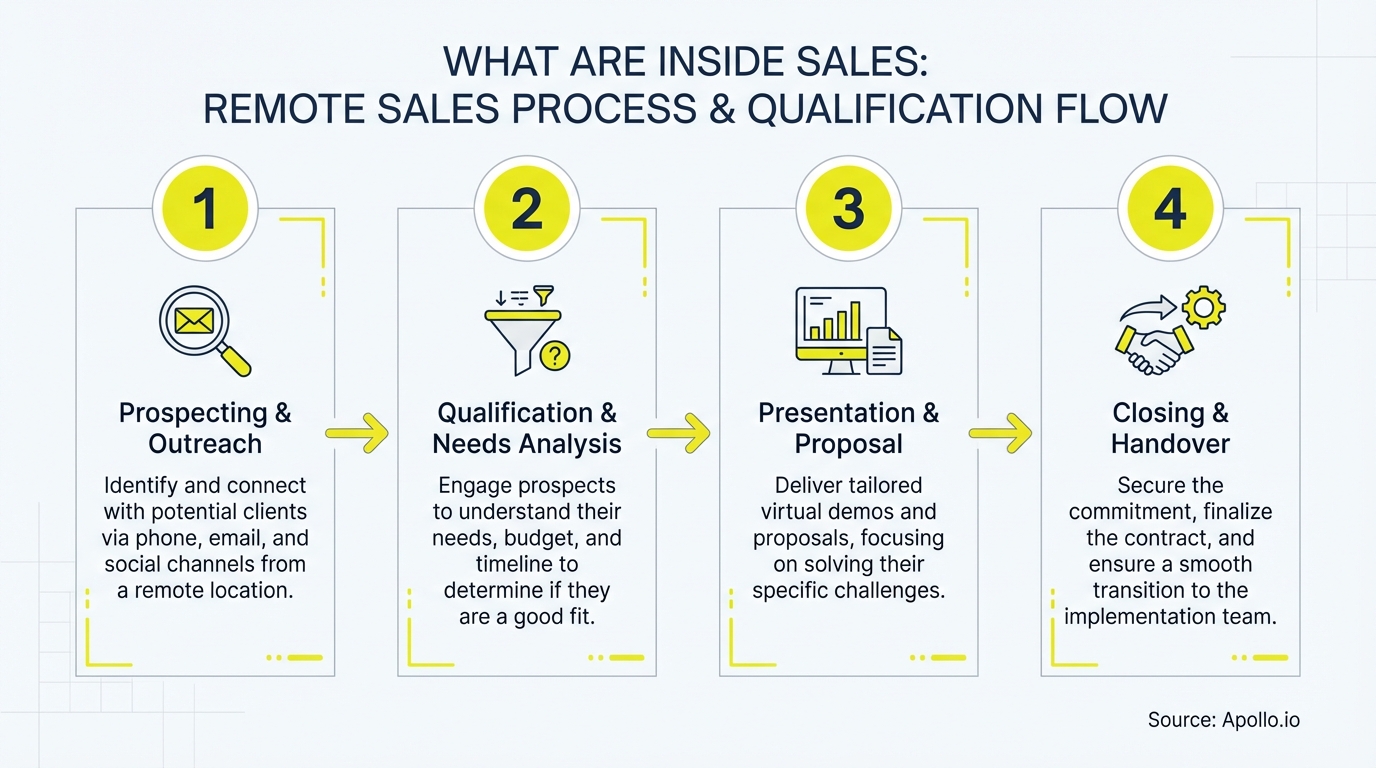
Inside sales are remote selling activities where sales professionals close deals through digital channels without face-to-face meetings. Teams operate from offices or remote locations, using phone calls, video conferencing, email, and sales intelligence tools to engage prospects. This model differs from field sales, where representatives travel to meet buyers in person.
Inside sales teams handle everything from initial prospecting to contract negotiation. Research by Landbase shows B2B buyers spend only 17% of their total purchase time interacting with all potential vendors combined. This means inside sales reps must deliver value quickly during limited engagement windows.
The role extends beyond cold calling. Inside sales professionals research accounts, identify decision-makers, build relationships across buying committees, and manage multi-touchpoint sequences.
They leverage data and automation to scale personalized outreach while maintaining the human connection that drives deals forward.
How Do Inside Sales Teams Differ From SDRs and Field Sales?
Inside sales teams manage the complete sales cycle remotely, from initial contact through contract signing. SDRs (Sales Development Representatives) and BDRs (Business Development Representatives) focus exclusively on early-stage prospecting and booking qualified meetings for Account Executives.
Field sales representatives travel to customer locations for in-person presentations and relationship building.
| Role | Primary Focus | Sales Cycle Stage | Travel Required |
|---|---|---|---|
| Inside Sales | Full cycle remote selling | Prospecting through close | No |
| SDR/BDR | Lead generation and qualification | Top of funnel only | No |
| Field Sales | In-person relationship building | Mid-to-late stage deals | Yes |
Inside sales professionals own revenue targets and close deals independently. They build relationships through consistent digital touchpoints rather than quarterly business reviews. This model works effectively for B2B sales with deal sizes ranging from mid-market to enterprise accounts, particularly in software, technology services, and business consulting.
Why Are Inside Sales Teams Critical in 2026?
Modern buyers prefer self-directed research over traditional sales interactions. According to Forrester, more than half (50%) of large B2B purchases ($1 million or greater) are predicted to be processed through digital self-serve channels, including vendor websites or marketplaces, in 2025. Inside sales teams bridge the gap between self-serve research and expert guidance at critical decision points.
Cost efficiency drives adoption across growing companies. Inside sales teams eliminate travel expenses, reduce sales cycles, and enable faster territory coverage compared to field sales models.
Sales leaders can scale teams quickly without geographic constraints, accessing talent nationwide rather than hiring within commuting distance of target accounts.

Data from RevWit indicates buyers do 70-90% of their research before speaking to sales representatives. Inside sales reps focus on high-value conversations rather than educational presentations. They answer specific technical questions, navigate procurement processes, and align solutions to business outcomes after prospects complete independent research.
See Every Deal Stage In Real Time With Apollo
Pipeline forecasting a guessing game? Apollo delivers real-time visibility across every deal stage while scoring leads that convert. Built-In boosted win rates 10% with Apollo's intelligence.
Start Free with Apollo →How Do SDRs Build Pipeline Using Inside Sales Strategies?
SDRs build pipeline by targeting specific accounts with personalized outreach across multiple channels.
They research prospects using sales intelligence platforms, identify trigger events like funding announcements or leadership changes, and craft messages addressing specific business challenges.
Successful SDRs focus on relevance over volume, avoiding generic templates that prospects ignore.
Struggling to find qualified leads? Search Apollo's 224M+ contacts with 65+ filters to identify your ideal buyers.
Modern SDRs leverage AI to automate research and administrative tasks. They use conversation intelligence to refine messaging, track engagement signals to prioritize follow-up, and coordinate with marketing on content that addresses buyer questions.
The best SDRs maintain consistent activity levels while personalizing each touchpoint based on prospect behavior and firmographic data.
What Tools Do Inside Sales Teams Need in 2026?
Inside sales teams require unified platforms that consolidate prospecting, engagement, and pipeline management. Successful teams move away from disconnected point solutions toward integrated systems that eliminate data silos and reduce context switching.
Census, an Apollo customer, reports: "We cut our costs in half" by consolidating their sales tech stack.
Essential capabilities include:
- Contact database with verified emails and phone numbers: Access to accurate buyer information eliminates manual research time
- Multi-channel sequence automation: Coordinate email, phone, and social outreach without manual task management
- AI-powered call assistance: Automatic note-taking and next-step recommendations during live conversations
- Pipeline visibility and forecasting: Real-time deal tracking for revenue operations teams
- Native CRM integration: Bidirectional data sync with Salesforce, HubSpot, or other systems of record
Spending hours on manual outreach? Automate your sequences with Apollo's multi-channel engagement platform.

Sales leaders should evaluate sales automation software based on data accuracy, ease of use, and consolidation potential. Platforms that replace multiple tools reduce training time, improve adoption rates, and lower total cost of ownership. Cyera, another Apollo customer, notes: "Having everything in one system was a game changer."
How Can Sales Leaders Improve Inside Sales Performance?
Sales leaders improve performance by aligning messaging between marketing and sellers. They create single-source-of-truth content repositories, develop talk tracks that match website claims, and establish governance for AI-generated outreach.
This consistency builds trust with buyers who research independently before engaging sales teams.
Focus on reducing non-selling time through automation and process optimization. Sales reps should spend time on conversations, deal strategy, and relationship building rather than data entry and administrative tasks. Implement sales coaching software to analyze calls, identify skill gaps, and provide targeted feedback that improves close rates.
Measure outcomes beyond activity metrics. Track conversion rates at each funnel stage, average deal size, sales cycle length, and win rates by segment. Use this data to refine ideal customer profiles, adjust territory assignments, and allocate resources to highest-performing channels. According to Extu, buyers are 50% more likely to buy a product or service when they perceive personal value (e.g., career advancement, confidence) in their business purchase decision.
Start Building Your Inside Sales Engine
Inside sales teams drive predictable revenue by combining digital channels with expert guidance. As buyers increasingly prefer self-directed research, inside sales professionals must deliver value during limited engagement windows.
Success requires accurate data, automated workflows, and unified platforms that eliminate tool sprawl.
Sales leaders should prioritize messaging consistency, reduce non-selling time, and measure outcomes beyond activity metrics. The best inside sales teams consolidate their tech stack into integrated platforms that provide complete visibility from prospecting through close.
This approach reduces costs, improves efficiency, and enables faster scaling across territories.
Ready to transform your inside sales motion? Start a free trial of Apollo to access 224M+ verified contacts, multi-channel sequences, and AI-powered tools that help your team close more deals with fewer tools.
Prove Apollo's ROI In Your First 30 Days
Budget approval stuck on unclear metrics? Apollo delivers measurable pipeline impact from day one—track time saved, meetings booked, and deals closed. Built-In increased win rates 10% and ACV 10% with Apollo's intelligence.
Start Free with Apollo →Don't miss these
Sales
Inbound vs Outbound Marketing: Which Strategy Wins?
Sales
What Is a Sales Funnel? The Non-Linear Revenue Framework for 2026
Sales
What Is a Go-to-Market Strategy? The 2026 GTM Playbook
See Apollo in action
We'd love to show how Apollo can help you sell better.
By submitting this form, you will receive information, tips, and promotions from Apollo. To learn more, see our Privacy Statement.
4.7/5 based on 9,690 reviews
