
How to Verify Email Addresses: The 2026 Deliverability Guide
Email verification has shifted from a nice-to-have cleanup task to a compliance requirement. With Google and Microsoft enforcing strict spam thresholds and Email-Check reporting that the average B2B inbox placement rate plummeted to 57% in 2025 (down from 78% in 2023), verifying email addresses protects both your sender reputation and your pipeline.
According to Allegrow, email lists naturally decay by approximately 25-35% annually, with B2B lists often experiencing even higher rates due to job changes, company restructuring, and outdated data. This means that quarterly list cleanup is no longer sufficient.

Stop Manual Research—Apollo Finds Contacts Fast
Tired of spending hours hunting for accurate contact info? Apollo delivers 224M+ verified contacts with 96% email accuracy. Join 550K+ companies who eliminated manual research.
Start Free with Apollo →Key Takeaways
- Email verification prevents bounces, spam complaints, and sender reputation damage that trigger inbox provider penalties
- Real-time verification at point of capture (forms, enrichment, outreach) replaces reactive batch cleanup
- Google's 0.3% spam threshold and authentication requirements (SPF/DKIM/DMARC) make verification a compliance function
- B2B lists decay faster than consumer lists, requiring verification cadences matched to use case (outbound vs newsletter vs lifecycle)
- Shift-left verification reduces invalid data entry before it reaches your CRM
Why Email Verification Now Protects Revenue
Verification isn't about open rates anymore. It's about avoiding deliverability spirals that lock you out of prospects' inboxes.
When spam complaints exceed 0.3%, Google states that "delivery support or mitigations [are] unavailable." Microsoft's 2025 enforcement behaviors show similar patterns.
The revenue impact is direct: bounced emails and spam flags trigger provider filters, which reduce inbox placement for future campaigns. Lower placement means fewer replies, fewer meetings, and stalled pipeline. Forbes reports that email marketing generally boasts an ROI of $36-$42 for every dollar spent, outperforming other digital channels—but only when emails reach the inbox.
"Apollo enriches everything we have: contacts, leads, accounts... And we don't really have to touch it, it just works."
How Email Verification Works
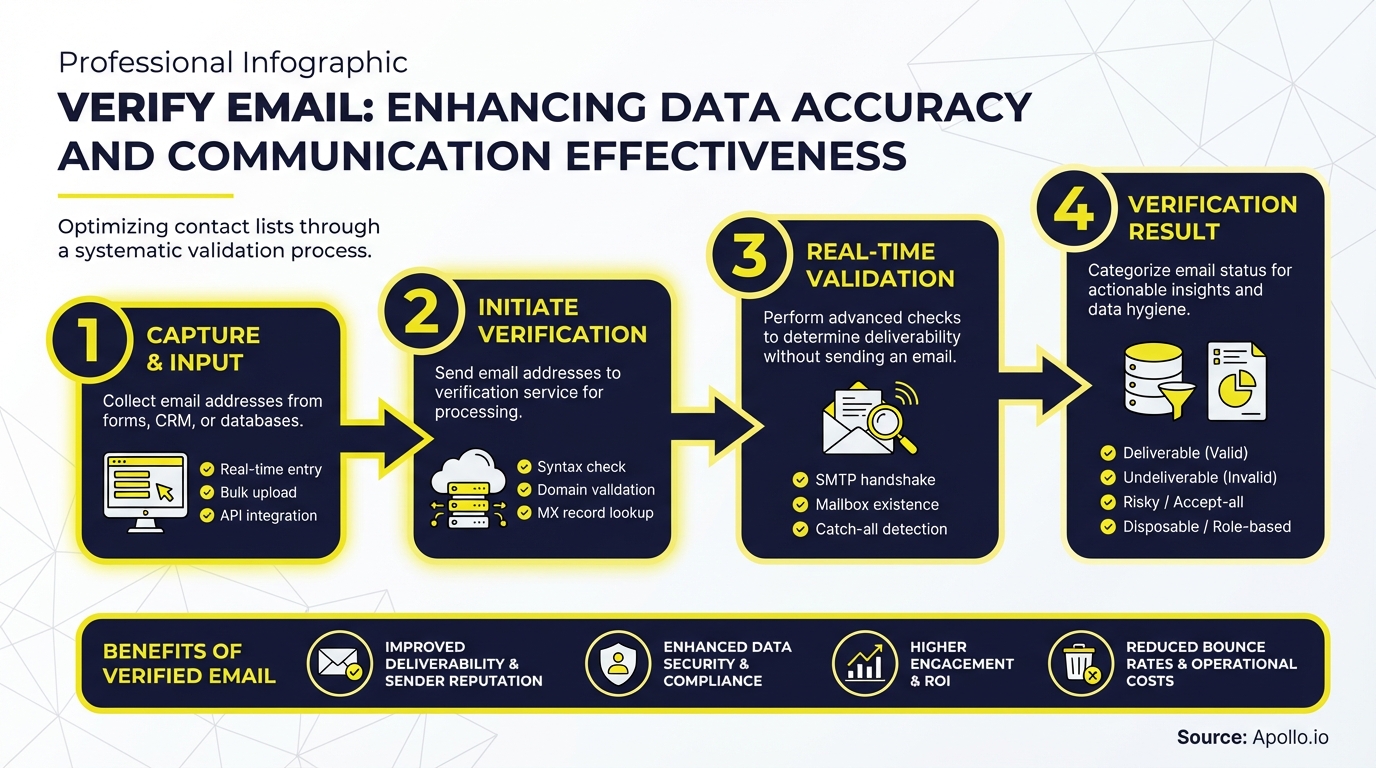
Modern verification runs multiple checks in sequence. Each layer catches different failure modes:
| Verification Type | What It Checks | What It Catches |
|---|---|---|
| Syntax Validation | Format rules (RFC 5322) | Typos, missing @ symbols, invalid characters |
| Domain Verification | MX records, DNS configuration | Non-existent domains, misconfigured servers |
| SMTP Validation | Mailbox existence (without sending) | Invalid mailboxes, inactive accounts |
| Risk Scoring | Disposable domains, role addresses, catch-alls | Temporary emails, distribution lists, risky addresses |
Syntax validation happens instantly. Domain and SMTP checks require server queries (milliseconds to seconds). Risk scoring uses pattern matching and reputation databases.
When to Verify: Shift-Left Strategies
The most effective verification happens before bad data enters your systems. Here's where to verify:
At Point of Capture
Validate emails in real-time on forms, chat widgets, and lead magnets. This prevents 7.6% invalid and 4.57% risky submissions (SafetyMails 2025 data) from ever reaching your CRM.
Use client-side validation for instant feedback, then server-side verification before database writes.
During Enrichment
When sourcing contacts from databases or enrichment tools, verify before adding to sequences. Need verified B2B contacts at scale? Apollo's 224M+ contacts include 96% email accuracy and automated enrichment.
Before Outreach
Re-verify contacts that have been in your CRM longer than 8 weeks. Hunter's experiment found 5.5% degradation in just 8 weeks (2.3% became invalid; 3.2% turned accept-all).
For outbound sequences, verify immediately before the first send.
Scheduled Re-Verification
Run verification on your entire database based on use case:
- High-velocity outbound: Every 4-6 weeks
- Newsletter/marketing: Quarterly
- Lifecycle/nurture: Bi-annually
- Dormant contacts: Before re-engagement campaigns
Turn Forecast Guesswork Into Revenue Certainty
Missing deals because you can't see who's ready to buy? Apollo reveals in-market prospects with real-time intent signals and scoring. Built-In increased win rates 10% with Apollo's buyer intelligence.
Start Free with Apollo →Verification and Deliverability Compliance
Verification supports the authentication and reputation requirements that inbox providers now enforce. To stay compliant:
- Implement SPF, DKIM, and DMARC: Google and Microsoft require these for bulk senders. Verification reduces bounce rates that damage your domain's reputation score.
- Monitor spam complaint rates: Keep complaints under 0.1% (Google's target). Verification catches invalid and risky addresses that generate complaints.
- Track bounce rates by provider: Belkins reports that Gmail consistently shows the lowest average bounce rate at 1.96% across industries, while Outlook has the highest at 6.95%. Segment your verification strategy accordingly.
- Maintain list hygiene: Suppress hard bounces immediately. Re-verify soft bounces after 2-3 attempts. Remove unengaged contacts quarterly.
For detailed deliverability tactics, see our guide on how to reach inboxes and dodge spam filters.
"We benchmarked ZoomInfo versus Apollo, Clearbit, Lusha, and Seamless, and ultimately Apollo won on all fronts, especially in enrichment. Higher quality than ZoomInfo, greater breadth than Clearbit."
Handling Verification Edge Cases
Three common scenarios require special handling:

Catch-All Domains
Catch-all servers accept all addresses, making validation impossible. Tag these as "unknown" and monitor engagement closely.
Send to catch-alls only when you have strong confidence in the contact (recent job title, verified company, specific role).
Role Addresses
Addresses like info@, sales@, and support@ often have multiple recipients and lower engagement. Verify that they exist, but segment them separately.
Use role addresses for initial discovery, then find individual contacts for outreach.
Disposable Email Services
Temporary email providers (10minutemail, guerrillamail) create addresses that expire quickly. Verification tools flag these as "disposable." Block or suppress them immediately—they inflate list size without adding value.
Building a Verification Workflow
Effective verification integrates with your existing tools and processes. Here's a practical implementation:
- API Integration: Connect your verification provider to forms, CRM, and marketing automation. Most providers offer REST APIs with real-time and batch endpoints.
- Result Handling: Define actions for each result status (valid, invalid, risky, unknown). Typically: accept valid, reject invalid, flag risky for manual review, treat unknown as risky.
- Suppression Lists: Automatically add hard bounces and invalid addresses to suppression lists. Sync these across all sending tools.
- Monitoring Dashboard: Track verification volume, invalid rate trends, and bounce rate improvements. Set alerts for spikes in invalid addresses.
Struggling to maintain data quality across prospecting and outreach? Apollo consolidates prospecting, verification, and engagement in one workspace.

Measuring Verification ROI
Track these metrics to quantify verification impact:
- Bounce rate reduction: Compare pre-verification and post-verification bounce rates. Target under 2% for hard bounces.
- Spam complaint rate: Monitor complaints per send. Stay well under 0.1%.
- Inbox placement rate: Use seed lists or inbox placement tools to measure deliverability by provider.
- Reply rate improvement: Higher inbox placement should increase replies. Track reply rates by campaign.
- Cost per valid contact: Calculate verification cost divided by valid addresses identified. Compare to cost of bounces and reputation damage.
For more on tracking email performance, read our guide on writing sales emails that get responses.
Start Verifying Smarter
Email verification has evolved from a maintenance task to a revenue-protection strategy. With inbox providers enforcing strict deliverability thresholds and B2B lists decaying faster than ever, verification must happen continuously—at capture, during enrichment, and before every send.
The teams that treat verification as infrastructure rather than cleanup maintain higher inbox placement, generate more replies, and protect their sender reputation. Start by implementing real-time verification on lead capture forms, then expand to pre-send checks and scheduled re-verification cadences.
Prove Apollo's ROI In Your First 30 Days
Budget approval stuck on unclear metrics? Apollo delivers measurable pipeline impact from day one—track time saved, meetings booked, and revenue generated. Customer. io achieved 50% YoY growth with clear ROI tracking.
Start Free with Apollo →Don't miss these
Data
How to Structure a Marketing Team That Actually Drives Revenue in 2026
Data
Solving Data Synchronization Headaches Across Multiple Business Systems
Data
What Marketing Metrics Should B2B Teams Track in 2026?
See Apollo in action
We'd love to show how Apollo can help you sell better.
By submitting this form, you will receive information, tips, and promotions from Apollo. To learn more, see our Privacy Statement.
4.7/5 based on 9,690 reviews
