
Technology Sales: Strategies to Close Complex B2B Deals in 2026
Technology sales in 2026 combines AI-powered tools with strategic human engagement to close complex B2B deals. Sellers who leverage AI alongside relationship-building skills are hitting quota 3.7 times more often than those relying on outdated methods. Yet 75% of buyers still prefer human interaction over pure automation, creating a delicate balance for modern tech sales teams. This guide reveals how top-performing SDRs, AEs, and sales leaders integrate AI tools while maintaining the consultative approach that wins enterprise accounts.

Get Verified Contacts, Not Dead Ends
Finding accurate emails and phone numbers takes forever. Apollo delivers 224M contacts with 96% email accuracy—verified and ready to connect. Join 550K+ companies closing more deals.
Start Free with Apollo →Key Takeaways
- AI-enabled sellers are 3.7x more likely to meet quota by combining automation with strategic human outreach
- Technology sales success requires balancing digital self-service (preferred by 61% of buyers) with consultative selling
- Top sales teams consolidate 3-5 tools into unified platforms, cutting costs while improving team efficiency
- Data-driven selling with verified contact intelligence shortens sales cycles and increases win rates
- Modern tech sales professionals need continuous enablement on AI tools and evolving buyer preferences
What Is Technology Sales?
Technology sales is the process of selling software, hardware, SaaS platforms, and IT services to businesses and professionals. Unlike transactional product sales, technology sales involves consultative selling where reps identify complex business problems and position technical solutions.
The sales cycle typically ranges from 30 days for SMB deals to 12+ months for enterprise contracts.
Tech sales professionals must understand both the technical capabilities of their product and the business outcomes buyers seek. According to Gartner, 60% of B2B sales organizations have transitioned to data-driven decision-making, integrating workflow, data, and analytics into unified practices. This shift reflects how technology sales has evolved from intuition-based pitching to evidence-backed consultative approaches.
The role encompasses prospecting qualified accounts, running product demos, navigating multi-stakeholder buying committees, and closing deals while managing post-sale expansion. Modern technology sales also requires proficiency with AI sales tools that automate research, outreach, and pipeline management.
How Does Technology Sales Work in 2026?
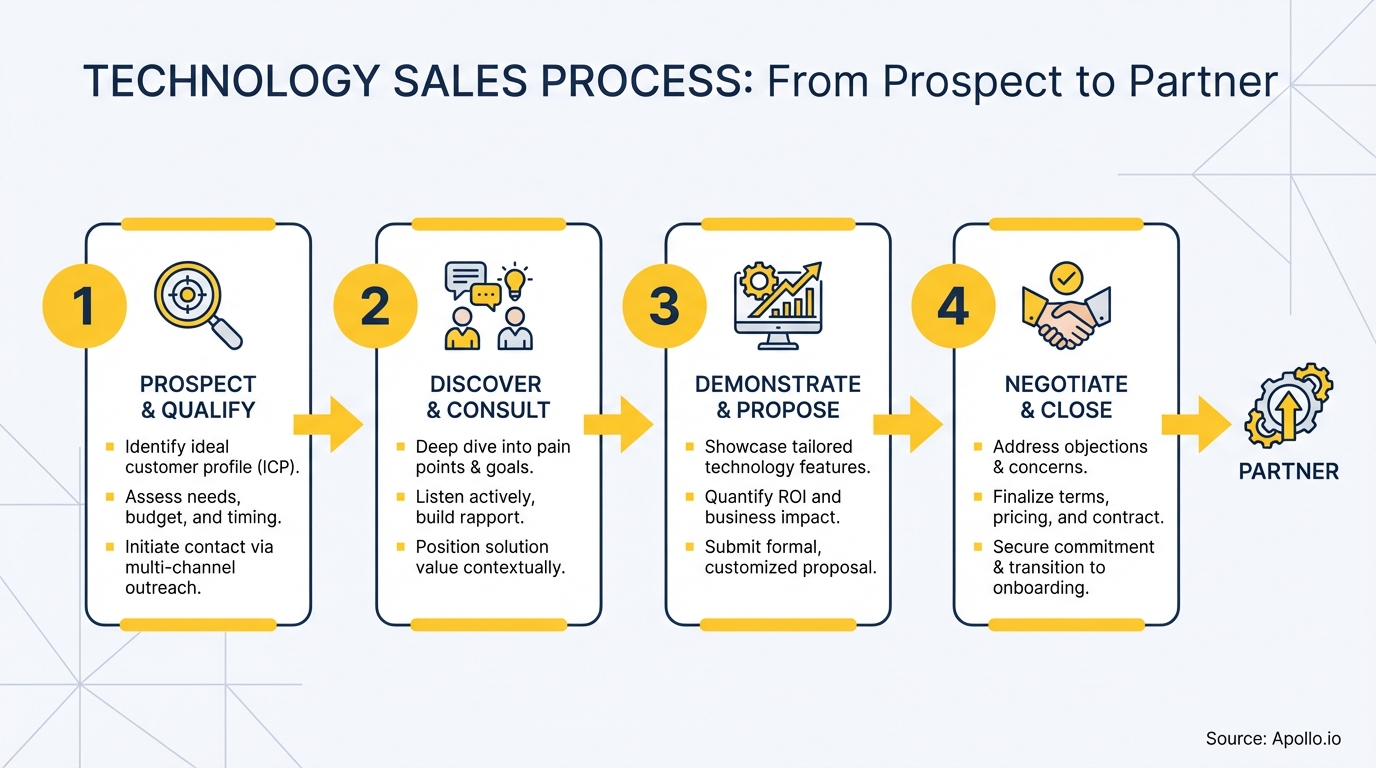
Technology sales in 2026 operates through a hybrid model combining AI automation with human expertise. The process starts with AI-powered prospecting to identify ideal customer profiles, then transitions to personalized human engagement for relationship building and deal closure. Research by Gartner shows that sellers who effectively partner with AI tools are 3.7 times more likely to meet their sales quotas.
The workflow follows these stages:
- AI-Powered Prospecting: Sales teams use platforms with verified contact databases to identify decision-makers at target accounts
- Automated Outreach: Multi-channel sequences (email, LinkedIn, calls) run automatically with personalized messaging based on prospect data
- Human Discovery Calls: SDRs and BDRs conduct qualification conversations to understand pain points and buying intent
- Consultative Demo: Account Executives present solutions tailored to specific business challenges identified during discovery
- AI-Assisted Negotiation: Deal management platforms track proposal status, competitor intelligence, and stakeholder engagement
Struggling to find qualified tech buyers? Search Apollo's 224M+ contacts with 65+ filters for precise targeting.
Data from Gartner indicates that 61% of B2B buyers prefer rep-free buying experiences, while 83% prefer digital commerce for transactions. This creates a paradox: sellers must provide self-service options while remaining available for consultative guidance when buyers need expertise.
How Do SDRs and BDRs Generate Pipeline in Technology Sales?
SDRs (Sales Development Representatives) and BDRs (Business Development Representatives) generate pipeline by identifying target accounts, conducting outbound prospecting, and qualifying leads before passing them to Account Executives. Their primary goal is booking qualified meetings, not closing deals.
Top-performing SDRs in 2026 use this framework:
| Activity | Daily Volume | Success Metric |
|---|---|---|
| Account Research | 50-75 accounts | ICP match rate >80% |
| Personalized Emails | 40-60 sends | Reply rate 8-12% |
| LinkedIn Outreach | 25-35 connections | Acceptance rate 30%+ |
| Cold Calls | 60-80 dials | Connect rate 10-15% |
| Qualified Meetings | 2-3 booked | Show rate >75% |
SDRs using unified platforms report significant efficiency gains. As one customer noted: "We reduced the complexity of three tools into one" (Predictable Revenue).
Instead of toggling between separate prospecting, enrichment, and engagement platforms, modern SDRs work from a single workspace.
The key differentiator in 2026 is AI-assisted research. Rather than spending 20 minutes researching each account manually, SDRs use AI to surface relevant insights like recent funding, technology stack, hiring trends, and pain points.
This allows them to personalize outreach at scale while maintaining the authenticity buyers expect.

Spending hours on manual prospect research? Let Apollo's AI handle research and outreach sequencing automatically.
What Are the Essential Skills for Technology Sales Professionals?
Technology sales professionals need a blend of technical knowledge, business acumen, and interpersonal skills. The most successful reps master both AI tools and human relationship-building strategies.
Core competencies for 2026:
- Technical Fluency: Understanding product architecture, integrations, security protocols, and competitive positioning
- Business Outcome Mapping: Translating technical features into measurable ROI and business value
- AI Tool Proficiency: Operating sales automation, conversation intelligence, and data enrichment platforms
- Consultative Discovery: Asking probing questions to uncover true pain points beyond surface-level needs
- Multi-Threading: Building relationships with multiple stakeholders across buying committees
- Data Interpretation: Reading pipeline metrics, engagement analytics, and buyer signals to prioritize activities
Account Executives managing complex deals benefit from deal management platforms that track stakeholder engagement, competitive threats, and next steps. RevOps leaders emphasize the importance of clean data and unified systems. As one customer shared: "Having everything in one system was a game changer" (Cyera).
The modern sales tech stack should consolidate prospecting, engagement, meetings, and pipeline management into fewer platforms. This reduces context-switching and allows reps to focus on high-value activities like customer conversations rather than administrative tasks.
Turn Funnel Gaps Into Predictable Revenue
Struggling with weak lead-to-opportunity conversion? Apollo delivers 224M verified contacts plus intent signals that identify sales-ready prospects before they go cold. Built-In increased win rates 10% with Apollo's scoring.
Start Free with Apollo →How Can Sales Leaders Build High-Performing Technology Sales Teams?
Sales Leaders build high-performing technology sales teams by implementing structured enablement programs, leveraging unified sales platforms, and creating data-driven coaching frameworks. The goal is predictable revenue growth through repeatable processes.
Proven strategies for 2026:

- AI-Powered Onboarding: New reps ramp 40% faster using AI-guided training and playbook automation
- Tech Stack Consolidation: Reducing 5-7 tools down to 2-3 platforms cuts costs and improves adoption
- Real-Time Coaching: Conversation intelligence platforms surface coachable moments from calls and emails
- Transparent Metrics: Shared dashboards showing activity levels, pipeline health, and conversion rates by rep
- Continuous Enablement: Weekly skill-building sessions on product updates, competitive positioning, and objection handling
According to recent research, 100% of B2B revenue enablement leaders have adopted AI in sales enablement, with 48% reporting increased revenue and 51% noting shortened sales cycles. Founders and CEOs building outbound teams should prioritize platforms that provide both automation and human oversight.
Sales Leaders at companies like Census report: "We cut our costs in half" by consolidating disparate tools into unified platforms. The key is choosing technology that grows with the team rather than requiring replacement as headcount scales. Modern B2B sales organizations emphasize tool efficiency over tool quantity.
Why Is Balancing AI and Human Touch Critical in Technology Sales?
Balancing AI and human touch is critical because buyers want efficiency from automation but trust from human relationships. Data from Gartner shows that by 2030, 75% of B2B buyers will prefer sales experiences that prioritize human interaction over AI, even as they demand faster response times and personalized outreach.
The paradox creates three distinct buyer segments:
- Self-Service Buyers (61%): Want to research independently, prefer chatbots and knowledge bases, minimal sales interaction
- Hybrid Buyers (28%): Research digitally but engage reps for complex questions, demos, and negotiation
- Relationship Buyers (11%): Expect dedicated account management, strategic guidance, and executive relationships
Sales teams must design sales funnels that accommodate all three segments. This means providing robust self-service resources while ensuring human experts are available when buyers need consultative help. The mistake many teams make is forcing all buyers through the same linear process.
AI excels at repetitive tasks: finding contacts, sending initial outreach, scheduling meetings, taking call notes. Humans excel at strategic thinking: understanding nuanced business problems, navigating political dynamics, building trust with skeptical buyers.
The best technology sales teams use AI to eliminate busywork so reps can focus on high-value human activities.
Start Winning More Technology Sales Deals
Technology sales in 2026 rewards teams that master the AI-human balance. Sellers who leverage automation for prospecting and outreach while maintaining consultative, relationship-focused selling consistently outperform those stuck in purely manual or purely automated approaches.
The path forward requires three commitments: consolidating your tech stack to reduce complexity, enabling your team on AI tools and modern buyer preferences, and measuring what matters (pipeline velocity, win rates, quota attainment) rather than vanity metrics. Companies that embrace unified platforms report cutting costs in half while improving team performance.
Ready to transform your technology sales process? Try Apollo Free and join 2M+ users building predictable pipeline with AI-powered prospecting, engagement, and intelligence.
Prove Apollo's ROI In Your First 30 Days
Budget approval stuck on unclear metrics? Apollo delivers measurable pipeline impact from day one—track time saved, meetings booked, and deals closed. Built-In increased win rates 10% and ACV 10% with Apollo's scoring.
Start Free with Apollo →Don't miss these
Sales
Inbound vs Outbound Marketing: Which Strategy Wins?
Sales
What Is a Sales Funnel? The Non-Linear Revenue Framework for 2026
Sales
What Is a Go-to-Market Strategy? The 2026 GTM Playbook
See Apollo in action
We'd love to show how Apollo can help you sell better.
By submitting this form, you will receive information, tips, and promotions from Apollo. To learn more, see our Privacy Statement.
4.7/5 based on 9,690 reviews
