InsightsSalesWhat Is a SPIFF in Sales? Definition, Design, and Governance
What Is a SPIFF in Sales? Definition, Design, and Governance
February 26, 2026
Written by The Apollo Team
What Is a SPIFF in Sales? Definition, Design, and Governance
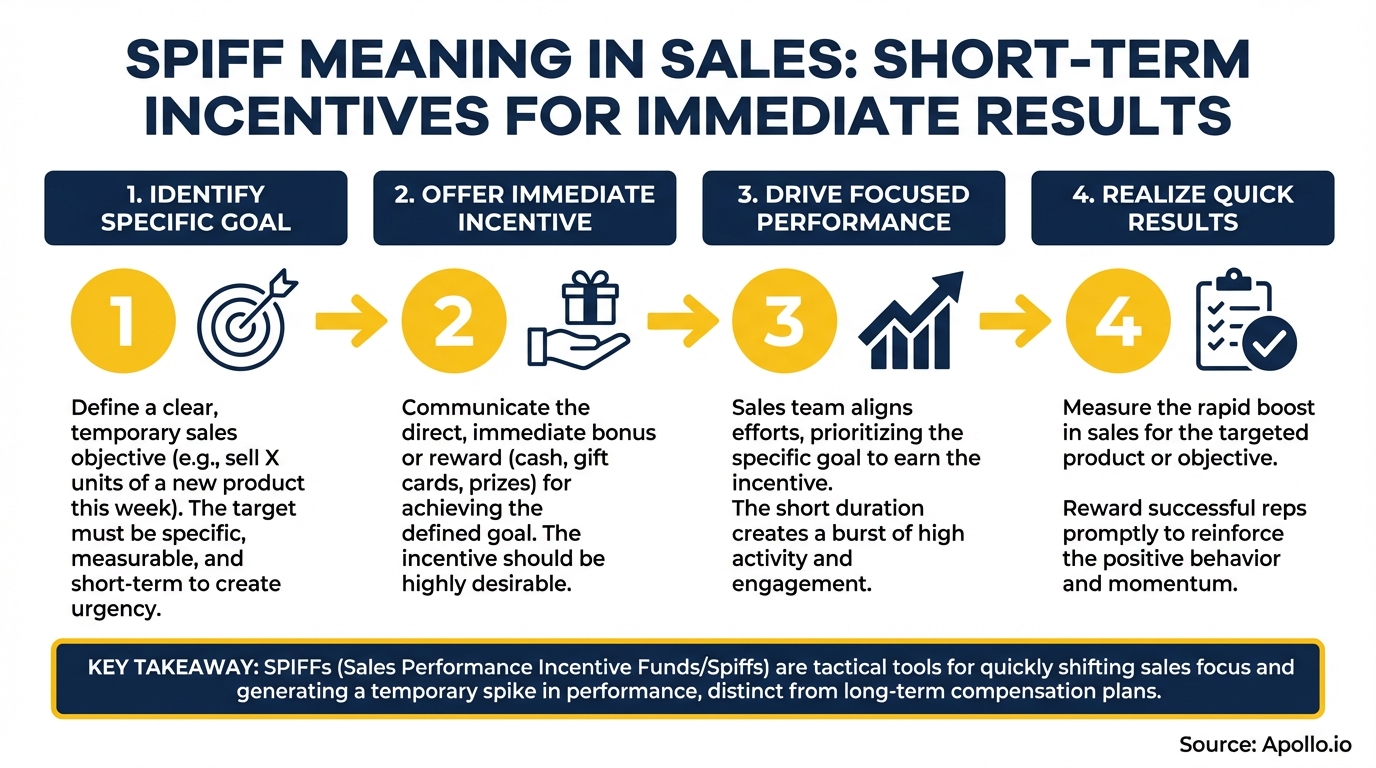
A SPIFF (Sales Performance Incentive Fund or Special Performance Incentive for Field Personnel) is a short-term bonus paid to salespeople for achieving specific, immediate objectives. Unlike recurring commissions, SPIFFs target tactical behaviors: closing a product launch deal, booking demos with enterprise accounts, or clearing aged inventory within 30 days.
In 2026, SPIFFs are no longer back-office spreadsheet bonuses. They're software-managed incentive compensation tools with real-time visibility, auditability, and governance.
Modern sales leaders use SPIFFs to steer pipeline quality, not just activity volume. But poorly designed SPIFFs add seller drag and overwhelm, undermining the very performance they're meant to boost.
Flowchart detailing a four-step sales spiff process with explanatory text and icons.
LEAD GENERATION EFFICIENCY
Scale Quality Lead Gen Without Adding Headcount
Struggling to generate enough qualified leads at the pace your pipeline demands? Apollo automates lead scoring and ICP targeting so you build pipeline faster. Join 550K+ companies scaling smarter.
SPIFFs are time-boxed, tactical bonuses that drive specific sales behaviors (product pushes, pipeline quality, channel enablement)
According to All Digital Rewards, organizations that implement SPIFFs with clear goals and robust tracking systems often see a 15% or higher lift in short-term sales performance
2026 trends emphasize intent-based SPIFFs (rewarding pipeline quality over activity volume), real-time payout visibility, and cross-functional incentives
Common pitfalls: unclear rules, slow payouts, activity metrics that inflate low-quality pipeline, and lack of auditability
Best practices: align SPIFFs with STI budgets, simplify rules to reduce seller drag, and use automation for tracking and disputes
SPIFF vs Commission: What's the Difference?
Commissions and SPIFFs both reward sales performance, but they serve different strategic purposes. Understanding when to use each determines whether you're building sustainable pipeline or chasing short-term activity.
Dimension
Commission
SPIFF
Duration
Ongoing (quarterly, annual)
Short-term (days to weeks)
Objective
Reward overall quota attainment
Drive specific tactical behavior
Payout Trigger
Revenue closed, pipeline created
Defined action (demo booked, product sold, training completed)
Governance
Structured, comp-plan driven
Ad-hoc or campaign-based
Tracking
CRM + finance systems
Incentive compensation management (ICM) tools
In B2B sales, commissions align with long-term revenue goals. SPIFFs are surgical: clear inventory, launch a product, or push partner certifications. The key is knowing which lever to pull.
Types of SPIFF Programs That Drive Results
Not all SPIFFs are created equal. The most effective programs tie payouts to business outcomes, not just activity. Here's how modern sales teams structure SPIFFs in 2026.
Product-Focused SPIFFs
Drive adoption of new solutions or clear aged inventory. Example: $500 bonus for every deal that includes Product X in Q1.
These work best when paired with enablement (training, battle cards, demo environments) so reps can sell confidently.
Intent-Based SPIFFs
Reward pipeline quality over volume. Instead of paying for "demos booked," pay for "ICP-fit demos with buying committee engagement." This shift prevents low-quality pipeline inflation and aligns SPIFFs with revenue outcomes. Teams using ICP frameworks see stronger conversion rates.
Channel Partner SPIFFs
Incentivize partner behaviors: certifications, solution attach, co-selling motions. As channel ecosystems evolve (AI/security complexity, specialization requirements), SPIFFs are becoming enablement accelerators, not just "move product" bonuses.
Cross-Functional SPIFFs
Extend incentives beyond quota-carrying reps to marketing (pipeline quality), customer success (expansion), and sales development (qualified meetings). This orchestrates revenue outcomes across the full go-to-market motion.
"Apollo allowed us to 3x our annual revenue without any decrease in efficiency."
Designing SPIFFs That Don't Create Seller Drag
Gartner reports that 83% of sellers experience high or medium drag (friction from processes, enablement, and internal barriers). Low-drag sellers have 1.7x higher quota attainment than high-drag sellers.
SPIFFs that add complexity or unclear rules become drag, not motivation.
SPIFF Design Checklist
Clear qualification criteria: Define exactly what earns the SPIFF (which products, customer segments, deal stages)
Simple payout structure: Flat bonus or tiered (avoid complex formulas that require a calculator)
Fast payout SLA: Commit to payout within 7-14 days of qualification (sellers expect real-time visibility)
Auditability: Track in your CRM or ICM tool with dispute resolution workflows
Communication plan: Announce rules, track progress publicly (dashboards), and celebrate wins
Research from UwinIwin shows well-designed incentive programs have been shown to boost sales performance by as high as 22%. The key is "well-designed": transparent rules, trackable metrics, and timely payouts.
PIPELINE FORECASTING GAPS
Turn Forecast Guesswork Into Revenue Certainty
Pipeline forecasting a guessing game? Apollo's real-time deal tracking and AI-powered scoring give you reliable forecasts that actually hit. Built-In increased win rates 10% with Apollo's visibility.
Gartner reports that 53% of organizations planned to keep 2024 short-term incentive (STI) budgets the same as 2023. Translation: finance isn't expanding SPIFF budgets.
Sales leaders must optimize within constraints, making every dollar count.
STI Budget Best Practices
Pre-allocate SPIFF budgets: Treat SPIFFs as a core STI lever, not ad-hoc spend
Set ROI thresholds: Only run SPIFFs where you can measure incremental revenue or pipeline quality improvement
Use non-cash rewards strategically:Lift and Shift reports cash rewards cost $0.12 for every incremental sales dollar, while non-cash rewards cost only $0.04
Automate tracking: Manual spreadsheets create payout errors and disputes. Use ICM tools for real-time calculation and visibility
A man talks on a headset at a desk while another walks down a brightly lit office corridor.
Common SPIFF Pitfalls and How to Avoid Them
ITA Group's 2025 survey of distributor and manufacturer sales reps found 96% report challenges with their sales incentive program experience. The most common SPIFF failures stem from poor design, not lack of budget.
Pitfall 1: Activity Metrics That Inflate Low-Quality Pipeline
The Problem: Paying for "demos booked" or "calls made" drives volume, not revenue. Reps book unqualified meetings to hit SPIFF thresholds.
The Fix: Tie SPIFFs to intent signals (buying committee engagement, ICP fit, qualified progression to next stage). Use sales analytics to track conversion rates and adjust criteria.
Pitfall 2: Slow or Opaque Payouts
The Problem: Sellers don't trust the program if they can't see earnings in real time or wait 60+ days for payout.
The Fix: Commit to 7-14 day payout SLAs. Use dashboards to show real-time SPIFF earnings. FMI Agency emphasizes transparency and regular communication of performance against targets are crucial for successful B2B incentive plans.
Pitfall 3: Unclear or Changing Rules
The Problem: Mid-campaign rule changes or ambiguous qualification criteria create distrust and disputes.
The Fix: Lock rules at launch. Communicate in writing (email, Slack, CRM task). If you must adjust, apply changes only to future periods.
"Apollo could be a third of the cost if you look at the full price of what we were spending on ZoomInfo, Outreach, Salesforce, and admins to make it all work."
Three smiling professionals discuss documents at a round table in a modern office.
2026 SPIFF Trends: AI, Automation, and Intent Signals
The shift from activity-based to intent-based SPIFFs is accelerating. Sales teams are moving away from rewarding "lots of demos" toward "ICP-fit, buying-committee-engaged demos." This prevents pipeline inflation and aligns SPIFFs with revenue outcomes.
AI is changing what gets rewarded. Gartner found sellers who effectively partner with AI tools are 3.7x more likely to meet quota.
Forward-thinking teams now run SPIFFs that incentivize AI adoption behaviors: using conversation intelligence for call prep, automating CRM hygiene, or leveraging intent data for account prioritization.
Automation is table stakes. Real-time dashboards, dispute workflows, and payout calculators are no longer "nice to have." Sellers expect the same visibility they get from consumer apps.
Organizations using modern ICM tools report fewer payout disputes and higher SPIFF engagement.
Channel SPIFFs are evolving. As partner programs emphasize specialization (AI expertise, security certifications), SPIFFs reward training completion, solution attach, and correct packaging.
This aligns partner incentives with what buyers actually need, not just what vendors want to move.
Implementing Your First SPIFF Program
Start small. Pick one high-impact objective (product launch, pipeline quality improvement, channel enablement). Run a 30-day pilot with 10-20 reps. Measure incremental lift vs control group.
Data-driven organizations are 23 times more likely to acquire new customers and six times more likely to retain them, according to Spiff. Apply that same rigor to SPIFF measurement.
Key SPIFF Metrics
Metric
What It Measures
Target
Participation Rate
% of eligible reps who qualify for payout
60-80%
Incremental Lift
Performance vs baseline or control group
15%+ improvement
Cost per Incremental Dollar
SPIFF spend / incremental revenue
<$0.12 (cash), <$0.04 (non-cash)
Time to Payout
Days from qualification to payout
<14 days
Dispute Rate
% of payouts challenged or corrected
<5%
If your SPIFF isn't delivering 15%+ incremental lift, the design needs work. Review qualification criteria, communication clarity, and enablement support before scaling.
Getting Started: Build Your SPIFF Playbook
Effective SPIFFs require repeatable processes.
Document your design framework, communication templates, tracking mechanisms, and dispute resolution workflows.
This becomes your SPIFF playbook for future campaigns.
Key playbook components:
SPIFF request form: Standardize how stakeholders propose new SPIFFs (objective, budget, duration, success metrics)
Approval workflow: Define who signs off (sales ops, finance, legal) and approval criteria
Communication templates: Pre-written launch emails, Slack announcements, and dashboard designs
Tracking templates: CRM fields, ICM tool configurations, and reporting dashboards
Dispute resolution process: How reps escalate questions and how ops resolves them
Conclusion: From Activity Rewards to Revenue Catalysts
SPIFFs are evolving from "book more meetings" bonuses to strategic revenue levers. The best programs in 2026 reward intent signals, pipeline quality, and cross-functional behaviors that drive real business outcomes.
They're governed like core STI investments, tracked with real-time visibility, and designed to reduce seller drag, not add to it.
Start with one high-impact pilot. Measure rigorously. Scale what works. Your SPIFF program should make sellers' jobs easier and revenue more predictable, not create confusion and disputes.
Ready to build pipeline that converts? Schedule a Demo to see how Apollo's unified GTM platform tracks the behaviors that matter.
ROI JUSTIFICATION
Prove Apollo's ROI In Your First 30 Days
Budget approval stuck on unclear metrics? Apollo tracks every touch to closed revenue so you justify spend with real pipeline impact. Built-In increased win rates 10% and ACV 10% with Apollo's visibility.