How to Generate Seamless Sales Leads That Convert in 2026
In 2026, B2B sales teams face a paradox: buyers want self-service options, yet they crave human connection at critical moments. Organizations that master seamless sales leads generate 3x more qualified pipeline by orchestrating AI-powered prospecting with strategic human touchpoints. This guide reveals the proven framework top-performing teams use to align sales and marketing, balance automation with personalization, and build a deal management system that converts.

Reclaim 4+ Hours Daily With Apollo's Automation
Tired of spending 4+ hours daily hunting for contact info? Apollo automates lead research with 224M+ verified contacts at 96% accuracy. Join 550K+ companies who turned manual work into pipeline growth.
Start Free with Apollo →Key Takeaways
- Seamless sales leads require aligning sales and marketing with shared KPIs, eliminating silos that cost teams up to 30% of potential revenue
- Hybrid sales models combining AI automation and human expertise deliver 10-15% efficiency gains while meeting buyer preferences for both self-service and rep interaction
- Omnichannel orchestration across 10+ touchpoints increases conversion rates by 38% when channels work together rather than compete
- Tech stack consolidation into one unified platform cuts costs in half while improving data quality and team adoption
- RevOps leaders using governance frameworks and real-time dashboards achieve 96% data accuracy and predictable pipeline growth
What Are Seamless Sales Leads?
Seamless sales leads are qualified prospects who move smoothly through your pipeline because sales and marketing teams share unified data, coordinated messaging, and integrated workflows. Unlike traditional lead generation where handoffs create friction, seamless leads experience consistent value at every touchpoint.
According to Gartner research, organizations that align commercial functions are nearly three times more likely to exceed customer acquisition targets. The difference lies in eliminating the gaps where leads fall through cracks between departments.
For SDRs and BDRs, this means receiving leads with complete context: what content they viewed, which pain points they expressed, and when they're ready for outreach. Account Executives inherit deals with full interaction history, eliminating redundant discovery calls.
RevOps teams maintain a single source of truth across all systems.
How Do SDRs Generate Seamless Sales Leads in 2026?
SDRs generate seamless leads by combining AI-powered prospecting with strategic human research and multi-channel engagement. The process starts with intelligent targeting using verified business contact databases, then layers personalized outreach based on buying signals.
Struggling to find qualified leads without burning hours on research? Search Apollo's 224M+ contacts with 65+ filters for instant ICP matches.
Modern SDRs follow this workflow:
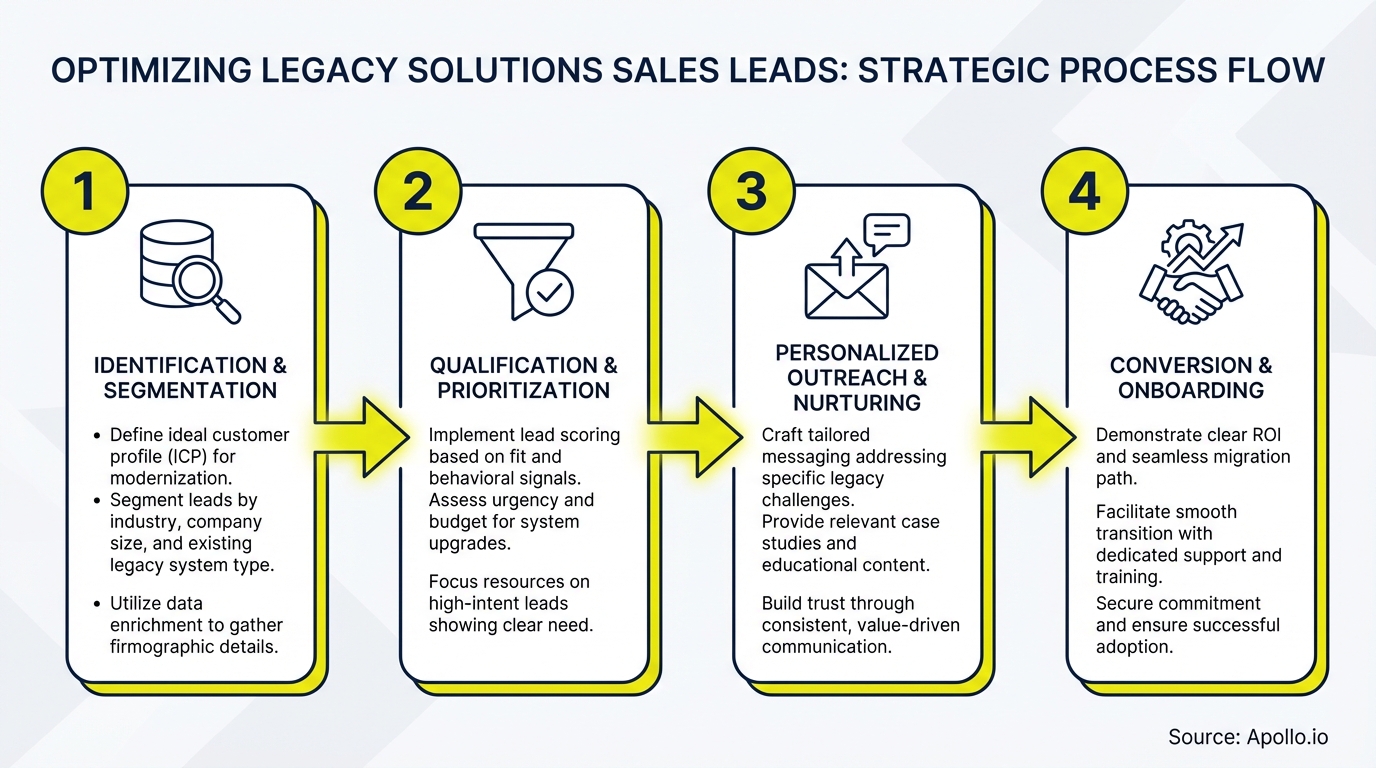
- Smart Segmentation: Define ICP criteria (company size, industry, tech stack, hiring signals) and build targeted lists in minutes rather than days
- Signal Detection: Monitor job changes, funding announcements, product launches, and other intent signals that indicate buying readiness
- Coordinated Outreach: Execute sequences across email, LinkedIn, phone, and video using consistent messaging that references prior marketing touches
- Real-Time Enrichment: Automatically update contact records with latest job titles, direct dials, and verified emails to maintain 96% data accuracy
Top-performing SDRs using unified platforms report booking 46% more meetings because they spend less time switching between tools and more time having conversations. The key is eliminating manual data entry and tool-switching that kills momentum.
Why Do Sales and Marketing Teams Struggle with Lead Quality?
Sales and marketing teams struggle with lead quality because they operate from different data sources, use conflicting definitions of "qualified," and lack visibility into each other's activities. This misalignment costs organizations up to 30% of potential revenue.

Common friction points include:
| Problem | Impact | Solution |
|---|---|---|
| Separate databases | Duplicate records, inconsistent scoring | Single unified platform with bi-directional sync |
| Different qualification criteria | Sales rejects 50%+ of marketing leads | Shared SLA with agreed-upon MQL/SQL definitions |
| No attribution visibility | Can't identify which channels drive revenue | End-to-end tracking from first touch to closed-won |
| Siloed communication | Conflicting messages confuse buyers | Unified messaging framework and content library |
Sales Leaders implementing shared KPIs like "pipeline generated from qualified leads" and "speed to first response" see immediate improvements in collaboration. When both teams are measured on revenue outcomes rather than vanity metrics, alignment happens naturally.
Turn Forecast Chaos Into Revenue Certainty
Pipeline forecasting a guessing game? Apollo surfaces buying signals and tracks deal progression in real-time. Built-In increased win rates 10% with Apollo's intelligence—no more surprises at month-end.
Start Free with Apollo →How Does Hybrid Sales Orchestration Balance AI and Human Touch?
Hybrid sales orchestration uses AI for repetitive research and outreach tasks while reserving human expertise for high-value conversations and relationship building. Data from Gartner indicates that by 2030, 75% of B2B buyers will prefer sales experiences that prioritize human interaction over AI, even as they demand self-service options.

The framework works through clear escalation rules:
- AI Handles: Initial prospecting, data enrichment, meeting scheduling, follow-up reminders, CRM updates, and routine qualification questions
- Humans Handle: Discovery calls, objection handling, executive alignment, contract negotiation, and relationship deepening
- Collaborative Zones: AI prepares pre-call research briefs, suggests talking points based on prospect behavior, and drafts personalized follow-ups that reps review before sending
Account Executives using this model close deals 35% faster because they enter every conversation fully prepared with context the AI gathered. The key is treating AI as an assistant that amplifies human capabilities rather than replacing judgment.
Tired of spending hours on manual research before each call? Let Apollo's AI automation handle prospect research and follow-up.
What Tech Stack Do RevOps Leaders Need for Seamless Leads?
RevOps leaders need an integrated tech stack that consolidates prospecting, engagement, enrichment, and analytics into one platform rather than managing 5-10 disconnected tools. The goal is eliminating integration headaches while maintaining complete visibility across the revenue cycle.
Essential capabilities include:
- Unified Database: 224M+ verified business contacts with 96% email accuracy, eliminating reliance on multiple data vendors
- Engagement Platform: Multi-channel sequences (email, phone, LinkedIn, video) managed from one workspace with unified analytics
- Intelligence Layer: AI-powered lead scoring, intent signals, conversation intelligence, and predictive analytics
- CRM Integration: Bi-directional sync ensuring every touchpoint is logged automatically without manual data entry
- Governance Framework: Role-based permissions, compliance controls, data quality monitoring, and audit trails
Companies switching to consolidated platforms report cutting costs in half compared to stitching together ZoomInfo, Outreach, and other point solutions. As one customer noted: "We reduced the complexity of three tools into one" (Predictable Revenue).
For Founders and CEOs evaluating sales tech stack options, the ROI calculation is straightforward: fewer tools mean lower subscription costs, faster team ramp time, better data quality, and higher user adoption. Teams spend time selling instead of managing integrations.
How Can Sales Leaders Implement Seamless Lead Orchestration?
Sales Leaders implement seamless lead orchestration by establishing cross-functional governance, defining clear handoff protocols, and instrumenting every stage of the pipeline with measurable KPIs. The process requires executive sponsorship and a phased rollout.
Implementation roadmap:
- Week 1-2: Audit current state (how many tools, where leads get stuck, what data is missing), define ICP and qualification criteria with sales and marketing alignment
- Week 3-4: Select unified platform, migrate data, configure workflows, and establish integration with existing CRM
- Week 5-6: Train teams on new processes, launch pilot with one segment, gather feedback and iterate
- Week 7-8: Roll out to full team, implement dashboards for real-time visibility, establish weekly pipeline reviews
Critical success factors include executive commitment to tool consolidation, clear SLAs between departments, and ongoing optimization based on conversion data. Teams using sales analytics dashboards identify bottlenecks faster and course-correct in real time.
The payoff is substantial: organizations with aligned commercial functions see 10-15% efficiency gains, 38% higher conversion rates from omnichannel coordination, and predictable pipeline growth quarter over quarter.
Start Building Your Seamless Lead Engine Today
Seamless sales leads aren't built on hope or heroic individual effort. They emerge from aligned teams, unified data, and orchestrated workflows that eliminate friction at every handoff.
In 2026, the winners are organizations that consolidate their tech stack, balance AI automation with human expertise, and instrument their entire revenue process with real-time visibility.
For SDRs and BDRs, seamless leads mean more time selling and less time hunting for contact information or switching between tools. Account Executives inherit deals with complete context, shortening sales cycles and improving close rates.
RevOps leaders gain the single source of truth they need to forecast accurately and optimize continuously.
The framework outlined here works because it addresses the root causes of lead leakage: misalignment, poor data quality, disconnected tools, and unclear handoffs. By implementing shared KPIs, governance protocols, and a unified platform, your team can achieve the same results top performers report: 3x more qualified pipeline, 46% more meetings booked, and costs cut in half.
Ready to transform your lead generation process? Start Your Free Trial and discover how Apollo's all-in-one platform helps 550K+ companies generate seamless sales leads with 224M verified contacts, AI-powered automation, and complete pipeline visibility in one workspace.
Show Real Pipeline ROI In Your First Week
Budget approval stuck on unclear metrics? Apollo tracks every touchpoint to pipeline, proving ROI with real revenue attribution. Built-In increased win rates 10% and ACV 10% with measurable Apollo impact.
Start Free with Apollo →Don't miss these
Sales
Inbound vs Outbound Marketing: Which Strategy Wins?
Sales
What Is a Sales Funnel? The Non-Linear Revenue Framework for 2026
Sales
What Is a Go-to-Market Strategy? The 2026 GTM Playbook
See Apollo in action
We'd love to show how Apollo can help you sell better.
By submitting this form, you will receive information, tips, and promotions from Apollo. To learn more, see our Privacy Statement.
4.7/5 based on 9,690 reviews
