
What Are Sales Verticals? A Practitioner's Playbook for 2026
Generic outreach is losing ground fast. As buyers increasingly research, evaluate, and decide without ever speaking to a rep, your vertical-specific content and sales motion have become your most important pipeline asset. Sales verticals give your team a repeatable, scalable framework to win in specific industries — with proof, messaging, and plays that actually resonate. Learn how sales analytics can sharpen your vertical targeting and accelerate revenue.

Research Less, Close More With Apollo
Tired of burning hours verifying contacts that go nowhere? Apollo delivers 224M+ business contacts with 96% email accuracy so your reps spend time selling, not searching. Join 550K+ companies building pipeline faster.
Start Free with Apollo →Key Takeaways
- Sales verticals are industry-specific go-to-market segments where you apply tailored messaging, proof, and plays rather than generic outreach.
- Vertical specialization shortens sales cycles and improves win rates by speaking the buyer's operational language.
- With most B2B buyers now preferring self-serve evaluation, your vertical content must do the selling before a rep ever enters the conversation.
- SDRs, AEs, and RevOps teams each need vertical-specific assets: talk tracks, ROI models, and objection responses mapped to the industry.
- Apollo's unified platform helps teams prospect, engage, and close within each vertical — without juggling multiple tools.
What Are Sales Verticals?
A sales vertical is a defined industry segment — such as healthcare, fintech, manufacturing, or SaaS — that your team targets with a specialized go-to-market motion. Instead of selling the same way to everyone, vertical selling means adapting your ICP definition, messaging, discovery questions, proof points, and objection responses to match the specific workflows, regulations, and KPIs of that industry.
Verticals are not the same as company size or geography. They reflect the business context of the buyer: their compliance environment, their internal stakeholders, their success metrics. A healthcare CISO evaluates risk differently than a fintech CFO. Vertical selling accounts for that difference from first touch to close.
- Examples of common B2B sales verticals: SaaS/Technology, Financial Services, Healthcare/Life Sciences, Manufacturing, Professional Services, Retail/eCommerce, Government/Public Sector
- Micro-verticals: HR Tech within SaaS, Wealth Management within Financial Services, MedTech within Healthcare
Why Do Sales Verticals Matter in 2026?
Buyer scrutiny is at an all-time high. According to a Teneo 2026 B2B Software Vendor Survey, buyers are demanding that vendors quantify ROI in their operational language — not generic outcomes. Teams that can't map their value to industry-specific KPIs are losing deals to those that can.
The data on win rates reinforces the urgency. A study from HubSpot's Sales Trends Report found the average B2B sales win rate was just 21% in 2023. Vertical specialization is one of the most direct levers to move that number — because reps who speak the buyer's language build credibility faster and face fewer objections.
Three forces make vertical GTM non-negotiable right now:
- Self-serve buying: Most B2B buyers now complete significant research before engaging a rep. Your vertical landing pages, case studies, and ROI tools are doing sales work 24/7.
- AI-accelerated generic outreach: AI makes horizontal, templated messaging cheaper and more abundant. Vertical expertise becomes the only defensible differentiator.
- Omnichannel expectations: Buyers expect consistent, industry-relevant messaging across every channel — website, email, calls, and events.
How Do You Build a Vertical Go-to-Market Framework?
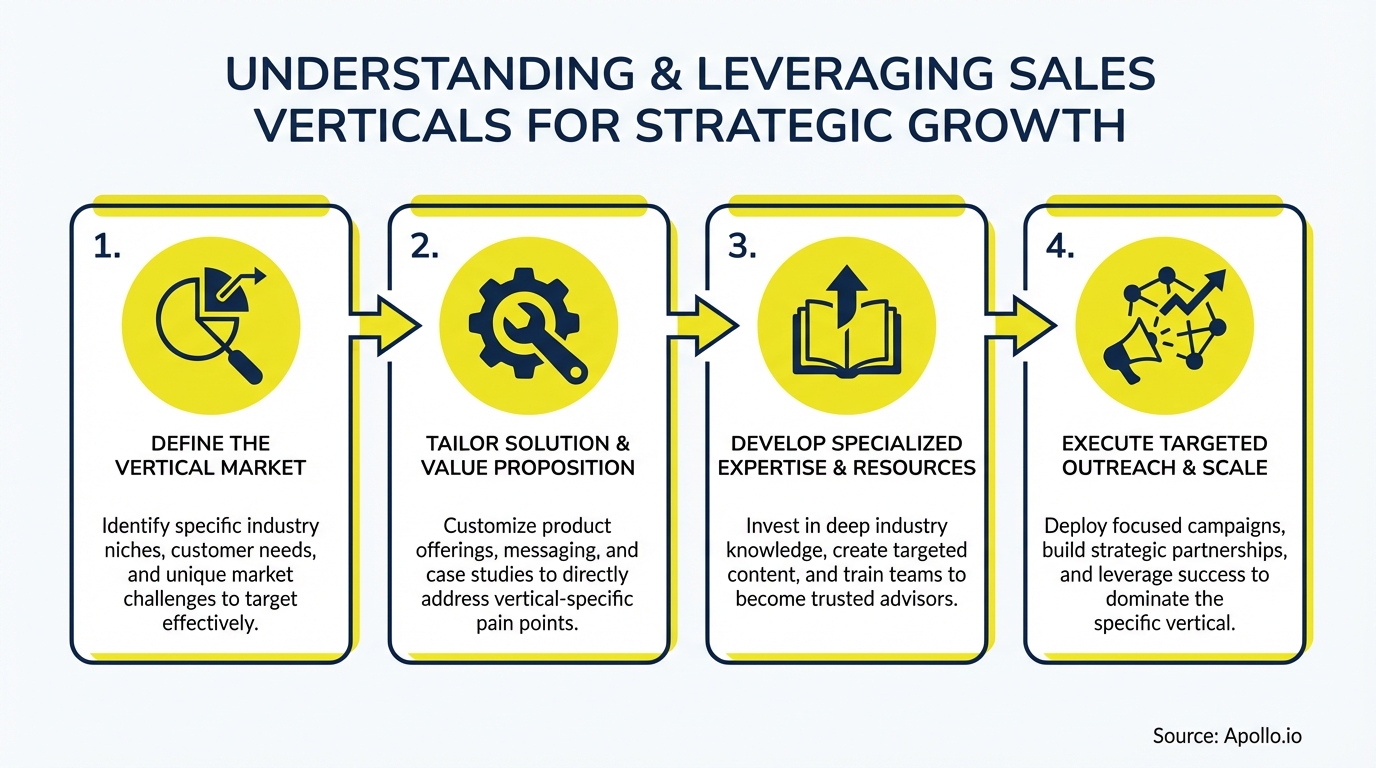
A vertical GTM framework is a repeatable system that aligns your ICP, messaging, content, and sales plays around a specific industry. Build it in four layers:
| Layer | What It Includes | Owner |
|---|---|---|
| 1. Vertical ICP | Firmographic filters, buying roles, trigger events, disqualifiers | RevOps / Sales Leadership |
| 2. Vertical Proof Pack | Case studies, benchmarks, ROI models mapped to vertical KPIs | Marketing / Enablement |
| 3. Vertical Talk Tracks | Discovery questions, value narratives, objection responses per industry | Sales Enablement |
| 4. Vertical Content Architecture | Self-serve pages, email sequences, call scripts, and event decks | Marketing / SDR Team |
RevOps leaders find the biggest gap is usually layer one: without clean, enriched data segmented by vertical, every other layer falls apart. Struggling to find qualified contacts within your target verticals? Search Apollo's 224M+ verified contacts with 65+ filters to build precise vertical prospect lists.

How Do SDRs Execute a Vertical Sales Motion?
SDRs are the front line of vertical execution. Without vertical-specific sequences, they default to generic messaging that fails to stand out.
Here's how high-performing SDR teams operationalize vertical selling:
- Segment sequences by vertical: Build separate email and call cadences for each target industry with different subject lines, pain points, and social proof.
- Lead with vertical proof: Reference a case study or benchmark from the same industry in the first touch. "We helped [similar company in their space] achieve [outcome in their KPI language]."
- Use trigger-based personalization: Industry regulatory changes, funding rounds, or leadership hires are vertical-specific triggers that justify outreach.
- Map to the right stakeholder: Healthcare outreach targets compliance officers differently than it targets CFOs. Vertical ICP maps define who to call at each stage.
Research from Gradient Works' B2B Sales Benchmarks shows sales cycles lengthened by 32% from 2021 to 2022 — a trend that continued into 2024. Vertical-specific outreach reduces cycle length by building buyer confidence earlier, with industry-relevant proof rather than generic claims.
For AEs managing active deals, vertical talk tracks and ROI models help accelerate evaluation by speaking directly to the economic buyers' metrics. Explore how enterprise sales strategies apply vertical expertise to close complex, multi-stakeholder deals.
Turn Funnel Guesswork Into Closed Deals
Pipeline forecasting a guessing game because quality leads never convert? Apollo surfaces in-market buyers at the right moment, so your pipeline reflects real revenue. Top sales teams use it to hit numbers, not hope for them.
Start Free with Apollo →What Content Does Each Vertical Need for Self-Serve Buyers?
With most buyers preferring to evaluate independently, your vertical content must serve as a 24/7 sales rep. Each vertical needs a self-serve evaluation kit that includes:
- Vertical landing page: Industry-specific headline, pain points, proof, and a clear path to pricing or demo.
- ROI calculator: Pre-built with the vertical's unit economics — cost per compliance incident, revenue per rep, churn cost, etc.
- Case studies: From recognizable companies within the vertical, with outcomes in the buyer's KPI language.
- Integration and security packet: For regulated verticals (healthcare, finance, government), a dedicated compliance and integration overview reduces procurement friction.
- Competitive differentiation: Clear, factual comparison of how your solution addresses the vertical's unique requirements.
Content consistency is a serious trust issue. Buyers who encounter different claims on your website vs. in a sales conversation lose confidence immediately. Build a claims registry — a single document that governs what your team says about each vertical, with approved proof points and evidence — to close this gap. This also supports your sales KPI tracking by standardizing the metrics you report across verticals.
How Does Apollo Help Teams Win Across Sales Verticals?
Executing a multi-vertical GTM motion requires clean data, personalized outreach, and a unified platform. Apollo consolidates prospecting, engagement, and pipeline management in one workspace — so teams don't lose context switching between tools.
- Vertical prospecting: Filter Apollo's 224M+ contact database by industry, sub-industry, technology used, revenue range, headcount, and 60+ other attributes to build precise vertical lists.
- Vertical sequences: Build multi-channel outreach sequences per vertical with industry-specific templates, automated follow-ups, and A/B testing.
- Pipeline visibility by vertical: Track deals, win rates, and cycle lengths segmented by industry to identify which verticals are performing and where to invest.
As Cyera put it: "Having everything in one system was a game changer." When your vertical data, outreach, and pipeline live in one place, your team spends time selling — not managing tools. Spending too much time manually building vertical sequences? Automate your vertical outreach with Apollo's multi-channel sales engagement platform.
Apollo's all-in-one platform also helps you build a sales tech stack that scales across multiple verticals without adding complexity.

Conclusion: Vertical Specialization Is Your 2026 Competitive Edge
Generic selling is getting commoditized. AI makes it easy for any team to send more emails and make more calls — but volume without vertical context produces noise, not pipeline.
The teams winning in 2026 are those that have built repeatable vertical systems: clean ICP data, industry-specific proof, consistent messaging, and self-serve content that earns buyer trust before a rep ever reaches out.
Start with one vertical. Define your ICP, build your proof pack, create your talk tracks, and instrument your pipeline to measure vertical performance. Then scale. The revenue operations framework that underpins your vertical motion will compound over time — each iteration making your GTM sharper and your win rates higher.
Apollo gives your entire team — SDRs, AEs, RevOps, and Sales Leaders — one platform to prospect, engage, and close across every vertical you target. Get Leads Now and start building your vertical GTM motion today.
Prove Pipeline ROI Before Next QBR
ROI pressure killing your tool budget before it even starts? Apollo delivers measurable pipeline impact fast — so you walk into every review with proof, not promises. Leadium 3x'd revenue. You're next.
Start Free with Apollo →Don't miss these
Sales
Inbound vs Outbound Marketing: Which Strategy Wins?
Sales
What Is a Sales Funnel? The Non-Linear Revenue Framework for 2026
Sales
What Is a Go-to-Market Strategy? The 2026 GTM Playbook
See Apollo in action
We'd love to show how Apollo can help you sell better.
By submitting this form, you will receive information, tips, and promotions from Apollo. To learn more, see our Privacy Statement.
4.7/5 based on 9,690 reviews
