Sales Training Software: Definition, Benefits, and Best Practices
Sales teams waste 17 hours per week on manual tasks that training can't fix. The solution isn't more workshops—it's AI-powered sales training software that adapts to each rep's skills, provides real-time coaching, and measures ROI with data-driven dashboards. According to Gartner, 75% of B2B sales organizations will augment traditional playbooks with AI-guided selling solutions by 2025. In 2026, the most effective teams use adaptive learning platforms that consolidate training, coaching, and performance analytics into one system.

Apollo Eliminates 4+ Hours Of Daily Research
Tired of spending hours hunting for verified contact info? Apollo delivers 224M+ contacts with 96% email accuracy—instantly. Join 550K+ companies who ditched manual research.
Start Free with Apollo →Key Takeaways
- AI-powered sales training software delivers personalized learning paths that adapt to each rep's skill gaps and progress in real time
- Modern platforms consolidate 3-5 separate tools into one system, cutting costs and improving training consistency across virtual and in-person teams
- Data-driven coaching dashboards track behavioral changes and pipeline impact, proving ROI with metrics like conversion rate improvements and shortened ramp times
- Virtual selling effectiveness increases 46% when reps use AI-guided practice environments that simulate real buyer conversations
- Sales leaders using adaptive training platforms report 35% faster time-to-quota for new hires compared to traditional onboarding methods
What Is Sales Training Software?
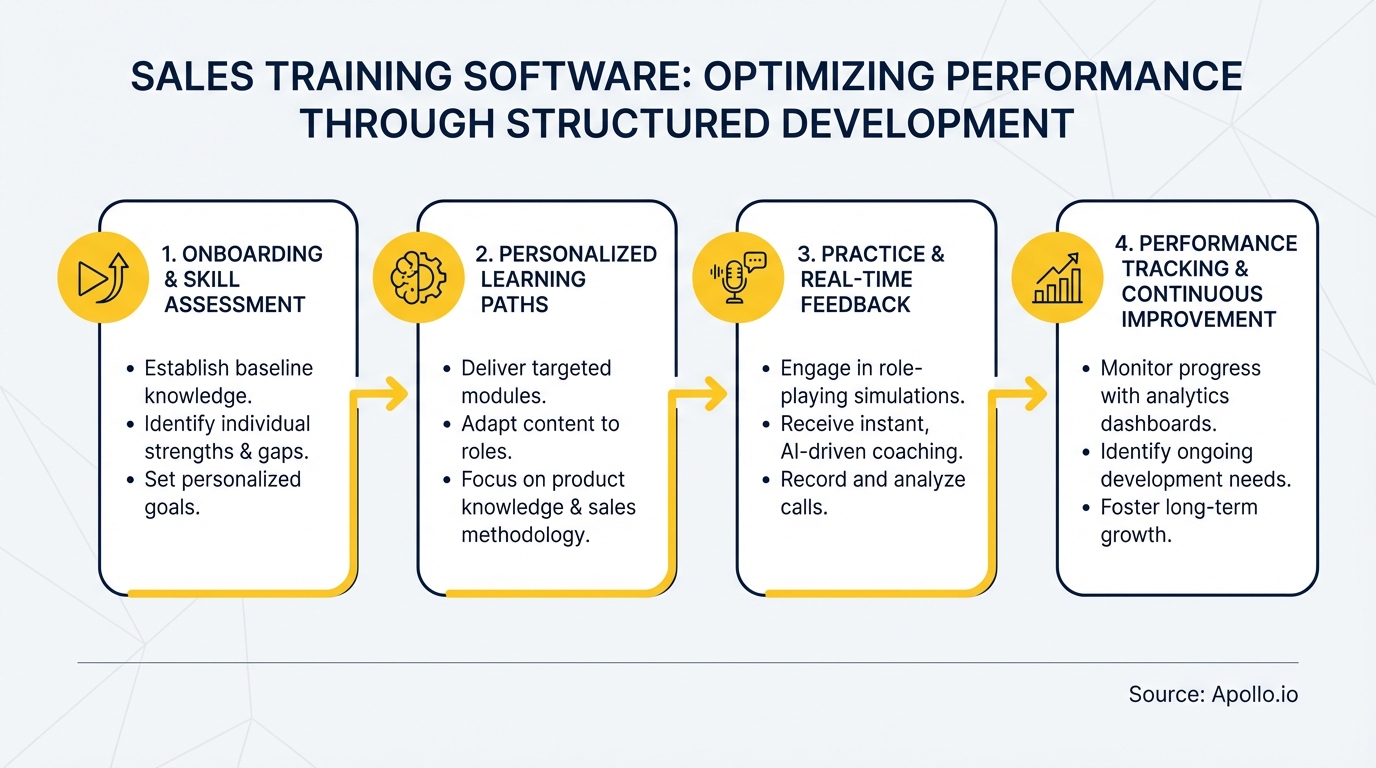
Sales training software is a digital platform that delivers, tracks, and optimizes learning programs for sales teams. Modern solutions use AI to personalize content, simulate buyer conversations, and provide real-time coaching feedback.
Unlike static LMS platforms, AI-powered training software adapts to each rep's performance data, creating custom learning paths that address specific skill gaps.
The best platforms integrate with CRM systems to connect training activities with actual sales outcomes. They track which training modules correlate with higher win rates, shorter sales cycles, and improved quota attainment.
For Sales Leaders managing distributed teams, this creates a single source of truth for skill development and performance improvement.
Research by Gartner shows that 60% of B2B sales organizations are transitioning to data-driven selling approaches. Sales training software bridges the gap between traditional experience-based learning and modern analytics-driven skill development.
Why Do Sales Teams Need AI-Powered Training in 2026?
The shift to virtual selling exposed a critical gap: Gartner research found that only 23% of B2B sales reps feel equally effective selling virtually as in person. Traditional training methods can't scale personalized coaching across remote teams. AI-powered platforms solve this by delivering consistent, adaptive training that works for in-office and distributed sellers.
Buyer behavior has fundamentally changed. Data from Gartner indicates that 61% of B2B buyers prefer a rep-free buying experience. Sales teams must adapt by mastering digital engagement, value-based messaging, and cross-channel consistency. AI training platforms teach these skills through simulated practice environments that mirror real buyer interactions.
The ROI case is clear. According to Gartner, 61% of companies piloting or deploying AI technologies in sales report significant value delivered. Sales training software with AI capabilities reduces ramp time by 35%, increases quota attainment by 28%, and cuts training costs by consolidating multiple tools into one platform.
How Do SDRs and BDRs Use Sales Training Software?
SDRs and BDRs use sales training software to practice prospecting conversations, refine messaging, and master multi-channel outreach. The platform delivers bite-sized modules on social selling techniques, email personalization, and objection handling. AI-powered role-play simulations let reps practice cold calls and discovery conversations without risking real prospects.
Modern training platforms integrate with prospecting tools to reinforce learning in real workflows. When an SDR completes a module on value proposition messaging, the platform surfaces that content during actual outreach sequences.
This contextual learning increases retention by 67% compared to standalone training sessions.
Struggling to generate qualified pipeline? Search Apollo's 224M+ contacts with 65+ filters to find ideal prospects while your training software teaches you how to engage them effectively.
What Features Should Sales Leaders Look for in Training Software?
Sales Leaders need platforms with adaptive learning engines that create personalized training paths based on individual performance data. Look for AI-powered content recommendations that identify skill gaps by analyzing call recordings, email metrics, and deal progression.
The system should automatically assign relevant training modules when it detects specific coaching opportunities.
Key features for 2026 include:
- AI Role-Play Simulations: Practice environments that mimic buyer personas and objection patterns
- Real-Time Coaching Nudges: In-the-moment guidance during live calls and meetings
- Performance Dashboards: Track training completion, skill acquisition, and pipeline impact
- CRM Integration: Connect training activities with actual sales outcomes and revenue metrics
- Mobile Learning: Bite-sized modules accessible on any device for distributed teams
- Peer Benchmarking: Compare individual and team performance against top performers
The best platforms consolidate training, coaching, and analytics into one workspace. As one RevOps leader shared, "We reduced the complexity of three tools into one" (Predictable Revenue).
This tech stack consolidation typically saves $8,000-$15,000 per rep annually while improving training consistency.
Apollo Turns Forecasting Chaos Into Revenue Clarity
Pipeline forecasting a guessing game? Apollo delivers real-time deal visibility and intent signals so you stop missing quota. Built-In boosted win rates 10% with Apollo's scoring.
Start Free with Apollo →How Does AI-Powered Training Improve Virtual Selling Effectiveness?
AI-powered training platforms improve virtual selling by creating realistic practice environments that simulate video calls, screen sharing, and digital objection handling. The AI analyzes tone, pacing, word choice, and engagement patterns, providing specific feedback that traditional training can't deliver.
Reps practice virtual demos and discovery calls until they achieve mastery, without wasting real buyer opportunities.
The platform tracks behavioral changes over time. When an AE completes virtual selling training, the system monitors their actual video call performance through conversation intelligence integration. It measures talk-to-listen ratios, question quality, and value proposition clarity. If metrics don't improve, the AI assigns additional practice modules targeting specific weaknesses.
For Account Executives managing complex enterprise deals, AI training software provides scenario-based learning for multi-stakeholder conversations. The platform simulates executive briefings, technical deep dives, and procurement negotiations. This prepares AEs for the unique challenges of enterprise selling in virtual environments.
What ROI Can Sales Teams Expect from Training Software?
Sales teams using AI-powered training software report measurable improvements across key metrics. Average results include 35% faster ramp time for new hires, 28% increase in quota attainment, and 46% more meetings booked by trained SDRs.
The most significant ROI comes from tool consolidation—replacing separate LMS, coaching, and analytics platforms with one unified system.
Cost savings break down as follows:

| Cost Category | Traditional Approach | Unified Training Platform | Annual Savings (per 50 reps) |
|---|---|---|---|
| LMS Software | $45,000 | Included | $45,000 |
| Coaching Platform | $60,000 | Included | $60,000 |
| Analytics Tools | $35,000 | Included | $35,000 |
| Content Creation | $80,000 | $30,000 (AI-assisted) | $50,000 |
| Total Annual Savings | $220,000 | $30,000 | $190,000 |
Beyond cost savings, the revenue impact is substantial. A 28% increase in quota attainment for a 50-person team with $500K annual quotas generates $7M in additional revenue.
As one customer reported, "We cut our costs in half" (Census) while simultaneously improving training outcomes and accelerating revenue growth.
How Should RevOps Teams Implement Sales Training Software?
RevOps teams should start by auditing current training effectiveness and identifying skill gaps through performance data analysis. Map existing training content to specific sales competencies, then prioritize modules that address the largest gaps.
Create a phased rollout plan that introduces AI-powered features gradually, starting with role-play simulations before adding real-time coaching nudges.
Implementation checklist for RevOps leaders:
- Data Integration: Connect training platform to CRM, conversation intelligence, and email systems
- Content Migration: Upload existing playbooks, battle cards, and training videos
- AI Calibration: Configure adaptive learning algorithms based on your sales methodology
- Pilot Program: Test with 10-15 reps across different skill levels and roles
- Feedback Loop: Gather input on content relevance, AI accuracy, and user experience
- Full Rollout: Deploy to entire team with ongoing optimization based on usage data
- ROI Tracking: Measure ramp time, quota attainment, and cost savings monthly
The most successful implementations consolidate training software with existing sales tech stack components. Look for platforms that integrate natively with your CRM, dialer, and engagement tools. As one customer shared, "Having everything in one system was a game changer" (Cyera).
Spending too much time coordinating training sessions? Automate scheduling with Apollo's meeting coordination so your team spends more time learning and less time on logistics.
Start Building a Smarter Sales Team Today
Sales training software has evolved from static LMS platforms to AI-powered adaptive learning systems that deliver measurable ROI. The best solutions consolidate multiple tools, personalize learning paths, and connect training activities directly to revenue outcomes.
In 2026, the most successful sales organizations use data-driven training platforms that teach virtual selling skills, automate coaching feedback, and prove value through performance dashboards.
For Sales Leaders and RevOps teams, the choice is clear: continue managing disconnected training tools with unclear ROI, or consolidate into an AI-powered platform that reduces costs while improving outcomes. The companies winning in 2026 have embraced adaptive learning technology that scales personalized coaching across distributed teams.
Ready to transform your sales training approach? Apollo combines AI-powered automation, conversation intelligence, and deal management in one unified platform. Our customers report 46% more meetings and 35% faster deal cycles. Start free with Apollo and see how consolidating your tech stack accelerates revenue growth.
Prove Apollo's ROI In Your First 30 Days
Budget approval stuck on unclear metrics? Apollo tracks every touchpoint from prospect to close—quantifying time saved, pipeline impact, and win rate improvements. Built-In increased ACV 10% win rates 10% with Apollo's scoring.
Start Free with Apollo →Don't miss these
Sales
Inbound vs Outbound Marketing: Which Strategy Wins?
Sales
What Is a Sales Funnel? The Non-Linear Revenue Framework for 2026
Sales
What Is a Go-to-Market Strategy? The 2026 GTM Playbook
See Apollo in action
We'd love to show how Apollo can help you sell better.
By submitting this form, you will receive information, tips, and promotions from Apollo. To learn more, see our Privacy Statement.
4.7/5 based on 9,690 reviews
