
What Is a Sales Trainer and How Do They Drive Revenue in 2026?
Modern buyers have fundamentally changed how they engage with sellers. With 61% preferring to avoid sales reps entirely during their buying journey, the role of a sales trainer has shifted from teaching basic product pitches to building omnichannel selling systems that align with buyer behavior.
A sales trainer in 2026 equips teams to deliver value across every channel while maintaining message consistency and measuring tangible revenue impact.
The stakes are high: irrelevant outreach now actively damages your pipeline, and training budgets are climbing as organizations recognize that well-trained teams directly influence revenue outcomes. According to The Sales Collective, for every dollar invested in sales training, companies are seeing an average return of $4.53, equating to an impressive 353% ROI.

Skip The Research - Apollo Finds Contacts Instantly
Tired of spending 4+ hours daily hunting for contact info? Apollo delivers 224M verified contacts with 96% email accuracy. Join 550K+ companies who turned research time into selling time.
Start Free with Apollo →Key Takeaways
- Sales trainers build revenue-focused programs that address buyer behavior shifts, including the 61% who prefer rep-free experiences and the 73% who actively avoid irrelevant outreach
- Effective training delivers measurable ROI: organizations see $4.53 return for every training dollar invested, while coached reps meet 17% more quota
- Modern sales training operates across three channels (in-person, remote, digital self-serve) to match McKinsey's "rule of thirds" buyer preference distribution
- Sales enablement adoption has grown 343% over five years, with 90% of organizations now running dedicated programs
- Training budgets rose 12.9% year-over-year, reaching $874 per learner in 2025, signaling executive commitment to skill development
What Is a Sales Trainer?
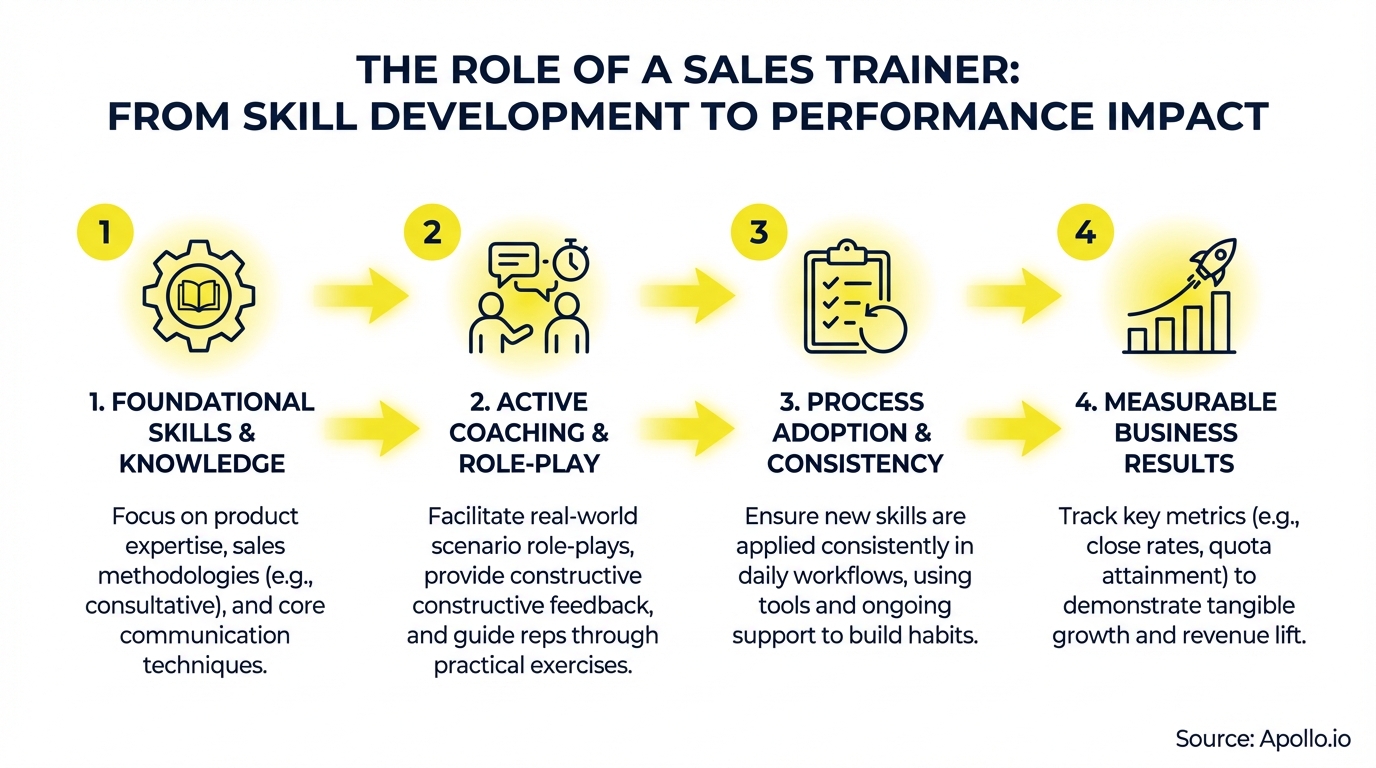
A sales trainer is a revenue enablement specialist who designs, delivers, and measures training programs that improve sales team performance across the entire buyer journey. Unlike traditional trainers who focus on product knowledge and pitch delivery, modern sales trainers architect omnichannel selling systems that address how buyers actually research, evaluate, and purchase.
Sales trainers operate at the intersection of revenue operations, content strategy, and skill development. They build frameworks that ensure message consistency across channels, eliminate buyer friction points, and tie training activities directly to pipeline metrics.
Core Responsibilities in 2026
| Responsibility | Impact Area | Key Deliverables |
|---|---|---|
| Omnichannel Curriculum Design | Buyer experience consistency | Channel-specific playbooks, self-serve resources, remote engagement scripts |
| Message Governance | Brand credibility | Content libraries, approval workflows, consistency scorecards |
| Performance Measurement | Revenue accountability | Training ROI dashboards, quota attainment tracking, skill gap analysis |
| Technology Integration | Workflow efficiency | CRM training modules, sales intelligence tool adoption, automation playbooks |
"Apollo could be a third of the cost if you look at the full price of what we were spending on ZoomInfo, Outreach, Salesforce, and admins to make it all work."
Why Sales Training ROI Matters More Than Ever
The business case for structured sales training has never been stronger. Research from Ner Digital shows that sales representatives who receive regular coaching meet 17% more of their quota compared to those who do not. With the global sales training market reaching $10.32 billion in 2024 and projected to grow to nearly $19 billion by 2032 according to Hyperbound, organizations are treating training as strategic investment rather than discretionary spend.
This ROI compounds when training addresses specific buyer behavior challenges. When 73% of B2B buyers actively avoid suppliers sending irrelevant outreach, training programs that emphasize research, personalization, and value delivery directly protect pipeline health.
Similarly, addressing the 69% of buyers who report messaging inconsistencies between websites and seller conversations prevents deal erosion at critical decision points.
ROI Calculation Framework
Effective sales trainers quantify impact using these metrics:
- Quota Attainment Lift: Compare pre-training vs. post-training quota achievement rates by cohort
- Time to Productivity: Measure days from hire to first closed deal
- Win Rate Improvement: Track close rates before and after specific training interventions
- Average Deal Size: Monitor whether training on high-ticket sales increases contract values
- Pipeline Velocity: Calculate whether trained reps move deals through stages faster
Struggling to equip your team with accurate prospect data? Apollo enriches your CRM with 224M+ verified contacts and 30M+ companies automatically, giving reps the intelligence they need to execute trained strategies.
The Omnichannel Training Imperative
McKinsey's 2024 B2B Pulse study revealed the "rule of thirds" in buyer channel preferences: at every buying stage, roughly one-third prefer in-person interactions, one-third choose remote engagement, and one-third opt for digital self-serve. Sales trainers must build competencies across all three modes because buyers switch between them fluidly throughout their journey.
Channel-Specific Training Modules
| Channel | Training Focus | Success Metrics |
|---|---|---|
| In-Person | Executive presence, whiteboarding, stakeholder mapping | Meeting-to-next-step conversion, executive sponsor engagement |
| Remote | Video selling, screen sharing, virtual demo delivery | Webinar attendance rates, remote close rates |
| Digital Self-Serve | Content creation, resource libraries, buyer enablement | Content download rates, self-serve trial conversions |
Training must also address channel transitions. When a buyer moves from self-serve research to requesting a sales conversation, reps need skills to acknowledge the buyer's existing knowledge, avoid redundant discovery, and advance the conversation appropriately.
This prevents the messaging inconsistency that damages 69% of buying experiences.
Turn Forecast Chaos Into Revenue Certainty
Pipeline forecasting a guessing game? Apollo's real-time deal intelligence gives you accurate visibility across every stage. Built-In increased win rates 10% with Apollo's signals and scoring.
Start Free with Apollo →Governance and Message Consistency
With buyers reporting widespread inconsistencies between marketing materials and seller conversations, sales trainers now own content governance frameworks. This includes:
- Single source of truth: Centralized content libraries with version control
- Approval workflows: Review processes for custom decks and proposals
- Consistency audits: Regular scorecards comparing website claims to seller messaging
- Feedback loops: Mechanisms for reps to flag outdated or inaccurate materials
Effective governance reduces buyer confusion, strengthens brand credibility, and prevents the self-inflicted damage that occurs when different team members communicate conflicting information about capabilities, pricing, or timelines.
"The thing that made me most excited as somebody who's been in sales development a long time was Apollo's integration between sales data and sales engagement and the magic that you can make happen when those two are together on the same platform."
Technology Integration and Tool Consolidation
Modern sales trainers teach teams to leverage unified platforms rather than managing fragmented tool stacks. When reps switch between separate systems for prospecting, engagement, and pipeline management, training complexity multiplies and adoption suffers.
Effective technology training focuses on workflow integration. Rather than teaching tools in isolation, trainers demonstrate how data flows from prospecting through closed deals. This includes sales automation that eliminates manual tasks, allowing reps to focus on high-value selling activities.
Need to simplify your team's tech stack? Apollo combines prospecting, engagement, and pipeline management in one workspace, reducing training burden and accelerating time to productivity.

Measuring Training Effectiveness
Sales trainers in high-performing organizations track leading and lagging indicators:
| Metric Type | Examples | Collection Method |
|---|---|---|
| Leading Indicators | Training completion rates, certification pass rates, skill assessment scores | LMS analytics, knowledge checks, role-play evaluations |
| Lagging Indicators | Quota attainment, win rates, average deal size, sales cycle length | CRM data, pipeline reports, sales KPI dashboards |
| Behavioral Indicators | Activity levels, tool adoption, content usage | Platform engagement data, call recording analysis |
The most sophisticated trainers establish control groups to isolate training impact from other variables like market conditions or product changes. This rigor builds executive confidence in continued training investment.
Career Stage Customization
Generic training programs fail because sellers at different career stages need different skill development. A 2023 study suggests that tailoring training to a salesperson's career stage (rookie, productivity, or expertise) significantly boosts effectiveness.

Stage-Based Training Focus
- Rookie Stage (0-6 months): Product knowledge, basic discovery, objection handling foundations, CRM proficiency
- Productivity Stage (6-18 months): Advanced questioning, competitive positioning, deal strategy, cross-sell techniques
- Expertise Stage (18+ months): Executive engagement, complex negotiations, enterprise sales methodologies, coaching peers
This segmentation prevents the common trap of boring experienced reps with basic content while overwhelming new hires with advanced concepts they're not ready to apply.
Building a Sales Training Program
Organizations launching or refreshing training programs should follow this implementation sequence:
- Conduct skill gap analysis: Identify performance gaps through CRM data, manager feedback, and win/loss analysis
- Design omnichannel curriculum: Build modules addressing in-person, remote, and digital self-serve competencies
- Establish governance framework: Create content libraries and approval workflows to ensure message consistency
- Implement measurement system: Deploy dashboards tracking both leading and lagging indicators
- Launch pilot cohort: Test with small group, gather feedback, iterate before full rollout
- Scale with reinforcement: Build ongoing coaching cadences and microlearning to prevent skill decay
According to Allego, sales training hours saw a substantial increase of 178% in one year, jumping from 7,534 hours in 2023 to 20,965 hours in 2024, reflecting growing recognition of training's strategic importance.
Conclusion: Sales Training as Revenue Infrastructure
The modern sales trainer role has evolved from teaching product features to architecting revenue systems. With buyers preferring rep-free experiences, punishing irrelevant outreach, and demanding message consistency, training programs must address buyer behavior realities while equipping teams with omnichannel competencies.
Organizations that treat training as strategic infrastructure rather than periodic events see measurable returns: 353% ROI on training spend, 17% quota attainment lifts for coached reps, and faster time to productivity for new hires. The key is connecting training activities to revenue outcomes through rigorous measurement and continuous reinforcement.
As sales enablement adoption grows and training budgets expand, the competitive advantage belongs to organizations that build buyer-driven training systems, maintain message governance, and consolidate their tech stacks to reduce complexity.
Ready to give your team the tools to execute trained strategies? Start free with Apollo and equip your reps with the data, engagement capabilities, and pipeline visibility they need to drive revenue.
Prove Apollo's Value In Your First 30 Days
Budget approval stuck on unclear metrics? Apollo tracks every touchpoint from prospect to closed deal, giving you the pipeline impact data leadership demands. Built-In increased win rates 10% and ACV 10% with Apollo's signals and scoring.
Start Free with Apollo →Don't miss these
Sales
Inbound vs Outbound Marketing: Which Strategy Wins?
Sales
What Is a Sales Funnel? The Non-Linear Revenue Framework for 2026
Sales
What Is a Go-to-Market Strategy? The 2026 GTM Playbook
See Apollo in action
We'd love to show how Apollo can help you sell better.
By submitting this form, you will receive information, tips, and promotions from Apollo. To learn more, see our Privacy Statement.
4.7/5 based on 9,690 reviews
