
How Sales Tracking Systems Drive Revenue in 2026
Sales tracking systems have evolved from simple spreadsheets to AI-powered platforms that orchestrate every stage of the revenue cycle. In 2026, the most effective systems balance automation with human connection, a shift driven by buyer preferences and digital-first selling. Modern lead tracking systems consolidate prospecting, engagement, and analytics into one workspace, eliminating the costly patchwork of disconnected tools.

Apollo Finds Quality Leads 3x Faster
Tired of slow lead generation killing your pipeline? Apollo delivers pre-qualified prospects with 96% email accuracy—no manual research required. Join 550K+ companies scaling outreach effortlessly.
Start Free with Apollo →Key Takeaways
- By 2030, 75% of B2B buyers will prefer human interaction over AI-only sales experiences
- Modern sales tracking systems combine AI automation with human touchpoints to meet buyer expectations
- Consolidating your tech stack with an all-in-one platform cuts costs in half and reduces tool complexity
- SDRs and AEs using unified tracking systems report 35-46% increases in meetings and bookings
- Digital-first tracking enables 80% of B2B sales interactions while maintaining personalized engagement
What Is a Sales Tracking System?
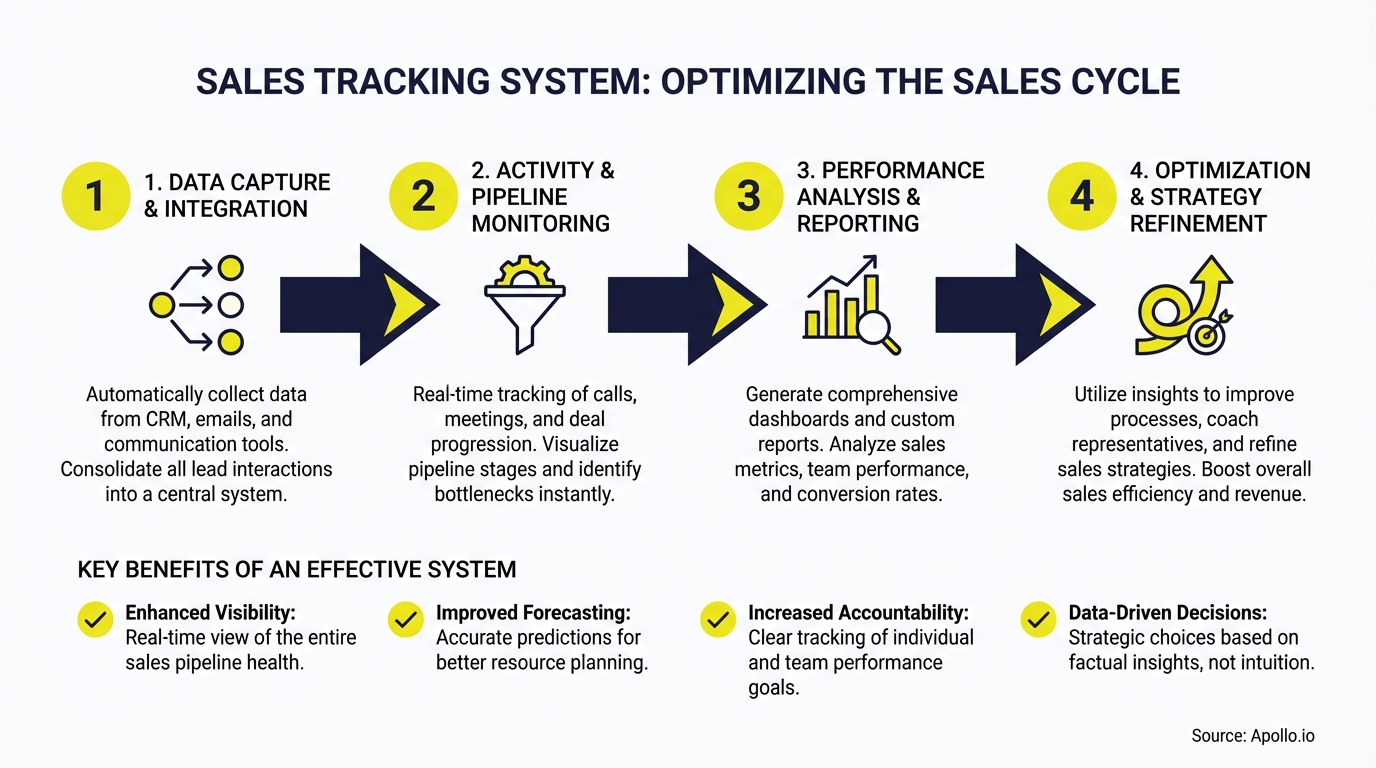
A sales tracking system is a platform that monitors and manages every interaction, activity, and outcome across your sales pipeline. It captures data from prospecting to close, providing visibility into what's working and where deals stall.
Modern systems integrate contact databases, engagement tools, call recording, meeting scheduling, and analytics in one workspace. This eliminates manual data entry and gives SDRs, AEs, and sales leaders real-time pipeline visibility. According to Gartner, the CRM and digital commerce software market is projected to grow at a 16% CAGR through 2027, reaching $21.7 billion as companies invest in unified tracking platforms.
The core components include:
- Contact and account management: Centralized database with enriched firmographic and technographic data
- Activity tracking: Logs emails, calls, meetings, and social touches automatically
- Pipeline visualization: Real-time dashboards showing deal stages, velocity, and forecast accuracy
- Engagement automation: Multi-channel sequences triggered by buyer behavior
- Performance analytics: Rep-level metrics, conversion rates, and revenue attribution
Why Do Sales Teams Use Tracking Systems in 2026?
Sales teams use tracking systems to eliminate guesswork, reduce manual tasks, and focus on high-value selling activities. The primary drivers are tool consolidation, AI-powered efficiency, and adapting to digital-first buyer behavior.
Research by Gartner shows that by 2025, 80% of B2B sales interactions occur in digital channels. Tracking systems enable this shift by capturing digital engagement signals and automating follow-up at scale. For SDRs, this means spending less time on research and more time on conversations. For AEs, it means pre-meeting intelligence that shortens sales cycles.
Key benefits include:

- Cost reduction: Consolidate 3-5 tools into one platform (Census cut costs in half)
- Faster ramp time: New reps hit quota 40% faster with unified systems
- Better forecasting: RevOps teams gain single source of truth for pipeline accuracy
- Coaching at scale: Sales leaders identify skill gaps and replicate winning behaviors
Struggling to track deals across multiple tools? Get complete pipeline visibility with Apollo's unified deal management platform.
How Do Sales Tracking Systems Balance AI and Human Selling?
The most effective sales tracking systems in 2026 use AI for efficiency while preserving human connection at critical moments. According to Gartner, by 2030, 75% of B2B buyers will prefer sales experiences that prioritize human interaction over AI.

Smart systems automate research, data entry, and follow-up scheduling, then surface insights that enable reps to personalize conversations. For example, AI sales tools can analyze call transcripts to identify buyer objections, but the AE delivers the customized response.
The balanced framework includes:
- AI-powered research: Automated contact discovery, enrichment, and intent signals (46% more meetings with AI research agents)
- Human-crafted messaging: Reps use AI-generated templates but personalize based on account context
- Automated workflows: Trigger sequences based on buyer actions, with manual override for high-value accounts
- Conversation intelligence: AI call summaries and coaching recommendations, with human review and decision-making
For SDRs managing 100+ accounts, this balance means spending 70% of time on conversations instead of administrative tasks. For sales leaders, it means coaching based on data, not guesswork.
See Every Deal In Real Time With Apollo
Pipeline forecasting a guessing game? Apollo gives you live visibility into every deal stage so you can forecast with confidence. Built-In increased win rates 10% with Apollo's real-time insights.
Start Free with Apollo →What Features Should Account Executives Look for in a Tracking System?
Account Executives need tracking systems that provide pre-meeting intelligence, streamline deal management, and shorten sales cycles. The most critical features for AEs in 2026 include unified contact timelines, automated meeting scheduling, and real-time deal collaboration.
AEs closing enterprise sales require multi-threading capabilities to track stakeholder engagement across buying committees. Systems should show which contacts have been engaged, what content they've consumed, and when to follow up.
| Feature | AE Benefit | Impact on Sales Cycle |
|---|---|---|
| Contact timeline view | See all touchpoints across buying committee | 30% faster stakeholder mapping |
| Meeting scheduling automation | Eliminate calendar coordination back-and-forth | 3x more meetings booked per week |
| AI call summaries | Automated notes and next steps after every call | Save 5 hours weekly on admin work |
| Pipeline collaboration | Share deal context with RevOps and leadership | 25% improvement in forecast accuracy |
| CRM integration | Auto-sync activity without manual data entry | Eliminate 8-10 hours weekly on logging |
Tired of taking notes during calls? Let Apollo's AI handle call summaries and automatically log next steps in your CRM.
How Do RevOps Teams Evaluate Sales Tracking Systems?
RevOps teams evaluate sales tracking systems based on data quality, integration capabilities, and reporting flexibility. The key criteria include single source of truth for pipeline data, minimal manual maintenance, and cross-functional visibility for marketing, sales, and customer success.
RevOps leaders prioritize systems that reduce tool sprawl. As Predictable Revenue noted, "We reduced the complexity of three tools into one" when consolidating their sales tech stack. This consolidation eliminates data sync issues, reduces integration maintenance, and lowers total cost of ownership.
The evaluation framework includes:
- Data accuracy: 96%+ email accuracy with real-time verification
- Native integrations: Bi-directional sync with Salesforce, HubSpot, and other core systems
- Custom reporting: Build dashboards for pipeline velocity, conversion rates, and rep performance
- User adoption: Intuitive interface that reps actually use (not bypass with spreadsheets)
- Security and compliance: SOC 2, GDPR controls, and role-based access
What ROI Should Sales Leaders Expect From Tracking Systems?
Sales leaders should expect 2-3x ROI within the first year from modern sales tracking systems, driven by increased rep productivity, higher win rates, and reduced tool costs. Quantifiable outcomes include 35-46% increases in meetings and bookings, 50% cost reduction from tool consolidation, and 30-40% faster onboarding for new reps.
The ROI calculation includes direct cost savings (eliminating 3-5 tools) and revenue impact (more deals closed, shorter sales cycles). Census reported cutting costs in half, while Cyera noted that "having everything in one system was a game changer" for scaling their B2B sales organization.
Expected metrics by role:
- SDRs/BDRs: 40-50% more qualified meetings booked per month
- AEs: 25-35% shorter sales cycles with better pre-meeting intelligence
- Sales leaders: 20-30% improvement in forecast accuracy with real-time pipeline data
- RevOps: 60-70% reduction in time spent on data cleanup and reporting
- Founders/CEOs: 50% lower sales tool costs, 2x faster team ramp time
For companies with 10-50 reps, the payback period is typically 3-6 months when accounting for productivity gains and tool consolidation.
Start Tracking Deals That Actually Close
The best sales tracking systems in 2026 combine AI-powered efficiency with human-centered selling, meeting buyers where they are in digital-first journeys. As buyer preferences shift toward personalized experiences and vendors compete for fewer evaluation slots, unified platforms that consolidate tools and surface actionable insights become competitive advantages.
For SDRs, tracking systems eliminate research busywork and maximize conversation time. For AEs, they provide the pre-meeting intelligence that shortens sales cycles.
For RevOps teams and sales leaders, they deliver the single source of truth needed for accurate forecasting and data-driven coaching.
The companies winning in 2026 are those that cut tech stack complexity, empower reps with AI-assisted workflows, and maintain the human connection that buyers increasingly demand. Ready to consolidate your sales tools and start closing more deals? Start prospecting for free with Apollo's all-in-one sales tracking platform.
Prove Apollo's ROI In Your First 30 Days
Budget approval stuck on unclear metrics? Apollo tracks every dollar spent to pipeline generated—quantify time savings and deal velocity from day one. Built-In increased win rates 10% and ACV 10% with measurable Apollo impact.
Start Free with Apollo →Don't miss these
Sales
Inbound vs Outbound Marketing: Which Strategy Wins?
Sales
What Is a Sales Funnel? The Non-Linear Revenue Framework for 2026
Sales
What Is a Go-to-Market Strategy? The 2026 GTM Playbook
See Apollo in action
We'd love to show how Apollo can help you sell better.
By submitting this form, you will receive information, tips, and promotions from Apollo. To learn more, see our Privacy Statement.
4.7/5 based on 9,690 reviews
