What Sales Tools Do High-Performing Teams Actually Use in 2026?
Sales tools are no longer optional. They're the infrastructure behind every team hitting quota. According to Sopro, businesses that use a CRM are 86% more likely to exceed their sales goals than those that do not. The right stack turns prospecting, outreach, and deal management from manual guesswork into repeatable revenue generation.
This guide breaks down the core categories of sales tools, how to build a stack that scales, and why consolidation beats complexity in 2026.

Find Verified Contacts In Seconds With Apollo
Tired of spending 4+ hours daily hunting for contact info? Apollo delivers 224M contacts with 96% email accuracy. Join 550K+ companies who eliminated manual research.
Start Free with Apollo →Key Takeaways
- Sales tools automate prospecting, engagement, and deal execution across the entire revenue cycle
- The best stacks consolidate multiple capabilities into unified platforms rather than juggling point solutions
- CRM adoption continues to grow: WPForms reports 91% of all companies with more than 10 employees use some type of CRM system
- AI-powered automation is now mainstream: Ner Digital shows 70% of B2B companies adopt AI in their sales strategy
- Tool consolidation reduces costs, improves data quality, and accelerates rep productivity
What Are Sales Tools?
Sales tools are software platforms that automate, enable, and scale sales execution from prospecting through close. They eliminate manual work, surface high-value opportunities, and drive predictable pipeline growth.
The best sales tools deliver three core outcomes: they automate repetitive tasks (data entry, follow-ups, research), they surface actionable insights (who to call, when to engage, what messaging works), and they integrate seamlessly with existing workflows (CRM, email, calendar).
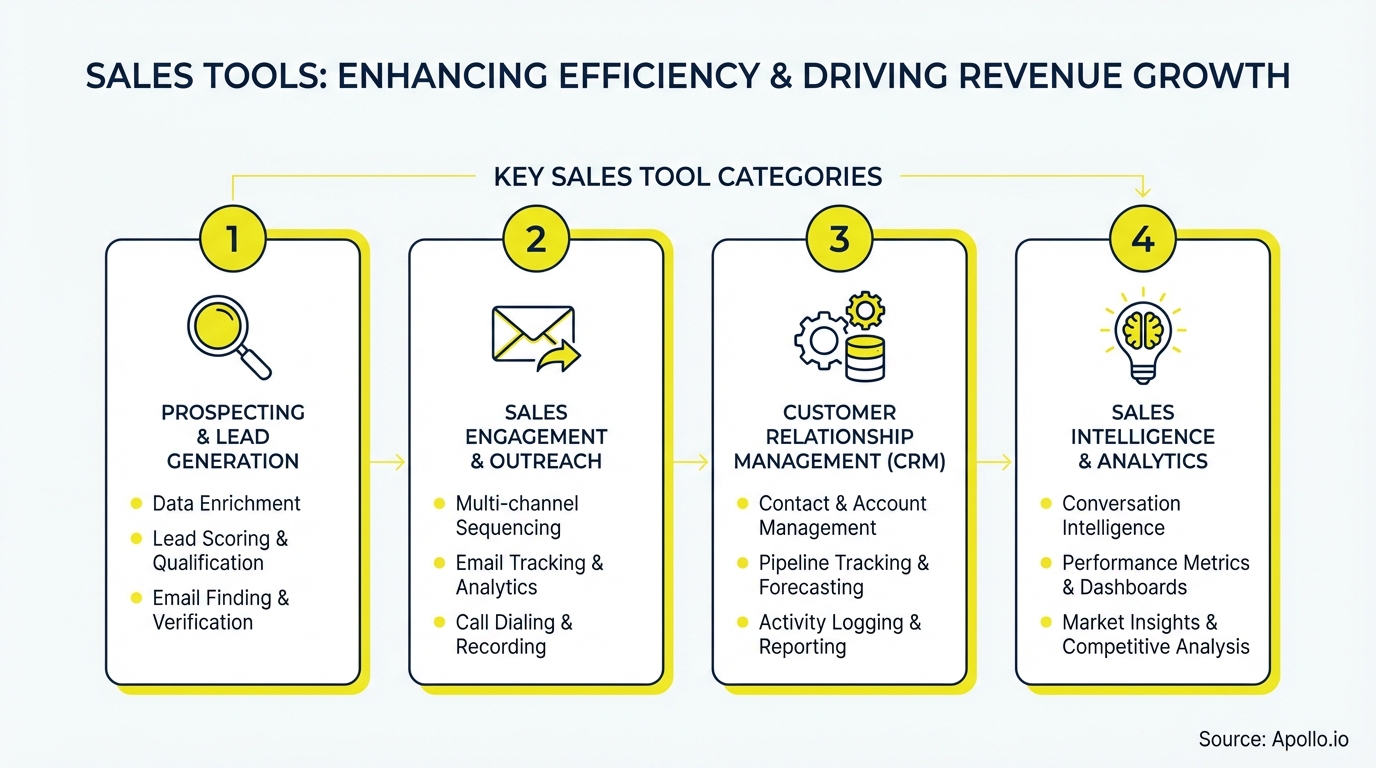
Modern sales tools fall into distinct categories based on where they operate in the revenue cycle. Understanding these categories helps teams build stacks that cover the full funnel without redundant capabilities.
Turn Forecast Guesswork Into Revenue Certainty
Pipeline forecasting a guessing game? Apollo's real-time deal tracking and lead scoring give you accurate visibility across every stage. Built-In boosted win rates 10% with Apollo's signals.
Start Free with Apollo →Core Categories of Sales Tools
| Category | Primary Function | Key Capabilities |
|---|---|---|
| CRM Systems | Manage relationships and pipeline | Contact management, deal tracking, forecasting, reporting |
| Sales Intelligence | Find and research prospects | B2B contact databases, firmographics, technographics, intent signals |
| Sales Engagement | Automate multi-channel outreach | Email sequences, call dialing, social touches, A/B testing |
| Conversation Intelligence | Analyze calls and coach reps | Call recording, transcription, deal insights, objection tracking |
| Enablement Platforms | Deliver content and training | Asset libraries, onboarding programs, certification tracking |
| Revenue Operations | Forecast and optimize performance | Pipeline analytics, quota tracking, territory planning |
Each category addresses specific pain points. Sales intelligence tools solve the "who do I call?" problem. Engagement platforms solve "how do I reach them at scale?" Conversation intelligence solves "what's working in our calls?"
"Apollo could be a third of the cost if you look at the full price of what we were spending on ZoomInfo, Outreach, Salesforce, and admins to make it all work."

How to Build a Sales Tech Stack That Actually Gets Used
Start with an audit. Map every tool to a specific funnel stage and user role. Cut tools with low adoption or overlapping capabilities. Most teams discover they're paying for features no one uses.
Define success metrics before buying. Are you optimizing for pipeline volume, conversion rates, deal velocity, or rep productivity?
Your goal determines which tools matter. Pipeline-focused teams prioritize prospecting and enrichment.
Velocity-focused teams prioritize engagement automation and conversation intelligence.
Prioritize native integrations. Tools that don't sync with your CRM create data silos and manual work. Look for bi-directional sync, automatic activity logging, and real-time updates. According to HubSpot, 78% of sales leaders say their CRM effectively improves alignment between sales and marketing teams.
Get rep buy-in early. Shadow your team for a week. Watch where they tab-switch, copy-paste, or manually update records. The tools that eliminate those friction points get adopted. Tools that add clicks get ignored.
Measure ROI by role. Track time saved per activity, conversion lift by stage, and quota attainment by user. Best-in-class teams tie tool usage directly to pipeline metrics and compensation.
Struggling to find qualified leads? Search Apollo's 224M+ contacts with 65+ filters to build targeted lists in minutes, not hours.
Why Unified Platforms Beat Point Solutions
The average sales tech stack includes multiple vendors for prospecting, engagement, enrichment, and analytics. This fragmentation creates three major problems: data decay (contacts update in one system but not others), workflow friction (reps toggle between 6+ tabs per task), and cost creep (multiple subscriptions with overlapping features).
Unified platforms consolidate these capabilities into a single workspace. Teams get accurate data, streamlined workflows, and predictable costs.
The trade-off: you lose best-of-breed depth in some categories. The payoff: reps actually use the tools because they're fast and integrated.
"We reduced the complexity of three tools into one. We're getting higher reply rates, open rates are doubled, meetings are up, and speed to booking a meeting is cut in half."
Modern go-to-market platforms combine AI-powered prospecting, multi-channel engagement, and pipeline management in one interface. This architecture reduces onboarding time, improves data accuracy, and cuts total cost of ownership.
AI and Automation: What Changed in 2026
AI moved from experimental feature to core requirement. iCumulus reports that 74% of sales professionals who use AI think AI/automation tools will make a significant impact on how they do their jobs in 2025.
The shift is from "copilot" tools that suggest next actions to "agent" tools that execute tasks autonomously. CRMs now deploy specialized agents for prospecting, lead scoring, and pipeline forecasting.
Sales engagement platforms use AI to personalize messaging, optimize send times, and prioritize accounts based on buying signals.
The winners in this wave provide guardrails, not just generation. Teams need AI that cites sources, respects brand voice, and flags low-confidence outputs.
Tools without governance controls create compliance risk and brand damage.
Key AI capabilities to evaluate: workflow automation that triggers sequences based on buyer behavior, generative personalization that adapts messaging to prospect context, and predictive scoring that surfaces accounts most likely to convert.
How Apollo Consolidates Your Sales Tool Stack
Apollo combines sales intelligence, engagement automation, and pipeline management in one platform. Teams replace 3-5 separate tools with a unified workspace that covers prospecting through close.
Prospecting and enrichment: Access 224M verified B2B contacts with firmographics, technographics, and intent signals. Filter by 65+ criteria including job title, company size, tech stack, and buying signals.
Multi-channel engagement: Build sequences that combine email, phone, and social touches. A/B test messaging, automate follow-ups, and track reply rates across channels.
AI-powered personalization: Generate contextual outreach using AI that references prospect activity, company news, and mutual connections. Maintain brand voice while scaling personalization.
Native CRM integration: Bi-directional sync with Salesforce, HubSpot, and other CRMs. Automatically log activities, update records, and trigger workflows based on engagement data.
Pipeline visibility: Track deal progress, forecast revenue, and identify at-risk opportunities. Surface next-best-actions for every account based on engagement history and buying signals.
Spending hours on manual outreach? Automate your sequences with Apollo and turn repetitive tasks into repeatable revenue.
Evaluating Sales Tools: The 2026 Buyer's Checklist
Data quality and coverage: How fresh is the contact data? What's the email accuracy rate? Does the database cover your target segments (enterprise, mid-market, specific verticals)?
Workflow integration: Does the tool work inside your existing surfaces (CRM, email, browser) or require constant tab-switching? Are integrations native or third-party middleware?
AI governance: Can admins control AI outputs, set approval workflows, and audit generated content? Does the tool cite sources and flag uncertain recommendations?
Adoption metrics: What's the typical time-to-value? Do reps use the tool daily or abandon it after onboarding? Request references from similar team sizes and industries.
Total cost analysis: Factor in seats, AI add-ons, usage-based pricing, implementation costs, and admin overhead. Compare the all-in cost of unified platforms versus best-of-breed point solutions.
For teams evaluating prospecting automation tools, prioritize platforms that combine accurate data with native engagement capabilities to reduce integration complexity.
Common Sales Tool Stack Mistakes to Avoid
Buying for features, not workflows. A tool with 200 features but poor UX gets ignored. Watch how reps actually work, then buy tools that fit their natural flow.
Ignoring data decay. Contact data goes stale fast. If your stack doesn't auto-enrich records or flag outdated information, you're burning budget on bad outreach.
Over-indexing on best-of-breed. The "best" prospecting tool that doesn't sync with your "best" engagement tool creates more problems than it solves. Integration quality matters more than feature depth.
Skipping change management. New tools fail without training, documentation, and executive sponsorship. Build onboarding programs and track adoption metrics from day one.
Not measuring tool ROI. Track metrics by tool: time saved per rep, conversion lift by stage, pipeline influenced. Cut tools that don't move core KPIs within 90 days.
Sales Tools Drive Predictable Revenue Growth
The right sales tools eliminate manual work, surface high-value opportunities, and scale what's working across your team. In 2026, the winners consolidate capabilities into unified platforms rather than managing fragmented point solutions.
Evaluate tools based on data quality, workflow integration, AI governance, and total cost of ownership. Prioritize platforms that combine prospecting, engagement, and pipeline management in one workspace to reduce complexity and improve rep productivity.
Teams that master their sales tool stack close more deals, hit quota more consistently, and scale revenue without proportional headcount growth. The tools don't replace strategy, but they make great strategy executable at scale.
Ready to consolidate your sales tech stack? Start free with Apollo and turn prospecting, outreach, and pipeline management into one unified workflow.
Prove Apollo's ROI In Your First 30 Days
Budget approval stuck on unclear metrics? Apollo tracks every touchpoint from first contact to closed deal. Built-In increased win rates 10% and ACV 10% with Apollo's signals and guidance.
Start Free with Apollo →Don't miss these
Sales
Inbound vs Outbound Marketing: Which Strategy Wins?
Sales
What Is a Sales Funnel? The Non-Linear Revenue Framework for 2026
Sales
What Is a Go-to-Market Strategy? The 2026 GTM Playbook
See Apollo in action
We'd love to show how Apollo can help you sell better.
By submitting this form, you will receive information, tips, and promotions from Apollo. To learn more, see our Privacy Statement.
4.7/5 based on 9,690 reviews
