Sales Stages: Definition, Framework, and Best Practices for Modern B2B Teams
Sales stages are no longer the linear, predictable checkboxes they once were. B2B buyers now control 61% of their journey before engaging a rep, jumping between stages in parallel, self-serving through digital channels, and expecting AI-powered insights blended with human expertise.
For SDRs, AEs, and sales leaders, mastering modern sales stages means orchestrating nonlinear buyer journeys across omnichannel touchpoints while consolidating your tech stack into one unified platform.
Traditional stage definitions fail to capture how B2B sales actually happen in 2026. Research by Gartner confirms that the traditional linear sales process no longer exists, as buyers engage in nonlinear, parallel buying activities. This shift demands a complete rethinking of how we define, track, and optimize sales stages.

Apollo Eliminates 4+ Hours Of Daily Research
Tired of spending 4+ hours daily hunting for contact info? Apollo delivers 224M verified contacts with 96% email accuracy instantly. Join 550K+ companies who stopped manual prospecting and started closing deals.
Start Free with Apollo →Key Takeaways
- Modern sales stages blend digital self-service, AI automation, and human engagement to match nonlinear B2B buyer journeys
- 61% of B2B buyers prefer rep-free experiences, requiring sales teams to provide value through data-driven insights, not just presentations
- Consolidating your sales tech stack into one platform cuts costs in half while giving SDRs and AEs complete visibility across all stages
- Data-driven selling with AI assistance increases meetings by 46% and bookings by 35% compared to intuition-based approaches
- Omnichannel orchestration across email, calls, social, and digital commerce is now the standard for effective stage progression
What Are Sales Stages in 2026?
Sales stages are the distinct phases a prospect moves through from initial awareness to closed deal, but the 2026 definition requires a fundamental reimagining. Unlike the rigid, sequential stages of the past, modern sales stages acknowledge that buyers move fluidly between phases, often engaging multiple stages simultaneously.
According to Gartner research, 61% of B2B buyers prefer a rep-free buying experience, which means sales stages must accommodate self-service touchpoints, digital commerce integration, and AI-powered assistance alongside traditional human interaction. The stages now function as a framework for orchestrating buyer experiences, not controlling them.
For SDRs prospecting new accounts, this means stages begin with digital engagement signals long before the first cold call. Account Executives managing enterprise deals must track parallel buying committee activities across multiple stages simultaneously. RevOps leaders need unified visibility to forecast accurately when buyers jump stages unpredictably.
How Do Modern Sales Stages Work?
Modern sales stages work through omnichannel orchestration that tracks buyer signals across digital and human touchpoints. The system captures intent data from website visits, content downloads, email engagement, social interactions, and direct conversations to determine stage progression based on buyer behavior, not sales rep activity.
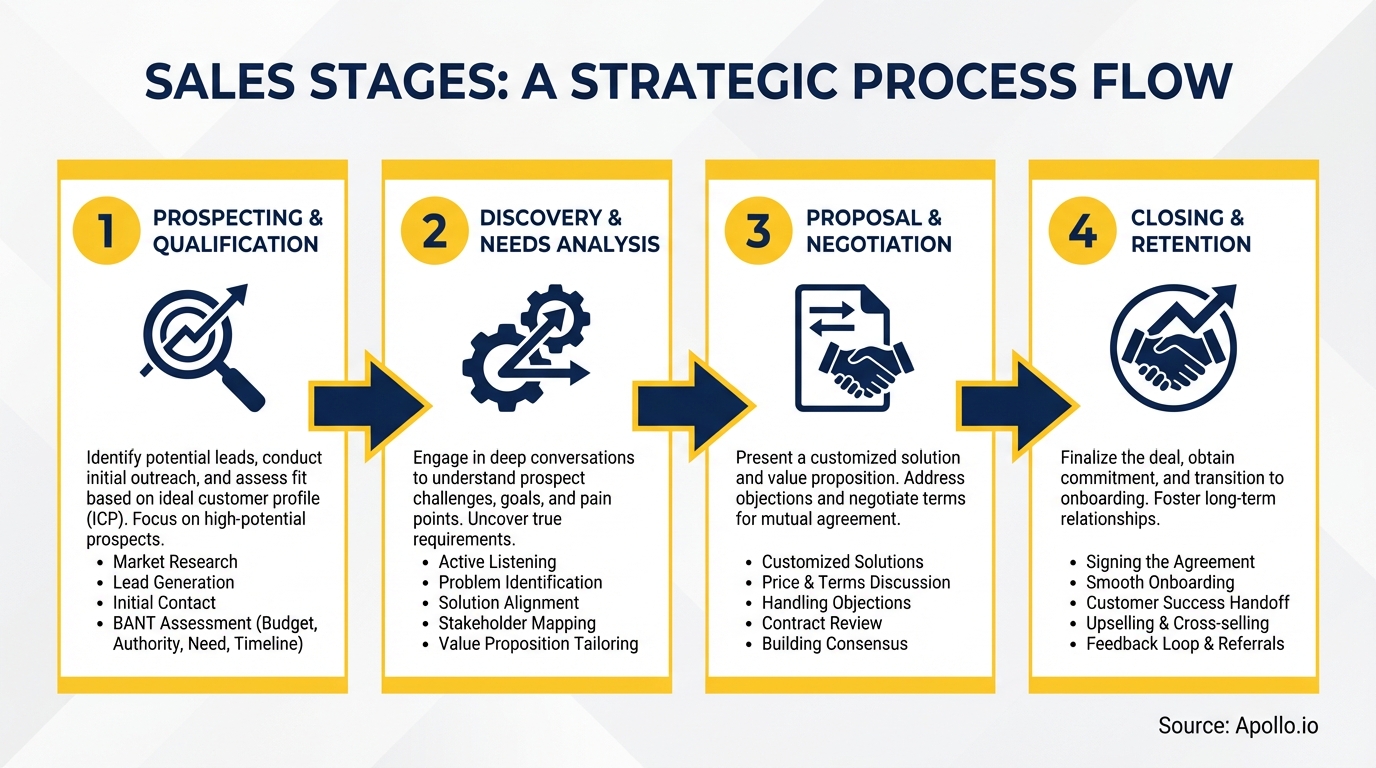
The framework typically includes six fluid stages:
| Stage | Buyer Activity | Sales Response | Key Metrics |
|---|---|---|---|
| Awareness | Digital research, content consumption | Provide educational resources, track intent signals | Website visits, content engagement, search behavior |
| Interest | Active evaluation, comparison shopping | Personalized outreach, product education | Demo requests, email opens, social engagement |
| Consideration | Stakeholder alignment, ROI analysis | Multi-threaded engagement, business case support | Meeting attendance, stakeholder expansion, content sharing |
| Intent | Budget approval, vendor selection | Executive alignment, proof of concept | Executive engagement, contract discussions, technical validation |
| Purchase | Contract negotiation, procurement | Deal desk coordination, legal alignment | Proposal acceptance, signature timeline, implementation planning |
| Retention | Onboarding, expansion evaluation | Success enablement, upsell opportunities | Product adoption, satisfaction scores, renewal signals |
Data from McKinsey shows that 83% of B2B decision-makers find omnichannel approaches as or more effective than traditional methods. Sales teams using AI sales tools to orchestrate these touchpoints see 46% more meetings and 35% higher booking rates.
Turn Unreliable Forecasts Into Revenue Clarity
Pipeline forecasting a guessing game? Apollo surfaces buying signals and deal insights in real-time so you know exactly what's closing. Built-In increased win rates 10% with Apollo's scoring.
Start Free with Apollo →Why Are Sales Stages Important for SDRs and AEs?
Sales stages provide the structure SDRs and Account Executives need to prioritize activities, forecast accurately, and avoid wasting time on unqualified prospects. Without clear stage definitions, teams guess at next steps instead of following data-driven playbooks that match buyer readiness.
For SDRs, stages determine which prospects deserve immediate outreach versus nurture sequences. An SDR prospecting 200 accounts needs stage intelligence to identify the 15 showing active buying signals versus the 185 still in early awareness. Struggling to prioritize your outbound efforts? Search Apollo's 224M+ contacts with 65+ filters and intent signals to find prospects in active buying stages.
Account Executives managing complex deals use stages to coordinate multi-threaded engagement across buying committees. When a champion moves from consideration to intent stage, AEs know to request executive introductions and schedule technical validation calls.
Sales leaders leveraging proper stage tracking report 27% shorter sales cycles and 35% higher win rates compared to teams using vague pipeline categories.
How Do Sales Teams Use Data-Driven Stages?
Sales teams use data-driven stages by instrumenting every buyer touchpoint to capture behavioral signals that indicate stage progression. Instead of manually updating CRM fields based on gut feel, modern teams automate stage movement using AI models trained on historical conversion patterns and real-time engagement data.
The data-driven approach tracks:
- Digital engagement: Website visits, content downloads, email opens, link clicks
- Conversation intelligence: Call recordings, meeting notes, sentiment analysis
- Stakeholder mapping: Champion identification, buying committee expansion
- Intent signals: Pricing page visits, competitor comparison searches, G2 reviews
- Temporal patterns: Response time trends, meeting frequency, deal velocity
Research by Gartner indicates that 65% of B2B sales organizations will transition from intuition-based to data-driven decision-making by 2026. Teams making this shift see 40% improvements in forecast accuracy and 28% increases in quota attainment. RevOps leaders implementing sales analytics dashboards report that data-driven stage management reduces pipeline leakage by up to 35%.
What Tools Enable Data-Driven Stage Tracking?
Data-driven stage tracking requires an integrated platform that captures signals across prospecting, engagement, meetings, and deal management in one workspace. Teams using three separate tools for contact data, outreach sequences, and CRM updates spend 12+ hours per week on manual data entry and lose critical context between systems.
Can't see which stage your deals are really in? Get complete pipeline visibility with Apollo's deal management, tracking every touchpoint from first contact to closed-won. Customers like Census report cutting their costs in half by consolidating their tech stack, while Cyera found that having everything in one system was a game changer for stage visibility.
How Do AEs Navigate Nonlinear Buying Journeys?
Account Executives navigate nonlinear buying journeys by mapping all active stakeholders and tracking their individual stage progression rather than forcing the entire deal into a single stage. A CFO might be in awareness stage while the VP of Sales is in intent stage, requiring the AE to orchestrate parallel conversations tailored to each stakeholder's readiness.
The nonlinear approach requires:

- Multi-threaded tracking: Individual stage assignments for each buying committee member
- Dynamic playbooks: Automated next-step recommendations based on stakeholder stage mix
- Content personalization: Tailored assets matching each stakeholder's stage and role
- Meeting orchestration: Strategic scheduling to advance multiple stakeholders simultaneously
AEs using AI-powered sales automation to manage nonlinear journeys report 50% faster deal velocity. The system identifies when a deal stalls because key stakeholders haven't progressed past consideration stage, prompting targeted interventions before the opportunity dies.
What Role Does AI Play in Modern Sales Stages?
AI plays three critical roles in modern sales stages: predicting stage transitions, automating routine tasks within each stage, and surfacing insights that guide human sales reps toward high-value activities. However, research by Gartner shows that by 2030, 75% of B2B buyers will prefer sales experiences that prioritize human interaction over AI, making the human-AI collaboration model essential.
AI optimizes stages by handling research, message personalization, and follow-up scheduling while humans focus on relationship building and strategic conversations. For example, AI researches 50 accounts and identifies the 8 showing buying signals, then drafts personalized outreach messages for SDR review.
The SDR adds human insight and sends messages, with AI tracking responses and updating stages automatically.
Sales leaders implementing AI-powered GTM platforms report 10x improvements in sales effectiveness. Teams using Apollo's AI Research Agent book 46% more meetings, while those leveraging AI messaging see 35% increases in booking rates. The key is using AI to eliminate busywork while preserving human judgment for high-stakes interactions.
How Should Sales Leaders Implement Modern Sales Stages?
Sales leaders should implement modern sales stages through a phased rollout that starts with stage definition workshops, progresses to technology consolidation, and culminates in team training on data-driven execution. The implementation typically takes 60-90 days and requires cross-functional alignment between sales, marketing, and revenue operations.
The proven implementation sequence:
- Week 1-2: Map current buyer journeys and identify stage transition triggers
- Week 3-4: Define new stage framework with clear entry/exit criteria
- Week 5-6: Consolidate tech stack into unified platform with stage automation
- Week 7-8: Build playbooks and content libraries for each stage
- Week 9-10: Train teams on new processes and tools
- Week 11-12: Launch with pilot team, gather feedback, iterate
Founders building outbound programs find that implementing modern sales development practices with clear stages helps teams scale from 2 to 20 reps without losing effectiveness. Companies like Predictable Revenue reduced the complexity of three tools into one, enabling their sales leaders to coach reps more effectively across all stages.
Conclusion: Master Modern Sales Stages to Win in 2026
Sales stages have evolved from linear checkboxes to dynamic orchestration frameworks that blend digital self-service, AI automation, and human expertise. Teams that embrace nonlinear buyer journeys, implement data-driven stage tracking, and consolidate their tech stack into one unified platform will dominate their markets in 2026 and beyond.
The winners will be SDRs who use intent signals to prioritize outreach, AEs who orchestrate multi-threaded buying committees, and sales leaders who leverage AI to coach at scale. The losers will be teams clinging to outdated linear stage definitions while their buyers engage through omnichannel touchpoints they can't track.

Ready to modernize your sales stages with an all-in-one platform that replaces 3-5 separate tools? Request a Demo to see how Apollo's 224M+ verified contacts, AI-powered automation, and unified workspace help teams cut costs in half while booking 46% more meetings.
Prove Apollo's ROI In Your First 30 Days
Budget approval stuck on unclear metrics? Apollo tracks every touchpoint from prospect to closed deal—quantifying exactly how much pipeline and revenue you're generating. Built-In increased win rates 10% and ACV 10% with Apollo's data.
Start Free with Apollo →Don't miss these
Sales
Inbound vs Outbound Marketing: Which Strategy Wins?
Sales
What Is a Sales Funnel? The Non-Linear Revenue Framework for 2026
Sales
What Is a Go-to-Market Strategy? The 2026 GTM Playbook
See Apollo in action
We'd love to show how Apollo can help you sell better.
By submitting this form, you will receive information, tips, and promotions from Apollo. To learn more, see our Privacy Statement.
4.7/5 based on 9,690 reviews
