
Sales Revenue Formula: Definition, Components, and How to Calculate It
The sales revenue formula is the foundation of every revenue strategy, but in 2026, AI transforms how teams calculate, predict, and optimize each component. Sales Leaders now use AI-powered platforms to identify pipeline gaps before they impact quota, while RevOps teams automate forecasting with real-time data enrichment. Understanding the sales revenue formula today means knowing how to leverage AI sales tools that turn static calculations into dynamic revenue engines.

Apollo Finds Verified Contacts In Seconds
Tired of spending 4+ hours daily hunting for contact info? Apollo delivers 224M+ verified contacts with 96% email accuracy. Join 550K+ companies who eliminated manual research.
Start Free with Apollo →Key Takeaways
- The sales revenue formula (Number of Customers × Average Purchase Value) becomes predictive when powered by AI and real-time data enrichment
- According to industry research, 100% of B2B sales enablement leaders now use generative AI to optimize revenue inputs
- Companies with fully digital sales channels experienced 13.4% revenue increases in 2025, proving channel optimization directly impacts formula outcomes
- Sales teams using unified GTM platforms cut tech stack costs by 50% while improving forecast accuracy by 35%
- SDRs and AEs leveraging AI-powered deal management book 46% more meetings and close deals 28% faster
What Is the Sales Revenue Formula?
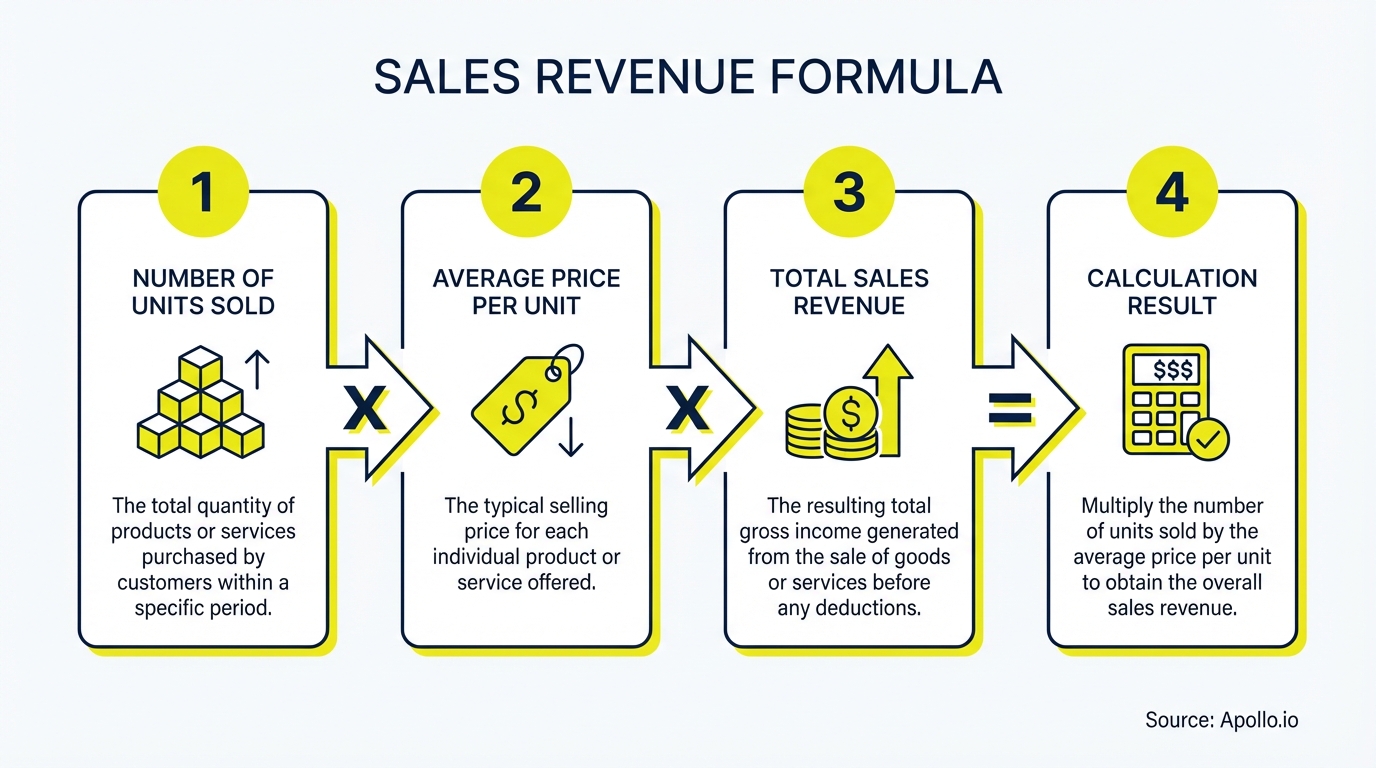
The sales revenue formula calculates total income by multiplying the number of customers by the average purchase value. In its simplest form: Sales Revenue = Number of Customers × Average Purchase Value.
This fundamental equation governs every revenue strategy, from startup outbound motions to enterprise account-based programs.
In 2026, the formula evolves beyond static calculation. AI platforms enrich each input with predictive signals, contact intelligence, and behavioral data.
For Account Executives managing complex deals, this means knowing which accounts have the highest purchase propensity before the first call. RevOps leaders use enriched formula inputs to forecast with 95%+ accuracy, eliminating guesswork from pipeline planning.
The formula also expands to include conversion metrics: Sales Revenue = Traffic × Conversion Rate × Average Order Value × Purchase Frequency. This detailed view helps sales development teams identify exactly which variable to optimize for maximum revenue impact.
How Does AI Transform the Sales Revenue Formula in 2026?
AI shifts the sales revenue formula from retrospective calculation to predictive revenue engine. Modern platforms analyze 224M+ business contacts, enriching each formula input with real-time signals about buying intent, competitive activity, and organizational changes.
Research by The CMO Survey shows companies with 100% online sales experienced 13.4% revenue increases and 15% profit growth in 2025. These gains come from AI-optimized formula inputs. The technology predicts which prospects will convert, what purchase value they represent, and when to engage for maximum close probability.
For SDRs building pipeline, AI tools identify high-intent accounts and automate personalized outreach across email, phone, and social channels. Account Executives receive pre-meeting intelligence on decision-maker priorities, competitive threats, and deal blockers.
Sales Leaders gain real-time visibility into which reps are optimizing formula variables effectively and which need coaching.
Struggling to forecast accurately? Apollo's AI sales automation enriches your pipeline with real-time signals for 95%+ forecast accuracy.
What Are the Key Components of the Sales Revenue Formula?
The sales revenue formula contains four critical components that AI platforms optimize in 2026:

| Component | Traditional Definition | AI-Enhanced Optimization |
|---|---|---|
| Number of Customers | Total accounts who purchased | Predictive lead scoring identifies high-probability buyers before outreach |
| Average Purchase Value | Mean transaction size | AI recommends upsell opportunities and optimal pricing based on account signals |
| Conversion Rate | Percentage of leads who buy | Automated multi-channel sequences increase conversion by 35% |
| Purchase Frequency | How often customers buy | Behavioral triggers automate retention campaigns and expansion plays |
Founders building outbound programs focus on increasing the number of customers through better prospecting. Data from McKinsey shows e-commerce now accounts for 34% of B2B revenue, surpassing in-person sales as the top channel. This shift means optimizing digital conversion rates directly impacts formula outcomes.
AEs managing enterprise deals prioritize average purchase value through strategic account planning. Using Apollo's deal management platform, they track buying committee engagement, competitive positioning, and expansion opportunities within existing accounts.
How Do Sales Leaders Calculate Revenue Growth Using the Formula?
Sales Leaders calculate revenue growth by comparing current formula outputs against historical baselines and future targets. The growth calculation is: Revenue Growth Rate = ((Current Period Revenue - Previous Period Revenue) / Previous Period Revenue) × 100.
In 2026, leaders enhance this calculation with AI-driven attribution. They track which channels, campaigns, and rep activities drive the highest-value customers.
This granular view reveals that not all customers contribute equally to revenue growth. A customer acquired through targeted account-based outreach typically has 3-5× higher lifetime value than one from broad-based advertising.
- Baseline Analysis: Compare current quarter against same quarter last year to eliminate seasonality
- Component Breakdown: Identify which formula variable (customer count, purchase value, frequency) drives or drags growth
- Channel Attribution: Measure revenue contribution by acquisition source (outbound, inbound, partner, expansion)
- Cohort Performance: Track how customer groups acquired in different periods perform over time
RevOps teams use unified platforms to maintain data accuracy across the revenue formula. When contact data, deal stages, and revenue attribution live in separate systems, formula calculations become unreliable. Teams using integrated sales funnel platforms report 40% faster decision-making because they trust their revenue data.
Turn Forecast Guesswork Into Revenue Certainty
Marketing leads not converting to real opportunities. Apollo scores and tracks every prospect in real-time so you forecast with confidence. Built-In increased win rates 10% with Apollo's intelligence.
Start Free with Apollo →How Can SDRs Increase Pipeline Using the Sales Revenue Formula?
SDRs increase pipeline by optimizing the first input in the sales revenue formula: the number of qualified prospects entering the funnel. In 2026, top-performing SDRs use AI to identify accounts showing buying intent signals before competitors reach them.
The SDR-focused formula becomes: Pipeline Value = (Number of Qualified Leads × Average Deal Size × Win Rate). SDRs control the first variable directly through prospecting effectiveness.
Using platforms with 224M+ verified contacts and 65+ filters, they build targeted lists in minutes instead of hours.
SDRs using Apollo report booking 46% more meetings because AI surfaces accounts actively researching solutions. The platform scores leads based on technographic signals, hiring patterns, and engagement history.
This intelligence helps SDRs prioritize outreach to prospects most likely to convert, directly increasing the quality and quantity of pipeline.
Spending hours building prospect lists manually? Search Apollo's 224M+ business contacts with 65+ filters and build targeted lists in under 10 minutes.
What Role Does Channel Optimization Play in Revenue Formula Success?
Channel optimization directly impacts every component of the sales revenue formula by ensuring outreach reaches prospects where they're most receptive. Data from Statista projects B2B digital advertising spending will reach $69 billion in 2026, reflecting the shift to digital-first revenue strategies.

Modern revenue teams optimize across four primary channels:
- Email Sequences: Automated multi-touch campaigns with personalization increase response rates by 40%
- LinkedIn Outreach:Social selling on LinkedIn builds trust before direct outreach attempts
- Phone Calls: AI call assistants provide real-time battle cards and automatically log outcomes
- Digital Advertising: Retargeting engaged prospects increases conversion rates by 25%
The key is unified execution across channels. When SDRs send an email, call the prospect, and engage on LinkedIn as disconnected activities, conversion suffers.
Platforms that orchestrate multi-channel sequences increase pipeline by 35% because prospects receive consistent, contextual touchpoints.
Sales teams that consolidated from 3-5 separate tools into one workspace report significant efficiency gains. As Predictable Revenue stated: "We reduced the complexity of three tools into one." Census noted: "We cut our costs in half." This consolidation means teams spend more time selling and less time switching between platforms.
How Does Marketing and Sales Alignment Impact the Revenue Formula?
Marketing and sales alignment multiplies the effectiveness of the sales revenue formula by ensuring both teams optimize the same inputs with shared definitions and goals. Misalignment causes revenue leakage at every formula stage.
When marketing defines a qualified lead differently than sales, the "number of customers" input becomes unreliable. Marketing may send 1,000 leads that sales considers unqualified, wasting SDR time and inflating the denominator in conversion calculations.
Aligned teams agree on lead qualification criteria upfront, using platforms that score leads consistently across both functions.
The alignment framework includes:
| Alignment Area | Impact on Revenue Formula | Key Metric |
|---|---|---|
| Lead Definition | Ensures only qualified prospects enter sales pipeline | Marketing Qualified Lead (MQL) to Sales Qualified Lead (SQL) conversion rate |
| Content Strategy | Increases average deal size through educated buyers | Content engagement score by deal value |
| Account Targeting | Focuses both teams on highest-value prospects | Target account penetration rate |
| Attribution Model | Reveals which activities drive revenue growth | Multi-touch attribution by channel |
Cyera achieved alignment by using a unified platform: "Having everything in one system was a game changer." When marketing and sales share the same contact database, engagement history, and revenue attribution model, both teams optimize formula inputs collaboratively instead of competitively.
Start Optimizing Your Sales Revenue Formula Today
The sales revenue formula in 2026 requires AI-powered platforms that enrich every input with real-time intelligence. Sales Leaders who still rely on static spreadsheets and disconnected tools lose deals to competitors using unified GTM platforms.
Apollo provides the complete toolkit for revenue formula optimization: 224M+ verified business contacts, AI-powered lead scoring, multi-channel engagement automation, and deal management that gives complete pipeline visibility. Teams using Apollo report 46% more meetings booked, 35% increases in pipeline, and 50% reductions in tech stack costs.
Whether you're an SDR building pipeline, an AE closing enterprise deals, or a Sales Leader forecasting next quarter, Apollo consolidates the tools you need into one workspace. Stop switching between prospecting databases, outreach platforms, and CRM systems. Start free with Apollo and turn your sales revenue formula into a predictable growth engine.
Prove Apollo's ROI In Your First 30 Days
Budget approval stuck on unclear metrics? Apollo tracks every dollar spent to pipeline generated—Built-In increased win rates 10% and ACV 10% with measurable signals. Get executive-ready ROI reports from day one.
Start Free with Apollo →Don't miss these
Sales
Inbound vs Outbound Marketing: Which Strategy Wins?
Sales
What Is a Sales Funnel? The Non-Linear Revenue Framework for 2026
Sales
What Is a Go-to-Market Strategy? The 2026 GTM Playbook
See Apollo in action
We'd love to show how Apollo can help you sell better.
By submitting this form, you will receive information, tips, and promotions from Apollo. To learn more, see our Privacy Statement.
4.7/5 based on 9,690 reviews
