
What Is a Sales Quota? Types, How to Set Them, and How to Hit Them
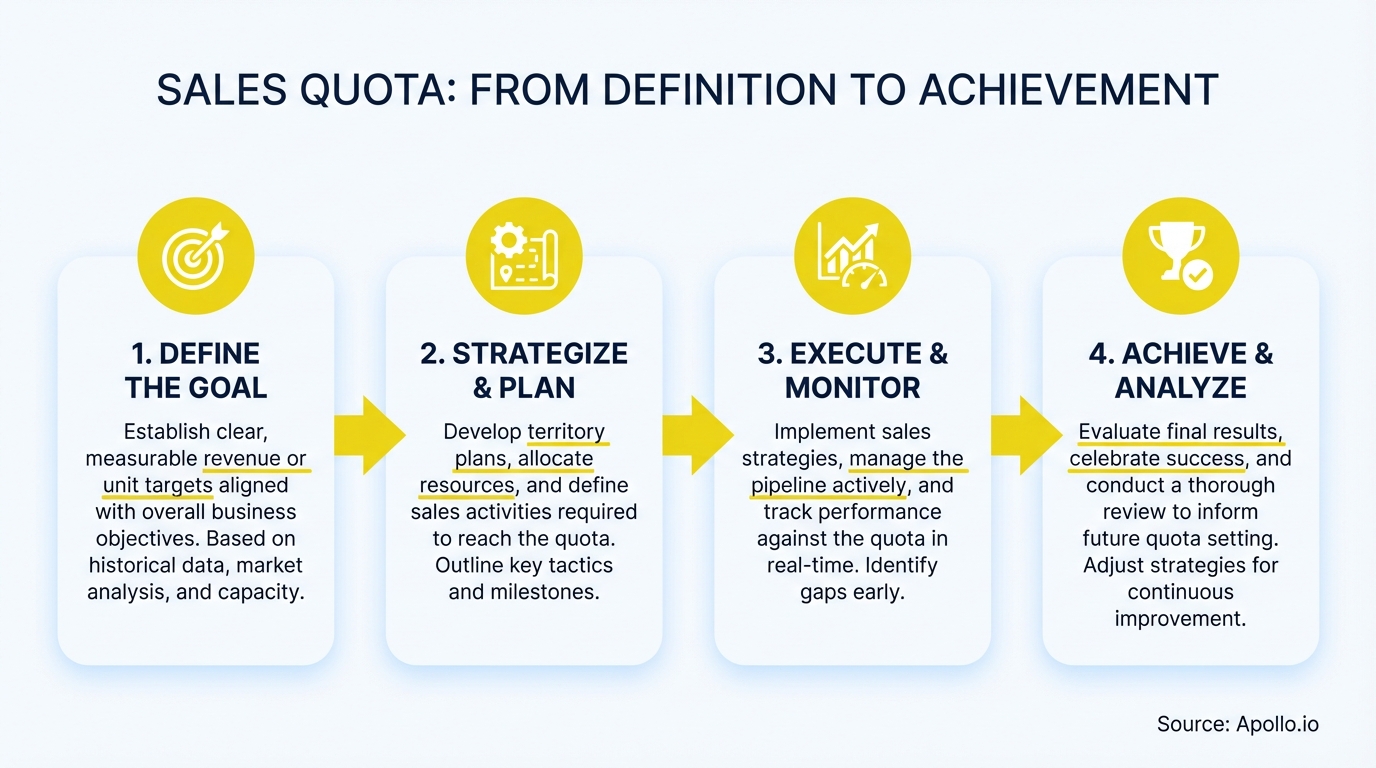
A sales quota is a performance target assigned to a rep, team, or territory for a defined period, typically monthly, quarterly, or annually. It answers one question: how much does this person or team need to sell? Quotas set the baseline for compensation, coaching, and go-to-market planning.
The challenge is that most reps aren't hitting them. According to BookYourData, 73% of sales representatives missed their H2 quotas in 2023, and 69% were still falling short on average in 2024. Understanding how to design, set, and support quotas is now a strategic priority, not a compensation formality.

Research Less, Close More With Apollo
Tired of burning hours hunting down contacts that bounce or go nowhere? Apollo surfaces verified decision-makers instantly, so your reps spend time selling — not searching. Join 550K+ companies building pipeline that actually converts.
Start Free with Apollo →Key Takeaways
- A sales quota is a time-bound revenue, activity, or pipeline target used to measure rep and team performance.
- Quota attainment rates remain low across B2B organizations, making quota design and enablement critical levers.
- AI-assisted selling is significantly improving quota attainment rates for teams that adopt it.
- Aligning sales and marketing KPIs is strongly correlated with meeting revenue goals.
- Long sales cycles require quota models and enablement assets tailored to multi-month, multi-stakeholder deals.
What Are the Main Types of Sales Quotas?
Different quota types serve different sales motions. Using the wrong type for your context leads to misaligned behavior and missed targets.
| Quota Type | What It Measures | Best For |
|---|---|---|
| Revenue Quota | Total closed revenue in a period | AEs, full-cycle reps |
| Activity Quota | Calls, emails, demos completed | SDRs, BDRs, new hires |
| Pipeline Quota | Qualified opportunities created | Outbound teams, early-stage orgs |
| Volume Quota | Number of units or accounts closed | Transactional, high-velocity sales |
| Profit Quota | Gross margin contribution | Complex deals with variable pricing |
| Combination Quota | Mix of revenue + activity targets | Teams balancing short and long cycles |
For enterprise sales, combination quotas are often most effective. They hold reps accountable for both pipeline creation and closed revenue, which matters when deal cycles stretch six to twelve months or longer.
Why Quota Attainment Is Broken (and What the Data Says)
Quota attainment is at a structural low. Sales Masters reports the average quota attainment for B2B sales organizations is around 47%, with some sources citing as low as 43% as of Q4 2024. In cloud sales specifically, attainment dropped to 42.69% in February 2026, down from 53% in Q1 2022, according to Venli Consulting.
The root causes are predictable: quotas set without historical data, no ramp periods for new hires, no mid-period adjustment process, and sales and marketing operating with separate KPIs. These aren't motivation problems.
They're design problems.
"Apollo has been huge in helping us to get our foot in the door with those accounts. Now we know exactly what we want to say and who we want to say it to.
It's just a matter of going into Apollo and making it happen."

How to Set Effective Sales Quotas
Effective quota setting starts with data, not aspiration. A top-down number disconnected from rep capacity and historical win rates is guaranteed to underperform.
The Quota-Setting Framework
- Anchor to historical performance. Use prior period attainment, average deal size, and win rate as your baseline. Avoid inflating quotas by more than 10-15% year-over-year without adding headcount or improving enablement.
- Factor in ramp time. New hires need structured ramp periods. A common model: 25% of full quota in month one, 50% in month two, 75% in month three, and 100% from month four onward. Adjust based on your average sales cycle length.
- Segment by territory and role. Quota should reflect the opportunity available in each territory. A rep covering an underpenetrated region shouldn't carry the same number as one in a mature market.
- Align with marketing pipeline SLAs. Quotas without a clear pipeline input plan fail. Define the MQL volume, conversion rate, and pipeline coverage ratio marketing is accountable for delivering.
- Build in a review cadence. Set clear triggers for mid-period adjustment: major market disruption, product changes, or team changes that materially affect opportunity.
Looking to build a stronger pipeline to support your quota targets? Build and manage your sales pipeline with Apollo to keep your funnel full and forecast-ready.
Turn Funnel Gaps Into Quota Wins
Pipeline forecasting a guessing game? Apollo surfaces verified, in-market buyers so your team stops chasing cold leads and starts closing real opportunities. Join 90K paying customers building predictable pipeline.
Schedule a Demo →The KPI Alignment Problem That's Killing Quota Attainment
One of the most underappreciated drivers of quota performance is sales and marketing KPI alignment. When both teams share goals around pipeline quality, conversion rates, and revenue influence, attainment rates improve materially.
Teams with complete or significant KPI overlap are nearly twice as likely to be meeting goals as those with partial or no alignment. Yet most organizations still run sales and marketing against separate scorecards, which creates finger-pointing instead of shared accountability.
The fix is a shared pipeline SLA that defines:
- What constitutes a qualified opportunity (agreed ICP criteria, not just MQL score)
- Pipeline coverage ratio both teams are accountable for (typically 3-4x quota)
- Handoff SLAs (response time, follow-up cadence, disqualification criteria)
- Shared reporting on pipeline-to-close rates by source
For sales performance management, this shared accountability model is the difference between a quota that motivates and one that demoralizes.
How AI Is Changing Quota Attainment
AI-assisted selling is now a measurable performance lever. Gartner reports that sellers who partner with AI are 3.7x more likely to meet quota, based on a survey of 1,026 B2B sellers conducted between January and March 2024.
The practical applications are straightforward: AI surfaces the right prospects faster, personalizes outreach at scale, flags at-risk deals earlier, and reduces non-selling time. All of these directly improve the inputs that drive quota attainment.
"With this kind of AI system, my BDRs can send 10x more personalized emails. Their productivity and growth has skyrocketed."
AI also enables dynamic quota modeling. Instead of setting a static annual number and hoping it holds, teams can use AI to run scenario planning across territory changes, market shifts, and headcount moves, then adjust targets with data rather than gut feel.
Want to put AI to work on your quota attainment? Automate your outreach and pipeline-building with Apollo's AI sales tools.
Quota Design for Long Sales Cycles
Standard quarterly quotas break down when your average deal takes six to twelve months to close. In those environments, reps can do everything right and still miss quota simply because timing doesn't align with the measurement period.
For long-cycle B2B sales, consider these adjustments:
- Pipeline quotas over revenue quotas for SDRs and early-funnel roles, so activity is rewarded even when deals haven't closed yet.
- Milestone-based tracking that credits reps for advancing deals through defined stages (discovery complete, business case approved, procurement engaged).
- Stage-specific enablement assets: early-stage one-pagers for champions, mid-cycle ROI narratives for economic buyers, late-stage procurement guides for legal and finance stakeholders.
- Extended measurement windows: annual quotas with quarterly pacing checks, rather than hard quarterly resets that penalize long-cycle sellers.
This is especially relevant given that a significant share of B2B organizations report average sales cycles of six months or longer. Quota structures that ignore this reality will consistently produce attainment rates that look like failure but actually reflect a measurement mismatch. Learn more about improving sales productivity in complex, multi-stakeholder environments.

How to Measure and Track Quota Performance
Quota tracking shouldn't wait until the last week of the quarter. Real-time visibility into pipeline and pacing is what separates reactive managers from proactive ones.
| Metric | What It Tells You | Ideal Benchmark |
|---|---|---|
| Quota Attainment Rate | % of reps hitting target | 60-70% of team at or above quota |
| Pipeline Coverage Ratio | Pipeline value vs. quota | 3-4x quota in active pipeline |
| Average Deal Size vs. Quota | How many deals needed to hit quota | Varies by segment |
| Win Rate by Stage | Where deals are lost | Track trend, not absolute |
| Ramp-to-Quota Time | How fast new hires reach full productivity | 3-6 months depending on cycle length |
Connect your quota tracking to your sales analytics system so you can identify underperformance early and intervene with coaching, territory adjustments, or pipeline support before the quarter is lost.
Common Quota Mistakes That Hurt Performance
- Setting quotas top-down without rep input. Reps who have no context for how their number was set are less likely to commit to it.
- Ignoring territory differences. Equal quotas across unequal territories produce unequal outcomes by design.
- No ramp for new hires. Expecting full productivity from day one leads to early attrition and skewed attainment data.
- Never adjusting mid-period. Markets change. A quota set in January may be irrelevant by March if a product launches, a competitor exits, or a major account churns.
- Treating quota as a ceiling. Reps who hit quota early and stop selling indicate a sandbagging problem, not a motivation problem. Accelerators and stretch targets solve this.
For a deeper look at building high-performing sales systems, explore the Apollo for Sales Leaders resource hub.
Conclusion: Build Quotas That Actually Drive Revenue
A well-designed sales quota is one of the most powerful tools in your revenue playbook. A poorly designed one is one of the fastest ways to lose your best reps.
The data is clear: attainment rates are low, AI adoption is a meaningful advantage, and KPI alignment between sales and marketing is a structural requirement, not a nice-to-have.
The teams consistently hitting quota share a few traits: they set targets grounded in real data, they align pipeline inputs with revenue outputs, they use AI to work smarter, and they track performance in real time rather than at quarter-end.
Apollo gives sales leaders the unified platform to prospect smarter, engage faster, and track pipeline performance in one workspace, so quota attainment becomes a system outcome rather than a hope.
Prove Pipeline ROI From Day One
Budget approval stuck on unclear metrics? Apollo delivers measurable pipeline impact fast — so you stop defending the spend and start showing the wins. Leadium 3x'd annual revenue. You're next.
Start Free with Apollo →Don't miss these
Sales
Inbound vs Outbound Marketing: Which Strategy Wins?
Sales
What Is a Sales Funnel? The Non-Linear Revenue Framework for 2026
Sales
What Is a Go-to-Market Strategy? The 2026 GTM Playbook
See Apollo in action
We'd love to show how Apollo can help you sell better.
By submitting this form, you will receive information, tips, and promotions from Apollo. To learn more, see our Privacy Statement.
4.7/5 based on 9,690 reviews
