
Sales Prospecting Techniques That Actually Work in 2026
Sales prospecting in 2026 looks fundamentally different than it did just two years ago. Buyers now complete 61% of their journey before talking to a sales rep, and 80% of sales reps consider prospecting the most challenging part of the sales process. The old playbook of volume-based cold calling and generic email blasts no longer works. Today's winning sales prospecting techniques combine AI-assisted personalization, multi-channel engagement, and buyer enablement content that builds trust before the first conversation.
Modern prospecting requires a strategic shift from interruption to influence. With 81% of B2B companies actively engaging in outbound lead generation efforts, standing out demands precision targeting, relevant messaging, and tools that consolidate your tech stack rather than add to it.

Apollo Cuts Research Time From Hours To Seconds
Tired of spending 4+ hours daily hunting for contact info? Apollo delivers 224M verified contacts with 96% email accuracy instantly. Join 550K+ companies who stopped manual prospecting.
Start Free with Apollo →Key Takeaways
- AI-assisted prospecting delivers measurable lift when combined with human judgment and brand voice controls
- Buyer enablement content (calculators, comparison guides, implementation checklists) accelerates deals by meeting buyers where they research
- Signal-rich targeting (intent + firmographic + technographic data) outperforms volume-based approaches
- Multi-channel sequences with email, phone, and social outreach generate higher response rates than single-channel tactics
- Deliverability and authentication now determine prospecting success as much as messaging quality
What Are Sales Prospecting Techniques in 2026?
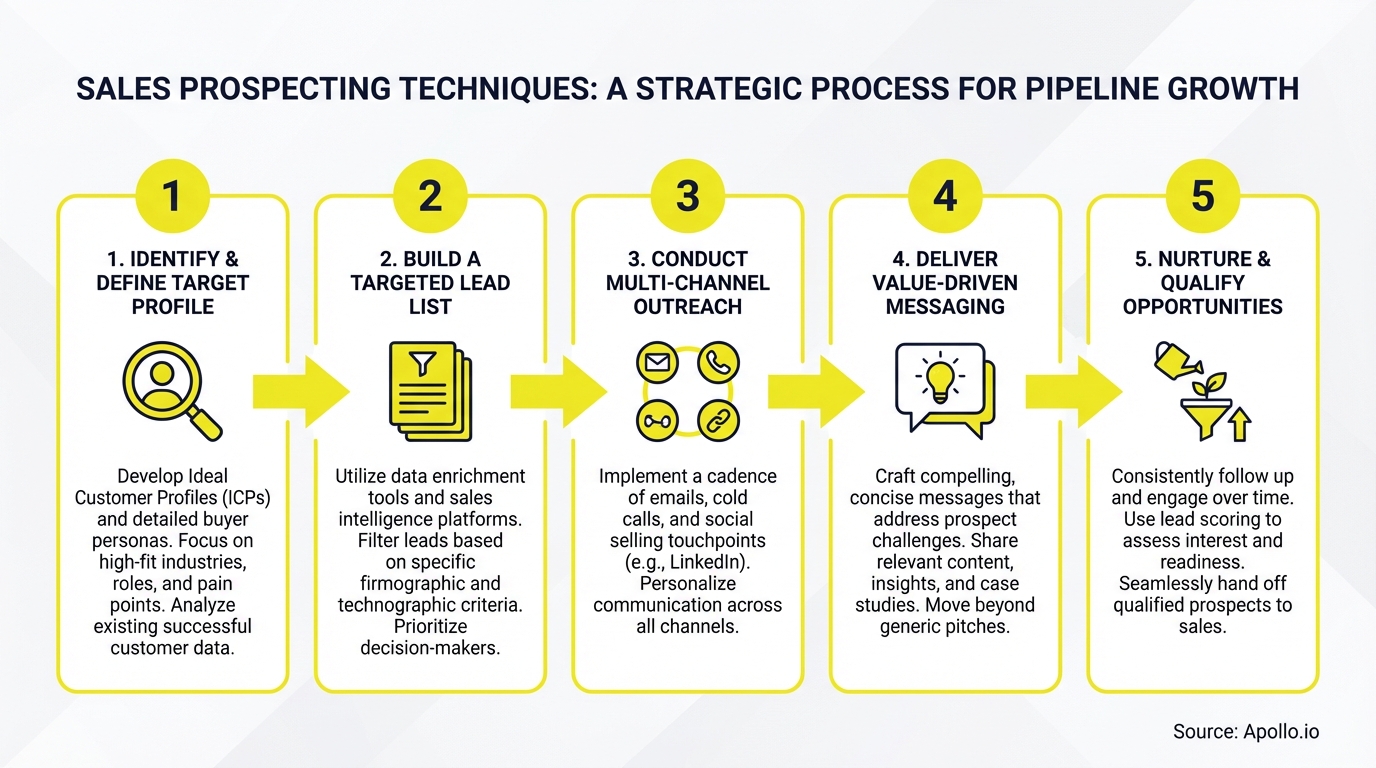
Sales prospecting techniques are systematic methods for identifying, researching, and engaging potential customers who match your ideal customer profile. In 2026, these techniques emphasize relevance over volume, combining data intelligence with personalized outreach across multiple channels.
The shift reflects buyer behavior changes. Research from TaskDrive shows 71% of consumers expect to hear from sales representatives early in the buying process, but only when that outreach provides genuine value. SDRs and BDRs now function as buyer enablers, providing educational content and self-serve resources before pitching solutions.
Effective prospecting in 2026 includes:
- Signal-based targeting: Using intent data, job changes, funding announcements, and technology adoption signals to time outreach
- AI-assisted research: Automating account research while maintaining human oversight for quality and brand voice
- Multi-channel sequences: Coordinating touchpoints across email, phone, social selling, and video
- Buyer enablement assets: Creating comparison guides, ROI calculators, and implementation checklists that support self-directed research
Struggling to find qualified leads? Search Apollo's 224M contacts with 65+ filters for precision targeting.
How Do SDRs Use AI-Assisted Prospecting Techniques?
SDRs using AI-assisted prospecting see measurable improvements in efficiency and response rates. The technique involves AI handling research and draft generation while SDRs apply judgment, personalization, and brand voice. This division of labor addresses the reality that SDRs spend an average of 13.4 hours per week researching prospects.
The AI-assisted prospecting workflow includes:
What Does the AI Handle?
- Account research (company news, technology stack, recent hires)
- Buyer persona identification and role mapping
- First-draft message generation based on triggers and pain points
- Optimal outreach timing recommendations
What Do SDRs Control?
- Final message approval and voice alignment
- Multi-threaded account strategy decisions
- Response handling and conversation progression
- Quality assurance and continuous improvement
For Sales Leaders managing teams, AI-assisted prospecting provides visibility into what's working. Track which prompts generate responses, which accounts engage across channels, and where reps need coaching. Data-driven prospecting strategies make quota attainment more predictable.
Why Is Multi-Channel Prospecting More Effective?
Multi-channel prospecting combines email, phone, social outreach, and video into coordinated sequences. According to Embryo, cold email campaigns with three email rounds have the highest reply rates (7.9%), but adding phone and social touches increases those rates further.
The effectiveness comes from meeting buyers on their preferred channels. Some prospects engage on email, others prefer a quick call, and executives often respond to thoughtful social selling.
Multi-channel techniques also create familiarity through repeated, valuable touchpoints.
| Channel | Best Use Case | Timing Strategy |
|---|---|---|
| Detailed value propositions, case studies, content shares | Tuesday-Thursday, 8-10am or 3-4pm | |
| Phone | Urgent opportunities, executive outreach, relationship building | Wednesday-Thursday, 10-11am or 4-5pm |
| Social Selling | Thought leadership, warm introductions, content engagement | Consistent daily presence |
| Video | Personalized messages, product demos, follow-ups | After initial engagement |
Spending hours on manual outreach? Automate your multi-channel sequences with Apollo's engagement platform.
Turn Forecast Chaos Into Revenue Certainty
Missing deals because your pipeline is a black box? Apollo reveals exactly which prospects are ready to buy with real-time intent signals and visitor tracking. Built-In increased win rates 10% with smarter targeting.
Start Free with Apollo →What Are Signal-Based Prospecting Techniques?
Signal-based prospecting uses buying intent signals, trigger events, and behavioral data to time outreach when prospects are most likely to engage. This approach prioritizes quality over quantity, focusing on accounts showing active interest or experiencing changes that create buying opportunities.
Key signals for prospecting in 2026:
- Intent signals: Content consumption, competitive research, solution category searches
- Trigger events: Funding rounds, leadership changes, new hires in relevant departments
- Technographic data: Technology stack changes, contract renewals, integration needs
- Engagement signals: Website visits, email opens, content downloads, event attendance
Account Executives benefit most from signal-based techniques when managing enterprise deals. Knowing a prospect just hired a VP of Sales or received Series B funding provides context for tailored conversations.
RevOps teams use signals to score leads and route opportunities to the right reps.
The shift to signal-based prospecting reflects market maturity. Rather than blasting every company in an industry, successful teams identify the 50-100 accounts showing genuine buying signals and execute focused, multi-threaded campaigns. Learn more about outbound prospecting strategies that prioritize signal quality.
How Do Buyer Enablement Assets Improve Prospecting Results?
Buyer enablement assets are self-serve resources that help prospects research, evaluate, and build internal business cases without requiring sales conversations. These assets address the reality that buyers prefer rep-free experiences for much of their journey, yet still need guidance to make confident decisions.
Effective buyer enablement assets include:

- ROI calculators: Interactive tools showing financial impact based on prospect inputs
- Comparison guides: Objective feature comparisons addressing common evaluation criteria
- Implementation checklists: Step-by-step guides reducing perceived adoption risk
- Use case libraries: Industry and role-specific scenarios with measurable outcomes
- Evaluation scorecards: Frameworks helping buyers assess vendor fit
When SDRs share these assets during prospecting, they position themselves as helpful advisors rather than pushy sellers. The assets do double duty: they provide immediate value to the prospect while also capturing engagement data showing serious buying interest.
Founders and CEOs building outbound motions should prioritize creating 3-5 core enablement assets before scaling prospecting volume. These assets become force multipliers, allowing smaller teams to compete with well-funded competitors by delivering exceptional buyer experiences.
What Prospecting Techniques Work for Enterprise Accounts?
Enterprise prospecting requires patience, multi-threading, and executive access strategies. Unlike SMB prospecting where you might reach a decision-maker directly, enterprise deals involve multiple stakeholders across departments, each with different priorities and concerns.
Winning enterprise prospecting techniques:

- Account mapping: Identify all stakeholders, their relationships, and influence on buying decisions
- Multi-threaded outreach: Engage multiple contacts simultaneously rather than single-threading through one person
- Executive sponsorship: Secure C-level or VP-level champions who can navigate internal politics
- Pilot programs: Offer limited-scope engagements that reduce risk and prove value
- Peer references: Connect prospects with similar customers who can speak to outcomes
Research from Tenbound found activities led to an average of 14.1 meaningful conversations a day, a 14.9% conversation rate. Enterprise prospecting requires higher conversation quality since volume alone won't penetrate complex organizations.
For insights on breaking into enterprise accounts, explore proven strategies for closing mega deals and high-ticket sales techniques.
How to Build a Sales Prospecting System That Scales
A scalable prospecting system combines technology, process, and governance to maintain quality as volume increases. The system should support SDRs, BDRs, and AEs with consistent data, messaging frameworks, and performance visibility.
Core components of a prospecting system:
- Single source of truth: Unified contact database with enriched firmographic and technographic data
- Sequence library: Templated multi-channel cadences for different personas and use cases
- Content governance: Approved messaging, battlecards, and enablement assets with version control
- Performance analytics: Dashboards tracking activity metrics, conversion rates, and pipeline contribution
- Quality assurance: Regular review of outreach quality, message alignment, and brand voice
RevOps leaders should establish clear SLAs between marketing and sales for lead routing, response times, and follow-up protocols. When prospecting systems lack governance, teams experience data inconsistencies, off-brand messaging, and wasted effort on unqualified accounts.
The ideal prospecting system consolidates tools rather than adding complexity. "We reduced the complexity of three tools into one," says Collin Stewart of Predictable Revenue. Companies using Apollo report similar consolidation benefits, replacing separate databases, engagement platforms, and enrichment services with a unified workspace.
Conclusion
Sales prospecting techniques in 2026 succeed through relevance, timing, and buyer enablement rather than volume and persistence. The winning approach combines AI-assisted research with human judgment, multi-channel engagement with signal-based targeting, and helpful content with strategic outreach.
For SDRs and BDRs, this means investing time in understanding prospect context before sending that first message. For Account Executives, it means building multi-threaded relationships and providing executive-level insights.
For Sales Leaders and RevOps teams, it means creating systems that scale quality prospecting across the entire team.
The prospecting techniques that work today require fewer tools, better data, and smarter automation. Companies that consolidate their tech stack around platforms combining contact intelligence, engagement automation, and analytics see faster ramp times, higher conversion rates, and more predictable pipeline generation.
Ready to transform your prospecting approach? Try Apollo Free and discover how 90K+ paying customers build pipeline with one unified platform for prospecting, engagement, and deal management.
Prove Apollo's ROI In Your First 30 Days
Budget approval stuck on unclear metrics? Apollo tracks every touchpoint from first contact to closed deal—quantifying exactly how much time and pipeline you're generating. Built-In increased win rates 10% and ACV 10% with measurable targeting.
Start Free with Apollo →Don't miss these
Sales
Inbound vs Outbound Marketing: Which Strategy Wins?
Sales
What Is a Sales Funnel? The Non-Linear Revenue Framework for 2026
Sales
What Is a Go-to-Market Strategy? The 2026 GTM Playbook
See Apollo in action
We'd love to show how Apollo can help you sell better.
By submitting this form, you will receive information, tips, and promotions from Apollo. To learn more, see our Privacy Statement.
4.7/5 based on 9,690 reviews
